The short answer
- Most bees nesting in lawns are solitary mining bees, sweat bees or cellophane bees. Each female digs her own burrow, even when hundreds of nests sit close together.[6][5][1]
- They are not aggressive and don't defend their nests. Females can sting but rarely do unless they are stepped on, handled or cornered, so people and pets can usually keep using the yard.[3][5][4]
- Activity is short. Sources give a few weeks, three to four weeks, or about 6 to 8 weeks in spring; a site can stay busy all summer if different species take turns using it.[3][5][6]
- To move them on, water the nesting area heavily and work toward thick, dense turf, or cover bare soil with mulch or a ground cover. They choose dry, sunny, bare or thinly grassed spots.[1][6][5][3]
- Large wasps nearly 2 inches long digging in sandy spots in July and August are cicada killers. Males have no stinger, and females rarely sting unless grabbed or stepped on.[8][11]
- Insecticides are almost never needed. Some extension services list a treatment for heavy nesting next to children or allergic people; others say not to spray these pollinators at all.[1][4][5][3]
Ground-nesting bee and wasp profiles
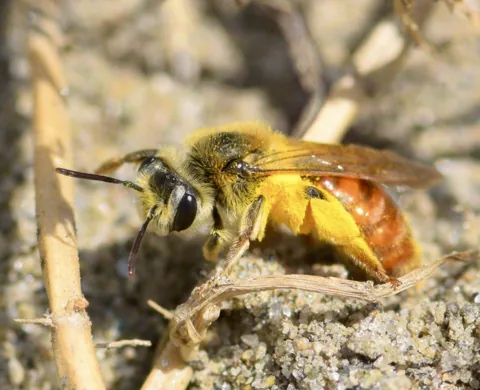 Mining Bees
Andrena species
Mining bees, genus Andrena, are solitary native bees that nest in the ground, often in dense spring aggregations in lawns and bare soil. They pollinate spring flowers and fruit crops, aren't aggressive, and Penn State says they aren't considered pests.
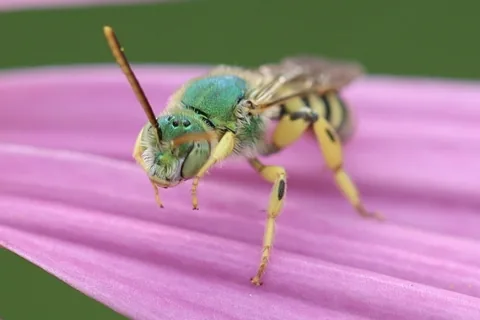 Sweat Bees
Family Halictidae (e.g., Halictus, Lasioglossum and Agapostemon)
Sweat bees are small native bees, many of them shiny metallic green or blue, that are drawn to human perspiration for its moisture and salt. They are not aggressive and are important pollinators of wildflowers and crops.
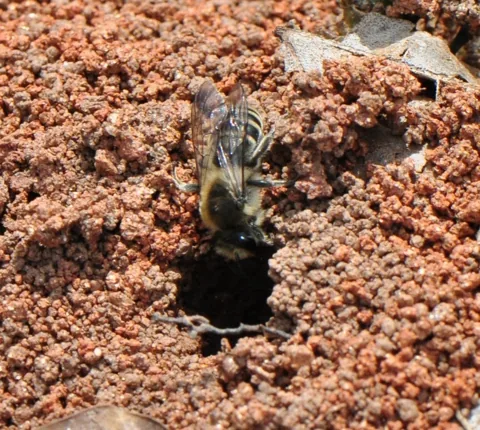 Cellophane Bees
Colletes
Cellophane bees are solitary, ground-nesting bees that line their underground brood cells with a clear, waterproof membrane. Chemically it is a polyester the female makes from her own gland secretions.
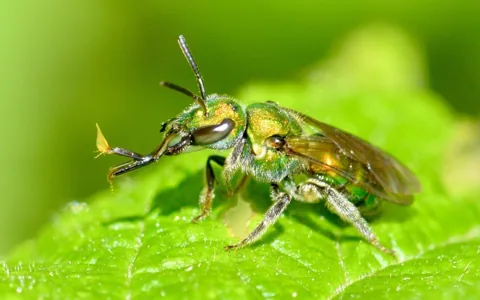 Pure Gold-Green Sweat Bee
Augochlora pura
The pure gold-green sweat bee is one of the most common bees in eastern North America and one of the most tied to woodlands. It nests in rotting wood, lives alone rather than in a colony, and pollinates many flowers.
 Digger bees
Anthophora (e.g., Anthophora abrupta, the chimney bee)
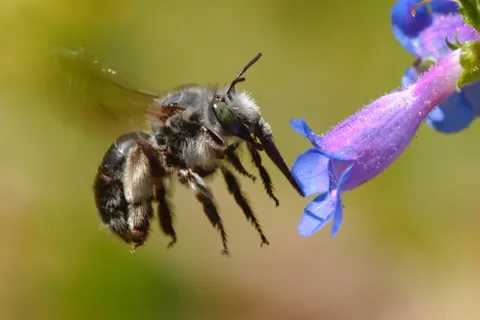
Digger bees are robust, hairy native bees, half an inch to an inch long, that many people take for small, fast, grayish bumble bees. They dig nest tunnels in dry ground with their jaws and legs, often in large groupings, and many species top each burrow with a little mud chimney. Although hundreds may nest side by side, each female works alone. They hover low, fly very fast, and are not aggressive toward people or pets. North America has about 100 Anthophora species, active from early spring into fall, and they need no control.
 Eastern Cicada Killer
Sphecius speciosus
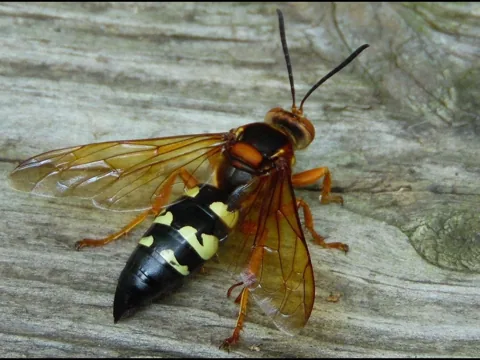
Cicada killers are very large solitary wasps seen mostly in July and August. Females dig burrows and stock them with annual cicadas. They look alarming, but the Missouri Department of Conservation calls them virtually harmless unless handled roughly, and Kentucky says they aren't a stinging hazard unless directly disturbed.
 Common Eastern Bumble Bee
Bombus impatiens
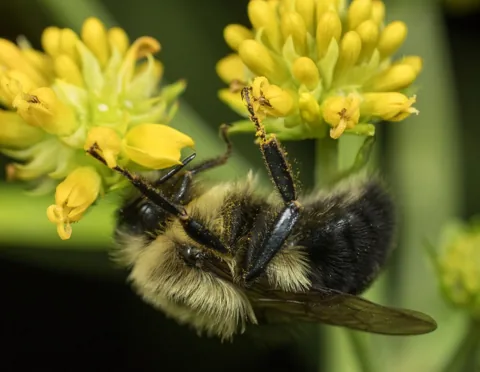
Bumble bees are social bees that form annual colonies in soil cavities, old rodent burrows and similar voids; they are valuable pollinators and defend their nests only when disturbed.
 Eastern Yellowjacket
Vespula maculifrons
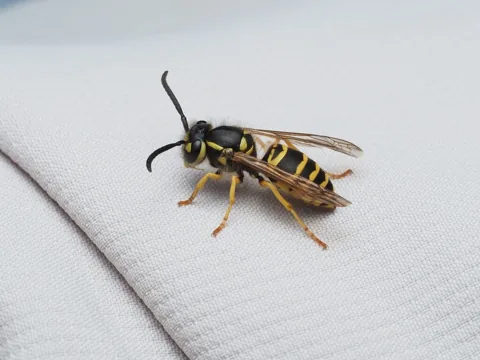
The eastern yellowjacket is a native, ground-nesting yellowjacket common across the eastern US in lawns, woodlands, pastures and parks; it defends its nest aggressively and can sting repeatedly.
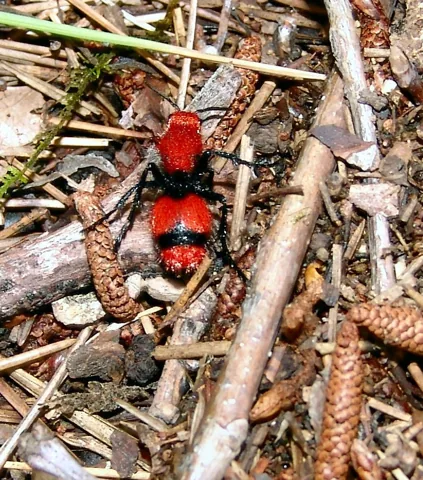 Velvet Ants (eastern velvet ant, "cow killer")
Dasymutilla occidentalis
Velvet ants aren't ants at all. They are solitary wasps in the family Mutillidae, and the wingless, fuzzy females look like large hairy ants as they run across open ground.
What are the bees in my lawn?
Many kinds of bees nest in soil. The ones most often found in lawns belong to a few families of solitary or partly social bees.[5][1][2]
- Mining bees (Andrena and related andrenid bees): about 1/4 to 1/2 inch long, mostly dark, some with white, yellow or reddish-brown markings. Ground-nesting bees like these are among the first bees out in spring, and mining bees often nest in large groups. See the mining bee profile.[4][6][1][3]
- Sweat bees (Halictidae): many are tiny, and some are bright metallic green or blue. Nearly all nest in the ground, and they are named for landing on people to drink sweat. Some species are partly social; in the small green sweat bees of the genus Augochlorella, nests rarely hold more than a few bees. See the sweat bee profile.[10][12][1]
- Cellophane bees (Colletes): solitary spring bees that also nest in dense groups and are among the bees most often found in lawns. See the cellophane bee profile.[6][5]
- Other ground nesters include membrane bees and leafcutter bees; leafcutters can nest in soil burrows, hollow stems, wood or rock crevices.[1][2]
- Bumble bees are different: they are social and usually nest in existing cavities such as old rodent nests, compost piles or spaces under objects on the ground.[5][13][6]
Signs of ground bees
The usual sign is a cluster of small holes, each with a little cone or mound of loose soil around it, in a dry, sunny patch where grass is thin. Clemson describes holes about 1/4 inch across; Iowa State describes them as anywhere from the width of a pencil to the width of an index finger, and the Connecticut station gives tunnels 1/4 to 1/2 inch wide.[3][4][5][6]
Watch for a minute and you will see bees going in and out, plus more bees flying a few inches above the ground as if patrolling the area. NC State notes that the mounds are sometimes mistaken for ant colonies, and N.C. Cooperative Extension in Lee County says for fire ants.[3][1][2]
Inside each burrow the female builds cells, packs each one with a ball of pollen and nectar about 1/8 to ¼ inch across, and lays one egg on it. The young develop underground and come out as adults the next spring.[1][3][2]
Ground bees or yellowjackets?
This is the question that matters most, because yellowjackets do defend their nests. The Connecticut Agricultural Experiment Station's rule of thumb: a yellowjacket nest has many wasps entering and leaving one entrance, while each ground bee uses its own hole.[5][13]
Yellowjackets build their ground nests in old rodent burrows or similar cavities, and wasps are usually smooth and hairless, while bees are covered in hair. A yellowjacket nest in the yard is a different problem; the stinging insects guide and the yellowjacket profiles cover it.[13][7]
Will ground bees sting?
Rarely. Solitary bees have no hive of sisters to defend, and as NC State puts it, they are not "programmed" to sting people: there is no mass attack signal like the ones honey bees and yellowjackets use.[1][10][2]
Females can sting if they are stepped on, handled roughly or cornered, and Iowa State calls the stinging threat "usually highly overrated." Male bees can't sting at all.[5][4][3][7]
Sweat bees that land on sweaty skin can be brushed off with a gentle scrape; pressing on a female may get a mild sting.[10]
NC State still says some management may be needed where large numbers of stinging insects overlap with children, pets or people with severe allergies.[1]
Why they chose your lawn
Ground-nesting bees prefer warm, dry, sunny ground with well-drained soil that is low in organic matter, often on south-facing slopes, and they pick bare or sparsely grassed spots.[1][3][6][2]
The bees usually don't cause the thin grass. Iowa State, Clemson and N.C. Cooperative Extension all say the turf was more likely thin first, from poor growing conditions, and the bees moved into the kind of site they look for.[4][3][2]
Damage is mostly cosmetic: the tunnel entrances are disruptive to the lawn but not usually damaging, and control is rarely necessary unless the bees are very numerous.[1][4]
Leave them, or act?
The extension sources agree on leaving them alone where you can. Ground-nesting bees are pollinators, their activity is short, and the Connecticut station advises ignoring the bees and their tunnels in most situations.[5][3][4][6]
Acting makes sense when nests are crowded right next to a play area, doorway or path, or when someone in the household has a severe sting allergy. In that case, start with the site changes below, which discourage further nesting.[1][4][7]
How to make the spot less inviting
These steps change the conditions the bees look for, so they move to a better site on their own.[2][5]
- Water the area. NC State says to irrigate the turf heavily, and Penn State suggests adding water over the nesting area to encourage the bees to look for a different site.[1][2][6]
- Thicken the turf. NC State calls dense turf the best discouragement to further nesting, and Clemson recommends improving growing conditions for thick, dense grass.[1][3][4]
- Add organic matter. NC State suggests fertilizing with organic matter; the Connecticut station suggests tilling the soil, adding organic matter and building up turf density.[1][5]
- Cover bare soil where grass won't grow: a heavy mulch, a ground cover suited to the site, or, along paths and driveways, pea gravel.[5][3][1][4]
- Tilling an active nest site can partly destroy the tunnels, but NC State says establishing dense turf is what prevents more nesting.[1][5]
Cicada killers: the big wasps in summer
The eastern cicada killer is a solitary wasp, not a bee. Females range from about 1.5 to nearly 2 inches long and males up to 1.5 inches; they have a dark orange head and thorax and a black abdomen with light-yellow bands. Adults are seen mostly in July and August.[8][11]
Each female digs a burrow and stocks it with annual (dog-day) cicadas she has paralyzed with her sting, one or two per cell, as food for her young. Kentucky gives tunnels 12 to 15 inches deep and up to 36 inches long; the Missouri Department of Conservation says a single nest can run four or more feet. The spoil piles, often with a thumb-like furrow leading to the hole, can smother patches of grass.[8][11]
Males hover at eye level and chase other insects away, which looks aggressive, but males have no stinger. Females reserve their sting for cicadas and sting people only when grabbed or stepped on. The Missouri Department of Conservation advises anyone allergic to wasp stings to stay away from all wasps. They are sometimes mistaken for the Asian giant hornet, which has a larger head and jaws.[8][11]
Management is usually unnecessary. Kentucky lists swatting the wasps (a tennis racket is the traditional tool) and an insecticide dust applied directly into the tunnels; liquid sprays on the turf above the tunnels don't help.[8]
For the long term, cicada killers want light, well-drained soil in full sun. More irrigation, thicker turf, wood or stone mulch, or shade can push them to nest elsewhere.[8][9]
If you are thinking about insecticides
The sources disagree here. The Connecticut station says pesticides should not be used on ground-nesting bees, and Clemson does not recommend insecticides because the bees are valuable and only a temporary nuisance. NC State says chemical treatment is almost never necessary and lists turf products only for heavy infestations, and Iowa State mentions a carbaryl dust in nest openings or a granular turf insecticide while doubting they are justified.[5][3][1][4]
If you do treat, use a product whose label lists lawns and these insects, follow the label, and treat only the nesting spot. The Connecticut station advises avoiding insecticides as much as possible, especially while flowering plants that attract bees are present; the guide on protecting pollinators when you spray covers this.[1][5]
Lawn sprays don't work on cicada killers; Kentucky recommends dust placed in the tunnel only where the wasps truly make a lawn or playground unusable.[8]
Other insects digging or flying low over lawns
A few other insects show up over lawns in summer and get mistaken for ground bees.[9][1]
- Scoliid wasps (usually Scolia) fly low over lawns in mid- to late summer and lay their eggs inside white grubs, which the wasp larvae feed on. They will sting if disturbed.[9]
- Velvet ants are densely hairy wasps found in lawns and pastures; the wingless females are sometimes confused with ants, and females will sting if encountered.[9]
- Ant mounds: ground bee mounds are sometimes mistaken for ant colonies, including fire ants.[1][2]
Common questions
- Should I get rid of ground bees in my yard?
- Usually not. They are pollinators, they rarely sting, and they are active for a few weeks. Extension services suggest ignoring them, or watering and thickening the turf if they nest where people play.[5][3][1]
- Does watering the lawn get rid of ground bees?
- It helps. NC State recommends irrigating heavily and Penn State suggests adding water over the nesting area so the bees look elsewhere. Thick turf and mulch over bare soil help prevent nesting the next year.[1][6][2]
- Are ground bees dangerous to kids and dogs?
- Not usually. Females sting only when stepped on, handled or cornered, and there is no group attack as with yellowjackets. Keep children from grabbing the bees, and treat a nest near play areas more seriously if anyone has a sting allergy.[3][5][1]
- How can I tell ground bees from yellowjackets?
- Watch the entrances. Many yellowjackets use a single hole, while each ground bee uses its own hole among many. Yellowjackets are smooth and shiny; bees are hairy.[5][7][13]
- Do cicada killers sting?
- Rarely. Males have no stinger at all, and females use their sting on cicadas, stinging people only if handled roughly or stepped on.[8][11]
- Did the bees kill my grass?
- Probably not. The bees pick sites where grass is already thin and the soil is dry and bare; poor growing conditions usually came first.[4][3][2]
Photo credits
- Mining Bees: (c) Bernie Paquette, some rights reserved (CC BY) — via iNaturalist, CC BY 4.0
- Sweat Bees: (c) eebee, some rights reserved (CC BY) — via iNaturalist, CC BY 4.0
- Cellophane Bees: (c) James Kindt, some rights reserved (CC BY) — via iNaturalist, CC BY 4.0
- Pure Gold-Green Sweat Bee: (c) Bernie Paquette, some rights reserved (CC BY) — via iNaturalist, CC BY 4.0
- Digger bees: (c) Joel Gardner, some rights reserved (CC BY) — via iNaturalist, CC BY 4.0
- Eastern Cicada Killer: (c) Steve Kerr, some rights reserved (CC BY) — via iNaturalist, CC BY 4.0
- Common Eastern Bumble Bee: Jesse Rorabaugh, public domain (CC0), via iNaturalist
- Eastern Yellowjacket: Brighton Lee, public domain (CC0), via iNaturalist
- Velvet Ants (eastern velvet ant, "cow killer"): (c) Gordon C. Snelling, some rights reserved (CC BY) — via iNaturalist, CC BY 4.0
Sources
- NC State Extension (TurfFiles), “Ground-Nesting Bees in Turf.” www.turffiles.ncsu.edu/insects/bees-in-turf/ (accessed 2026-11-10)
- N.C. Cooperative Extension, Lee County Center, “The Buzz on Ground Nesting Bees.” lee.ces.ncsu.edu/2021/06/the-buzz-on-ground-nesting-bees/ (accessed 2026-11-10)
- Clemson Cooperative Extension Home & Garden Information Center, “Spring Has Sprung and So Have The (Ground-Nesting) Bees.” hgic.clemson.edu/spring-has-sprung-and-so-have-the-ground-nesting-bees/ (accessed 2026-11-10)
- Iowa State University Extension and Outreach, Yard and Garden, “Mining (Andrenid) Bees.” yardandgarden.extension.iastate.edu/article/2002/4-19-2002/andrenid.html (accessed 2026-11-10)
- The Connecticut Agricultural Experiment Station, “Ground Nesting Bees (fact sheet).” portal.ct.gov/-/media/CAES/DOCUMENTS/Publications/Fact_Sheets/Entomology/GroundNestingBeespdf.pdf (accessed 2026-11-10)
- Penn State Extension, “Spring Bees: Who Are They and Where Do They Live?.” extension.psu.edu/spring-bees-who-are-they-and-where-do-they-live (accessed 2026-11-10)
- Penn State Extension, “Five-Step Decision Support: Nesting Bees and Wasps Near Homes.” extension.psu.edu/five-step-decision-support-nesting-bees-and-wasps-near-homes (accessed 2026-11-10)
- University of Kentucky Entomology, “Cicada Killer Wasps (ENTFACT-004).” entomology.mgcafe.uky.edu/ef004 (accessed 2026-11-10)
- University of Kentucky Entomology, “ENTFACT-411.” entomology.mgcafe.uky.edu/ef411 (accessed 2026-11-10)
- Missouri Department of Conservation, “Halictid Bees (Sweat Bees).” mdc.mo.gov/discover-nature/field-guide/halictid-bees-sweat-bees (accessed 2026-11-10)
- Missouri Department of Conservation, “Eastern Cicada-Killer Wasp.” mdc.mo.gov/discover-nature/field-guide/eastern-cicada-killer (accessed 2026-11-10)
- Washington State University HortSense, “Halictidae (alkali bees, sweat bees and cuckoo bees).” hortsense.cahnrs.wsu.edu/fact-sheet/halictidae-alkali-bees-sweat-bees-and-cuckoo-bees/ (accessed 2026-11-10)
- University of Minnesota Extension, “Wasps and bees.” extension.umn.edu/insects-infest-homes/wasps-and-bees (accessed 2026-11-10)