The short answer
- You don't need to do anything about the cicadas themselves. They are not a threat to people or pets, and large, healthy trees handle the egg-laying damage without lasting harm.[1][3]
- Protect small trees and shrubs, especially ones planted in the last few years, by covering them with netting before or as the cicadas start singing, tied shut around the trunk below the lowest branches.[1][2][3]
- If you know a brood is due, hold off planting young trees until after the emergence, in late summer or fall.[2][3][1]
- Skip the insecticides. Ohio State and Illinois Extension don't recommend them, sprays need repeating every few days as new cicadas fly in, and netting works better.[2][3][1]
- Afterward, prune out twigs that died from egg-laying damage.[1][2]
Cicadas and the wasp that hunts them
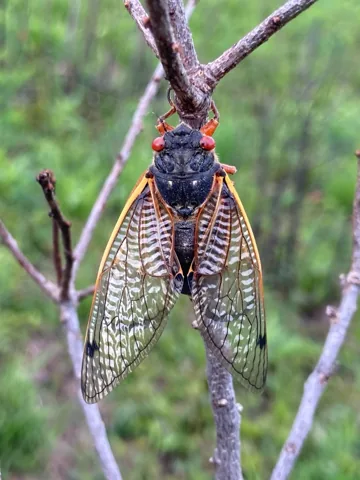 Periodical Cicadas
Magicicada species (e.g., M. septendecim)
Periodical cicadas spend 13 or 17 years underground feeding on root sap, then emerge together in huge numbers in late spring. They don't bite or sting; the real harm is egg-laying damage to small twigs, which matters most on young trees.
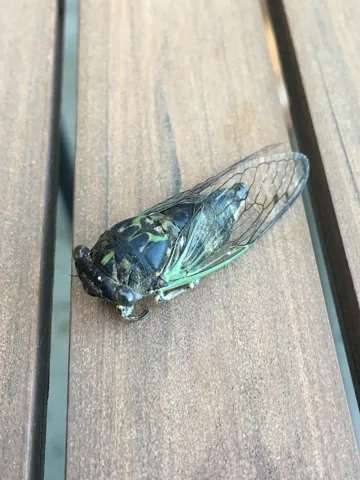 Annual Cicadas (dog-day cicadas)
Neotibicen species (e.g., N. canicularis)
Annual cicadas, also called dog-day cicadas, are the large cicadas heard droning from trees every summer. Their life cycles overlap, so some adults come out every year. They can't bite or sting, and Clemson and Minnesota extension both say they pose no danger to people or pets.
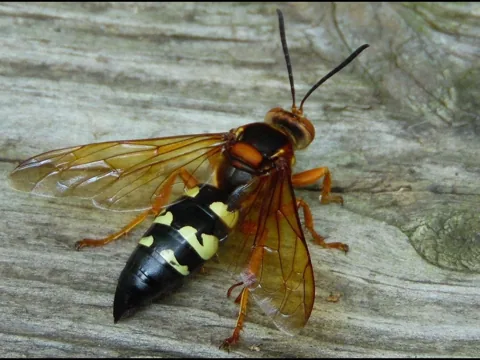 Eastern Cicada Killer
Sphecius speciosus
Cicada killers are very large solitary wasps seen mostly in July and August. Females dig burrows and stock them with annual cicadas. They look alarming, but the Missouri Department of Conservation calls them virtually harmless unless handled roughly, and Kentucky says they aren't a stinging hazard unless directly disturbed.
Periodical cicada or dog-day cicada?
Two kinds of cicadas show up in yards in the eastern United States. Periodical cicadas (genus Magicicada) spend 13 or 17 years underground and come out together in late spring. Annual or dog-day cicadas take 2 to 5 years to develop, but their generations overlap, so some appear every summer.[3][6][2]
- Periodical cicadas: black bodies, red or reddish-orange eyes and orange wing veins. Penn State gives about 1 1/2 inches long; Illinois Extension gives about 3/4 to 1 1/2 inches. They emerge in late spring, mostly May into early June.[1][3][2][5]
- Annual (dog-day) cicadas: larger, about 1 1/2 to 2 1/2 inches by Illinois Extension's measure, with green and brown or green and black bodies, greenish wing veins and dark eyes. They appear from July through September.[3][1][6]
- Hearing cicadas in late April through early June, near the year of a big emergence, usually means periodical cicada stragglers; the Missouri Department of Conservation notes annual cicadas don't emerge that early.[5]
Broods: when will they come out where you live?
A brood is the group of periodical cicadas that emerges in a given year in a given area. Broods are numbered with Roman numerals: I through XVII are 17-year broods and XVIII through XXX are 13-year broods. Penn State counts at least 13 broods of 17-year cicadas and five of 13-year cicadas; Illinois Extension lists 12 and three. Some broods have died out, such as Brood XI in New England.[1][4][3][5]
Each brood covers its own patch of the map and returns to the same places on schedule. Illinois Extension says a periodical cicada flies less than half a mile from where it came out of the ground, so broods spread very slowly. Clearing woods, paving and large earthworks can wipe out local populations.[3][1][5]
- Upcoming emergences named by these sources: Brood XXII, a 13-year brood, in Ohio in 2027; Brood XXIII, a 13-year brood, in central and southeastern Missouri and much of the Mississippi River valley in 2028; Brood I in 2029 and Brood II in 2030 in parts of Pennsylvania; Brood III in 2031 in far northern Missouri, Iowa and eastern Illinois; Brood IV in 2032 in western Missouri, southwestern Iowa, eastern Kansas, Nebraska and Oklahoma.[2][5][1]
- Penn State also lists Brood V in 2033, VI in 2034, VII in 2035 and VIII in 2036 for parts of Pennsylvania. Check your state extension service for a county-level list.[1]
- Some cicadas in a brood come out 1 to 4 years early or late, so a few may sing in off years.[1][5]
What an emergence looks like
Nymphs come out once the soil about 8 inches down reaches 64 degrees F, often after a warm rain. Most come out at night, leave a hole about 1/2 inch across, climb a tree trunk, building or other upright object and shed their skins, which stay stuck there. In wet soil the nymphs may build mud chimneys 1 to 4 inches tall over their holes.[2][5][3]
The numbers can be enormous. Illinois Extension cites a 1956 Field Museum estimate of as many as one million cicadas per acre in a forested floodplain near Chicago. Males start singing a few days after they emerge, and choruses of thousands of males can be heard inside well-insulated homes. They don't sing at night, and Illinois Extension cites the National Institutes of Health for calls over 90 decibels.[3][2]
How long it lasts depends on the source: Ohio State says adults live about two weeks and peak numbers last around a month, Penn State says three to four weeks, and Illinois Extension says adults start dying after about a month. Dead cicadas can pile up under trees and smell like roadkill for a while.[2][1][3]
Are they a danger to people or pets?
No. Penn State says cicadas don't bite or sting and are not a threat to people or pets, and Illinois Extension says the same. The Missouri Department of Conservation notes one rare exception: a cicada left sitting on your arm for a long time may poke you with its mouthparts, mistaking you for a plant. It's painful but harmless and isn't an attack.[1][3][5]
The real complaints are the noise and the sheer number of insects, which can interfere with outdoor activities, especially for people who are afraid of insects. Illinois Extension adds that anyone allergic to shellfish should not eat cicadas.[2][3]
How cicadas damage trees
Feeding isn't the problem. Ohio State says feeding by nymphs and adults appears to cause little to no damage to the overall health of host plants. The damage comes about 10 days after emergence, when females cut rows of slits into twigs with a saw-like egg-laying organ and lay eggs in them. Penn State gives 24 to 28 eggs per slit, Ohio State 20 to 30 and Illinois Extension 10 to 20, with each female laying around 400 to 600 eggs in all.[2][1][3]
Twigs with heavy egg-laying split, wilt and turn brown, a symptom called flagging, and some break off weeks, months or even years later. Penn State says the slits can run 2 to 3 inches; NC State describes double rows up to four or five inches long. On crabapple and other rose-family plants flagging can look like fire blight, so inspect the stems for egg slits.[2][1][4]
The sources differ on the twig size cicadas prefer: Penn State says 3/16 to 7/16 inch in diameter, Ohio State says no more than about 1/2 inch and 1/4 to 1/2 inch as the preferred size, and Illinois Extension says about the width of a pencil up to 1/2 to 1 inch.[1][2][3]
- Most at risk: small trees with most of their branches in that size range, especially recently transplanted or stressed trees. Ohio State says flagging is especially serious on trees 4 years old or younger, and Illinois Extension says newly planted small trees and shrubs can be killed.[1][2][3]
- Location matters. Trees in yards in or near woods are at the greatest risk, because the nymphs fed on tree roots there for 13 or 17 years.[2]
- Favored hosts include oak, maple, beech, dogwood, hawthorn and fruit trees such as apple, cherry, peach and pear; Penn State says egg-laying has been recorded in more than 80 species. Late in an emergence females move to shrubs such as holly, rose, rose of Sharon, spirea, rhododendron and viburnum. Conifers are rarely used.[2][1]
- Large, healthy trees: Ohio State reports that studies comparing netted and unnetted trees found heavy egg-laying did not significantly affect tree growth, and cites researchers who called it a minor natural pruning event for larger trees. Illinois Extension says flagging won't kill healthy, mature trees.[2][3]
- One measurable effect on big trees: a 2023 study found oaks produced fewer acorns in emergence years and the year after, and more acorns two years after an emergence.[10]
Netting young trees and shrubs
Penn State, Ohio State and Illinois Extension all recommend netting to protect small trees. In a University of Maryland trial, netted trees sustained very little injury while unprotected trees were heavily damaged. Penn State says netting trees under 10 feet tall is usually more effective than spraying, both in cost and in damage prevented.[9][1][3][2]
Mesh size is where the sources disagree. Ohio State says nylon netting with mesh no larger than 1/4 inch, and Illinois Extension says openings no larger than 1/4 inch. Penn State says 1/2-inch mesh. The smaller size is the safer choice if you're buying netting for this.[2][3][1]
- Close it at the bottom. Gather and secure the netting around the trunk below the lowest branches so cicadas can't crawl up from the ground under it.[2][3]
- Keep it off the twigs if you can. Illinois Extension says a frame around the plant helps, because cicadas may still lay eggs in branches touching the netting.[3]
- Timing: Penn State says to put netting on before the emergence and keep it on for the 4 to 6 weeks cicadas are present. Ohio State says to drape it when you hear the first male cicadas singing and remove it as soon as cicada activity stops, since netting left on too long can deform new shoots.[1][2]
- Use the right material. Ohio State says light fabric that lets air through, such as tulle, also works, but not tightly woven fabric like bed sheets: it holds moisture that favors leaf diseases, and wet cloth or high wind can break branches.[2]
Planting and pruning around an emergence
Timing your planting and pruning around the brood year keeps the most vulnerable stems out of reach and lets you clean up afterward.[1][2][3]
- Delay planting. Penn State says to avoid transplanting trees the fall and spring before an emergence. Ohio State suggests putting off small landscape trees until later in the summer or fall of the emergence year, and putting off fruit trees until the following spring. Illinois Extension says to avoid planting the year before and the spring of an emergence, and if you must plant, choose trees with a stem diameter of at least 2 1/2 inches.[1][2][3]
- Don't prune ahead of time. Penn State says to avoid pruning the fall and spring before an emergence, because you can prune out the branches cicadas kill once they die.[1]
- Prune damage afterward. Ohio State says removing injured stems can lessen long-term effects if the injury is light, using proper pruning cuts. Twigs that aren't killed grow lip-like wound tissue over the slits, but incompletely closed wounds can let in wood decay fungi, and weakened branches may break a year or more later.[2]
- Pruning twigs with eggs in them before they hatch keeps those nymphs from reaching the ground, but Illinois Extension notes the nymphs' root feeding doesn't seem to harm trees, so this is optional. Ohio State notes eggs seldom survive in twigs that wither or break early.[3][2]
Why insecticides aren't recommended
Ohio State and Illinois Extension both say insecticides are not recommended for periodical cicadas, and the Missouri Department of Conservation calls spraying them pretty much useless because adults are everywhere and fly in. Penn State says sprays often need reapplying every 2 to 3 days as new cicadas arrive, can kill beneficial insects and mites, and aren't recommended at all for large, healthy trees. Illinois Extension adds that pesticides may harm other animals, including the ones that eat cicadas.[2][3][5][1]
Systemic products don't solve it either. In the Maryland trial, trees treated with imidacloprid had fewer egg nests, scars and flags than untreated trees, but netting did better, and the treatment didn't affect egg hatch.[9]
If you treat a young tree anyway, Ohio State says to follow the label, apply before egg-laying starts, reapply as the label's residual period allows until egg-laying stops, and don't spray blooming trees or plants or let spray drift onto them. Penn State notes sprays are mainly for situations where netting isn't practical, such as orchards.[2][1]
The Missouri Department of Conservation also mentions hosing cicadas off small trees with water or wrapping the trunk with foil or insect-barrier tape, alongside netting.[5]
What eats them
Birds, raccoons, opossums, coyotes, snakes, fish and poultry all eat cicadas, and some bird populations rise in the years after an emergence. The point of a mass emergence is that there are far too many cicadas for predators to make a dent, so predators won't control them for you.[3][2][1]
A fungus, Massospora cicadina, infects some cicadas and eventually makes the abdomen fall off. Ohio State says its effect on numbers appears negligible, citing one study where less than 1% of an Arkansas brood was infected.[2]
When the adults die, their bodies feed the soil. Ohio State and Illinois Extension describe research showing a rise in soil microbes and nitrogen that supports tree growth afterward.[2][3]
Dog-day cicadas in July and August
The cicadas buzzing every summer are annual (dog-day) cicadas. They come out in much lower numbers, starting in July in Missouri, and the Missouri Department of Conservation describes the scissors grinder cicada as its most common one. Penn State says annual cicada egg-laying doesn't usually damage trees, so they need no control. The annual cicada profile below covers identification.[6][2][1][3]
Cicada killer wasps
The large wasps nearly 2 inches long that dig in lawns and sandy spots in July and August are cicada killers. Females hunt annual cicadas, paralyze them with a sting and bury them in tunnels as food for their young. They won't help with periodical cicadas: Illinois Extension notes they come out later in the year, after the periodical adults are dead.[7][8][3]
Males can't sting at all, and females almost never sting people unless stepped on or grabbed. University of Kentucky says control is usually unnecessary and the tunnel damage is mostly cosmetic. The ground bees guide covers what to do if they make a lawn unusable.[7][8]
Common questions
- Do periodical cicadas kill trees?
- Not healthy, mature ones. Small, newly planted trees and shrubs can be badly damaged or killed when many of their branches are the size females use for egg-laying.[3][1][2]
- What size netting do I need for cicadas?
- Ohio State and Illinois Extension say openings no larger than 1/4 inch; Penn State says 1/2-inch mesh. Secure it around the trunk below the lowest branches.[2][3][1]
- Should I spray my trees for cicadas?
- No, according to Ohio State and Illinois Extension. Sprays need frequent reapplication, can harm beneficial insects, and protect small trees less well than netting. Large trees don't need protection.[2][3][1]
- Can cicadas hurt my dog or cat?
- Penn State says cicadas don't bite or sting and are not a threat to people or pets.[1]
- How long do periodical cicadas stay?
- A few weeks. Sources give adults about two weeks to about a month above ground, with eggs hatching six to ten weeks after they're laid.[2][1][3][4]
Photo credits
- Periodical Cicadas: (c) Jake McCumber, some rights reserved (CC BY) — via iNaturalist, CC BY 4.0
- Annual Cicadas (dog-day cicadas): suzannehale, public domain (CC0), via iNaturalist
- Eastern Cicada Killer: (c) Steve Kerr, some rights reserved (CC BY) — via iNaturalist, CC BY 4.0
Sources
- Penn State Extension, “Periodical Cicada (M. Skvarla, updated March 21, 2021).” extension.psu.edu/periodical-cicada (accessed 2026-11-10)
- Ohio State University Extension, CFAES Knowledge Hub, “Periodical Cicadas in Ohio, ENT-0058 (March 18, 2025).” ohioline.osu.edu/factsheet/ent-58 (accessed 2026-11-10)
- University of Illinois Extension, “Cicadas.” extension.illinois.edu/insects/cicadas (accessed 2026-11-10)
- NC State Extension, “Periodical Cicadas in the Landscape (J. Baker, reviewed May 7, 2023).” content.ces.ncsu.edu/periodical-cicadas (accessed 2026-11-10)
- Missouri Department of Conservation, “Periodical Cicadas (Field Guide).” mdc.mo.gov/discover-nature/field-guide/periodical-cicadas (accessed 2026-11-10)
- Missouri Department of Conservation, “Annual Cicadas (Field Guide).” mdc.mo.gov/discover-nature/field-guide/annual-cicadas (accessed 2026-11-10)
- University of Kentucky Entomology, “Cicada Killer Wasps, ENTFACT-004.” entomology.mgcafe.uky.edu/ef004 (accessed 2026-11-10)
- Missouri Department of Conservation, “Eastern Cicada-Killer (Field Guide).” mdc.mo.gov/discover-nature/field-guide/eastern-cicada-killer (accessed 2026-11-10)
- Journal of Economic Entomology, abstract via PubMed, “Ahern, Frank and Raupp 2005, Comparison of exclusion and imidacloprid for reduction of oviposition damage to young trees by periodical cicadas.” pubmed.ncbi.nlm.nih.gov/16539142/ (accessed 2026-11-10)
- The American Naturalist, abstract via PubMed, “Koenig, Liebhold, LaMontagne and Pearse 2023, Periodical cicada emergences affect masting behavior of oaks.” pubmed.ncbi.nlm.nih.gov/37130235/ (accessed 2026-11-10)