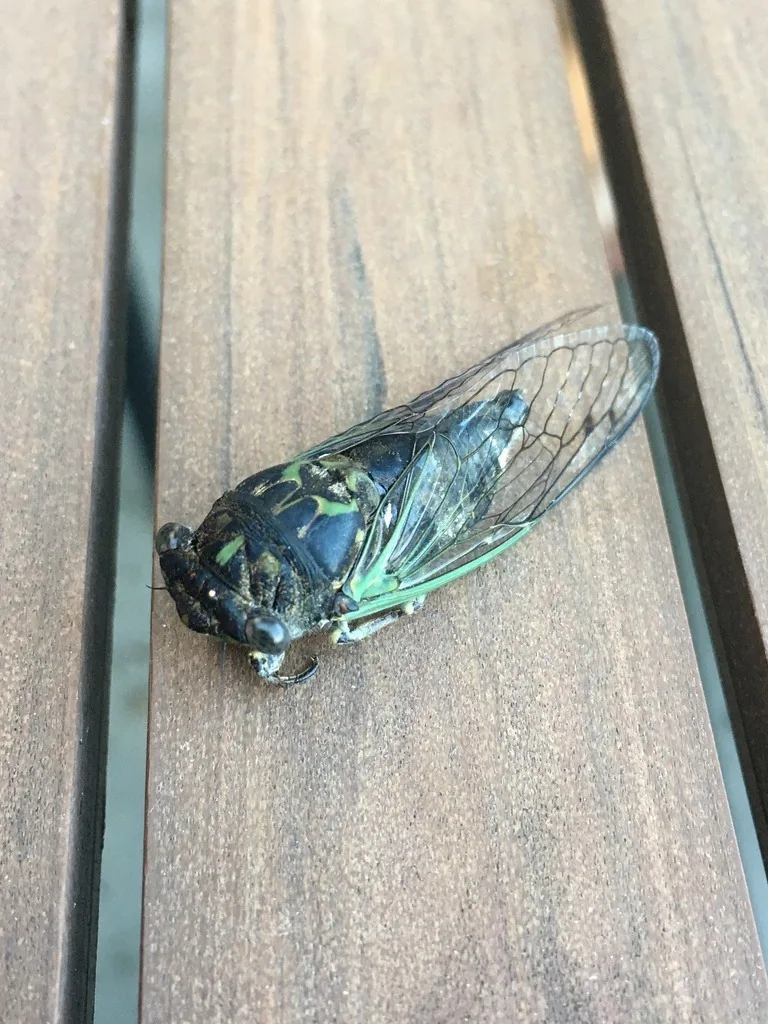
How to identify it
- Adults are about 1 1/2 to 2 inches long, with brown or green, black and white markings on a stout body.[1][3]
- They have bulging eyes on the sides of the head, usually black or brown, and clear wings held like a roof over the body.[1][2]
- The mouthpart is a short, sharp beak tucked under the head; they crawl and fly but don't jump.[2]
- Females carry a curved egg-laying tube at the tip of the abdomen, and males make a loud, raspy call.[2]
- Empty tan nymph skins are often left clinging to tree trunks, fences and other upright objects.[1][2]
Look-alikes
| Look-alike | How to tell them apart |
|---|---|
| Periodical cicadas | Smaller, with black bodies, red eyes and orange wing veins. They emerge in huge synchronized broods in late spring every 13 or 17 years, not every summer.[1][2] |
| Cicada killer wasp | Not a cicada at all: a very large wasp that specializes in catching annual cicadas to feed its young.[2] |
Where it lives
Dog-day cicadas are one of two cicada groups common in the eastern United States. In Missouri they occur statewide, mostly in forests, parks, wooded suburbs and along streams.[1][2]
Biology and life cycle
Females cut slits in pencil-thick twigs and lay rice-shaped eggs in batches of 20 to 30.[1]
Eggs hatch in about six weeks; the tiny nymphs drop to the ground and burrow down to suck sap from tree roots.[1][3]
Nymphs live underground for 2 to 5 years. Because generations overlap, some members of each species mature every year.[1][2]
Mature nymphs crawl out at night, leaving holes about 1/2 inch wide, climb a trunk or post, and split open to release the winged adult.[3][1]
Adults appear from June through August, and Texas A&M AgriLife notes they can live 5 to 6 weeks.[1][3]
Only males sing, by rapidly vibrating drum-like membranes on the sides of the abdomen. Each species has its own call and time of day.[3][2]
Damage and signs
- Texas A&M AgriLife does not consider Texas dog-day cicadas plant pests; adults don't eat leaves.[3]
- The only real plant injury from cicadas is egg-laying. Slit twigs may break and the leaves wither, but this is natural pruning for established trees.[1][2]
- Emergence holes in a lawn can look untidy but don't permanently harm turf or the roots of established plants.[1]
Health risk
Cicadas can't sting and don't bite in defense. Very rarely, one left sitting on skin may jab with its beak, mistaking a person for a plant; it hurts but is harmless.[1][2]
Control
Prevention
No control is needed or recommended for established trees, and insecticides don't meaningfully reduce cicada numbers or damage.[1]
Keep them out
If a small, young tree or shrub is being heavily used for egg-laying, insect netting with 1/4 to 3/8 inch openings can protect it; bird netting is too coarse.[1]
Pesticides
UMD Extension cautions that insecticides also put people, pets, beneficial insects and birds at risk.[1]
Common questions
- Why are they called dog-day cicadas?
- Adults are out during the dog days of July and August, a name tied to the late-summer prominence of Sirius, the Dog Star.[2]
- Do annual cicadas bite or sting?
- No. The female's egg-laying tube can look like a stinger, but cicadas can't sting and won't bite to defend themselves.[1][2]
- What is the big wasp carrying cicadas around my yard?
- Likely a cicada killer, a large wasp that catches annual cicadas and stocks them as food for its young.[2]
Sources
- University of Maryland Extension, “Cicadas (updated September 23, 2026).” extension.umd.edu/resource/cicadas (accessed 2026-10-06)
- Missouri Department of Conservation, “Annual Cicadas (Field Guide).” mdc.mo.gov/discover-nature/field-guide/annual-cicadas (accessed 2026-10-06)
- Texas A&M AgriLife Extension, Department of Entomology, “Dog-day cicada (Field Guide to Common Texas Insects).” texasinsects.tamu.edu/dog-day-cicada/ (accessed 2026-10-06)
- iNaturalist, “Neotibicen canicularis taxon page (order and family).” www.inaturalist.org/taxa/469238 (accessed 2026-10-06)