PestControlBasics
Menu

Cellophane Bees

Colletes[3]

Cellophane bees are solitary, ground-nesting bees that line their underground cells with a clear, cellophane-like secretion.[1][2]

Group
Insect
Order
Hymenoptera
Family
Colletidae
US records
44 states
Sources
3 cited
Updated
2026-10-16
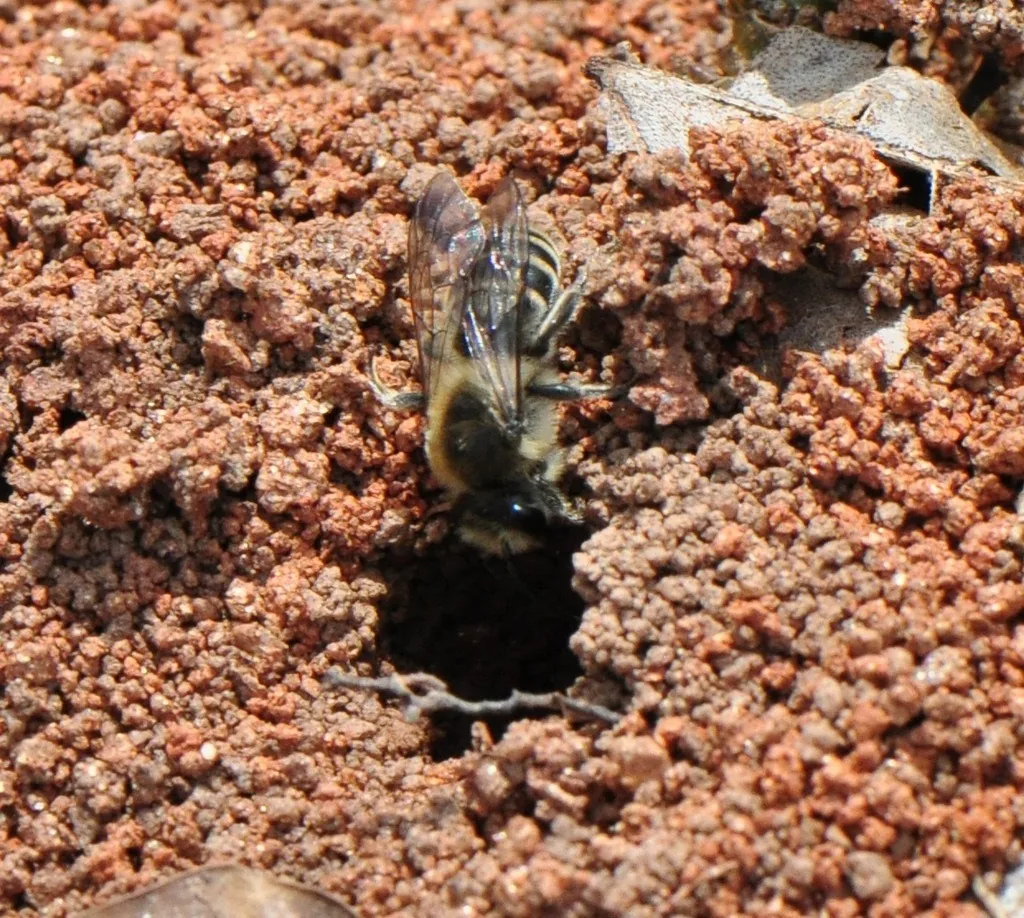
Cellophane bee at the entrance of its nest burrow in sandy soil
Cellophane bee at the entrance of its nest burrow in sandy soil. (c) James Kindt, some rights reserved (CC BY) — via iNaturalist, CC BY 4.0
On this page
  1. Identification
  2. Look-alikes
  3. Where it lives
  4. Biology
  5. Damage and signs
  6. Health risk
  7. Control
  8. Related profiles
  9. Common questions
  10. Sources

How to identify it

  • They are black, about the size of a honey bee, with pale hairs around the thorax and pale bands on the abdomen.[2]
  • Unlike honey bees, their eyes are bare rather than hairy.[2]
  • Each female digs her own nest in the ground, and they favor sandy soil.[1][2]

Look-alikes

Look-alikeHow to tell them apart
Honey beeSimilar in size, but honey bees have short hairs on the eyes; cellophane bees do not.[2]

Where it lives

Found in eastern North America, including Maryland and North Carolina.[1][2]

US map: public records from 44 states since 1990 (GBIF).

Biology and life cycle

There is one generation a year; adults emerge in spring and live only about a month in the Northeast.[1][2]

Females stock each cell with pollen and nectar and lay an egg; the new bee spends 9 to 10 months underground before emerging the next spring.[1][2]

Damage and signs

  • They do no damage; they are valuable pollinators of spring crops, visiting carrot-family, rose-family and aster-family flowers.[1][2]

Health risk

They are not aggressive: they lack a nest-guarding instinct, so walking past nests will not provoke them; a sting is possible only if one is stepped on barefoot.[1][2]

Control

Prevention

Coexist with the bees if you can; the adults die off within weeks, and control is rarely justified.[1][2]

Common questions

Are the bees nesting in my lawn dangerous?
Cellophane bees are not aggressive and do not defend their nests.[1][2]
How long will they be around?
Only a few weeks in spring; the next generation stays underground until the following spring.[1]

Sources

  1. University of Maryland Extension (Home and Garden Information Center), “Meet a Pollinator: Cellophane Bee (June 2018).” extension.umd.edu/resource/meet-pollinator-cellophane-bee (accessed 2026-10-16)
  2. NC State Extension, “Colletid Bees (Plasterer Bees, Cellophane Bees, and Polyester Bees) (PDIC Factsheet).” content.ces.ncsu.edu/colletid-bees-plasterer-bees-cellophane-bees-and-polyester-bees (accessed 2026-10-16)
  3. iNaturalist, “Colletes inaequalis taxon page (order and family).” www.inaturalist.org/taxa/1438690 (accessed 2026-10-06)

Updated 2026-10-16. Built from sourced records. Spot an error? Tell us.