The short answer
- Step 1: broadcast a fire ant bait over the entire yard with a hand-held or crank seed spreader, at a time when the ants are out foraging. Expect 80% to 90% control over the following weeks to months.[1][4][2]
- Step 2: treat individual mounds near play areas, paths or the mailbox with a labeled mound drench, granule, dust or fast-acting bait, or with very hot water.[1][5]
- Late August to October is the time Texas A&M favors for the bait, so it works over the winter; spring baiting also works once the ants are actively foraging.[1][2][5]
- Apply bait to dry grass with no rain expected, use fresh bait, and don't disturb the mounds.[1][10][11]
- With only a few mounds (fewer than about 5 per quarter-acre), skip the broadcast and treat mounds one at a time, which spares the native ants that compete with fire ants.[6][4][5]
- For stings: brush the ants off fast, wash the area, and get emergency care for chest pain, trouble breathing, swelling of the face or throat, or slurred speech.[14][15][8]
Fire ant profiles
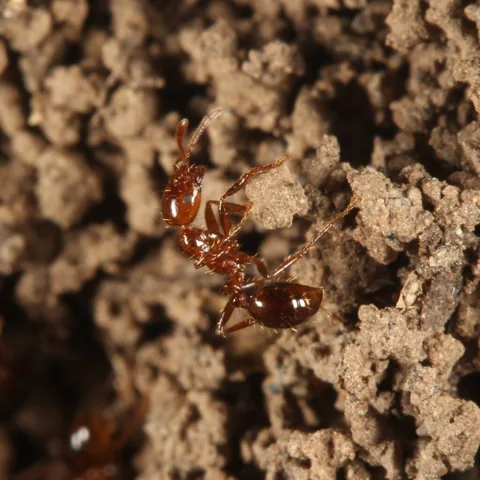 Red Imported Fire Ant
Solenopsis invicta
The red imported fire ant is an aggressive stinging ant that infests most of the southern United States and parts of California, building mounds in open, sunny areas such as lawns, parks and roadsides. USDA APHIS says imported fire ants came from South America, probably in soil on cargo ships, and now infest more than 367 million acres in Alabama, Arkansas, California, Florida, Georgia, Louisiana, Mississippi, North Carolina, Oklahoma, South Carolina, Tennessee, Texas, Virginia and Puerto Rico.
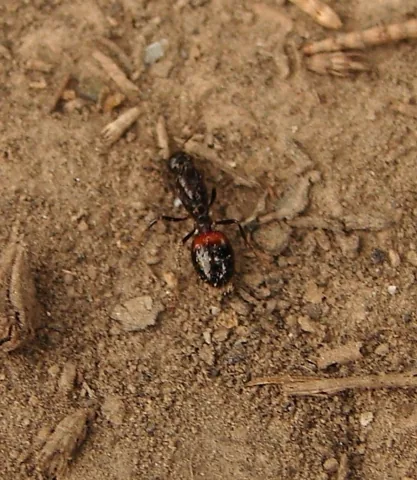 Black Imported Fire Ant
Solenopsis richteri
The black imported fire ant is a South American fire ant that reached Mobile, Alabama, decades before the red imported fire ant. Its range stays limited to northeastern Mississippi, northwestern Alabama and southern Tennessee.
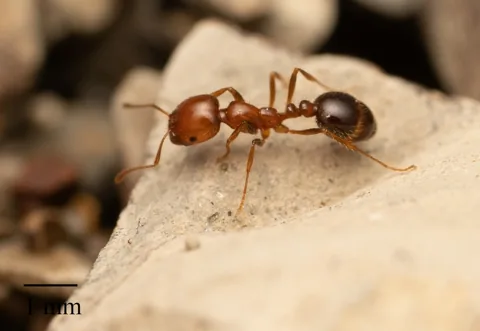 Southern Fire Ant
Solenopsis xyloni
The southern fire ant is a native fire ant of the Southwest. It nests in bare, sunny soil, swarms out to bite and sting when its nest is disturbed, and often wanders indoors for food in warm months.
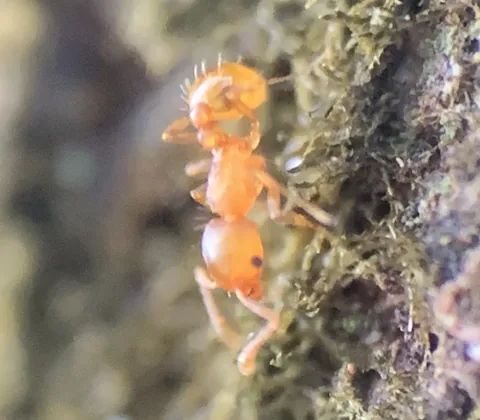 Little Fire Ant
Wasmannia auropunctata (listed on iNaturalist as Allomerus auropunctatus)
The little fire ant is an invasive ant from the American tropics whose sting, the Hawaii Department of Agriculture (HDOA) notes, is out of proportion to its tiny size. It was first found in Hawaii in 1999 and has spread there in plants, logs and green waste.
No photo yet
Fire Ant Decapitating Flies
Pseudacteon
Fire ant decapitating flies (Pseudacteon species) are tiny phorid flies that lay their eggs in fire ants. The maggot grows inside the ant's head, which eventually falls off. Since 1997, six South American species have been released in the southern United States as biological control for imported fire ants, and eight native species attack native fire ants.
Make sure they're fire ants
Texas A&M's fire ant program lists the signs: a mound of fluffy, worked soil, often showing up a few days after a heavy rain, with no opening in the center, because the ants come and go through underground tunnels. Mounds in lawns are usually only a few inches tall.[7]
The workers are small, about 1/8 to 1/4 inch long, and come in mixed sizes in the same colony, while many other ants are all one size. Disturb the mound and dozens to hundreds of reddish-brown workers run up grass stems and other vertical surfaces. A sting burns, and a day or so later a white pustule forms at the spot.[7][11]
Under a hand lens, fire ants have two nodes (bumps) in the waist. NC State notes almost all other ants have one.[11]
- Not every ant hill is a pest. Texas A&M describes native ants such as pyramid ants and bigheaded ants that compete with fire ants, and says many native species attack new fire ant queens trying to start colonies.[9][5]
- Insecticides for fire ants kill native ants too, so Texas A&M advises using them only where fire ants are actually present.[5]
- If you're not sure what you have, our ant identification guide covers the look-alikes, and USDA APHIS suggests your local extension office can identify the species.[13]
Pick a plan by how many mounds you have
Texas A&M says the two-step method works best in fully infested areas, which it defines as five or more mounds per quarter-acre of yard, or where you aren't concerned about keeping native ants.[1][6]
For small areas with fewer mounds (fewer than 5 per quarter-acre, or fewer than 20 per acre) or where you want to keep native ants, treat mounds individually. Expect new colonies to move in, and plan on more labor and checking.[6][3][4]
- Two-step (bait plus problem mounds): the usual choice for medium and large yards. Texas A&M says it is relatively inexpensive and cuts down on mound treatments, which use more toxic insecticides than baits.[6][10]
- Individual mound treatments only: for a few mounds, or a small area of ornamental turf.[6][3]
- Broadcast contact insecticide (granules spread over the lawn and watered in): costs more but may be more effective in small areas, because ants moving into treated ground die while the product lasts. Granular fipronil is slow but long-lasting and allowed once a year; pyrethroids kill surface ants for months but may miss colonies deep in the soil.[3][10]
- Clemson notes the broadcast granules only control fire ants where you put them, so it suggests pairing them with bait to reach areas you missed.[10]
Step 1: Broadcast a fire ant bait
Fire ant baits are processed corn grits coated with soybean oil that carries the insecticide. Workers carry the bait home and share it with the queen, which dies or stops laying eggs. The active ingredient is a very small amount, and you don't need to find the mounds for it to work.[1][12][5]
Look for the words "fire ant bait" on the label, as UC IPM advises. Plastic bait stations sold for indoor ants are not likely to do much against large outdoor fire ant infestations.[12]
- Use fresh bait, ideally from an unopened container. Sources differ on how long an opened bag lasts: UC IPM says only a couple of weeks, NC State says 1 to 3 months, and Texas A&M's Mike Merchant advises throwing out bait opened more than a few months.[1][12][11][5]
- Bait goes stale when its soybean oil turns rancid, so store it cool and dry, away from gasoline, insecticides and cigarette smoke, which can taint it.[10][11]
- Test before you spread: put a little bait or a potato chip near a mound. Texas A&M and Clemson say ants should find it within 30 minutes; NC State looks for ants feeding at 20 minutes.[1][10][11][12]
- Spread when the ants are foraging. Texas A&M gives 65 to 95°F as the best range, often mid-morning after the dew dries or late afternoon on hot days; UC IPM says 70 to 90°F. In summer heat, evening is best.[2][12][10]
- Keep it dry. Texas A&M says apply to dry ground and grass with no rain expected for 24 to 48 hours; Clemson gives a 12-hour window before rain or irrigation, and NC State says skip it if rain is expected within 24 hours.[1][10][11]
- Go light. Typical rates are about 1 to 1.5 pounds per acre, which Clemson works out to about 30 granules per square foot (UC IPM says about 20). Texas A&M says a quarter-acre lot needs less than half a pound. Follow your product's label.[2][10][12]
- Use a hand-held or crank seed spreader set on its lowest opening; Clemson says it must open at least ⅛ inch. Don't mix bait with fertilizer or seed.[1][4][10]
- Spread it around mounds, not on top of them. NC State says ants don't forage on the mound itself, and that ants busy rebuilding a disturbed mound aren't out foraging.[11]
When to bait, and how long it takes
Texas A&M's program favors late August through October. The ants are still foraging, the weather is easier to predict, and the bait works over the winter so mound numbers are already down by spring. Re-apply once or twice a year.[1][4][2]
Spring works too, once ants are actively foraging. Texas A&M's Mike Merchant says to wait until soil is around 70°F at 1 inch deep, and the program warns that baiting in cool spring weather below 65°F won't work. In hot, dry summers mounds are hard to see because the colonies go deeper, but the ants still forage in the cool of the evening and will take bait.[5][2]
NC State names late spring and late September to early October as the best seasons.[11]
- Indoxacarb baits: the fastest, working in 3 to 10 days, with full control in about 2 weeks.[3][2]
- Hydramethylnon baits: 7 to 14 days on a mound, 2 to 3 weeks broadcast; Texas A&M's FAQ gives 3 to 6 weeks for maximum control.[3][2]
- Spinosad baits: several weeks.[3]
- Insect growth regulator baits (methoprene, pyriproxyfen, fenoxycarb) and abamectin: slower, 1 to 2 months after a spring application and about 6 months after a fall one, but they last longer. UC IPM gives 4 to 6 weeks for an IGR bait.[3][12]
- Some products blend a fast ingredient with an IGR, such as hydramethylnon plus methoprene, to get both quick and lasting control.[3][2]
Step 2: Treat the mounds that can't wait
Mounds by the mailbox, the swing set or the garden path can be treated directly. Texas A&M's Allen Knutson says most products applied to the mound kill the colony in 1 to 2 days. Clemson suggests treating problem mounds 7 to 10 days after the bait; NC State says to bait first and follow with a mound treatment a few days later if the bait seems slow, and not to drench and bait the same mound at the same time.[5][10][11]
Clemson notes that mound treatments only kill the mounds you find, and missed colonies are why people think the ants have just moved. They also put more insecticide into the environment than baits.[10]
- Liquid drenches usually wipe out a mound within a few hours and leave little residue on the surface.[1]
- Granules go on and around the mound, then get watered in with 1 to 2 gallons of water without disturbing the mound (NC State says 1.5 to 2 gallons).[1][11]
- Dusts need no water and act fast but leave a residue on the surface.[1]
- Fast-acting baits (hydramethylnon, indoxacarb, spinosad) are handy for colonies under sidewalks, in plant beds or at the base of trees.[3]
- Treat in mid-morning, around 70°F, when the ants sit close to the surface. Don't kick or dig into the mound first: NC State says ants move the queen away from a disturbance.[11][3]
- Check back a few days later for small satellite mounds that sprang from the treated one.[11]
- If you use a watering can for an insecticide drench, don't use it for anything else afterward.[3]
Hot water and organic options
Pouring very hot or boiling water on a mound kills the colony about 60% of the time; otherwise the ants usually just move. Texas A&M suggests 2 to 3 gallons (its FAQ says about 3) on a cool, sunny morning when ants are near the surface. The water kills the grass and plants it touches, and you can scald yourself.[1][2]
Texas A&M's program says organic options fit into the two-step method: spinosad baits, and mound drenches with pyrethrins or d-limonene. Some carry OMRI organic certification.[2][1]
UC IPM is less positive about the contact sprays. It doesn't recommend mound treatments or granules that aren't fire ant baits, naming pyrethrin and d-limonene among others, because they mostly kill the workers you can see and not the colony.[12]
USDA ARS researchers reviewing natural products in 2020 described synthetic insecticides, in baits and contact products, as still the main tools for fire ants, with natural toxins, repellents and fumigants under study as safer alternatives.[17]
- Instant grits don't work. The old idea is that ants eat them and swell up, but Texas A&M says workers can't swallow particles that large.[2]
- Don't pour gasoline on a mound. Texas A&M says it often doesn't kill the whole colony, is dangerous to handle, kills plants, and leaves residue that can reach ground or surface water.[2]
- Biological control is real but limited. USDA and the University of Texas have released three species of parasitic phorid flies that are established in parts of Texas, but even in South America the flies affect only about 3% of the workers in a colony.[2]
Keeping kids, pets, gardens and ponds safe
Texas A&M's answer to "what's safest for my kids and pets" is to follow the label and keep concentrated contact insecticides where children and animals can't touch them. Broadcast bait is spread so thinly, and falls so far down into the grass, that few creatures other than ants run into it.[2]
Granules and dusts stay on the surface until watered in, so a drench may be the better mound treatment where kids play. Keep children and pets off treated areas as the label says, or until the grass and soil are dry; NC State suggests keeping pets off for 12 to 24 hours after a bait application.[2][11]
Fire ant stings are a concern for pets as well as people, and USDA APHIS notes that young and newborn animals are especially at risk. Teach children and visitors what a fire ant mound looks like.[12][13][8]
- Vegetable gardens: use only products whose label lists that site. Most baits aren't labeled for use inside a garden, so Texas A&M suggests spreading bait around the garden's edge; foraging ants carry it to colonies inside and out. Mounds in the garden can be shoveled out or treated with hot water, keeping it off your plants.[6][11][5]
- Ponds and creeks: baits can go near the shore but not into the water, where fish may eat them. Clemson suggests leaving a 30-foot buffer around a pond and letting foragers bring bait back from beyond it. Avoid pyrethroid and pyrethrin products near water, since they are highly toxic to fish.[6][2][10][11]
- Electrical boxes and air conditioners: fire ants nest in them and can cause short circuits. Texas A&M advises calling an electrician or a licensed pest control operator rather than treating them yourself.[6]
- Ants coming indoors: treat mounds near the house and use a bait labeled for indoor use. Our guide to ants in the house covers indoor baiting.[6]
Why they come back
No method is permanent. Texas A&M says new colonies will probably show up after the next rain and certainly within a year, as mated queens fly in and colonies move over from untreated yards nearby. Larger treated areas see less of this.[2]
Fire ants travel from yard to yard, so the program suggests teaming up with neighbors to treat at the same time. Its rhythm: bait in the fall, bait again when mounds start to reappear, and treat nuisance mounds in between.[4][2]
Fire ant stings: first aid
A fire ant grips the skin with its jaws and stings over and over, and many ants tend to sting at once when you move. The sting burns, and a white pustule usually forms within a day or two. UC IPM says the pustules take several weeks to go away.[8][2][14][12]
Pustules get infected easily and can leave scars, so keep them clean and unbroken.[8][12][2]
- Brush the ants off briskly. CDC's NIOSH advice notes they hang on with their jaws.[14]
- Wash the stings with soap and water. MedlinePlus suggests ice wrapped in a washcloth, 10 minutes on and 10 minutes off.[15]
- An antihistamine or an anti-itch cream can help; antihistamines may cause drowsiness. Texas A&M suggests a bite remedy that numbs pain and protects against infection.[15][14][8]
- Over the next several days, watch for signs of infection such as spreading redness, swelling or pain.[15]
- Texas A&M estimates about 1% of people are hypersensitive to fire ant venom. Very young and very old people, and those with weak immune systems, are most likely to react badly, and even healthy people can go into anaphylactic shock after many stings.[2]
- Infants, older people and anyone bed-bound can be stung indoors, because they can't move away easily. An allergist's 2008 review notes indoor attacks and the risk at both age extremes.[16][6]
When a sting is an emergency
Call 911 or get to an emergency room right away for trouble breathing or wheezing, swelling of the face, mouth or throat, trouble swallowing, chest pain, nausea, heavy sweating, slurred speech, weakness or fainting. If the person carries an epinephrine auto-injector, use it.[15][14][8]
Texas A&M advises people who become sensitive to fire ant stings to see an allergist. A 2008 review by an allergist reports that immunotherapy with fire ant whole-body extract appears to work.[8][16]
The federal fire ant quarantine
USDA APHIS says imported fire ants (the red and the black imported fire ant) infest more than 367 million acres in Alabama, Arkansas, California, Florida, Georgia, Louisiana, Mississippi, North Carolina, Oklahoma, South Carolina, Tennessee, Texas, Virginia and Puerto Rico. It sets quarantine areas where colonies are known, to stop people from spreading them.[13]
Within those areas, APHIS and the states regulate things that carry ants: nursery stock, baled hay, soil, plants and soil-moving equipment. If you're moving these out of a quarantined county, check the rules first; APHIS has a state-by-state lookup and map.[13]
In California the red imported fire ant is a quarantined pest. UC IPM says to call the state's fire ant line (1-888-434-7326) to get a suspected ant identified, and not to start your own control program in an area where it hasn't been found before.[12]
When to call a professional
Clemson notes professionals can buy products not sold to homeowners and know how to use them; NC State says lawn care companies have a few extra products too.[10][11]
Common questions
- What is the fastest way to get rid of a fire ant mound?
- Treat it directly with a labeled mound drench, granules watered in, or a dust. Most mound products kill the colony in 1 to 2 days, and drenches often work within hours. Leave the mound undisturbed until you treat it.[5][1][11]
- When is the best time to put out fire ant bait?
- Texas A&M favors late August through October, when ants still forage and the bait can work over the winter, plus a spring application if mounds come back. Spread it when ants are foraging, on dry grass, with no rain expected.[1][4][2]
- Does boiling water kill fire ants?
- Sometimes. Texas A&M says 2 to 3 gallons of very hot or boiling water kills the mound about 60% of the time, and the surviving ants usually move. It also kills grass and can burn you.[1][2]
- Is fire ant bait safe for dogs?
- Broadcast bait contains very little insecticide and is spread thinly into the grass, and NC State calls baits safe when used as directed. It suggests keeping pets off treated areas for 12 to 24 hours; always follow the label.[2][11]
- Should I pop a fire ant blister?
- No. The pustules get infected easily and can scar, so keep them clean and intact, and watch for redness, swelling or pain that grows over the next few days.[8][2][15]
- Will I ever get rid of fire ants completely?
- Not for good. Texas A&M and NC State both say fire ants can't be eliminated from an area, and new colonies usually appear within a year. The goal is keeping them low with a yearly bait plan and treating problem mounds.[3][11][2]
Photo credits
- Red Imported Fire Ant: (c) Natasha Taylor, some rights reserved (CC BY) — via iNaturalist, CC BY 4.0
- Black Imported Fire Ant: (c) Nicolas Olejnik, some rights reserved (CC BY) — via iNaturalist, CC BY 4.0
- Southern Fire Ant: Jesse Rorabaugh, public domain (CC0), via iNaturalist
- Little Fire Ant: natalie, public domain (CC0), via iNaturalist
Sources
- Texas A&M AgriLife Texas Imported Fire Ant Research and Management Project, “Two-Step Method.” fireant.tamu.edu/controlmethods/twostep/ (accessed 2026-11-10)
- Texas A&M AgriLife Texas Imported Fire Ant Research and Management Project, “Fire Ant FAQ.” fireant.tamu.edu/manage/faq/ (accessed 2026-11-10)
- Texas A&M AgriLife Texas Imported Fire Ant Research and Management Project, “Control Methods.” fireant.tamu.edu/controlmethods/ (accessed 2026-11-10)
- Texas A&M AgriLife Texas Imported Fire Ant Research and Management Project, “Tackle fire ants in the fall for fewer ants in the spring.” fireant.tamu.edu/manage/tackle/ (accessed 2026-11-10)
- Texas A&M AgriLife Texas Imported Fire Ant Research and Management Project, “Don't let fire ants ruin your summer, take steps this spring.” fireant.tamu.edu/dont-let-fire-ants-ruin-your-summer-take-steps-this-spring/ (accessed 2026-11-10)
- Texas A&M AgriLife Texas Imported Fire Ant Research and Management Project, “Managing Fire Ants for Specific Sites.” fireant.tamu.edu/manage/site/ (accessed 2026-11-10)
- Texas A&M AgriLife Texas Imported Fire Ant Research and Management Project, “How can I tell if I have fire ants?.” fireant.tamu.edu/manage/how-can-i-tell-if-i-have-fire-ants/ (accessed 2026-11-10)
- Texas A&M AgriLife Texas Imported Fire Ant Research and Management Project, “Medical Information.” fireant.tamu.edu/manage/medical-information/ (accessed 2026-11-10)
- Texas A&M AgriLife Texas Imported Fire Ant Research and Management Project, “Native Ants.” fireant.tamu.edu/learn/native-ants/ (accessed 2026-11-10)
- Clemson Cooperative Extension Home & Garden Information Center, “Fire Ant Management In The Home Lawn (HGIC 2501).” hgic.clemson.edu/factsheet/fire-ant-management-in-the-home-lawn/ (accessed 2026-11-10)
- NC State Extension, “Red Imported Fire Ants in the Landscape.” content.ces.ncsu.edu/managing-fire-ants-in-your-yard (accessed 2026-11-10)
- University of California Statewide IPM Program, “Pest Notes: Red Imported Fire Ant (Home and Landscape).” ipm.ucanr.edu/home-and-landscape/red-imported-fire-ant/ (accessed 2026-11-10)
- USDA Animal and Plant Health Inspection Service, “Imported Fire Ants.” www.aphis.usda.gov/plant-pests-diseases/ifa (accessed 2026-11-10)
- CDC, National Institute for Occupational Safety and Health, “Insects and Scorpions at Work.” www.cdc.gov/niosh/outdoor-workers/about/insects-and-scorpions.html (accessed 2026-11-10)
- NIH National Library of Medicine, MedlinePlus, “Insect bites and stings (Medical Encyclopedia).” medlineplus.gov/ency/article/000033.htm (accessed 2026-11-10)
- Current Opinion in Allergy and Clinical Immunology (PubMed 18596594), “Tankersley MS. The stinging impact of the imported fire ant. Curr Opin Allergy Clin Immunol 2008;8(4):354-9.” pubmed.ncbi.nlm.nih.gov/18596594/ (accessed 2026-11-10)
- Insects (PubMed 33158097), “Chen J, Oi DH. Naturally occurring compounds/materials as alternatives to synthetic chemical insecticides for use in fire ant management. Insects 2020;11(11):758.” pubmed.ncbi.nlm.nih.gov/33158097/ (accessed 2026-11-10)