The short answer
- A swarm on a tree, fence or shrub: leave it alone and keep people and pets back. Swarms are usually not aggressive and move to a new home within a day or two. A beekeeper may come and collect it.[1][2][4]
- Bees going in and out of a wall, soffit or roofline: that's an established colony. Have it removed by a beekeeper who does structural removals, or by a pest control professional if it can't be saved.[1][3][6]
- Don't spray it, and never seal the entrance. Spraying makes the colony defensive, and sealed-in bees can chew through drywall and come out inside the house.[6][3]
- All the comb and honey has to come out of the wall. Left behind, it can leak honey, stain walls, and draw robber bees, wax moths, carpet beetles, mice and the next swarm.[1][3][4][6]
- Bumble bees in a wall or the ground: their colonies die out in late summer or fall, so if you can keep away from the nest, waiting is usually the answer.[4][2]
- Find a beekeeper through your county extension office, a local beekeeping group, a state beekeeper list or even the fire station.[1][4][5]
Bee profiles
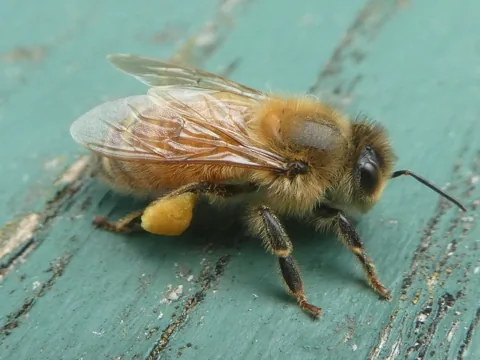 Western Honey Bee
Apis mellifera
Honey bees are important pollinators, but a colony that moves into a wall void or attic can become a stinging hazard. A swarm is temporary and usually best left alone, while an established colony in a building should be removed along with its comb.
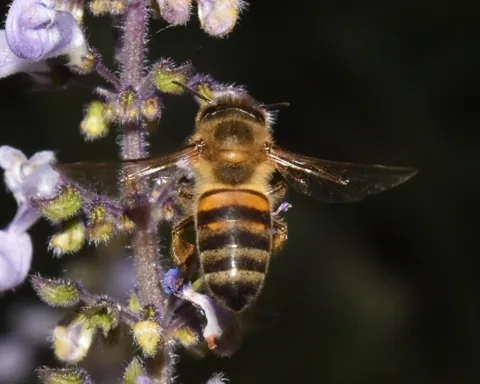 Africanized Honey Bee
Apis mellifera scutellata and its hybrids with European honey bees (Apis mellifera)
Africanized honey bees descend from African honey bees taken to Brazil in the 1950s that got into the wild and bred with European honey bees. They look like ordinary honey bees and carry the same venom, but colonies respond faster, in greater numbers and over a wider area when their nest is disturbed.
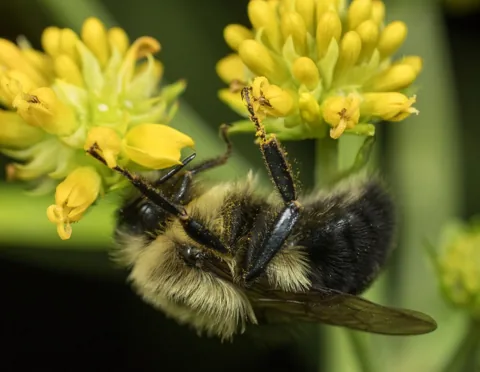 Common Eastern Bumble Bee
Bombus impatiens
Bumble bees are social bees that form annual colonies in soil cavities, old rodent burrows and similar voids; they are valuable pollinators and defend their nests only when disturbed.
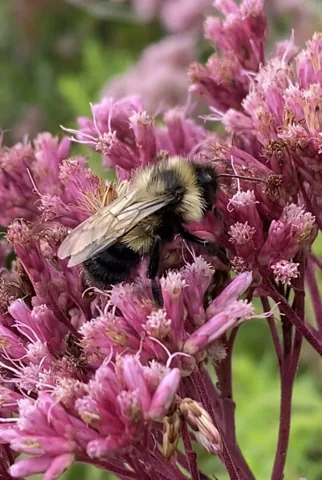 Rusty-patched bumble bee
Bombus affinis
The rusty patched bumble bee was once common across the northern part of eastern North America. The U.S. Fish and Wildlife Service listed it as endangered in 2017, making it the first federally protected bumble bee and the first bee on the endangered species list, and it now survives in low numbers in a small part of its former range.
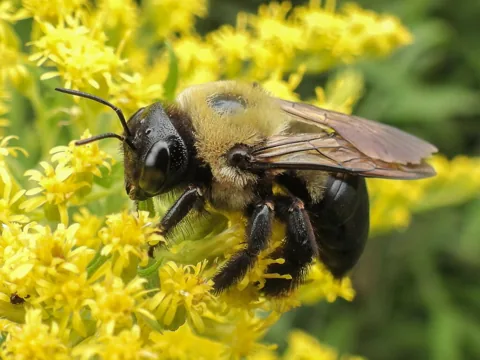 Eastern Carpenter Bee
Xylocopa virginica
Carpenter bees are large, solitary bees that bore round tunnels into bare, weathered wood to rear their young; they rarely cause severe damage but can weaken wood that is reused year after year.
Swarm or established colony?
Honey bee colonies reproduce by swarming. In spring and early summer the old queen leaves with about half the workers, and the bees left at home raise a new queen. The swarm clusters in the open while scout bees look for a cavity to move into. Penn State describes these clusters as lasting several hours or days.[3][2][4]
- Swarm: a dense cluster of bees hanging from a branch, shrub, fence or eave, with no comb. Kentucky says swarms are common from late April through June; Minnesota says swarming typically happens in late spring and early summer, usually starting in the warmer hours of the day.[1][4]
- How big: sources differ. Penn State says the half of the colony that leaves can include tens of thousands of bees; Minnesota gives several hundred to several thousand workers, a few drones and one queen.[2][4]
- How long it stays: Kentucky says a swarm usually finds a home within a day or so, Penn State says within two days, and Minnesota says from an hour to a few days depending on the weather and how long the scouts take.[1][2][4]
- Established colony: bees flying steadily in and out of one opening in a wall, soffit, chimney or attic vent, day after day. Inside, the bees build wax comb where they rear young and store honey, and Kentucky notes the comb may sit some distance from the hole you see.[1][4]
- Why it matters: Kentucky says swarming bees are usually not aggressive and unlikely to sting unless disturbed, but once bees settle into a permanent home they become far more defensive.[1][7]
Make sure they're honey bees
Minnesota Extension says honey bee colonies aren't usually found in buildings, and advises capturing a bee or taking a clear picture to have it identified before deciding anything. Yellowjackets, bumble bees and honey bees each call for a different response.[4][2]
- Honey bees: fuzzy, striped and more slender than bumble bees, with special baskets on their legs for carrying pollen. Their wings lie flat over the abdomen when resting, and they build vertical sheets of wax comb.[2][4]
- Bumble bees: larger, stout and fuzzy all over, banded black and yellow, sometimes with orange or red. Ohio State notes bumble bees have a head distinctly narrower than the thorax, while carpenter bees have a head as broad as the thorax and usually a shiny tip to the abdomen.[8][3]
- Wasps and yellowjackets: smooth, mostly hairless bodies with narrow waists. Penn State's quick test is hair: bees are covered in it, wasps usually aren't. Yellowjacket nests in walls are a different job, covered in the wasp nest guide.[2][3]
- Carpenter bees: big bees with a shiny, hairless abdomen that nest in exposed wood rather than in a wall void. Penn State notes bumble bee queens are often confused with them; see the carpenter bee guide.[3][8]
What to do about a swarm
Minnesota Extension says that in most situations a honey bee swarm can be ignored: it's temporary and the bees will move off on their own. Stay back and keep others away. Only a swarm in a spot that poses a real health threat, such as a busy public area, needs any action.[4][1]
- Call a beekeeper if you'd rather it go sooner. Kentucky says swarms are often sought by beekeepers, and Minnesota says an experienced beekeeper may be willing to gather the swarm and relocate it.[1][4]
- Don't spray it. Kentucky says swarming bees are not likely to sting unless disturbed, and the Texas apiary service warns that spraying chemicals at bees makes them defensive.[1][6]
- Left-behind bees: Kentucky says a few bees sometimes stay on the branch after the swarm leaves. They can't survive alone and die within a few days.[1]
- Watch where it goes. If the swarm moves into your wall, act soon: Kentucky notes swarms are easier to eliminate soon after they enter a building than once they are established.[1]
- In areas with Africanized honey bees, be more careful with any cluster or colony. UC IPM says Africanized bees look the same as European honey bees but defend a larger area around the nest and respond faster and in greater numbers. See the Africanized honey bee profile for where they occur.[7]
Bees in a wall: why they have to come out
Scout bees usually pick a hollow tree, but Kentucky says many times they choose the wall void of a home. A study of honey bee nest-site choice notes that the quality of the cavity is critical to a swarm's survival and that suitable cavities are scarce, which may help explain why a wall void gets picked.[1][10]
- They don't leave. Unlike bumble bee and wasp colonies, honey bee colonies live through the winter by clustering together and eating stored honey. Penn State says a feral colony inside or near a home may survive for many years.[2][3]
- It's bigger than you think. Penn State says a colony in a wall could hold more than 100 pounds of honey and tens of thousands of bees, plus an extensive network of comb with developing bees.[3]
- They can get defensive. Kentucky says established colonies can become very defensive and much more likely to sting than swarms, while Penn State says feral colonies near homes rarely show defensive behavior and suggests leaving nesting bees in peace if they aren't damaging the structure or acting aggressively toward the people living there.[1][3][2]
- The cavity stays attractive. Penn State says honey bees are particularly drawn to spaces that other honey bees used before, and Kentucky says odors from an old colony can linger a long time and draw new swarms.[3][1]
Live removal: how it works and who does it
Penn State says it's often possible to remove a whole colony from a wall and rehome it in a regular hive, but large nests can take extensive work and should be handled by someone experienced with both bees and home construction. Kentucky adds that salvaging a colony from a wall isn't always practical, and to agree in advance with the remover about cleanup and repairs.[3][1]
- Expect the wall or soffit to be opened. The remover has to reach the comb, cut it out with the bees and take all of it, then the opening gets closed and every entrance sealed so another colony can't move in.[3][6][1]
- Find the nest first. Kentucky says you can sometimes locate it by tapping the wall with a hammer and listening for the bees' answering buzz.[1]
- Who does it: a beekeeper who does structural removals, or a pest control company. Penn State suggests asking a beekeeper or pest control expert whether they'll remove the colony or can refer you to someone who will.[3][1]
- Licensing varies by state. In Texas, the state apiary service keeps a list of registered beekeepers who do live removals; registered beekeepers are exempt from the structural pest control law for that work, but the service says no bee removal license exists, it has no information on listed beekeepers' qualifications, and most listed beekeepers have no pesticide license, so they can't use chemicals.[5][6]
- Get it in writing. The Texas Apiary Inspection Service recommends a contract that states the work to be done, the charge and the timeline, and suggests calling every remover listed for your county to compare experience, cost and schedule.[6]
- Questions to ask: how much experience they have with this kind of removal, what it involves and how long it takes, whether they'll write a contract, what they do with the bees afterward, whether they carry liability insurance, and whether you can call references.[6]
- On removal day, tell the neighbors and ask them to keep pets and children inside until the job is done.[6]
Why spraying, sealing or killing them yourself backfires
The Texas Apiary Inspection Service's advice to homeowners starts with three don'ts: don't try to remove the hive yourself, don't spray chemicals into it, and don't seal the bees in.[6]
- Spraying the entrance: Texas says it makes the colony defensive and endangers you and others. Kentucky explains why it often fails as well: insecticide at the entrance may never reach the comb. Foragers die, but the queen and the young house bees can survive and rebuild the colony unless the comb itself is treated.[6][1]
- Sealing the hole: Penn State says honey bees can chew through drywall and come out in large numbers inside the home. Texas says sealed-in bees will find a way out, possibly inside the structure. Seal only after the colony and comb are gone.[3][6]
- Killing them and leaving the comb: Kentucky says the wax may melt or be riddled by wax moth larvae and begin to leak honey, which can seep through interior walls and leave a permanent stain. Bees from other colonies come to rob the honey, and carpet beetles and other scavengers move in. Minnesota adds mice to that list.[1][4]
- Sources differ on old wax. Minnesota says wax with no honey left in it shouldn't be a problem because wax moths usually destroy it quickly; Penn State and the Texas service say every bit of comb has to come out, because leftover comb can attract the next swarm or other pests.[4][3][6]
- Ladders: Kentucky warns that a few distracting stings while working on bees high up can cause a fall from a ladder or roof. Anyone allergic to stings should stay away from the job entirely.[1][3]
- Treated honey: never save or use honey or comb from a colony that was treated with insecticide.[1][4]
When the colony can't be saved
Both Kentucky and Minnesota describe insecticide treatment as the fallback when no beekeeper can remove a colony. Kentucky says it's best to remove or destroy colonies too close to where people live and work. Since the Texas apiary service notes most beekeepers have no pesticide license and can't use chemicals, this usually falls to a pest control professional.[1][4][6][3]
- Timing: Minnesota suggests early spring, March to April if possible, when the colony may already be dead or has little honey left; by late April or early May the bees start bringing in nectar again. Kentucky likewise says established colonies are best killed in late winter when their numbers are low, and in late afternoon when all the bees are home.[4][1]
- Treat the nest, not just the hole. Kentucky says quicker, safer results come from treating the comb itself, often through a hole bored from the outside wall, and warns not to plug that hole right away or agitated bees may be forced into the living space.[1]
- Then remove the comb and honey if it can be done without extensive structural damage, repair the wall and plug every entrance. Kentucky says older homes with cracks in walls or under eaves are likely targets, so seal or screen gaps before swarm season.[1][6]
Bumble bees in walls, sheds and the ground
Bumble bee colonies are annual. A single queen starts the nest in spring, the colony grows through summer, and after the first hard frost it dies out. Only new mated queens survive the winter, usually somewhere other than the old nest.[2][3][8]
- Where they nest: usually underground in old rodent burrows or other cavities, in compost piles and under objects on the ground. Minnesota says some species nest higher, in trees, wall cavities, birdhouses and bird nests; Missouri adds brush piles and trash heaps.[4][8][9][3]
- Colony size: Penn State says up to several hundred workers in some species, far fewer than a honey bee colony, and the nests are usually well hidden.[3]
- Leave them if you can. Minnesota says most species aren't aggressive unless you reach into the nest or step on it, and some common species are done by early August, the rest by September. A small fence around a ground nest prevents accidents.[4][3]
- What doesn't work: Minnesota says live-trapping bumble bees, covering the nest entrance and moving the nest are all impractical; moved colonies often don't survive.[4]
- Check the species first. The rusty patched bumble bee is federally endangered, and it's illegal to harm one without a permit. Minnesota says to photograph the bee and confirm it isn't a protected species before treating any nest, and notes that one out of every three bumble bee species is in decline.[4][3]
- If a nest in a high-traffic spot has to go, Minnesota suggests treating at night, dressed with sleeves and pant legs closed, using soapy water (about 1/4 cup of laundry or dish soap per gallon of water). For a nest inside a wall, the same never-seal-it-in rule applies; wait for fall or get professional help.[4][3]
Finding a beekeeper
There's no single national list. Kentucky says county extension offices, and sometimes the local fire station, keep lists of beekeepers who remove bees from buildings.[1]
- Minnesota Extension links a bee removal directory for Iowa, Minnesota and Wisconsin. Penn State links Pennsylvania beekeeping organizations.[4][3]
- Texas: the Texas Apiary Inspection Service posts a county-by-county list of registered beekeepers who do live removals, with a separate list of those working in more than 15 counties.[5]
- Elsewhere, start with your county extension office or a local beekeeping association.[1][3]
If someone gets stung
A honey bee's stinger is barbed and stays in the skin with the venom sac attached, so each bee stings once. The venom sac also releases an alarm scent that draws more bees, so walk away from the colony first.[3][7]
- Get the stinger out fast. UC IPM says venom keeps entering the skin for 45 to 60 seconds after a sting, and the method doesn't matter as long as you remove it quickly; a fingernail or the edge of a card works.[7][4]
- Wash the sting and use a cold compress; antihistamine creams or sprays with a skin coolant can help.[7]
- Get medical help right away for severe symptoms or stings on the neck or mouth, where swelling can block breathing. People who know they're allergic should carry the epinephrine injector their doctor prescribed.[7]
- Many stings at once are dangerous, especially for children. UC IPM says people can be killed if stung enough times in a single incident. The bug bite guide covers sting reactions in more detail.[7]
Common questions
- Will a bee swarm leave on its own?
- Usually, yes. Swarms are a colony in transit and move to a new home within a day or two, sometimes within hours. Keep people and pets back, or call a beekeeper to collect it.[1][2][4]
- Can I just seal the hole the bees are using?
- No. Honey bees sealed in a wall can chew through drywall and come out inside the house. Seal the entrance only after the colony and all its comb have been removed.[3][6]
- Why can't I just spray bees in my wall?
- Spray at the entrance often doesn't reach the comb, so the queen and young bees survive and the colony recovers, and a disturbed colony gets defensive. If the bees do die, the honey and comb left inside can leak, stain walls and attract robber bees, wax moths, carpet beetles and mice.[1][6][4]
- Will a beekeeper remove bees from my wall for free?
- Don't count on it. Structural removals are skilled, risky work that usually involves opening the wall, and the Texas Apiary Inspection Service says to expect any removal specialist to charge something. Get a written contract.[6][3]
- Do bumble bees come back to the same nest?
- Not as a colony. The whole colony dies in fall and only new queens overwinter, usually elsewhere. Penn State suggests marking entrances in summer and sealing them in winter or early spring once the insects are gone.[2][3]
- How long can bees live in a wall?
- Honey bee colonies survive winter, and Penn State says a feral colony inside or near a home may live there for many years.[2]
Photo credits
- Western Honey Bee: (c) Doug Miller, some rights reserved (CC BY) — via iNaturalist, CC BY 4.0
- Africanized Honey Bee: (c) Sunčana Bradley, some rights reserved (CC BY) — via iNaturalist, CC BY 4.0
- Common Eastern Bumble Bee: Jesse Rorabaugh, public domain (CC0), via iNaturalist
- Rusty-patched bumble bee: Milwaukee County Parks - Natural Areas Program, public domain (CC0), via iNaturalist
- Eastern Carpenter Bee: Erik Schiff, public domain (CC0), via iNaturalist
Sources
- University of Kentucky Entomology, “Controlling Nuisance Honey Bees (Entfact 606).” entomology.mgcafe.uky.edu/ef606 (accessed 2026-11-10)
- Penn State Extension, “Five-Step Decision Support: Nesting Bees and Wasps Near Homes.” extension.psu.edu/five-step-decision-support-nesting-bees-and-wasps-near-homes (accessed 2026-11-10)
- University of Minnesota Extension, “Wasps and bees.” extension.umn.edu/insects-infest-homes/wasps-and-bees (accessed 2026-11-10)
- Texas Apiary Inspection Service, Texas A&M AgriLife, “Bee Removal.” txbeeinspection.tamu.edu/bee-removal/ (accessed 2026-11-10)
- Texas Apiary Inspection Service, Texas A&M AgriLife, “Honey Bee Removal Informational Document.” research.entomology.tamu.edu/wp-content/uploads/sites/29/2018/03/Bee-Removal-FAQ.pdf (accessed 2026-11-10)
- University of California Statewide IPM Program, “Bee and Wasp Stings.” ipm.ucanr.edu/home-and-landscape/bee-and-wasp-stings/ (accessed 2026-11-10)
- Ohio State University Extension, Ohioline, “Bumble Bees and Solitary Bees and Wasps in Urban Landscapes (HYG-2143-10).” ohioline.osu.edu/factsheet/HYG-2143-10 (accessed 2026-11-10)
- Missouri Department of Conservation, “Bumblebees.” mdc.mo.gov/discover-nature/field-guide/bumblebees (accessed 2026-11-10)
- Philosophical Transactions of the Royal Society B, abstract via PubMed (PMID 29581395), “Beekman and Oldroyd 2018, Different bees, different needs: how nest-site requirements have shaped the decision-making processes in homeless honeybees (Apis spp.).” pubmed.ncbi.nlm.nih.gov/29581395/ (accessed 2026-11-10)