The short answer
- 1. Make sure it's a carpenter bee: a shiny, mostly bare black abdomen and a round hole about 1/2 inch across in wood. Bumble bees have a fuzzy abdomen and nest in the ground.[1][3][5][4][8][9][10]
- 2. Paint exposed wood with oil-based or polyurethane paint and keep it maintained. That is the most reliable deterrent; stain gives little or no protection.[4][5][1][3]
- 3. For active holes, puff a labeled insecticide dust into each opening at night, wait a day or more so the bees spread it through the tunnel, then plug the hole with a glued dowel, steel wool and caulk, or wood putty, and paint over it.[2][3][4][5][1][8]
- 4. Time it right: early spring when bees first appear, or fall when they settle in to overwinter. Dusting sealed brood cells in early summer does little.[2][3]
- 5. If damage is minor, UC IPM's advice is to rely on prevention and skip insecticides, since carpenter bees are beneficial pollinators.[2][5]
Carpenter bees and look-alikes
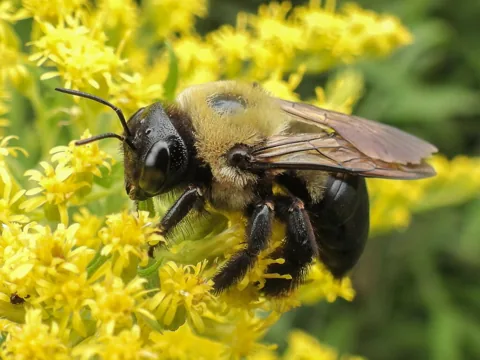 Eastern Carpenter Bee
Xylocopa virginica
Carpenter bees are large, solitary bees that bore round tunnels into bare, weathered wood to rear their young; they rarely cause severe damage but can weaken wood that is reused year after year.
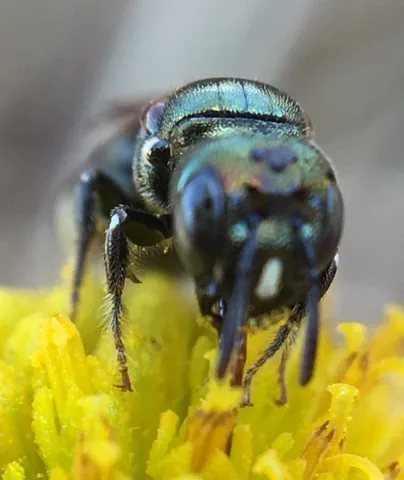 Small Carpenter Bees
Ceratina species
Small carpenter bees are tiny, shiny black bees with blue or green highlights that hollow out nests in the pith of broken weed stems, dead canes and freshly cut rose stems. They are gentle pollinators, though nesting in a fresh rose cut can make the cane die back.
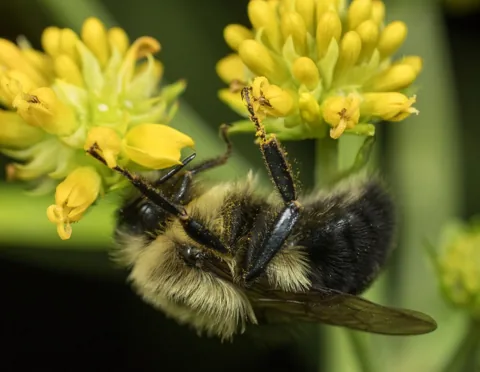 Common Eastern Bumble Bee
Bombus impatiens
Bumble bees are social bees that form annual colonies in soil cavities, old rodent burrows and similar voids; they are valuable pollinators and defend their nests only when disturbed.
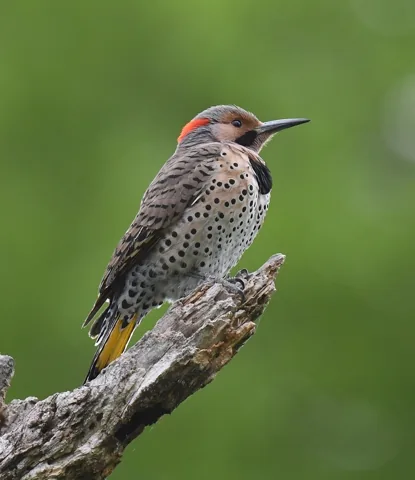 Woodpeckers
Family Picidae (shown: northern flicker, Colaptes auratus)
Woodpeckers come into conflict with people when they peck buildings looking for insects, drum on loud surfaces to claim territory, or carve out nest holes. All are protected under the federal Migratory Bird Treaty Act, but they can legally be kept off a house.
Is it a carpenter bee or a bumble bee?
The two are about the same size and both are big, black and yellow, so people mix them up all the time. Penn State notes that homeowners complaining about bumble bees under the eaves are probably seeing carpenter bees. Look at the abdomen: on a carpenter bee the top of it is mostly bare and shiny black, while a bumble bee's is covered in hair, much of it yellow. Texas A&M and the Arkansas Extension pest manual use the same test: no hair on the top of a carpenter bee's abdomen, which Arkansas describes as blue-black and almost metallic.[3][1][5][9][10][8]
- Size: Clemson and Ohio State put the eastern carpenter bee at about 3/4 inch to 1 inch long; UC IPM gives females of the western species as about 5/8 to 1 inch. Bumble bees overlap: Penn State gives 1/2 to 1 inch, Texas A&M 15 to 25 mm, and Iowa State 3/4 to 1 inch for both kinds of bee, so size alone won't separate them.[4][5][2][3][10][8]
- Head: a carpenter bee's head is almost as wide as its thorax, while a bumble bee's head is much narrower. Bumble bees also carry large pollen baskets on their hind legs.[5][11]
- Male or female: the female has an all-black head; the male has yellow or white markings on the face.[5][4]
- Nest: carpenter bees tunnel into wood. Bumble bees are social bees that nest in existing cavities, often underground in places like old rodent burrows. Iowa State and Texas A&M also describe bumble bees as social and carpenter bees as not social.[1][5][3][4][8][10]
- Behavior: if you see several large bees hovering near the eaves or drilling into wood, Penn State says you have carpenter bees.[3]
- Which species: the eastern carpenter bee, Xylocopa virginica, is the one most homeowners in the East meet; Ohio State lists a second eastern species, X. micans, and several native species in the West, such as the valley and mountain carpenter bees pictured by UC IPM.[5][3][2]
How carpenter bees live: the yearly cycle
Carpenter bees are solitary. They don't form colonies, and each female has her own gallery, although many bees often nest close together in the same piece of wood. Ohio State notes that each one behaves independently of the others.[5][1][3][8][10]
Researchers who watch the eastern carpenter bee in observation nests describe it differently: as facultatively social. In their account many females leave the nest they grew up in each spring and often try to join another nest, sometimes with unrelated bees, and the females there sort out an order for who reproduces before brood rearing starts.[13]
- Spring: adults that spent the winter inside old tunnels come out, in April and May in Clemson's and Ohio State's accounts, and mate. Males hover near the nesting sites while the mated females look for a place to nest. Iowa State also gives April or May.[4][5][1][8]
- Nest building: the female chews a round entrance hole across the grain, goes in about an inch, then turns at a right angle and tunnels along the grain. She would rather refurbish or extend an old gallery than start a new one, because digging is slow work; Ohio State gives a rate of about 1 inch every six days.[5][3][4][1][8][9]
- Brood cells: working from the far end, she packs a ball of pollen and nectar ('bee bread'), lays one egg on it and walls it off with chewed wood pulp, then repeats. Sources count about five or six cells (Kentucky), six to eight (Penn State, Clemson) or six to 10 (Ohio State, Iowa State) per gallery.[3][4][5][1][8]
- Development: estimates run from about seven weeks (Ohio State, varying with temperature) to about three months (UC IPM) from egg to adult.[5][2]
- Late summer: the new adults emerge, in August in Penn State's account, feed on flowers, store some pollen in the galleries and then shelter in the old tunnels for winter. Iowa State puts that feeding period in August or September.[3][5][2][4][8]
- Generations: one a year in the north; Ohio State says there are sometimes two in the southern United States, and the Forest Service says one or two. The Forest Service also says carpenter bees are long lived, up to three years.[2][5][6]
Are carpenter bees spreading north?
Iowa State says carpenter bees were once considered a southern insect, but their incidence and distribution in Iowa have steadily increased over the past 30 years. A genetic study of eastern carpenter bees sampled from 16 populations across the range found signs that the species may be expanding northward, and noted that it now nests almost exclusively in artificial wooden structures. The authors suggest it may be one of the rare species that thrive in landscapes changed by people.[8][12]
Which wood they choose
Carpenter bees go for bare, weathered softwood. Kentucky lists redwood, cedar, cypress and pine; Ohio State adds fir and says the bees can tunnel more easily through soft, straight-grained wood. Painted or pressure-treated wood is much less likely to be attacked, and the bees avoid wood that is well painted or still has its bark.[1][5][2][8]
- Around the house: eaves, rafters, fascia boards, roof gables, porch ceilings, siding, shingles and shake roofs, shutters, window trim, doors, windowsills, decks, railings and outdoor furniture. The Arkansas manual adds roof rafters, gutter boards, beams, plates and patio wood fixtures, and Iowa State deck joists.[1][5][4][3][9][8]
- Elsewhere: fence posts, utility poles, firewood, arbors and dead wood on trees.[5][2][3]
- Penn State says the bees prefer wood more than two inches thick. Iowa State says the same.[3][8]
- Hidden holes: Ohio State says entrance holes used to be common in exposed sites, but those bees and their offspring were the easiest targets for control, so today's population is dominated by bees that hide their entrances. The inner surface of fascia boards is a common spot.[5]
- Nail holes, exposed saw cuts and unpainted wood are attractive places for a bee to start.[5][4]
- UC IPM says carpenter bees avoid most hardwoods, but Ohio State notes western species often nest in oak, eucalyptus and redwood.[2][5]
How much damage do they do?
One bee's work is minor. The trouble comes from reuse: bees come back to the same boards year after year, enlarging old galleries and digging new ones beside them. Several sources say a gallery used over many years can reach 10 feet long, and Ohio State notes wood must be replaced once posts, poles or structural members lose strength. Still, UC IPM says they rarely cause severe damage, and Kentucky says they are seldom as destructive as termites. Iowa State agrees that wood used for nesting year after year may be structurally damaged.[3][5][4][2][1][8]
The return trips aren't just habit at the scale of one board. A genetic study of eastern carpenter bees across 14 sites spanning more than 450 km found strong site-level philopatry: bees within less than 1 km of each other were closely related, which the authors call surprising for such a large bee. That suggests bees tend to stay close to where they were raised.[14]
- Signs: a round hole about 1/2 inch across, sawdust on the ground below it in spring, and yellowish to brown fecal stains on the wall or brick under the opening. You may even hear buzzing or chewing inside the wood. Iowa State says carpenter bees are often first discovered by the large amount of coarse sawdust falling from the nest openings.[4][5][3][1][8]
- A typical gallery runs about 4 to 6 inches (Clemson, Ohio State); UC IPM says 6 to 10 inches deep, and a Rhode Island study measured an average tunnel length of 15.4 cm (about 6 inches). Iowa State adds that a bee may dig several tunnels from a single opening.[4][5][2][7][8]
- Holes also let moisture in, which leads to rot and decay.[1]
- Carpenter bees don't damage aluminum, vinyl siding, asphalt or other non-wood materials.[5][4]
Woodpeckers make it worse
Some of the worst-looking damage isn't from the bees at all. Ohio State says woodpeckers and flickers riddle infested wood with holes to dig out the larvae and adults, and seem to target the adults overwintering in the galleries. If birds are tearing up fascia boards or siding where carpenter bees nest, the birds are after the bees; our woodpecker profile covers the birds themselves.[5]
Will they sting? Males can't
The bees that dive at you near the nest are males defending territory, and they have no stinger. Only female bees and wasps have one, because the stinger is a modified egg-laying organ. Ohio State calls the males' behavior a bluff.[5][1][3][4][2][8]
- Females can sting but are docile and rarely do unless handled or provoked. Ohio State notes a female can sting more than once. Iowa State and the Arkansas manual agree that females can sting, painfully in Iowa State's words, but seldom do, and Texas A&M says carpenter bees do not sting to defend their nests.[5][3][4][2][1][8][9][10]
- Even so, Kentucky advises treating at dusk or wearing protective clothing, because females provisioning a nest may sting.[1]
Prevention: paint, harder materials and flashing
Paint is the main defense. Clemson calls a painted surface, with oil-based or polyurethane paint, the most effective deterrent, and Kentucky calls painting a more permanent solution. Ohio State adds that paint wears down with weather, exposing wood again, so inspect painted surfaces regularly and repaint.[4][1][5][2][8]
- Stain is weak protection. Kentucky says stains and preservatives may repel bees somewhat compared with bare wood, but are less reliable than paint; Clemson says stains give little repelling action, Penn State that stained wood usually isn't protected, and Ohio State that stain won't prevent damage. Iowa State is the outlier: it says a coat of paint or a heavy stain will protect wood from further attack.[1][4][3][5][8]
- Fill the starting points: fill nail holes, saw cuts, cracks and depressions with wood putty or dowels, then paint.[4][2][5]
- Choose materials: where possible, UC IPM suggests building vulnerable exterior parts from hardwoods. Clemson suggests replacing badly damaged wood with pressure-treated lumber, and Ohio State lists aluminum and vinyl siding as alternatives to wood.[2][4][5]
- Cover rough spots: protect timber ends and other rough areas with wire screening or metal flashing.[2]
- Keep them out of buildings: close garage and outbuilding doors and windows in spring while the bees are searching for nest sites, which usually tapers off by late spring.[1][4]
- Surface sprays are a short-term option only. A labeled pyrethroid sprayed on favored wood can make bees avoid it or kill those that land, ideally applied in early spring, but it lasts about 3 to 4 weeks (Kentucky), less than 30 days (Clemson) or weeks to months (Ohio State), and it's hard to cover all the wood on a house.[1][4][5]
- Clemson notes that insecticide-additive paints are sold that may repel nesting bees.[4]
Treating active holes: dust, wait, then plug
Dust works best. Ohio State says a dust formulation in the nest gallery gives long-lasting action and is typically the most effective approach. Use a hand duster or bulb applicator to puff it deep into each hole so it coats the tunnel walls, and Ohio State says to apply it to the adjacent wood surface as well. Products labeled for carpenter bees include pyrethroid dusts (deltamethrin, cyfluthrin and others) and pyrethrin dust; UC IPM notes many of these are sold only to licensed applicators. Iowa State lists insecticide dust or a wasp and hornet aerosol for individual nests.[5][3][2][1][8]
Leave the hole open at first. Returning bees need to crawl through the dust and carry it through the tunnel, and young bees coming out later should get a dose too. How long to wait varies by source: a day or two (UC IPM), 24 hours (Clemson), a few days (Kentucky, Ohio State), or until fall (Penn State). Iowa State says not to plug the entrance after treatment while the bees are active, and to fill the holes in fall.[3][2][4][1][5][8]
- Do it at night, or after dark on a cool evening, when the bees are inside and slow. Penn State's tip: cover a flashlight with red cellophane, since the bees can't see red light but you can still see the holes. Find the holes in daylight first. Iowa State also says to treat at night to avoid stings.[3][5][4][2][8]
- Timing in the season: UC IPM says to treat in early spring before nesting begins, or in fall when adults settle in for winter. Treating active nests in late spring and summer does little, because each brood cell is sealed with wood-particle walls the insecticide can't get through, and the young bees chew out after it has worn off. Penn State instead suggests three rounds: spring, mid-summer, and early fall.[2][3]
- Protect yourself: dust drifts. Penn State advises protective clothing, gloves, goggles and a respirator or dust mask, washing that clothing separately and showering afterward; UC IPM warns these dusts can seriously irritate the lungs. Because treating eaves and soffits from a ladder has obvious risks, Penn State notes many homeowners hire a licensed company. Iowa State likewise mentions hiring a certified pest management professional.[3][2][8]
- Liquids and aerosols labeled for bees or wasps can also be aimed into the hole, and Penn State suggests a pyrethrum or wasp-and-hornet spray to knock down any bees flying around if you must work in daylight.[1][4][3][8]
- Borates are disputed. UC IPM lists a disodium octaborate dust among products labeled for carpenter bees, but Ohio State says stomach poisons such as borates are typically ineffective, because the bees don't eat the wood they dig.[2][5]
- Read and follow the label. Kentucky notes that some products named in extension publications may not be legal in your area.[1][3]
Plugging and repairing the holes
Plugging keeps new bees from moving into old tunnels, which is how damage builds up, and it keeps moisture out. Plug with a wooden dowel coated in carpenter's glue, wood putty, caulk, or steel wool or copper gauze topped with putty or caulk, then paint or varnish over the repair.[1][4][2][5][3][8]
- Without insecticide: Ohio State describes sealing each entrance hole as a non-chemical approach, filling the whole gallery with sealant first if possible. It reports that bees sealed inside typically won't chew out. Clemson disagrees: if no insecticide was used, it says trapped adults can dig new openings. UC IPM's version avoids the question by filling only unoccupied holes, after the bees have emerged.[5][4][2]
- Ohio State also notes larvae and pupae can be killed by pushing a stiff wire as deep into the gallery as it will go, and females can be swatted near the nest.[5]
Carpenter bee traps
Kentucky and Clemson both describe carpenter bee traps as a helper, not a cure. Most are a small wooden box with 1/2-inch holes drilled into the sides, angled upward in Clemson's design, and a clear plastic bottle attached below. Bees looking for a nest site go in, are drawn toward the light into the bottle, and can't find their way out. They are sold in hardware stores and online or can be built at home.[1][4]
- Hang traps in early spring from eaves and overhangs at the corners of the house, porch, deck or shed, near where bees have been active.[1][4]
- Kentucky says traps may help reduce drilling; Clemson says they help with monitoring and control. Neither gives a figure for how much damage they prevent.[1][4]
- Empty dead bees by unscrewing and rinsing the bottle.[1]
- Drilled wood also draws other insects. In a Rhode Island study of wooden trap nests (blocks used to study nesting, not kill traps), carpenter bees used only 2 of 216 nests in 2017 and 4 of 96 in 2018, while mason bees and grass-carrying wasps took many more.[7]
Pollinators, and when to leave them alone
Carpenter bees are native pollinators. The Forest Service calls them excellent pollinators of eggplant, tomato and other vegetables and flowers, and they shake pollen loose with their flight muscles ('buzz pollination'). In Rhode Island, their pollen loaves held pollen from 21 to 39 plant genera a year, with garden snapdragon the most common. On long tubular flowers like salvias and penstemons they sometimes cut a slit at the base and take nectar without pollinating.[6][7][5][8]
That nectar robbing doesn't seem to cost fruit growers much. On rabbiteye blueberry farms in the Southeast, a USDA-ARS study found that corolla slitting by male carpenter bees had no appreciable effect on fruit set, and honey bees then took nectar through the same slits. In an experimental highbush blueberry planting in Rhode Island, slitting did not affect fruit set and had no significant negative effect on fruit quality.[15][16]
UC IPM's position is that under most conditions their damage can be managed with prevention, and insecticides are not recommended. It suggests using insecticides only when the infestation is high or the risk to structural wood is great.[2]
- A few bees in a fence post or old timber away from the house are often worth leaving alone; the Forest Service describes eastern carpenter bees in posts and timbers as a minor nuisance.[6][2]
- Act when the same boards are hit year after year, holes are in structural wood, stains or rot are spreading, or woodpeckers have started on the wood.[1][5][3]
- If you treat, keep it targeted: dust placed into the holes, rather than broad spraying. Our guide to protecting bees when you spray covers label bee warnings and drift.[5][2]
- Other small solitary bees and wasps may visit empty carpenter bee holes, usually to scavenge leftover pollen or to shelter. Kentucky says they seldom cause problems.[1]
Common questions
- What kills carpenter bees in their holes?
- A labeled insecticide dust puffed deep into each hole, applied at night when the bees are inside. Leave the hole open long enough for them to spread it, then plug it. Ohio State calls dusting the galleries typically the most effective approach.[5][3][2][4]
- Should I plug carpenter bee holes right away?
- Not if you just dusted them: the bees need to pass through the dust first. Sources say to wait anywhere from 24 hours to a few days, or until fall. If you are not using insecticide, UC IPM says to fill only holes the bees have already left.[4][2][1][5][3]
- Does painting wood stop carpenter bees?
- It is the best long-term deterrent. Carpenter bees usually won't tunnel into well-painted wood, especially with oil-based or polyurethane paint. Stain does much less.[1][4][5][3]
- Can carpenter bees sting?
- Males can't; they have no stinger, even though they dive at people. Females can, but rarely do unless handled.[5][4][3][1]
- Do carpenter bee traps work?
- Kentucky and Clemson say traps can help reduce drilling and help with monitoring when hung in early spring near active areas, but they are an aid rather than a fix. Painting and plugging old holes still matter.[1][4]
- Are carpenter bees bad for my house?
- A few holes are mostly cosmetic. Repeated use of the same wood over years can cause real structural damage and rot, and woodpeckers can make it worse, but UC IPM says severe damage is rare.[2][1][5]
- Why do carpenter bees keep coming back to the same house?
- Overwintering adults shelter in the old tunnels and emerge from them in spring, and females would rather clean out and enlarge an old gallery than dig a new one. Genetic work also shows the bees tend to stay close to where they were raised. Plugging old holes and painting the wood breaks the cycle.[5][3][14][1][4]
- Are carpenter bees social?
- Extension sources call them solitary bees that don't form colonies like bumble bees or honey bees. Studies of eastern carpenter bees in observation nests found they can be facultatively social, with several females sometimes sharing a nest.[5][1][3][13]
Photo credits
- Eastern Carpenter Bee: Erik Schiff, public domain (CC0), via iNaturalist
- Small Carpenter Bees: (c) James Kindt, some rights reserved (CC BY) — via iNaturalist, CC BY 4.0
- Common Eastern Bumble Bee: Jesse Rorabaugh, public domain (CC0), via iNaturalist
- Woodpeckers: Chrissy McClarren and Andy Reago, public domain (CC0), via iNaturalist
Sources
- University of Kentucky Entomology, “ENTFACT-611: Carpenter Bees (M. F. Potter).” entomology.mgcafe.uky.edu/ef611 (accessed 2026-11-11)
- University of California Statewide IPM Program, “Pest Notes: Carpenter Bees (Publication 7417).” ipm.ucanr.edu/home-and-landscape/carpenter-bees/ (accessed 2026-11-11)
- Penn State Extension, “Carpenter Bees.” extension.psu.edu/carpenter-bees (accessed 2026-11-11)
- Clemson Cooperative Extension Home & Garden Information Center, “Carpenter Bees (HGIC).” hgic.clemson.edu/factsheet/carpenter-bees/ (accessed 2026-11-11)
- Ohio State University Extension, Ohioline, “Carpenter Bees (S. C. Jones).” ohioline.osu.edu/factsheet/hyg-2074 (accessed 2026-11-11)
- USDA Forest Service, “Carpenter Bees (Xylocopa spp.), Pollinator of the Month (S. Buchmann).” www.fs.usda.gov/wildflowers/pollinators/pollinator-of-the-month/carpenter_bees.shtml (accessed 2026-11-11)
- Environmental Entomology, via PubMed, “Tucker, Ginsberg and Alm (2019), Eastern carpenter bee: nest structure, nest cell provisions, and trap nest acceptance in Rhode Island, Environ. Entomol. 48(3):702-710.” pubmed.ncbi.nlm.nih.gov/30980666/ (accessed 2026-11-11)
- Iowa State University Extension and Outreach, “Carpenter Bees, Yard and Garden (adapted from University of Kentucky EntFact 611).” hortnews.extension.iastate.edu/carpenter-bees (accessed 2026-11-11)
- University of Arkansas Cooperative Extension Service, “Household Pest and Rodent Control, Classification 2 Training Manual (AG1156).” uaex.uada.edu/farm-ranch/pest-management/docs/training-manuals/AG1156.pdf (accessed 2026-11-11)
- Texas A&M AgriLife Extension Service, Insects in the City, “Bumble Bees, ENT-3005 (M. Merchant).” citybugs.tamu.edu/factsheets/biting-stinging/bees/ent-3005/ (accessed 2026-11-11)
- Ohio State University Extension, Ohioline, “Bumble Bees and Solitary Bees & Wasps in Urban Landscapes (HYG-2143).” ohioline.osu.edu/factsheet/hyg-2143 (accessed 2026-11-11)
- Molecular Ecology, via PubMed, “Vickruck and Richards (2017), Nesting habits influence population genetic structure of a bee living in anthropogenic disturbance, Mol. Ecol. 26(10):2674-2686.” pubmed.ncbi.nlm.nih.gov/28214357/ (accessed 2026-11-11)
- Behavioural Processes, via PubMed, “Vickruck and Richards (2017), Nestmate discrimination based on familiarity but not relatedness in eastern carpenter bees, Behav. Processes 145:73-80.” pubmed.ncbi.nlm.nih.gov/29031812/ (accessed 2026-11-11)
- Evolutionary Applications, via PubMed, “Ballare and Jha (2021), Genetic structure across urban and agricultural landscapes reveals evidence of resource specialization and philopatry in the Eastern carpenter bee, Evol. Appl. 14(1):136-149.” pubmed.ncbi.nlm.nih.gov/33519961/ (accessed 2026-11-11)
- Journal of Economic Entomology (USDA-ARS authors), via PubMed, “Sampson, Danka and Stringer (2004), Nectar robbery by bees Xylocopa virginica and Apis mellifera contributes to the pollination of rabbiteye blueberry, J. Econ. Entomol. 97(3):735-740.” pubmed.ncbi.nlm.nih.gov/15279245/ (accessed 2026-11-11)
- Environmental Entomology, via PubMed, “Tucker, Ginsberg and Alm (2019), Effect of corolla slitting and nectar robbery by the eastern carpenter bee on fruit quality of Vaccinium corymbosum, Environ. Entomol. 48(3):718-726.” pubmed.ncbi.nlm.nih.gov/31100115/ (accessed 2026-11-11)