The short answer
- Don't spray, fog or dust with a repellent insecticide. Texas A&M says repellent liquids and dusts typically cause the colony to bud into new nests, and Ohio State says bug bombs don't reach the colonies and can make the ants move.[1][2]
- Bait instead, with a slow-acting bait the ants will eat. Pharaoh ants take fats, proteins and sweets, and UC IPM says they prefer protein or greasy baits year-round. Workers carry the bait back to the queens and brood.[5][2]
- Put bait stations along every active trail throughout the home or building, not just where you saw the first ants, so that workers from all the colonies feed. Check them often and replace them when they're empty.[1][2]
- Expect it to take a while. Texas A&M says a baiting program can take several months to a year; Ohio State says months to years in large buildings such as hospitals.[1][2]
- In apartments and other shared buildings, every unit has to be part of the plan. Minnesota Extension recommends an experienced pest management professional, noting that the baits sold to residents generally aren't effective against pharaoh ants.[2][3]
Small indoor ant profiles
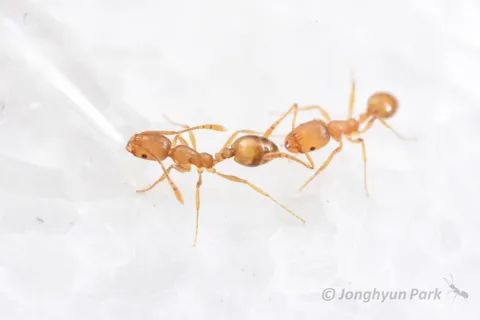 Pharaoh Ant
Monomorium pharaonis
The Pharaoh ant is a tiny, yellowish ant that nests inside heated buildings and is a serious pest in hospitals, apartments, hotels and food businesses. Texas A&M says it occurs throughout the United States but generally only in heated buildings, because it usually can't survive outdoors all year; it does nest outside in subtropical areas such as Hawaii, Florida and southern Texas.
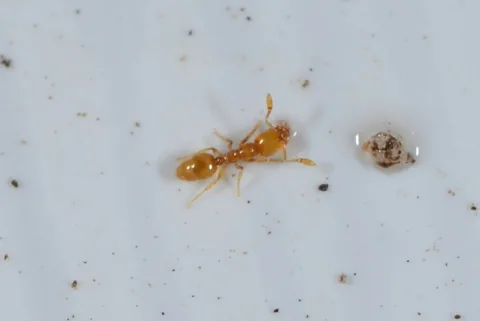 Thief Ant
Solenopsis molesta
The thief ant is a tiny native ant named for nesting near larger ants and stealing their food, larvae and pupae. Also called the grease ant, it trails indoors to greasy and protein-rich foods and is small enough to get into packaged food.
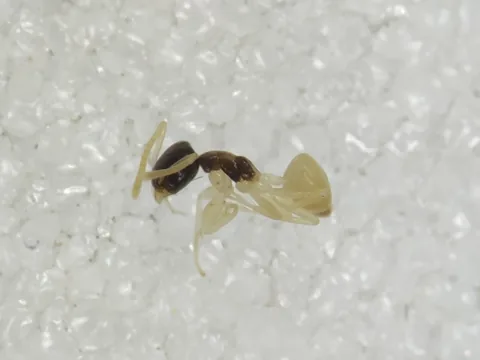 Ghost Ant
Tapinoma melanocephalum
The ghost ant is a tiny tropical tramp ant whose pale abdomen and legs make it hard to see. It nests indoors and out, forages on set trails and favors sweets, and because each colony is spread over many nests it is hard to eliminate.
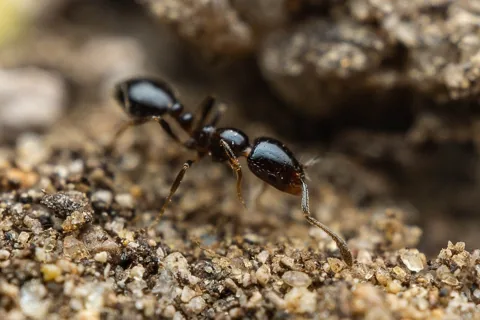 Little Black Ant
Monomorium minimum (iNaturalist files it under Monomorium carbonarium)
The little black ant is a tiny native ant that nests outdoors in lawns and under stones, and indoors in woodwork, wall voids and masonry. It is most noticeable when long foraging trails reach food cabinets and pantries.
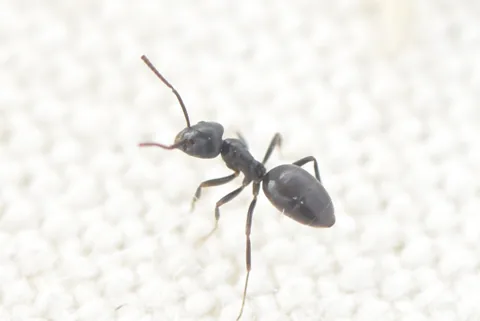 Odorous House Ant
Tapinoma sessile
The odorous house ant is a small native ant found across most of the United States that trails into homes for sweets and gives off a strong, rotten odor when crushed. Texas A&M says it ranges from Canada to Mexico but is rarely found in the southwestern deserts.
Make sure they're pharaoh ants
Workers are very small: about 1/16 inch by Ohio State's and UC IPM's measure, 1/12 to 1/16 inch by Texas A&M's, and 1 to 2 mm by Missouri's. They're light yellow to reddish brown, with the hind part of the body somewhat darker, and all the workers are the same size. Under magnification they have two nodes in the waist and an antenna that ends in a three-segmented club.[2][1][4][5]
The usual mix-up is the thief ant, which is just as small and also yellowish. Ohio State says the thief ant's antennal club has two segments instead of three, and Minnesota Extension says a microscope is often needed to tell the two apart. The difference matters because pharaoh ants call for a bait-only, no-spray approach. Our ant identification guide walks through the other small household ants.[2][3]
Sources disagree on the sting. Ohio State says pharaoh ants have no stinger; Texas A&M says a stinger is present but not always visible, and that they don't sting humans.[2][1]
Where you find them is a clue. In cooler regions they live only indoors: Minnesota Extension says they nest strictly inside buildings in the north central states and don't survive outdoors, and Texas A&M says they are generally found only in heated structures. They can nest in soil outside buildings in subtropical places such as Hawaii, Florida and southern Texas, and UC IPM says they also nest outdoors in the warmer parts of California.[3][1][5]
How a pharaoh ant colony spreads (budding)
Pharaoh ants don't swarm to start new colonies. Mating happens inside the nest, and new nests form by budding: when a colony gets too large or is stressed, a group of workers carries larvae and pupae to a new site, often with one or more queens. Missouri Extension notes that almost any tiny space is suitable for a queen to set up in after budding.[2][3][4]
Ohio State lists three triggers: overcrowding, seasonal changes in a building's central heating and cooling, and a repellent pesticide. The nests can be tiny. Ohio State says one can fit in a thimble or sit between sheets of paper, in laundry or furniture, and Texas A&M says workers move freely between the nests of one colony without fighting.[2][1]
Laboratory work shows how quickly a disturbance moves a nest. In a Universiti Sains Malaysia study, almost all workers carried the entire brood to an empty nest site within a day after the nest was physically disturbed, treated with a pyrethroid or invaded by another ant species, and the brood never went back during the 5-day study. Running out of food split the colony between two nests instead, while drying out the nest had no significant effect.[7]
A 2025 University of California, Riverside study tested over-the-counter aerosol sprays on pharaoh ant colonies of several sizes. Essential-oil sprays were more likely to set off budding at a high application rate, and pyrethroid sprays at a low rate. So even a light application of a store-bought pyrethroid aerosol was among the treatments that pushed colonies to split.[8]
Why there are so many: colony size and breeding
Colony size estimates vary a lot between sources. Texas A&M says colonies range from a single queen with a few hundred workers to hundreds of queens with several thousand workers. Ohio State says mature colonies can reach 300,000 or more members, and that a single hospital may hold dozens or hundreds of colonies.[1][2]
They breed year-round in heated buildings. Texas A&M says queens may live for a year and lay up to 35 eggs a day; Ohio State says a queen can lay 400 or more eggs in her lifetime and that one queen can produce many hundreds of workers in a few months. Workers take about 36 days from egg to adult and live about 70 days, and winged males and females take about 44 days to develop, according to Texas A&M. Ohio State gives 38 to 45 days for the whole life cycle, depending on temperature and humidity.[1][2]
Ohio State adds the number that explains why sprays disappoint: about 90 percent of the colony stays hidden in the nest. Killing the 10 percent you can see leaves a large reserve of ants and queens behind.[2]
Find the trails and the warm, damp spots
Pharaoh ants nest in wall voids, under floors, behind baseboards and countertops, in electrical outlets, light fixtures and trash containers, and among stored linens. They prefer dark, warm places near moisture: around hot water pipes and heating, in kitchens and bathrooms. Minnesota Extension says the nests are very difficult to find, which is why the plan below relies on workers carrying bait home rather than on locating every nest.[2][3][4][5]
Ohio State's inspection advice for buildings:[2]
- Follow the trails to where the ants are feeding. Lots of ants coming and going on a trail points to a large colony.[2]
- A single line of ants all walking in one direction may be a colony moving, not foraging.[2]
- Pre-bait to find the hot spots: dab dilute honey or peanut butter on index cards and see where ants gather.[2]
- Mark active feeding trails with a dated sticker so you can track them over time.[2]
- Check places with moisture: pipes, faucets, air conditioners, refrigerators, drains and roof leaks.[2]
- Expect the pattern to change with the seasons. In winter the ants cluster near heat; in spring and summer they spread to the outer walls and through the building.[2]
What not to do: sprays, dusts and bug bombs
Repellent insecticides are the main thing to avoid. Texas A&M says liquid or dust formulations of repellent insecticides are not recommended indoors because they typically cause budding, and Ohio State says pyrethroids (ingredients ending in -thrin) and pyrethrins can spread an infestation, with several new colonies appearing in the building. In a Purdue lab study, the pyrethroid cypermethrin caused colony budding, though the response was delayed.[1][2][6]
Total-release foggers (bug bombs) don't help either. Ohio State says they aren't effective at reaching pharaoh ant colonies, and if the fumes do reach a nest, the ants may move it.[2]
Don't spray while you bait. UC IPM says not to use insecticide sprays while baits are out, and it warns that granular products with cyfluthrin or permethrin can look like baits but are contact insecticides that kill foragers fast and don't control the colony.[5]
Ohio State notes these ants avoid certain pesticides, and that contact sprays reach only the foragers: about 90 percent of the colony stays in the nest.[2]
How to bait pharaoh ants
Baits work because workers take the toxicant back to the nest and feed it to the larvae and queens, and because the insecticide acts slowly enough that this sharing happens before the workers die. Texas A&M's approach is to place bait stations extensively throughout the structure along the trails where ants are active, so that workers from every colony in the building feed on them.[2][1]
Steps that make baiting work:[1][5]
- Use more than one kind of bait at first. UC IPM suggests offering small amounts of different baits and watching which one the ants take, since preferences shift; pharaoh ants generally favor protein and grease baits.[5]
- Place stations on or beside every active trail, in each room where ants show up, and near the warm spots they favor: hot water pipes, kitchens and bathrooms.[1][2]
- Remove competing food: crumbs, sticky spills and food residue in cracks near sinks and pantries.[5]
- Inspect stations routinely, see whether ants are feeding, and replace them when the bait is used up. UC IPM notes that baits can dry out or go rancid.[1][5]
- In warm months, Texas A&M says exterior baiting may be needed where ants are seen outside.[1]
- Keep bait stations where pets and small children can't reach them; UC IPM says bait station products are quite safe if kept away from children and pets.[5]
Fast-acting vs insect growth regulator baits
Research on pharaoh ants keeps returning to one tradeoff: baits that kill quickly clear the nests nearest the bait, and slow baits reach farther. In a lab study of groups of four colonies, a hydramethylnon bait cut worker and brood numbers by at least 80% within 3 weeks, and queens by 73 to 100%, in nests within 132 cm of the bait. Ants from colonies farther away then moved into those emptied nests.[9]
A pyriproxyfen bait in the same study spread more evenly to every nest. Brood fell 95% at all nest sites by week 3 and workers declined gradually by 73% after 8 weeks, while queen reductions averaged 31 to 49%. The insect growth regulator didn't kill workers quickly, so more of them survived to carry bait to all the colonies.[9]
Other lab studies point the same way. Pyriproxyfen in peanut butter oil cut egg laying, killed brood and pupae, and colonies dwindled until the queens died; at 0.25 to 1%, it outperformed an older methoprene bait. In Malaysian tests, 0.3 to 0.9% pyriproxyfen eliminated both single-queen and multi-queen colonies, with complete brood death by week 8 and at least 98.67% of workers dead by week 10. A second Malaysian study found a commercial 0.3% S-methoprene bait significantly reduced colony members and left treated queens unable to lay eggs; the authors note that these hormone-mimic baits eliminate colonies at a relatively slow rate.[10][11][12]
Field results go back decades. In a 1983 field study, a methoprene egg-yolk bait applied twice, 8 to 12 days apart, completely eradicated pharaoh ants in two medium-size health establishments and one apartment house. The researchers expected complete eradication within 100 days of the first application, provided bait reached every colony on the premises.[13]
Our pyriproxyfen, methoprene, hydramethylnon and boric acid pages cover these active ingredients in more detail.[9][10][13][2]
Other tools: dusts in voids, non-repellent treatments and sticky barriers
Ohio State pairs baiting with non-repellent boric acid dust applied into wall and ceiling voids through cracks and crevices near active colonies. Our insecticide dust guide covers how to apply dusts safely.[2]
Non-repellent liquid insecticides are a professional option. Purdue's lab study found them effective as indoor treatments against pharaoh ants and possibly as exterior perimeter treatments; fipronil gave a 100% reduction in activity by 2 days after treatment on concrete and mulch, and chlorfenapyr was highly effective on both outdoor and indoor surfaces. Treatments on ceramic tile worked better than on vinyl tile.[6]
Where insecticides aren't allowed, such as around sensitive equipment and in patient-care areas, Ohio State suggests sticky barriers: double-sided tape or masking tape wrapped glue side out, a ring of petroleum jelly, non-hardening glue, sticky mats or glue boards under equipment legs.[2]
Cockroach gel baits aren't a dependable substitute. In a 2025 lab study, pharaoh ants feeding on cockroaches killed by a fipronil gel lost significantly more queens and brood, while colonies fed on cockroaches killed by a gel combining indoxacarb with two growth regulators dropped quickly at first, then recovered once workers abandoned the cadavers for their regular food.[14]
Apartments, condos and other shared buildings
Because nests sit in shared walls and colonies move between them, treating one unit rarely ends a pharaoh ant problem. Ohio State says ants quickly rebound when a few colonies are missed, and that complete cooperation from the property manager and residents is essential. Texas A&M's goal of getting workers from every colony to feed on bait means stations need to go wherever ants are active, which in a building means multiple units.[2][1]
Minnesota Extension and Ohio State both recommend professional help for pharaoh ants, citing the experience and baits professionals have access to. If you rent, report pharaoh ants to the landlord or manager rather than spraying on your own, since Ohio State says repellent products can spread an infestation to new areas of a building. Our property manager guide covers building-wide pest programs and hiring a contractor.[3][2][1]
Pharaoh ants in hospitals, nursing homes and food businesses
Ohio State calls pharaoh ants a serious nuisance in hospitals, rest homes, apartment buildings, hotels, grocery stores and food businesses. In hospitals, foraging workers have been found in surgical wounds, IV glucose solutions, sealed packs of sterile dressings and water pitchers, and they forage in drains, toilets and bedpans. Ohio State says they can mechanically transmit disease and contaminate sterile materials.[2]
Minnesota Extension says pharaoh ants have been known to transmit some diseases, such as Salmonella, and Missouri Extension names them, with the odorous house ant, as the ants most likely to carry contaminants in that state.[3][4]
Hospital surveys in Brazil back this up. In an emergency hospital in the eastern Amazon, pharaoh ants were 39.2% of all ants collected and the most contaminated species (38.3%), and Pseudomonas aeruginosa was the pathogenic bacterium isolated most often. In two hospitals in Santa Catarina, pharaoh ants were the most frequently found species (71.5%), and nineteen species of bacteria were isolated in one of them.[15][16]
Ohio State says control in hospitals and food plants is difficult and often takes months to years, and that treatments are best left to commercial applicators who understand baiting.[2]
How long it takes, and how to tell it's working
Plan on months. Texas A&M says a baiting program may take several months to a year depending on the size of the problem, and Ohio State says control is often long term, months to years, depending on the building. Lab studies show why: pyriproxyfen baits killed brood within weeks, but worker numbers fell over 8 to 10 weeks as the old workers died off without replacements.[1][2][9][11]
Texas A&M says routine inspections should confirm that ants are feeding on the baits and show when stations need fresh bait. Ohio State notes that populations rebound quickly when a few colonies are missed, so keep checking after the ants seem to be gone and bait any new trail that appears.[2][1]
Preventing a return
Keep food sealed and counters, sinks and pantry shelves free of crumbs and sticky residue, which also helps baits compete. Fix leaks and moisture under sinks and around appliances, since pharaoh ants seek warm, damp nest sites.[5][2]
Pharaoh ants have spread around the world through commerce, according to Minnesota Extension and Texas A&M, and Ohio State says nests can turn up in clothing, laundry, furniture and food.[3][1][2]
Common questions
- Why did spraying make my pharaoh ants worse?
- Repellent sprays stress the colony, and stressed colonies bud: workers carry brood and queens to new nests nearby. Texas A&M says repellent liquids and dusts typically cause this, and lab studies have recorded budding after pyrethroid treatments.[1][7][6]
- What's the best bait for pharaoh ants?
- A slow-acting bait the ants will eat. UC IPM says they prefer protein or greasy baits year-round. In lab studies, insect growth regulator baits such as pyriproxyfen spread to more nests than a fast-acting bait did.[5][9]
- Can I get rid of pharaoh ants myself?
- It's hard. Minnesota Extension says the baits sold to residents are generally not effective and recommends an experienced professional, and Ohio State says treatments are best left to commercial applicators. If you try, skip sprays, bait every trail with slow baits and expect months.[3][2]
- How long do pharaoh ants take to get rid of?
- Several months to a year for a baiting program, according to Texas A&M, and longer in large buildings such as hospitals.[1][2]
- Are pharaoh ants dangerous?
- They don't sting people, but they can carry bacteria. Ohio State says they can mechanically transmit disease and contaminate sterile materials in hospitals, and Minnesota Extension mentions Salmonella.[1][2][3]
- Do pharaoh ants live outside?
- Not in cold climates, where they live only in heated buildings. In subtropical areas such as Florida, Hawaii, southern Texas and warmer parts of California they can also nest outdoors.[3][1][5]
Photo credits
- Pharaoh Ant: (c) Jonghyun Park, some rights reserved (CC BY) — via iNaturalist, CC BY 4.0
- Thief Ant: (c) Elias Freyhof, some rights reserved (CC BY) — via iNaturalist, CC BY 4.0
- Ghost Ant: (c) Elias Freyhof, some rights reserved (CC BY) — via iNaturalist, CC BY 4.0
- Little Black Ant: (c) Jake Nitta, some rights reserved (CC BY) — via iNaturalist, CC BY 4.0
- Odorous House Ant: Thompson Hyggen, public domain (CC0), via iNaturalist
Sources
- Texas A&M Urban and Structural Entomology Program, “Pharaoh Ant, Monomorium pharaonis.” urbanentomology.tamu.edu/urban-pests/ants/pharoah/ (accessed 2026-11-10)
- Ohio State University Extension, “Pharaoh Ant, HYG-2136 (2011).” ohioline.osu.edu/factsheet/hyg-2136 (accessed 2026-11-10)
- University of Minnesota Extension, “Ants.” extension.umn.edu/insects-infest-homes/ants (accessed 2026-11-10)
- University of Missouri Extension, “Ants, G7392.” extension.missouri.edu/publications/g7392 (accessed 2026-11-10)
- University of California Statewide IPM Program, “Pest Notes: Ants, UC ANR Publication 7411 (2012).” ipm.ucanr.edu/legacy_assets/PDF/PESTNOTES/pnants.pdf (accessed 2026-11-10)
- Journal of Economic Entomology, abstract via PubMed, “Buczkowski G et al. 2005. Efficacy of simulated barrier treatments against laboratory colonies of Pharaoh ant. J Econ Entomol 98(2):485-492.” pubmed.ncbi.nlm.nih.gov/15889742/ (accessed 2026-11-10)
- Journal of Economic Entomology, abstract via PubMed, “Tay JW, Lee CY. 2015. Induced disturbances cause Monomorium pharaonis nest relocation. J Econ Entomol 108(3):1237-1242.” pubmed.ncbi.nlm.nih.gov/26470251/ (accessed 2026-11-10)
- Journal of Economic Entomology, abstract via PubMed, “Feng X, Choe DH, Lee CY. 2025. Effects of over-the-counter aerosol products on sociotomy of Monomorium pharaonis. J Econ Entomol 118(5):2526-2535.” pubmed.ncbi.nlm.nih.gov/40834271/ (accessed 2026-11-10)
- Journal of Economic Entomology, abstract via PubMed, “Oi DH, Vail KM, Williams DF. 2000. Bait distribution among multiple colonies of Pharaoh ants. J Econ Entomol 93(4):1247-1255.” pubmed.ncbi.nlm.nih.gov/10985038/ (accessed 2026-11-10)
- Journal of Economic Entomology, abstract via PubMed, “Vail KM, Williams DF. 1995. Pharaoh ant colony development after consumption of pyriproxyfen baits. J Econ Entomol 88(6):1695-1702.” pubmed.ncbi.nlm.nih.gov/8537545/ (accessed 2026-11-10)
- Tropical Biomedicine, abstract via PubMed, “Tay JW, Lee CY. 2015. Effects of a juvenile hormone analogue pyriproxyfen on monogynous and polygynous colonies of the Pharaoh ant. Trop Biomed 32(3):453-462.” pubmed.ncbi.nlm.nih.gov/26695205/ (accessed 2026-11-10)
- Journal of Economic Entomology, abstract via PubMed, “Lim SP, Lee CY. 2005. Effects of juvenile hormone analogs on new reproductives and colony growth of Pharaoh ant. J Econ Entomol 98(6):2169-2175.” pubmed.ncbi.nlm.nih.gov/16539147/ (accessed 2026-11-10)
- Journal of Hygiene, Epidemiology, Microbiology and Immunology, abstract via PubMed, “Rupes V et al. 1983. Effectiveness of methoprene-impregnated baits in the control of Monomorium pharaonis ant populations infesting health establishment and households. J Hyg Epidemiol Microbiol Immunol 27(3):295-303.” pubmed.ncbi.nlm.nih.gov/6644016/ (accessed 2026-11-10)
- Journal of Economic Entomology, abstract via PubMed, “Feng X et al. 2025. Toxicant translocation and colony impact in the Pharaoh ant after consumption of gel bait-killed German cockroach cadavers. J Econ Entomol 118(5):2536-2544.” pubmed.ncbi.nlm.nih.gov/40832766/ (accessed 2026-11-10)
- Journal of Medical Entomology, abstract via PubMed, “do Nascimento LE et al. 2020. Ants as potential mechanical vectors of pathogenic bacteria in a public hospital in the Eastern Amazon, Brazil. J Med Entomol 57(5):1619-1626.” pubmed.ncbi.nlm.nih.gov/32368780/ (accessed 2026-11-10)
- Revista da Sociedade Brasileira de Medicina Tropical, abstract via PubMed, “Lise F, Garcia FR, Lutinski JA. 2006. Association of ants with bacteria in hospitals in the State of Santa Catarina. Rev Soc Bras Med Trop 39(6):523-526.” pubmed.ncbi.nlm.nih.gov/17308695/ (accessed 2026-11-10)