The short answer
- Find the nests. Extension entomologists agree that locating and treating the parent nest and every satellite nest is the key step, and that spraying foraging workers does little to the colony.[3][2][5][6][7]
- Ants indoors in late winter or early spring, or many winged ants inside, point to a nest in the building. A few foragers in summer may only mean a colony outdoors is within reach of the house.[2][5][4]
- Track workers between sunset and midnight, when they are most active, and look for coarse sawdust with insect parts in it below small openings.[2][3][4]
- Treat a nest in a wall or timber with an insecticide dust labeled for that use, puffed through the entry hole or small drilled holes. Don't put water-based sprays inside wall voids.[3][4][7]
- Fix the moisture. The parent nest depends on damp wood, so leaks, rot and wood-to-soil contact have to be corrected and damaged wood replaced.[3][7][5]
- Baits are a separate approach, used where nests can't be found. Results vary, and they fail if sprays or dusts are used in the same spots.[3][2][4]
- Hidden or multiple nests usually call for a professional, who has moisture meters, drills and non-repellent products labeled for professional use.[2][5][4]
Carpenter ants and look-alikes
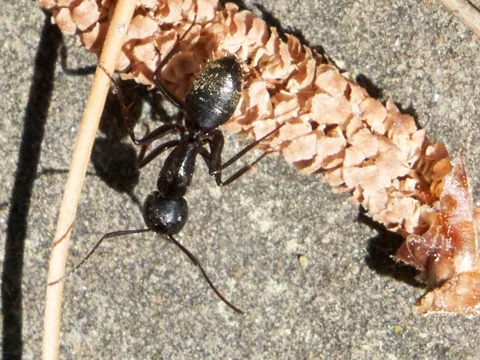 Carpenter Ants
Camponotus species
Carpenter ants don't eat wood the way termites do; they excavate it to nest, usually starting where wood is damp or decayed, and indoor nests are often satellites of a parent colony outdoors. Minnesota and Clemson extension both stress that they don't eat wood; they tunnel into it to make a nest.
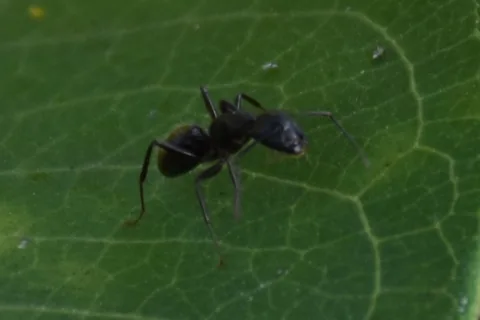 Black carpenter ant
Camponotus pennsylvanicus
The black carpenter ant is a common home invader in the northeastern United States and the most common carpenter ant in Ohio and Nebraska. Its large black workers come indoors looking for food, and colonies can set up satellite nests in moist or rotting wood and foam insulation inside the house.
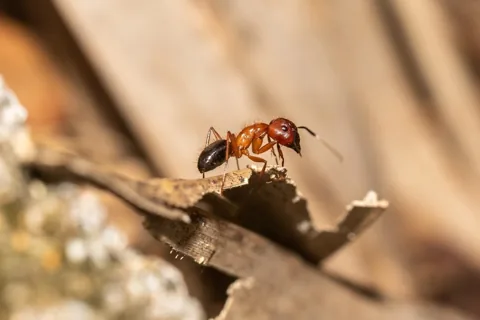 Florida Carpenter Ant
Camponotus floridanus
The Florida carpenter ant, called the bull ant in Florida for its strong bite, is a large two-toned carpenter ant of the Southeast and one of the more common ants found foraging and nesting in and around homes.
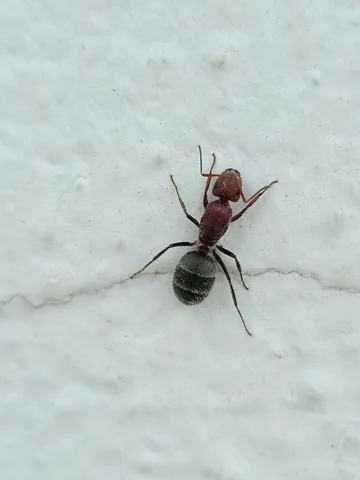 Compact Carpenter Ant
Camponotus planatus
The compact carpenter ant is a small tropical carpenter ant that forages by day on exterior walls, trees, shrubs and sidewalks, so people notice it more than night-active carpenter ants. It mainly nests in trees but is becoming more of a structural pest in Florida.
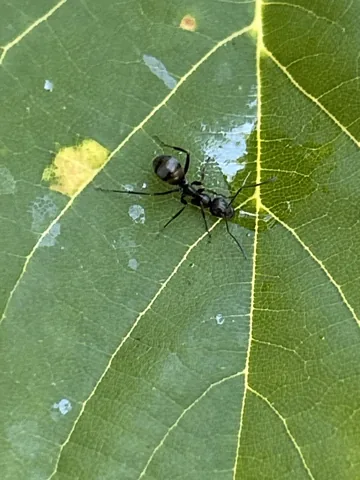 Field Ants
Formica species (e.g., F. subsericea, F. integra, F. exsectoides)
Field ants are medium to large ants in the genus Formica, among the most common ants in yards. They nest in soil, and in Wisconsin their mounds can reach three to four feet wide, spoiling lawns and making mowing difficult.
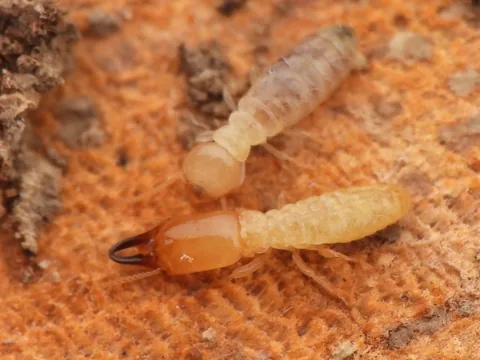 Eastern Subterranean Termite
Reticulitermes spp. (shown: R. flavipes)
Subterranean termites live in the soil and travel into buildings through earthen shelter tubes; they are the most destructive termites in most of the United States and usually warrant a professional.
First, make sure they're carpenter ants
The ID details are on our ant identification guide and the carpenter ant profiles, so here are only the checks that change the treatment plan. Carpenter ants have one node at the waist and a smooth, evenly rounded back seen from the side. Large black ants with a dented back that build soil mounds are field ants, and Ohio State warns that mistaking those for carpenter ants leads to the wrong control plan.[3][2][4]
- Size alone isn't proof. Workers in one colony come in several sizes, so small and large workers can both be carpenter ants.[3][4][2]
- Winged ants in spring may be carpenter ants or termites. Ants have elbowed antennae, a pinched waist and hind wings shorter than the front wings; termites have straight antennae, a broad waist and wings of equal length. Our swarmer comparison page goes through it.[2][5][1]
- Debris tells them apart too. Carpenter ant sawdust is fibrous, while drywood termites leave hard pellets, and subterranean termite tunnels are packed with soil where carpenter ant galleries are clean.[1][3][5]
Is the nest inside your house?
Seeing carpenter ants indoors does not by itself mean the house is infested. University of Nebraska notes the house may simply be within foraging range of a colony outside. The season and the kind of ants you see are the best clues.[4][2][5]
- Winter: University of Minnesota says carpenter ants seen indoors in winter mean there is a nest inside. They become active when heat from the house or the sun warms the nest, and then wander toward sinks, tubs, dishwashers and damp towels looking for water.[2][3]
- Late winter and early spring: ants inside at this time are coming from a nest in the building. Later in the year it's harder to say where they come from.[2][4]
- Lots of winged ants inside: a sure sign of an indoor nest, according to University of Minnesota. Penn State adds that many winged ants at the windows probably came from a nest in the house.[2][5]
- One or two winged or wingless queens: not proof of an indoor nest. These are usually newly mated queens that wandered in looking for a place to start a colony.[2]
- Steady numbers: University of Minnesota counts regular indoor sightings of 20 or more workers as a sign of a nest.[2]
- Ants brought in with firewood can't start a nest or cause damage on their own.[2]
- A quiet winter proves little. A nest in an unheated spot, such as a north-facing outer wall, can stay dormant until spring.[2]
Parent nests and satellite nests
Most established colonies are split up. The parent nest holds the queen, the eggs and the youngest larvae. Satellite nests hold workers, older larvae and pupae, but never eggs or a queen. Workers travel between them and can move the brood around, and one parent nest may feed several satellites in different places in and around the house.[3][4][2][1]
- Where each one tends to be: the parent nest needs steady moisture, so it is often outdoors in a tree, stump, log or buried wood. Satellites are most often indoors and can sit in fairly dry places such as insulation, hollow doors, curtain rods and wall voids, because they don't hold eggs that would dry out.[4][2][3]
- Ohio State ties the parent nest to wood above 15 percent moisture and says satellites prefer drier, warmer spots that speed up larval and pupal development.[3]
- The parent nest can still be inside. University of Minnesota lists parent nests in moist or decayed wood in homes, behind bathroom tiles, around tubs and showers, under roofing and under subfloor insulation.[2]
- How far apart: Penn State says the parent colony is often within 100 yards of the house. Sources differ on how far workers roam: Ohio State says up to 100 feet from the nest, University of Minnesota up to 100 yards, and University of Nebraska several hundred feet.[5][3][2][4]
- Why it matters: Penn State says that if both the parent and the satellite nests aren't destroyed, the ants reappear within days or weeks, and Ohio State says the queen has to be killed to end the colony.[5][3]
- Expect more than one. Ohio State notes more than one colony may be on the property, and University of Minnesota says finding one nest doesn't rule out others.[3][2]
How to track down the nests
Ohio State calls finding the parent and satellite nests the most important and often the hardest part of carpenter ant control. It takes patience at night, because foragers leave the nest soon after sunset and follow set trails between the nest and food.[3][6][4]
- Go out between sunset and midnight in spring and summer, the window University of Minnesota gives. Cover the flashlight with red film, which the ants can't see, or shade the lens with your hand.[2]
- Give them something to carry. Ants hauling food are easier to follow. University of Minnesota suggests small pieces of tuna packed in water in spring, when they favor protein; honey and other sweets also draw them. Clemson suggests honey. Set it close to where you've seen activity.[2][6]
- Ohio State's satellite trick: drop a dead, soft-bodied insect near a forager and follow the ant that picks it up. It is taking food to larvae, which live in a satellite nest. Repeat on other sides of the house, since there may be more than one satellite.[3]
- Read the sawdust. Carpenter ants push shavings out of the nest, and a cone-shaped pile often builds up under the opening. Ohio State compares the shavings to pencil-sharpener shavings; they often contain dead ants, insect parts and seed husks. Inside a wall void you won't see any.[3][4][6]
- Listen. An active colony can make a dry rustling sound, which Ohio State likens to crinkling cellophane and which gets louder if the nest is disturbed. Tap the suspect area and press an ear to it; Penn State says an inverted water glass or a stethoscope helps.[3][2][5]
- Follow trails outdoors too. Foragers travel over branches and vines touching the roof, utility wires, fences and firewood piles, and their trails often cross the lawn. Ohio State says plants carrying aphids or scale insects are a good place to watch.[3][4]
- Check the usual wet spots: around windows and doors, skylights, chimneys, gutters, roof eaves, decks and porches, hollow porch posts, window boxes and crawl spaces, and anywhere plumbing or vents pass through a wall.[3][4][2][5]
- Write it down. Notes on when, where and how many ants you've seen, past leaks and any swarmers or sawdust help a professional find nests faster, University of Minnesota and Ohio State say.[2][3]
Moisture-damaged wood and how much damage to expect
Carpenter ants don't eat wood; they excavate it. Galleries usually start in wood softened by leaks or decay, and Texas A&M calls moisture the most important factor in drawing carpenter ants into buildings and keeping them there. Fixing the water problem is part of the treatment, not an extra.[1][7][3]
- Penn State says carpenter ants usually won't infest sound wood below 15 percent moisture. Moisture meters find wet areas hidden behind surfaces; University of Nebraska suggests homeowners hire a home inspector or pest professional who owns one and knows how to use it.[5][4][2]
- Repairs that matter: leaking roofs, chimney flashing and plumbing; blocked gutters and downspouts; poorly ventilated attics and crawl spaces; condensation on pipes; and leaks around tubs, showers and appliances.[3][5][1]
- Replace rotted, water-damaged or previously infested wood with sound, dry lumber, and end wood-to-soil contact. Penn State also suggests a plastic moisture barrier over crawl-space soil and pressure-treated wood where wood must touch soil.[7][4][5][3]
- Paint or seal exposed wood before it gets wet. Poorly kept log homes can have serious carpenter ant problems, University of Nebraska notes.[4][5]
- Damage, sources differ. UC IPM says large colonies can spread from rotted wood into sound wood and weaken the structure. Penn State says expansion into timbers rarely causes structural damage and that tunneling through sound wood to reach a void has little effect. University of Minnesota says damage builds slowly, often over years, and can weaken wood when severe.[1][5][2]
- Judging old damage: carpenter ant galleries are clean and smooth, as if sanded, and run with and across the grain. Our termite damage guide covers telling them from termite workings.[2][3]
Treating a nest in a wall, door or timber
Once a nest is pinned down, it can be removed or treated directly. Ohio State says nests can be taken out physically, for instance with a vacuum, or treated with insecticide. Texas A&M says indoor treatments should be applied only into cracks, crevices and holes, never broadcast through rooms. The how-to for dust products in general, including safety, is on our insecticide dust guide; what follows is specific to carpenter ant galleries.[3][7][2]
- Use dust, not water, inside walls. University of Nebraska says liquid concentrates and water-based ready-to-use sprays should not go into wall voids, where water can damage insulation, drywall or wiring. Use a dust labeled for wall voids or for use in homes.[4]
- Get the dust into the nest. Use a hand duster with a tip that fits snugly into the entrance hole; the hole may need to be enlarged, or one or more access holes drilled.[4][6]
- Where to drill: Ohio State suggests holes about three to six feet on either side of where ants are going in, and in infested timbers a row of holes 12 inches apart to hit the galleries. Plug each hole with a dowel, small cork or sealant and touch up the paint.[3]
- Drilling yourself, sources differ. University of Minnesota says drilling small holes, about 1/8 inch, and dusting the nest is a job for a professional, and to not do it yourself. University of Nebraska and Clemson describe drilling and dusting as something a homeowner can do.[2][4][6]
- No duster? University of Nebraska describes using a squeeze bottle with a narrow tip, filled no more than one-third full and squeezed in pulses. Label it, return leftover dust to the original container, and throw the bottle away afterward so it is never used for food.[4]
- Which dusts: Penn State lists diatomaceous earth, silica aerogel and boric acid as low-toxicity choices for blowing into nests; UC IPM lists disodium octaborate tetrahydrate and desiccant dusts. University of Nebraska says non-repellent dusts may work better because ants walk through them and carry them deeper into the colony.[5][1][4]
- Check the label for carpenter ants. One retail diatomaceous earth label's indoor ant directions exclude carpenter ants, even though extension sheets list diatomaceous earth for nests. Use a product whose label covers carpenter ants and the site you're treating. UC IPM says silica gel dusts are for licensed applicators only.[8][1][2]
- Don't breathe desiccant dusts; UC IPM says they can seriously irritate the lungs. Keep dust where people and pets won't contact it.[1][4]
- Nest exposed during remodeling or reroofing? University of Minnesota says a ready-to-use liquid or aerosol on the exposed colony works, and that the ants start relocating as soon as the nest is opened, so have a labeled product ready before work starts.[2]
- Ohio State notes an aerosol into the nest can work where there's a lot of insulation, since vapors spread through the galleries, and that areas next to the nest should be treated with a residual product.[3]
Baits vs dusts: pick one approach per spot
Baits suit nests you can't reach or find, because workers carry the slow-acting bait back to the colony. Ohio State calls baiting a stand-alone strategy that shouldn't be used where sprays or dusts have been applied, and University of Minnesota says never to put insecticide on or around baits, since it stops feeding. Bait basics for all ants are on our ant treatment guide.[3][2][1]
- How well baits work, sources differ. University of Nebraska says that because carpenter ants eat such a varied diet, baits usually aren't successful. Penn State says ants frequently ignore them, Clemson that baits sometimes work very well and sometimes don't, and University of Minnesota and Ohio State that baits can control colonies with good placement and follow-up.[4][5][6][2][3]
- Active ingredients in ant baits, per University of Minnesota: avermectin, borax, fipronil and spinosad, in liquid or gel form.[2]
- Place baits on or right beside active trails and entry points, not scattered around the house. Indoors, Ohio State says to use child-resistant bait stations.[3][6][2]
- Check after 24 hours. Clean up and replace a bait that's being ignored, refill one that's being eaten, and expect weeks or months to control the colony.[2]
- Seasonal tastes, sources differ. Clemson says carpenter ants favor protein in spring and sweets in winter, and Ohio State cites a Virginia study where black carpenter ants collected the most protein in June and September, when older larvae are in the nest. In a 2024 study of western carpenter ants, field colonies kept choosing amino acids over sugar from late May to mid-September with no lasting shift, and baits that combined sugar and amino acids were taken consistently.[6][3][11]
- If ants ignore everything, try different bait types side by side and let them choose, as UC IPM suggests, making sure ants are listed on each label.[1]
Outdoor nests, trees and perimeter treatments
Indoor satellites are often fed by a parent colony outdoors, and Nebraska says outdoor colonies should be treated as the source of satellites that could move into walls in warm months. Look in trees, stumps, roots, fence posts, landscape timbers and firewood.[4][2][5]
- Remove the wood when you can. University of Minnesota suggests taking out the piece of wood holding the parent colony and calling a professional when that isn't possible. Clemson says nests in soil can be removed or drenched with a water-based insecticide.[2][6]
- How far to clear stumps and logs, sources differ: Ohio State says dead stumps within about 50 feet of the house, if practical; Penn State says stumps, logs and waste wood within 100 yards.[3][5]
- Trees: carpenter ants nest in rotted wood or heartwood that is already weak, and University of Minnesota says they don't harm the tree and control isn't needed for the tree's sake, only when ants from it are getting into the house. University of Nebraska suggests a labeled dust puffed into the cavity.[2][4]
- Firewood: University of Nebraska says store only one heating season's worth, off the soil on a concrete pad and away from the house, and don't spray firewood with insecticide.[4][5]
- Cut off the bridges: trim branches off the roof and walls and away from electrical lines, seal where utilities enter, and keep mulch near the foundation to 2 to 3 inches.[2][1][6][3]
- Perimeter sprays can help keep foragers out when the nest can't be found, Clemson says. Ohio State describes a band 2 feet up the foundation and 3 feet out, plus under siding edges and around windows, doors and chimney flashing, reapplied every four to six weeks in summer or within a week of heavy rain.[6][3]
- Perimeter timing, sources differ. University of Nebraska says regularly scheduled sprays aren't needed for carpenter ants and that termite-style soil injection around the foundation is unnecessary. Penn State says one non-repellent perimeter treatment from a professional is usually enough.[4][5]
- Research on perimeter products: in a Purdue study around apartment buildings, a fipronil band left 2 percent of pretreatment ant numbers after 8 weeks; imidacloprid and cyfluthrin worked as well for 4 and 2 weeks. Carpenter ants were one of several species present, not the only target.[10]
- Why non-repellents reach the nest: a Purdue field study showed fipronil passed from treated black carpenter ant workers to untreated ones in lab tests, killing them and then a further round of ants, and moved through field colonies when treated foragers were released back to their nests. UC IPM says fipronil perimeter sprays are very effective on carpenter ants but can be applied only by licensed applicators.[9][1]
What doesn't work
Most failed carpenter ant jobs come from treating ants instead of nests.[4][3][2]
- Spraying foragers: few ants carry insecticide back, most foragers never touch the spray, and only a small share of the colony is out at once. UC IPM puts it at about 10 percent.[2][1][4]
- Fast-knockdown sprays on trails kill the ants on the trail but likely do nothing to the colony, Ohio State says.[3]
- Dusting every exterior wall void instead of finding the colony. University of Nebraska says taking time to locate it is less disruptive, uses less insecticide and costs less.[4]
- Treating at random. University of Minnesota says to pin the nest down as precisely as possible and treat only nests that have actually been found.[2]
- Mixing baits with sprays or dusts in the same area, which keeps ants from feeding on the bait.[3][2]
Which carpenter ant you have, by region
Texas A&M counts 25 Camponotus species in the United States, most of them minor pests that only occasionally infest buildings. A few cause most of the trouble, and their colonies differ enough to matter.[7][1]
- East and Midwest: the black carpenter ant, from the Atlantic coast to the Rocky Mountains. Colonies have one queen. Ohio State puts a mature colony at about 2,000 to 4,000 ants and swarmers at 3.5 to 4 years; Penn State says swarmers appear at about 2,000 to 3,000 workers; Nebraska and Clemson say 6 to 10 years and more than 2,000 workers; Texas A&M says a colony may reach 15,000 workers. Swarms run roughly March to July.[7][3][5][4][6]
- Nebraska also has a smaller reddish-orange and black species, Camponotus sayi, with no official common name; people there have reported its swarms during warm spells in winter.[4]
- West of the Rockies: UC IPM names Camponotus modoc, the western black carpenter ant (black with dark red legs), and Camponotus vicinus (usually red and black) as the most destructive western species. Texas A&M says C. modoc colonies may hold up to 50,000 workers and C. vicinus up to 100,000 with multiple queens; UC IPM says a C. vicinus nest can have as many as 40 queens. C. modoc swarms in the late afternoon, often after heavy rain.[1][7]
- In lab tests, C. vicinus queens survived longer than C. modoc queens at every humidity tested and started colonies with less dependence on moisture, which the researchers read as better adaptation to dry conditions.[12]
- A small yellow-and-black species, Camponotus clarithorax, is also common in California, at a little over 1/8 inch to just under 5/16 inch.[1]
- Southeast: the Florida carpenter ant, which Texas A&M calls one of the most serious structural pests in Florida and the far Southeast, with colonies up to 8,000. Clemson says carpenter ants can be a serious structural pest across the Southeast, though they are usually more of a problem in the Northwest and Northeast.[7][6]
- Ohio State notes that its life-cycle details are for the black carpenter ant and don't necessarily apply to other species. The species profiles below have more on each.[3]
When to call a professional
University of Minnesota says carpenter ant control is usually best left to an experienced pest management professional, and Penn State doubts a satellite colony can be wiped out without at least one professional-use product. Clemson calls the job very difficult for an untrained person.[2][5][6]
- Call when the nest is hidden in walls, ceilings, subfloors or hollow doors and you can't place it, when there are satellite nests indoors, or when ants are coming from a tree or stump you can't remove.[2][5]
- What a professional brings: moisture meters and stethoscopes to locate nests, drills for void treatments, flushing aerosols that drive ants out of hidden nests, and non-repellent liquids such as imidacloprid, chlorfenapyr and fipronil that University of Nebraska says are meant for professional use only.[4][2][3]
- Getting quotes: Clemson suggests asking two or three companies and choosing one that guarantees results rather than the lowest bid. Our guide to finding a pest control company covers license checks and red flags.[6]
- Ask how they'll find the nests. University of Nebraska says treating the colony itself is less disruptive and uses less insecticide than routine perimeter or soil treatments, so a plan built on an inspection is a good sign.[4]
- Some companies also seal holes and gaps to help keep ants out, University of Minnesota notes.[2]
How long it takes and how to tell it worked
Missed nests bring ants back within days or weeks, Penn State says. University of Nebraska advises monitoring after treating the colony rather than scheduling repeat sprays.[5][4]
- Baits are slower: University of Minnesota says weeks or months.[2]
- Keep checking the old trails and nest sites at night. New sawdust, rustling or workers on the old trails mean a nest is still active.[3][2][5]
- Watch for swarmers next spring; winged ants inside again point to a nest that's still there.[2][5]
- Colonies grow slowly. Texas A&M says a new colony has only about 10 to 15 workers in its first year, and Clemson says the earlier a carpenter ant problem is handled, the less insecticide it takes.[7][6]
Common questions
- I found one winged ant in the house. Are carpenter ants nesting inside?
- Not necessarily. University of Minnesota says one or a few winged or wingless queens usually wandered in after mating. Many winged ants indoors, ants inside in winter, or regular sightings of 20 or more workers are better signs of an indoor nest.[2][5]
- Do carpenter ants eat wood?
- No. They chew out galleries to nest in and push the shavings outside. They eat insects, honeydew from aphids and scale insects, and sweets, meats and grease indoors.[1][3][2]
- Will carpenter ants kill my tree?
- No. University of Minnesota and University of Nebraska say they nest in wood that is already rotting or weak and don't kill living trees. Treat them only if they are coming into the house from the tree.[2][4]
- Can I use diatomaceous earth or boric acid on carpenter ants?
- Penn State and UC IPM list desiccant dusts and boric acid or borate dusts for blowing into nests. Labels vary, though: one diatomaceous earth label excludes carpenter ants from its indoor ant uses, so check that the label covers carpenter ants and the site. Dust only works when it reaches the nest.[5][1][8]
- Why do I see carpenter ants in the house during the day?
- They forage mostly at night, but University of Nebraska says daytime activity is not unusual, and University of Minnesota notes ants from an indoor nest may walk around on bright, sunny days.[4][2]
- Do carpenter ants bite?
- Yes. They don't sting, but they can give a painful bite and spray formic acid into it.[1][3][7]
Photo credits
- Carpenter Ants: (c) Linda Watson, some rights reserved (CC BY) — via iNaturalist, CC BY 4.0
- Black carpenter ant: (c) Zac Peterson, some rights reserved (CC BY) — via iNaturalist, CC BY 4.0
- Florida Carpenter Ant: (c) Richard Stovall, some rights reserved (CC BY) — via iNaturalist, CC BY 4.0
- Compact Carpenter Ant: (c) Rodolfo Salinas Villarreal, some rights reserved (CC BY) — via iNaturalist, CC BY 4.0
- Field Ants: Milwaukee County Parks - Natural Areas Program, public domain (CC0), via iNaturalist
- Eastern Subterranean Termite: (c) Sam Kieschnick, some rights reserved (CC BY) — via iNaturalist, CC BY 4.0
Sources
- University of California Statewide IPM Program, “Pest Notes: Carpenter Ants (UC ANR Publication 7416).” ipm.ucanr.edu/home-and-landscape/carpenter-ants/ (accessed 2026-11-10)
- University of Minnesota Extension, “Carpenter ants (Hahn and Kells; reviewed 2024).” extension.umn.edu/insects-infest-homes/carpenter-ants (accessed 2026-11-10)
- Ohio State University Extension (Ohioline), “Carpenter Ants, HYG-2063 (Jones, 2017).” ohioline.osu.edu/factsheet/hyg-2063 (accessed 2026-11-10)
- University of Nebraska-Lincoln Extension, “Carpenter Ant Management, NebGuide G1738.” extensionpubs.unl.edu/publication/g1738/na/html/view (accessed 2026-11-10)
- Penn State Extension, “Carpenter Ants (Jacobs).” extension.psu.edu/carpenter-ants (accessed 2026-11-10)
- Clemson Cooperative Extension, Home & Garden Information Center, “Carpenter Ants (HGIC factsheet).” hgic.clemson.edu/factsheet/carpenter-ants/ (accessed 2026-11-10)
- Texas A&M Urban and Structural Entomology Program, “Carpenter Ants, Camponotus sp..” urbanentomology.tamu.edu/urban-pests/ants/carpenter/ (accessed 2026-11-10)
- U.S. EPA Pesticide Product Label System, “Diatomaceous earth dust label, EPA Reg. No. 3-18 (EPA-stamped, Apr. 28, 2021).” www3.epa.gov/pesticides/chem_search/ppls/000003-00018-20210428.pdf (accessed 2026-11-10)
- Pest Management Science (PubMed 30663198), “Buczkowski G. Trap-treat-release: horizontal transfer of fipronil in field colonies of black carpenter ants, Camponotus pennsylvanicus. Pest Manag Sci 2019;75(8):2195-2201.” pubmed.ncbi.nlm.nih.gov/30663198/ (accessed 2026-11-10)
- Journal of Economic Entomology (PubMed 15154488), “Scharf ME, Ratliff CR, Bennett GW. Impacts of residual insecticide barriers on perimeter-invading ants. J Econ Entomol 2004;97(2):601-5.” pubmed.ncbi.nlm.nih.gov/15154488/ (accessed 2026-11-10)
- Scientific Reports (PubMed 38459134), “Renyard A et al. Effects of macro- and micro-nutrients on momentary and season-long feeding responses by select species of ants. Sci Rep 2024;14:5727.” pubmed.ncbi.nlm.nih.gov/38459134/ (accessed 2026-11-10)
- Journal of Economic Entomology (PubMed 21735888), “Mankowski ME, Morrell JJ. Role of relative humidity in colony founding and queen survivorship in two carpenter ant species. J Econ Entomol 2011;104(3):740-4.” pubmed.ncbi.nlm.nih.gov/21735888/ (accessed 2026-11-10)