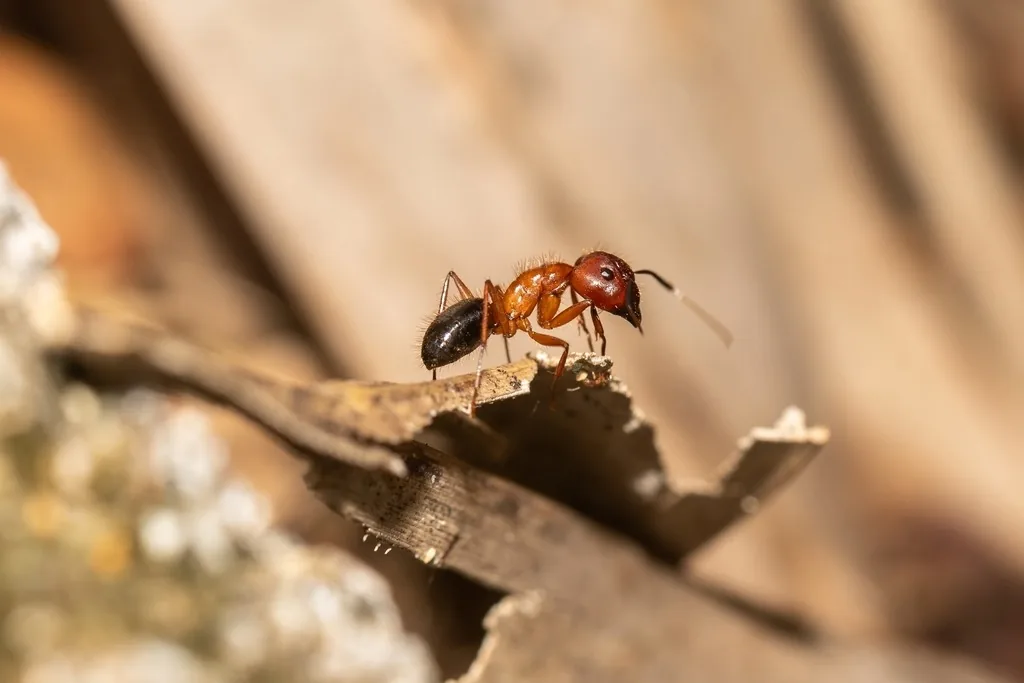
How to identify it
- The head and thorax are ash brown to rusty orange and the abdomen is black, with abundant long golden hairs.[1]
- Workers range from about 0.2 to 0.4 inch long, while winged queens reach about 3/4 inch.[1]
- The waist has a single node and the top of the thorax is an even, smooth curve, a key carpenter ant feature.[1]
- There is no stinger, but workers bite and can spray formic acid.[1]
Look-alikes
| Look-alike | How to tell them apart |
|---|---|
| Black carpenter ant | The black carpenter ant of Florida's panhandle can damage wood, while Florida carpenter ants use existing voids or soft, rotten wood.[1] |
| Termite swarmers | Termite alates have straight, beaded antennae, four wings of equal size and a broad waist; winged ants have elbowed antennae, larger front wings and a pinched waist.[1] |
Where it lives
Widespread throughout Florida and in some neighboring states. A close relative, the Tortugas carpenter ant, lives only in central and southern Florida.[1]
Biology and life cycle
A single mated queen starts a colony, which can grow to several thousand workers and begins producing winged reproductives at two to five years old.[1]
Winged reproductives fly in the evening or at night; complaints peak in the spring swarm season, usually April to June, when they gather at window ledges and sliding doors.[1]
Workers forage mostly at night, peaking from just before sunset to two hours after, and again around dawn.[1]
They feed on sweets, flower nectar, honeydew from aphids, scales and mealybugs, and live or dead insects.[1]
Satellite nests without a queen often sit 20 to 100 feet from the main nest.[1]
Damage and signs
- Unlike wood-damaging carpenter ants, Florida carpenter ants don't tunnel in sound wood; they hollow out wood already softened by moisture or decay, or Styrofoam.[1]
- Indoor nests turn up in wall voids, under attic insulation near the eaves, around leaky windows, doors and skylights, under dishwashers and bathtubs, and in electrical boxes.[1]
- Outdoors they nest in old termite galleries, rotting stumps, palm leaf bases, mulch, landscape timbers and voids in concrete or decorations.[1]
Health risk
They can't sting, but workers bite and spray formic acid when disturbed.[1]
Control
Keep them out
Trim branches and shrubs touching the house, block ant routes along wires and cables, and caulk and weather-strip exterior openings.[1]
Sanitation
Fix leaks and moisture problems, and control aphids and other honeydew producers on nearby plants to cut the ants' food.[1]
Traps and physical control
Find the nest by following foragers at night; a few drops of sugar water or honey along a trail can draw more ants to follow back.[1]
Pesticides
A small amount of insecticidal dust or spray placed directly in the nest usually works; heavy treatment next to the nest can make the colony move.[1]
If the nest can't be found or reached, place a carpenter ant bait along trails, though these finicky feeders don't always take baits well.[1]
Common questions
- Do Florida carpenter ants damage houses?
- Rarely. They move into existing voids or wood that is already soft from rot or moisture, so finding them may point to a leak that needs fixing.[1]
- Do bull ants sting?
- No. Florida carpenter ants have no stinger, but they can bite and spray formic acid.[1]
- Why do I see them at night?
- They are mainly night foragers, most active from just before sunset to two hours after, and again near dawn.[1]
Sources
- University of Florida, IFAS Extension (EDIS), “Florida Carpenter Ant, Bull Ant, Tortugas Carpenter Ant, Camponotus floridanus and Camponotus tortuganus (Featured Creatures, publication IN455).” ask.ifas.ufl.edu/publication/IN455 (accessed 2026-10-06)
- iNaturalist, “Camponotus floridanus taxon page (order and family).” www.inaturalist.org/taxa/81709 (accessed 2026-10-06)