On this page
How to identify it
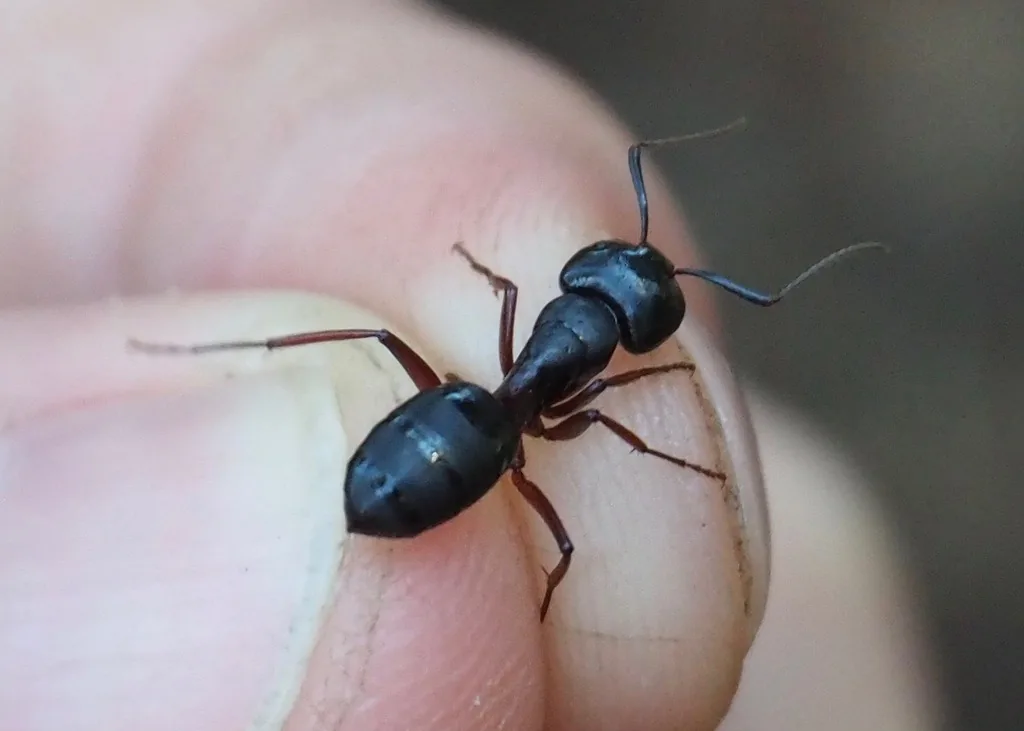
- Workers are uniformly black with dark red legs and range from 1/4 to 1/2 inch long, among the largest ants in North America.[1]
- Seen from the side, the back (thorax) is evenly rounded, and the narrow waist has a single bump (one node on the petiole).[1]
- Winged queens and males appear on spring mating flights. This species swarms in the late afternoon, often after a heavy rain.[1]
- Debris pushed out of the nest is fibrous sawdust, unlike the six-sided pellets left by drywood termites.[1]
Look-alikes
| Look-alike | How to tell them apart |
|---|---|
| Black carpenter ant | The common eastern species. It is dull black all over, legs and antennae included, and ranges from the Atlantic coast to the Rocky Mountains.[5] |
| Camponotus vicinus | The other highly destructive western carpenter ant. Its workers are the same size, but its color varies and it is usually red and black rather than black with red legs.[1] |
| Termite swarmers | Winged carpenter ants are often mistaken for termites. The two differ in their antennae, waists and wings, and carpenter ant sawdust is fibrous rather than the six-sided pellets of drywood termites.[1] |
Where it lives
UC IPM names it as one of the two most destructive carpenter ants in the western United States and notes that it is found in California. Carpenter ants there are especially common in forested foothill and mountain communities, and researchers studying the species collected colonies from conifer forests.[1][2]
Biology and life cycle
A newly mated queen finds a spot such as a dead tree or stump, digs a chamber, seals herself in and starts laying eggs. Growth is slow at first, and it takes several years before a colony matures and sends out its own winged swarmers.[1]
In lab tests the number of colonies western black carpenter ant queens started varied significantly with moisture, and its queens died sooner at every humidity tested than queens of Camponotus vicinus, a species the authors judged better suited to dry conditions.[4]
Workers feed on dead and living insects, nectar, fruit juices and honeydew. In feeding tests western carpenter ants sought out the honeydew of Cinara splendens aphids, chose food by sugar type and strength, and favored sucrose.[1][3]
Foragers lay scent trails from the hindgut to lead nestmates to food; the main trail compound has been identified as 2,4-dimethyl-5-hexanolide.[2]
The main parent nest, with the queen, is usually outdoors in a live or dead tree, woodpile or landscaping. Nests indoors are typically satellites of that parent nest, and a colony can have several of them. Nests can contain several thousand ants.[1]
Workers are most active after sunset, and only about 10 percent of a colony is out foraging at any one time.[1]
Damage and signs
- Carpenter ants excavate wood rather than eat it. Galleries often begin in wood damaged by water or decay and can spread into sound wood, weakening the structure.[1]
- They also nest in wall voids, hollow doors and insulation. Even new buildings can be invaded when land clearing nearby disturbs established colonies.[1]
- Signs include piles of fibrous sawdust, their droppings (frass) and a faint rustling inside walls, floors or woodwork.[1]
Health risk
Carpenter ants can't sting, but they can give a painful bite with their strong jaws and spray formic acid into the wound, which burns.[1]
Control
Prevention
Fix the moisture and decay that draw them in: replace damaged wood, clear clogged gutters, repair leaky pipes, ventilate damp attics and crawl spaces, and remove any earth-to-wood contact.[1]
Keep them out
Trim branches and shrubs back from the house, seal openings such as where utility lines enter, keep mulch along the foundation to 2 to 3 inches, and store firewood off the ground and several feet from the building.[1]
Sanitation
Store food in tightly sealed containers, and control aphids and other honeydew producers near the house, since carpenter ants have a sweet tooth.[1]
Traps and physical control
Find the nests before treating. After sunset, set out sugar milk (equal parts sugar and milk) or diced crickets or mealworms and follow the workers home.[1]
Pesticides
Once a nest is found, insecticide can go directly into it, sometimes through drilled holes. UC IPM lists pyrethroid sprays such as permethrin or cyfluthrin and dusts with disodium octaborate tetrahydrate or desiccants such as diatomaceous earth or silica gel. Baits should be slow-acting so foragers carry them back to the colony. Follow the label.[1]
When to call a professional
Perimeter sprays of fipronil are very effective on carpenter ants, but only licensed applicators can apply them.[1]
Common questions
- Are the big black ants with red legs in my California cabin carpenter ants?
- They may well be. The western black carpenter ant is uniformly black with dark red legs, 1/4 to 1/2 inch long, and carpenter ants are especially common in forested foothill and mountain communities.[1]
- Why did winged ants appear after a rainstorm?
- This species makes its mating flights in the late afternoon, often after a heavy rainfall.[1]
- Do western carpenter ants eat my house?
- No. They don't eat wood, but they excavate it for nest galleries, often starting in water-damaged or decayed wood and spreading into sound wood.[1]
Sources
- University of California Statewide IPM Program, “Pest Notes: Carpenter Ants (UC ANR Publication 7416).” ipm.ucanr.edu/home-and-landscape/carpenter-ants/ (accessed 2026-11-10)
- Journal of Chemical Ecology, “Renyard, Alamsetti, Gries, Munoz and Gries (Simon Fraser University). Identification of the trail pheromone of the carpenter ant Camponotus modoc. Journal of Chemical Ecology 45 (2019) 901-913, PMID 31773376.” pubmed.ncbi.nlm.nih.gov/31773376/ (accessed 2026-11-10)
- Royal Society Open Science, “Renyard, Gries, Lee, Chalissery, Damin, Britton and Gries. All sugars ain't sweet: selection of particular mono-, di- and trisaccharides by western carpenter ants and European fire ants. Royal Society Open Science 8 (2021) 210804, PMID 34430049.” pubmed.ncbi.nlm.nih.gov/34430049/ (accessed 2026-11-10)
- Journal of Economic Entomology (Entomological Society of America), “Mankowski and Morrell. Role of relative humidity in colony founding and queen survivorship in two carpenter ant species. Journal of Economic Entomology 104 (2011) 740-744, PMID 21735888.” pubmed.ncbi.nlm.nih.gov/21735888/ (accessed 2026-11-10)
- Texas A&M Urban and Structural Entomology Program, “Carpenter Ants, Camponotus sp..” urbanentomology.tamu.edu/urban-pests/ants/carpenter/ (accessed 2026-11-10)
- iNaturalist, “Camponotus modoc taxon page (order and family).” www.inaturalist.org/taxa/68954 (accessed 2026-11-10)