On this page
How to identify it
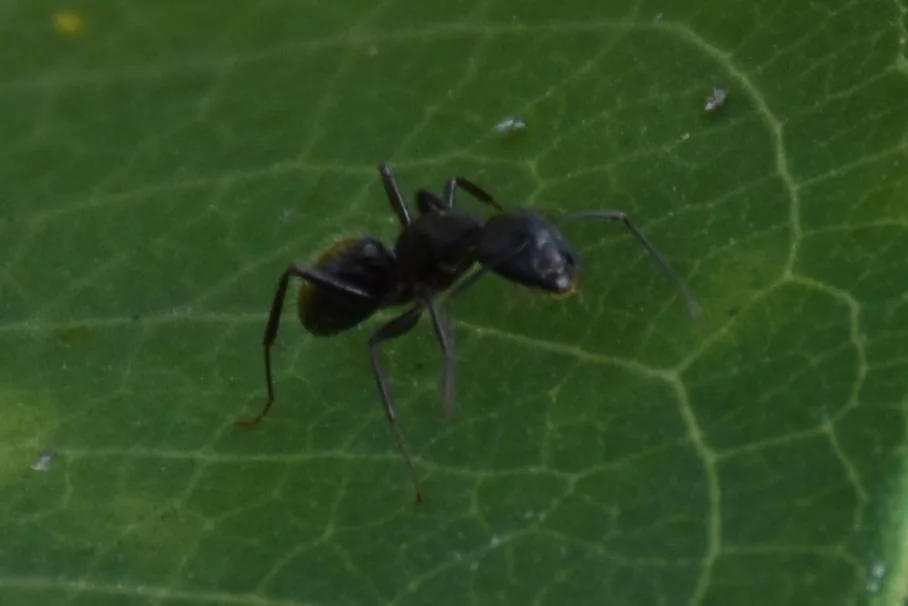
- Workers are black, with very fine whitish or yellowish hairs on the abdomen.[2]
- Workers come in several sizes. Small workers are about 1/4 inch long and the largest are about 1/2 inch, and Nebraska measurements run up to 5/8 inch. Small workers are not young ants; they just do different jobs in the colony.[2][3]
- Penn State describes workers as dark, shiny brown to black and 1/4 to 1/2 inch long, and Kentucky gives 3/8 to 1/2 inch for carpenter ants in general.[1][5]
- Seen from the side, the thorax is one smooth, evenly rounded arch, and there is a single node in the waist between thorax and abdomen.[2][3][5]
- Winged queens and males look like workers but can reach 3/4 inch, and the front wings are longer than the hind wings. Males are much smaller than females.[1][3][5]
Look-alikes
| Look-alike | How to tell them apart |
|---|---|
| Field ants (Formica) | Also large and black, but they build mounds in soil and the thorax has a distinct dip in profile. Management differs, so check before treating.[2] |
| Red carpenter ant (Camponotus sayi) | A smaller carpenter ant, 1/8 to 3/8 inch, with a reddish-orange head and thorax and a black abdomen.[3] |
| Subterranean termites | Termite workers are creamy white, hide in their tunnels, have straight beaded antennae and no pinched waist, and winged termites have front and hind wings of equal length.[1] |
Where it lives
A common home invader in the northeastern United States, and the most common carpenter ant in Ohio and in Nebraska.[1][2][3]
Biology and life cycle
Winged males and queens swarm from mature colonies, usually between March and July; in Nebraska swarms are most often seen March through June. After mating the male dies and the queen starts a colony in a small cavity in moist, decayed wood.[2][3]
Kentucky gives a narrower mating period for carpenter ants, late May to early June, and says the new queen seals herself into a small cavity in soil or wood.[5]
A new queen lays 15 to 20 eggs and raises the first workers on her own body reserves. Going from egg to worker takes at least about 60 days.[1][5]
The queen lays eggs in early spring and again in late summer. Spring eggs produce workers and winged forms in August and September, while late-summer eggs produce only workers the next June and July.[2]
Sources differ on when a colony starts swarming. Ohio State says a black carpenter ant colony is usually 3.5 to 4 years old and holds about 2,000 to 4,000 ants by then; Penn State says several years old with about 2,000 to 3,000 workers; Nebraska says 6 to 10 years old with more than 2,000 workers.[2][1][3]
Penn State says about 200 to 400 winged ants develop in summer, stay in the nest through the winter and leave the next spring or early summer.[1]
The parent nest, with the queen, eggs and small larvae, sits in damp, decayed wood with more than 15 percent moisture. Satellite nests in drier, warmer spots hold workers, larger larvae and pupae, but never eggs.[2][3]
Workers forage mostly at night, following set trails up to 100 feet from the nest. They eat insects, honeydew from aphids and scale insects, sweets, meats and grease, and do not eat wood. In a Virginia study their protein collecting peaked in June and September, when older larvae were in the nest.[2][3]
Estimates of how far workers roam vary: Ohio State says up to 100 feet, Nebraska says several hundred feet, and Minnesota says sometimes up to 100 yards.[2][3][6]
Ants are inactive in winter unless the nest is in a heated part of the building.[1][2][6]
Minnesota says carpenter ants seen indoors in winter, or in late winter and early spring, point to a nest inside the building. A nest in a cold spot, such as a north-facing outside wall, can stay dormant and unnoticed until spring.[6]
Damage and signs
- Workers hollow out moist, rotting wood and soft materials such as foam insulation board for nests; they seldom tunnel into dry, sound wood. Damage to structural timbers is rare.[1]
- Sources weigh the risk differently. Penn State says expansion into structural timbers rarely causes structural damage, Kentucky says the damage can be significant given enough time, and Nebraska calls carpenter ants a serious problem in poorly maintained log homes.[1][5][3]
- Nebraska says the parts of a house most often infested are around and under windows, roof eaves, decks and porches, because those areas take on the most moisture.[3]
- Signs of a nest are piles of coarse wood shavings, like pencil-sharpener shavings, mixed with dead insect parts, below cracks or small openings. The galleries are smooth and clean, with no soil in them, unlike termite work.[1][2][3]
- An active nest can make a dry rustling sound in a wall, like crinkling cellophane.[2]
Health risk
Workers bite readily if handled and can inject formic acid into the wound, which makes the bite painful, but they do not sting. Kentucky says they bite only when the nest is disturbed or when someone picks one up.[2][5]
Control
Prevention
Fix leaking roofs, flashing, plumbing and blocked gutters, and replace rotted or water-damaged wood; the parent nest needs moisture to survive.[2][1][5]
Trim branches so they don't touch the house, keep firewood off the ground and away from the building, remove nearby stumps and logs, and seal openings where pipes and wires enter.[1][2][3]
Sanitation
Penn State says to remove stumps, logs and waste wood within 100 yards of the building; Ohio State suggests removing dead stumps within about 50 feet of the house where practical.[1][2]
Traps and physical control
Find the nests. In summer, check the basement, attic, garage and outside walls with a flashlight late at night and follow workers back. A worker carrying a dead insect is usually heading to a satellite nest with larvae.[1][2]
Penn State suggests looking from May through July between about 10 p.m. and 2 a.m. Kentucky suggests setting out drops of honey or jelly and following the ants home; in spring, Minnesota says they go especially for protein such as tuna packed in water (not in oil).[1][5][6]
Many winged ants at windows inside the house usually mean a nest indoors. Seeing workers inside may only mean the house is within reach of an outdoor colony.[1][3]
Pesticides
Spraying where ants walk kills foragers but not the queen or brood inside the nest. Dusts such as diatomaceous earth, silica aerogel or boric acid can be blown into a nest cavity once it is found.[2][1]
Don't spray a fast knockdown insecticide on trails, Ohio State says; it kills the ants on the trail and likely has no effect on the colony.[2]
Baits work only if ants carry them home: put them on or near active trails, use childproof stations indoors, and don't combine baiting with sprays or dusts.[2]
Sources disagree on how well baits work. Ohio State says baits can control carpenter ants, Penn State says the ants frequently ignore them, and Nebraska says baits usually fail because the ants' diet is so varied. Minnesota says baiting can take weeks or months and that ignored bait should be cleaned up and replaced with a different one.[2][1][3][6]
When to call a professional
Satellite colonies inside walls are hard to eliminate without materials used by pest management professionals.[1]
Minnesota advises leaving it to a professional to drill small holes and dust a nest hidden in a wall, ceiling or hollow door, and Kentucky says drilling may be best left to professionals because it can damage the structure.[6][5]
Common questions
- I see big black ants in my kitchen. Is the nest in my house?
- Not necessarily. The nest may be outside, with workers coming in for food and water. Many winged ants at windows indoors point to an indoor nest.[1][3][6]
- Do black carpenter ants eat wood?
- No. They hollow out wood for nest space and carry the shavings outside the nest; their food is insects, honeydew and kitchen sweets, meats and fats.[3][1]
- Can a black carpenter ant bite?
- Yes. Workers bite readily when handled, and the bite can be painful because they can inject formic acid. They do not sting.[2][5]
- Why do I see carpenter ants inside in winter?
- Usually because the nest is inside, in a spot warmed by indoor heat or sun. Penn State, Ohio State and Minnesota all say the ants stay inactive through winter unless the nest is in a heated part of the building.[1][2][6]
Sources
- Penn State Extension, “Carpenter Ants.” extension.psu.edu/carpenter-ants (accessed 2026-11-11)
- Ohio State University Extension, “Carpenter Ants (HYG-2063).” ohioline.osu.edu/factsheet/hyg-2063 (accessed 2026-11-11)
- University of Nebraska-Lincoln Extension, “Carpenter Ant Management (NebGuide G1738).” extensionpubs.unl.edu/publication/g1738/na/html/view (accessed 2026-11-11)
- iNaturalist, “Camponotus pennsylvanicus taxon page (order and family).” www.inaturalist.org/taxa/129902 (accessed 2026-11-11)
- University of Kentucky Entomology, “Carpenter Ants (ENTFACT-603), by Allison Lopina and Zach DeVries.” entomology.ca.uky.edu/ef603 (accessed 2026-11-11)
- University of Minnesota Extension, “Carpenter ants (Hahn and Kells; reviewed 2024).” extension.umn.edu/insects-infest-homes/carpenter-ants (accessed 2026-11-11)