❓ Common Questions About Argentine Ant
How do I confirm I actually have this pest (not something similar)?
The most reliable confirmation is a physical specimen — capture one and compare to reference images on this page. For cryptic pests (bed bugs, termites), look for secondary signs: frass, shed skins, mud tubes, or bites with a specific pattern. When uncertain, a professional inspection is faster than months of misidentification.
Can I treat this myself or do I need a professional?
DIY is effective for small, accessible infestations caught early. Professionals are worth the cost when: the infestation is inside wall voids or structural elements, multiple rooms are affected, you have health-risk pests (hantavirus, venomous species), or DIY has already failed twice.
How long until the infestation is completely gone?
Expect 3–8 weeks for most infestations with proper treatment. Insects with dormant life stages (pupae, eggs) extend the timeline because those stages are impervious to most insecticides. Follow-up treatments at 2 and 4 weeks catch each new cohort as they emerge.
What's the most common mistake people make treating this pest?
Treating only the visible pest population while ignoring the harborage site, entry point, or breeding location. Killing adults provides temporary relief but the population rebuilds from hidden egg cases, pupae, or new arrivals through unaddressed entry points.
Identifying common household ants and matching the bait
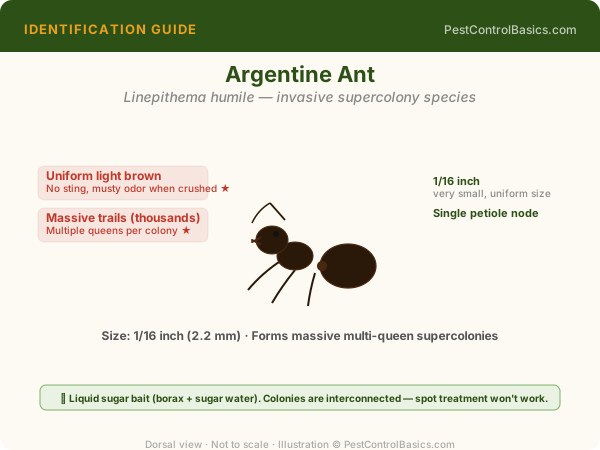
Different ant species prefer different baits, and identifying the species before purchasing bait prevents wasted product. Argentine ants (light brown, even-sized, no scent when crushed) prefer sweet baits but will take protein in summer. Odorous house ants (very small, dark brown, distinct rotten coconut smell when crushed) prefer sweets. Carpenter ants (large, often black, may have wings) prefer protein but will take sweet — and signal a structural issue, not just a foraging issue. Pharaoh ants (tiny, yellowish, indoor-only, often in multiple satellite colonies) require protein baits and respond poorly to sprays which cause severe budding. Pavement ants (small, dark, foraging from sidewalk cracks) take both. Most state extension offices will identify ant species from a photo, and the right identification routinely makes the difference between resolution in days and ongoing frustration for months.
How environmental conditions affect treatment efficacy
Pesticide efficacy is highly sensitive to the conditions at application and immediately after. Temperature affects both vapor pressure (volatility) and residual binding — products applied above ~90°F often volatilize before binding to surfaces, while applications below ~50°F can fail to spread properly. Surface porosity changes residual duration: a residual that lasts eight weeks on a sealed concrete slab might last three weeks on bare wood. Rainfall within four hours of an outdoor application typically washes off most surface deposits, though microencapsulated products are more rain-fast. UV exposure degrades many pyrethroids within days to weeks on sunny surfaces, which is why fence-line applications often fail mid-summer. Indoor humidity affects bait acceptance — dry baits perform worse in high humidity as they absorb moisture and lose palatability. Reading conditions correctly explains many otherwise mysterious treatment failures.
Bait placement specifics that improve uptake
Where bait is placed matters as much as which bait. Place bait directly on trails when possible — workers find it faster than placements at points without active traffic. Use multiple small placements rather than fewer large ones; ants share food via trophallaxis, so distributed availability collapses the colony faster than concentrated availability. Replace fresh bait every few days during heavy uptake — ants ignore dried-out or contaminated bait, and continuous fresh availability accelerates colony collapse. Don't combine repellent sprays in the same area as the bait, and don't clean trails with surface cleaners during the treatment window (the trail pheromone helps recruit workers to the bait). If uptake is low after several days, switch bait type — colonies sometimes shift feeding preference seasonally.
Ant prevention: closing entry points and reducing trail attractants
After a colony is eliminated, recurrence depends largely on whether the conditions that attracted the original colony persist. Specific exclusion targets: caulk around plumbing penetrations through walls, weatherstrip the bottom of exterior doors, seal cracks in the foundation seam between sill plate and slab, and ensure window screens are intact. Trail attractants — leaks under sinks, pet food bowls left out, sticky residues behind appliances, fruit left on counters — should be eliminated as part of the same cleanup. Outdoor changes that reduce pressure: keep mulch and groundcover six inches from the foundation, avoid stacking firewood against the structure, and trim vegetation so branches don't touch siding or roof (ants use vegetation as bridges to enter at the roofline). These are one-time fixes with multi-year benefits.
How resistance develops and how to slow it down
Pesticide resistance is now common enough across major pest categories — cockroaches, bedbugs, mosquitoes, certain ant species, some flies — that treatment recommendations have shifted to account for it. Resistance develops through repeated exposure to a single active ingredient class; the surviving population reproduces, and over generations the population shifts toward resistance. Slowing resistance development requires rotating active ingredient classes (not just brands), using full label rates rather than reduced rates, and avoiding routine prophylactic spraying when it isn't needed. The EPA mode-of-action (MoA) classification on product labels helps with rotation: alternating between products in different MoA classes is more effective than alternating brand names within the same class. For homeowners, the practical translation is: don't use the same product month after month; if you're spraying regularly, rotate among at least two unrelated chemistries; and don't spray when monitoring suggests no active population.
Why different ant species need different baits
The category 'ant bait' covers products with very different active ingredients and matrices, and matching the right bait to the species is critical. Sugar-loving species — common pavement ants, odorous house ants, Argentine ants — respond to liquid sugar baits like borax-based sugar bait. Protein-feeding species and species with seasonal preferences shift toward protein require oil- or protein-based bait matrices. Carpenter ants are technically protein/sugar-feeding but respond best to specific protein-rich baits like indoxacarb-based products. Pharaoh ants are notoriously difficult and respond only to specific bait formulations (typically methoprene-based growth regulator baits or hydramethylnon at low concentrations); standard ant sprays will cause Pharaoh ant colonies to bud and multiply, making the problem dramatically worse. Identifying the species — typically possible from a clear photograph — and selecting the right bait matrix multiplies effectiveness compared to using a single 'all ants' product. Many DIY ant treatments fail not because the homeowner used a bad product but because the right product was used against the wrong species.
The role of caulk, sealant, and exclusion in long-term pest control
Sealing entry points is the most underrated pest control activity in residential settings, partly because it produces no immediate visible result and partly because it feels like home repair rather than pest control. The yield is substantial: a thoroughly sealed structure with appropriate exterior caulking, intact weatherstripping, sealed utility penetrations, and screen integrity has dramatically lower pest pressure than the same structure without those interventions. Specific high-yield targets include gaps around dryer vents, electrical and plumbing penetrations through exterior walls, gaps where siding meets foundation, mortar joints in older brick, weep holes in newer brick (which should be screened, not sealed), garage door bottom seals (where rodents commonly enter), and the gap above door thresholds where many ants and small insects pass. Materials matter: silicone-based caulk for moisture areas, polyurethane sealant for foundation cracks, copper mesh for rodent exclusion at utility penetrations (steel wool degrades), and 1/4-inch hardware cloth for larger openings. A weekend of methodical sealing in spring or fall — when activity is moderate and weather permits exterior work — produces lasting reduction that no single treatment matches.
Outdoor ant management: protecting the indoor perimeter
Many indoor ant problems originate from outdoor colonies that find access points into the structure, which means the most effective long-term ant management often happens outdoors. Reducing landscape conditions that support colonies near the foundation is the first step: pulling mulch back six to twelve inches from the foundation, trimming shrubs and tree branches that touch the structure (eliminating direct access bridges), removing leaf litter and debris from the foundation area, and addressing any wood debris (firewood, scrap lumber) stored against the structure. Granular baits applied to the perimeter address foraging colonies, while perimeter sprays (where appropriate) create a brief barrier during peak pressure periods. The granular and liquid approaches work together: granular baits target the colony, liquid perimeter sprays kill foraging individuals that would otherwise cross. For chronic problems, identifying and treating actual colony locations (typically following workers back to their entry points, then tracing further) is more efficient than blind perimeter treatment.
Ant colony dynamics and the limits of trail-level treatment
An ant trail is the visible surface of a colony that may include tens of thousands of individuals, multiple satellite nests, and reproductive structures distributed across an area much larger than the trail suggests. Treating the trail without affecting the colony produces predictable failure: the foragers you killed are replaced from a much larger reservoir, and the colony's reproductive capacity is unaffected. This is the structural reason that bait — which is carried back to the colony and shared through trophallaxis — outperforms contact insecticide for most household ant problems. The bait reaches the queens and the brood; the spray reaches only the workers currently outside the nest. Understanding this also explains why partial bait treatment often fails: if the bait is consumed only on one trail while the rest of the colony continues foraging on untreated trails, the toxic load on the queen may not reach lethal levels. Effective bait programs identify all active trails, treat them simultaneously, and continue baiting for long enough that the entire colony cycles through the affected food source.
Pesticide residual life and reapplication intervals
The residual life of a pesticide is one of the most misunderstood properties in household pest management. Active ingredients vary widely in how long they remain bioavailable on a treated surface, and the same active can behave very differently depending on substrate, exposure to sunlight and rain, temperature, and the formulation it's carried in. A pyrethroid applied to a porous masonry surface in full sun will degrade in days; the same active in a microencapsulated formulation on a protected interior surface may remain effective for months. Understanding this is the difference between an evidence-based treatment schedule and one driven by superstition. Reapplying too soon wastes product and increases selection pressure for resistant individuals; reapplying too late creates gaps in coverage during which pest populations rebound. The right answer depends on specific conditions and is not the same number printed on the bottle in all circumstances. Field experience and willingness to monitor for early signs of pest return are what calibrate the schedule. The label is a guide, but conditions in front of you are the real input.
Pavement ants: structural vulnerability rather than household pest
Pavement ants get their name from their habit of nesting under and adjacent to concrete slabs, walkways, and driveways, and they're a common but often overlooked driver of indoor ant activity in homes with slab-on-grade construction or attached garages. The nest itself is usually outside, but foraging trails enter the structure through expansion joints, utility penetrations, and gaps in slab perimeters. Treating the indoor foraging trails without addressing the outdoor nest produces only short-term relief. Effective control combines bait stations placed along the indoor trails with outdoor perimeter treatment focused on the slab-adjacent soil and exclusion work that closes the entry points. The structural component is what distinguishes pavement ant control from other indoor ant work — without sealing the entry routes, the next colony to discover the same openings will produce the same problem within months, regardless of how well the previous colony was eliminated. Homeowners who address pavement ants without the exclusion piece often see the same activity pattern return year after year, and conclude that the ants are unbeatable; in fact the colony is being eliminated each cycle, but the route is being reopened to the next colony in line.