The short answer
- Ants: hang the feeder below a water-filled ant moat, or buy a feeder with one built in. Virginia's Department of Wildlife Resources says feeders with a water-filled moat can reduce ant problems, and Georgia DNR says most ants turn back at the water's edge.[5][3]
- Bees and wasps: use bee guards or a feeder that keeps the nectar out of their reach. Hummingbirds reach through the guard with their long bills; Iowa State says insect mouthparts are generally too short. Iowa State also says guards help with bees only to some extent and that wasps are harder to discourage.[1][3][4]
- Fix leaks and skip yellow. Illinois Extension advises feeders with no yellow parts, because yellow attracts bees and wasps, and checking that feeders don't leak.[8][10]
- Move the feeder every other day or so. Missouri's Department of Conservation says hummingbirds find the new spot faster than bees do.[4]
- Don't spray pesticides on or near the feeder. Virginia's wildlife agency says not to use pesticides near bird feeders, and Illinois Extension says pesticides and insecticides can harm these tiny birds.[5][8]
Insects at hummingbird feeders
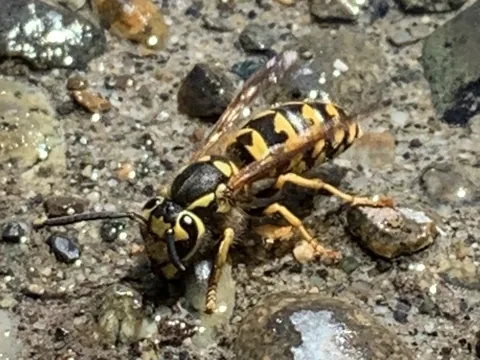 Western Yellowjacket
Vespula pensylvanica
Yellowjackets are social wasps that nest mostly in the ground and in wall voids, defend their nests vigorously, and become persistent scavengers at picnics and garbage cans in late summer and fall.
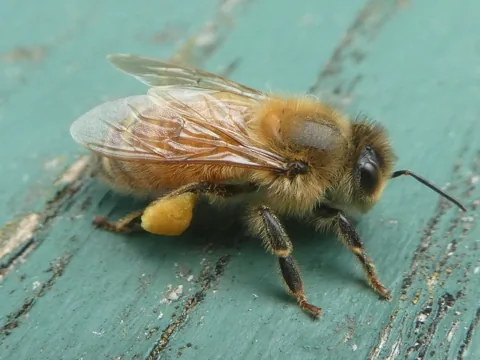 Western Honey Bee
Apis mellifera
Honey bees are important pollinators, but a colony that moves into a wall void or attic can become a stinging hazard. A swarm is temporary and usually best left alone, while an established colony in a building should be removed along with its comb.
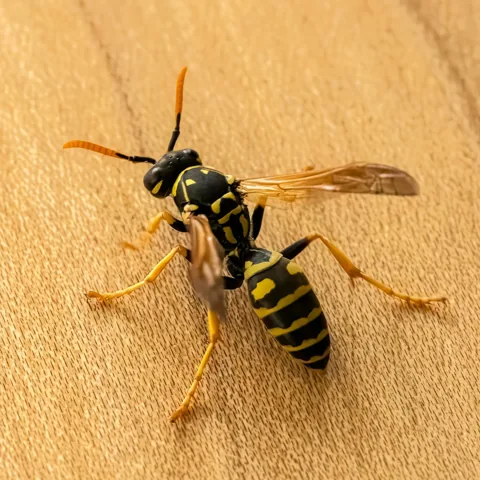 European Paper Wasp
Polistes dominula
Paper wasps hang open, umbrella-shaped paper nests under eaves and in sheltered spots; they are much less defensive than yellowjackets and rarely sting unless a nest is disturbed.
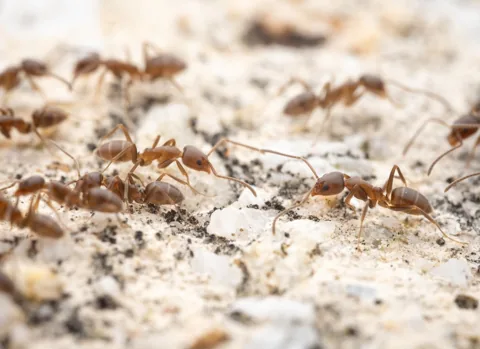 Argentine Ant
Linepithema humile
The Argentine ant is the most common ant in and around homes in California; its nests are linked into huge multi-queen supercolonies. It is native to Argentina and Brazil. Texas A&M says it was discovered in New Orleans in 1891, is now established in many places in the southern United States, and has been found in Arizona, California, Illinois, Maryland, Missouri, Oregon, Texas and Washington.
Which insects show up, and when
Iowa State University Extension names wasps such as yellowjackets, bees and ants as the common nuisance insects at hummingbird feeders. Georgia DNR lists ants, yellowjackets, honey bees and wasps, and says their numbers build through the summer along with the hummingbirds'.[1][3]
Yellowjackets get worse late in the season. UC IPM explains that by late summer yellowjacket and paper wasp colonies need large amounts of sugar to keep the queen and workers going, so foraging wasps are particularly interested in sweet things then. Georgia DNR says yellowjackets at feeders in late summer are a real stinging risk for both birds and people.[13][3]
Honey bees come too, though UC IPM says they usually aren't attracted to food, may go to sweets, and are unlikely to sting unless trapped or stepped on. If you're not sure what you're looking at, the stinging insects guide covers how to tell bees, yellowjackets and paper wasps apart.[13]
Ants that find a feeder usually arrive in a trail. UC IPM says long trails of ants may run from the nest to a food source, and Clemson says Argentine ants, one of the trailing species, prefer sweets and may travel 200 feet or more from the nest to food.[11][12]
Do the insects actually hurt hummingbirds?
Sources differ on how much it matters. Iowa State says these scavenging insects may have little impact on hummingbirds, mainly spoiling the view, and that tolerating them may be the most practical answer. It notes that hummingbirds and wasps occasionally argue over feeder ports but that the birds usually find an open one.[1]
Others put more weight on it. The U.S. Fish and Wildlife Service lists bees, ants and other insects among the things that can pose a threat to hummingbirds at feeders, along with cats and spoiled nectar. Illinois Extension says some wasps can chase birds away, and that wasps that get inside a feeder may not get out and make the nectar spoil faster.[6][9]
Ants cause a mess either way. Iowa State says ants often climb inside and drown, which means more frequent cleaning and replacing the sugar water.[1]
Ant moats: the main fix for ants
An ant moat is a small cup that hangs between the hook and the feeder, with a wire running through its center. Filled with water, it puts a barrier across the route ants climb to the feeder. Georgia DNR calls it an improvement over the old method of greasing the pole. Some newer feeders have a moat built into the top, and Illinois Extension and the U.S. Fish and Wildlife Service both suggest choosing a feeder with an ant moat.[3][8][6]
To make one, Texas Parks and Wildlife suggests an old plastic prescription bottle or the upturned cap of a shaving foam can. Poke a hole in the bottom, thread the hanging wire up through it so the cup opens upward, and seal the hole around the wire with hot glue. Georgia DNR describes the same design with a stiff wire bent into a hook above and below the cup, and stresses sealing the spot where the wire passes through.[2][3]
What to put in it: Georgia DNR fills its moat with water. Texas Parks and Wildlife suggests an inch of water or vegetable oil, oil because it doesn't evaporate as fast. [3][2]
Keep it from becoming a mosquito source. Georgia DNR suggests emptying the water every few days so mosquito larvae can't develop in it. See the guide to stopping mosquitoes breeding around your home for other standing water.[3]
Top it up. Georgia DNR says moat water disappears over time, partly to evaporation and partly because birds drink it.[3]
Other ant barriers: poles, lines and grease
Grease on the pole: Georgia DNR says ants typically avoid crossing sticky grease, so smearing it on a shepherd's hook or pole works, but it is messy and works best on metal; on wood some greases soak in and need reapplying. Iowa State says a metal pole can be coated with sticky trap-coating products, which also discourage chipmunks, squirrels and raccoons, and that cooking oil has to be reapplied often.[3][1]
Fishing line: Iowa State suggests hanging the feeder from a short length of monofilament fishing line and coating just the line with vegetable oil.[1]
A grease-filled cap: Georgia DNR describes a mini-moat made from a soft drink bottle cap on a stiff wire, filled with petroleum jelly or grease, hung above the feeder with the filled side up.[3]
Keep these products on the hanger, line or pole, above the feeder, rather than on the feeder where birds perch and feed. Every barrier above is placed on the route ants climb, not at the feeding ports.[1][3][2]
Bees and wasps: guards and feeder design
Bee guards are small perforated plastic caps that fit over or into each feeding port like a grate. Iowa State says hummingbirds reach their slender bills through the holes to the nectar while insect mouthparts are generally too short. Georgia DNR says the same about bees' short tongues. Virginia's wildlife agency says bee guards can reduce a feeder's attractiveness to bees and other stinging insects.[1][3][5]
Guards aren't a complete fix. Iowa State says they help keep bees away to some extent, but wasps are not so easily discouraged and may keep trying to feed.[1]
Low-nectar or saucer feeders: Missouri's Department of Conservation says some feeders are bee-proof because the nectar sits low enough in the feeder that bees can't reach it, while hummingbirds can with their long bills.[4]
Avoid yellow. Illinois Extension advises feeders with no yellow parts, and in another post says not to have yellow flowers around the feeding holes, since some studies show bees are attracted to yellow. Iowa State says bee guards come in red or yellow; red ones fit this advice better.[8][10][1]
Stop the drips. Illinois Extension says to make sure feeders don't leak. Texas Parks and Wildlife says bees and wasps have a harder time finding a feeder whose outside and feeding ports were rinsed before it was hung.[10][2]
Look for a feeder that comes apart for cleaning and has bee and ant guards, Illinois Extension says, so you're feeding the birds instead of the bugs. Penn State suggests one that holds only as much as the birds will drink in three to four days, since nectar left longer goes bad.[9][7]
Where to hang the feeder, and moving it
Move it. Missouri's Department of Conservation suggests changing the feeder's location every other day or so, because the birds relocate it faster than bees do. Penn State says that once hummingbirds are using a feeder it can be moved gradually to almost any spot, and the birds will find it.[4][7]
Spread out. Penn State suggests adding a second feeder away from the first when birds fight over one, and Illinois Extension recommends several feeders over one large one. Iowa State notes that when wasps hold a port, hummingbirds usually find another one without wasps.[7][8][1]
Think about cats too. Penn State says to hang feeders in open areas, high enough to be out of a cat's reach, and the U.S. Fish and Wildlife Service gives the same advice.[7][6]
Nectar strength and cleaning
The standard mix is one part sugar to four parts water, according to Penn State, Illinois Extension and Virginia's wildlife agency. Illinois Extension says not to make it sweeter, because that attracts more bees, and Virginia's agency says more sugar is not better.[7][10][5]
Weaker nectar is where sources part ways. Missouri's Department of Conservation suggests trying a 1-5 ratio of sugar to water instead of 1-4 to make the feeder less appealing to bees. Penn State says weaker solutions are less attractive to hummingbirds. If you try a weaker mix, watch whether the birds keep coming.[4][7]
Clean often. Virginia's agency says to replace the sugar water and clean hummingbird feeders every 2-5 days depending on temperature, more often in warm weather; Illinois Extension says every few days, or more often above 80 degrees F.[5][9]
Yellowjacket traps near feeders
In late summer some people add a trap. Illinois Extension describes putting out a yellowjacket trap around Labor Day to keep wasps away from hummingbird feeders, and Georgia DNR says a trap will reduce the number of stinging insects around feeders.[10][3]
Georgia DNR's homemade version: cut four 1-inch holes, evenly spaced, about halfway up a two-liter plastic soft drink bottle, pour in nectar to a depth of about two inches, add a few drops of liquid soap, and hang it near the feeders. The wasps go in and drown.[3]
Don't trap when honey bees are the visitors. Georgia DNR says not to use a trap if honey bees are gathering at the feeders, since the last thing you want is to kill them. Use guards, a low-nectar feeder and moving the feeder for bees instead.[3]
For trap types, where to hang them relative to where people sit, and what to do when there's a nest nearby, see the yellowjacket traps guide.[13]
What not to put on or near a feeder
Insecticide sprays. Virginia's Department of Wildlife Resources says not to use pesticides or herbicides near bird feeders. Penn State says hummingbirds eat insects as well as nectar, that pesticides reduce that food, and that birds may also be susceptible to the chemicals themselves. Illinois Extension says to keep your lawn and flowers chemical free because pesticides and insecticides can harm these tiny birds.[5][7][8]
Insecticide ant guards. Georgia DNR describes hanging devices that are plastic shells holding disks impregnated with an insecticide such as permethrin, sold to repel ants. It reports that the manufacturers say the chemicals don't threaten birds or other wildlife, and that the devices kept ants off its writer's feeders for the short time he used them. That claim comes from the makers; Virginia's agency's advice is to keep pesticides away from feeders, and a water moat does the same job without one.[3][5]
Oil or grease at the ports. Georgia DNR suggests wiping vegetable oil with a cotton swab on the feeder surface next to the ports, since bees avoid greasy surfaces, and says not to spray oil on the perches. Iowa State and Texas Parks and Wildlife keep oil off the feeder, on the hanging line or in the moat. Keeping oil and grease above the feeder, away from where birds perch and feed, follows the more cautious advice.[3][1][2]
Harsh cleaners. The U.S. Fish and Wildlife Service says cleaning products can leave harmful residue in feeders and recommends plain water or a weak vinegar solution. Virginia's agency, by contrast, soaks hummingbird feeders in dish soap and hot water, then rinses thoroughly and lets them dry. Whichever you use, rinse well before refilling.[6][5]
When the ants are a bigger problem
A moat stops ants at the feeder, not at the colony. If the same trail is also getting into the house, UC IPM says to wipe up trails with soapy water to remove the scent trail and to use baits outdoors near trails and nest openings, since sprays give only temporary control. See the guide to getting rid of ants in the house.[11]
Argentine ants are small (workers about 1/16″ long, light to dark brown, per Clemson). For them, Clemson says baiting is the preferred treatment indoors, and UC IPM says liquid borate baits in refillable stations are best for severe Argentine ant infestations. Follow the bait label; the Argentine ant guide covers them in detail.[12][11]
Common questions
- Should I put water or oil in an ant moat?
- Georgia DNR uses water and suggests emptying it every few days so mosquitoes can't breed in it; it also notes birds drink from the moat. Texas Parks and Wildlife says water or vegetable oil both work and that oil evaporates more slowly.[3][2]
- Why do bees and wasps get worse in late summer?
- Missouri's Department of Conservation says bees and wasps visit feeders most in late summer, fall and early spring, when natural nectar is limited. UC IPM adds that yellowjacket colonies need large amounts of sugar by late summer.[4][13]
- Can I spray the wasps at my hummingbird feeder?
- Wildlife agencies advise against pesticides near bird feeders (Virginia DWR), and Penn State says birds may be susceptible to the chemicals. Use bee guards, a low-nectar feeder, moving the feeder or, for yellowjackets only, a trap. If there's a nest nearby, see the guide on yellowjacket nests.[5][7][3]
- Do bee guards keep wasps out?
- Only partly. Iowa State says bee guards help keep bees away to some extent, but wasps are not so easily discouraged and may persist.[1]
- Will making the nectar weaker keep bees away?
- Missouri's Department of Conservation suggests reducing the sugar from a 1-4 ratio to a 1-5 ratio. Penn State cautions that weaker solutions are less attractive to hummingbirds, and Illinois Extension says a sweeter mix draws more bees.[4][7][10]
Photo credits
- Western Yellowjacket: (c) eebee, some rights reserved (CC BY) — via iNaturalist, CC BY 4.0
- Western Honey Bee: (c) Doug Miller, some rights reserved (CC BY) — via iNaturalist, CC BY 4.0
- European Paper Wasp: (c) Andrew McKinlay, some rights reserved (CC BY) — via iNaturalist, CC BY 4.0
- Argentine Ant: Philipp Hoenle, public domain (CC0), via iNaturalist
Sources
- Iowa State University Extension and Outreach (Yard and Garden), “Hummingbird Feeder Insect Pests.” yardandgarden.extension.iastate.edu/encyclopedia/hummingbird-feeder-insect-pests (accessed 2026-11-10)
- Texas Parks and Wildlife Department, “Nongame Wildlife FAQ: How can I keep ants and wasps away from my hummingbird feeders?.” tpwd.texas.gov/landwater/land/habitats/faq/nongame/bird6.phtml (accessed 2026-11-10)
- Georgia Department of Natural Resources, Wildlife Resources Division, “Out My Backdoor: When Insects Pose Problems at Hummer Feeders.” georgiawildlife.com/out-my-backdoor-when-insects-pose-problems-hummer-feeders (accessed 2026-11-10)
- Missouri Department of Conservation, “Miscellany (Ask the Ombudsman: honeybees at hummingbird feeders), Missouri Conservationist, August 2010.” mdc.mo.gov/magazines/conservationist/2010-08/miscellany (accessed 2026-11-10)
- Virginia Department of Wildlife Resources, “Safe Bird Feeding.” dwr.virginia.gov/wildlife/safe-bird-feeding/ (accessed 2026-11-10)
- U.S. Fish and Wildlife Service, “Quiz: How can you help a hummingbird?.” www.fws.gov/story/quiz-how-can-you-help-hummingbird (accessed 2026-11-10)
- Penn State Extension, “Attracting Hummingbirds.” extension.psu.edu/attracting-hummingbirds (accessed 2026-11-10)
- University of Illinois Extension, “Welcoming hummingbirds to your yard.” extension.illinois.edu/blogs/ilriverhort/2025-05-02-welcoming-hummingbirds-your-yard (accessed 2026-11-10)
- University of Illinois Extension, “Hummingbirds are on the move.” extension.illinois.edu/blogs/over-garden-fence/2024-03-11-hummingbirds-are-move (accessed 2026-11-10)
- University of Illinois Extension, “Creating a Haven for Hummingbirds.” extension.illinois.edu/blogs/garden-scoop/2015-07-17-creating-haven-hummingbirds (accessed 2026-11-10)
- University of California Statewide IPM Program, “Pest Notes: Ants.” ipm.ucanr.edu/home-and-landscape/ants/ (accessed 2026-11-10)
- Clemson Cooperative Extension Home and Garden Information Center, “Argentine Ants.” hgic.clemson.edu/factsheet/argentine-ants/ (accessed 2026-11-10)
- University of California Statewide IPM Program, “Pest Notes: Yellowjackets and Other Social Wasps.” ipm.ucanr.edu/home-and-landscape/yellowjackets-and-other-social-wasps/ (accessed 2026-11-10)