The short answer
- Cut down on spilled seed first. Wildlife damage specialists list removing or changing bird feeders for chipmunks, tree squirrels, voles, opossums and raccoons, and recommend feeders that catch fallen seed before it reaches the ground.[16][11][18][19][21]
- Keep feeders away from the house. CDC says to place them away from the house and use squirrel guards; Penn State puts feeders 15 to 30 feet from buildings so spilled seed doesn't attract and support chipmunks near the house.[5][15]
- Store seed in heavy, tight-lidded containers. CDC names thick plastic or metal, and ICWDM says galvanized steel in good condition resists rats better than vinyl or plastic.[5][7]
- Tiny moths or beetles in the kitchen may have come from the bird seed. Clemson says household Indianmeal moth infestations are often traced to bird seed and dry pet food, and Georgia names bird seed as a favorite food of the sawtoothed grain beetle.[24][26]
- Clean feeders regularly, outdoors, with soapy water and then a dilute bleach soak, and wash your hands afterward. Wild birds can carry Salmonella, and CDC has linked human illnesses to contact with feeders.[1][2]
Pests covered on this page
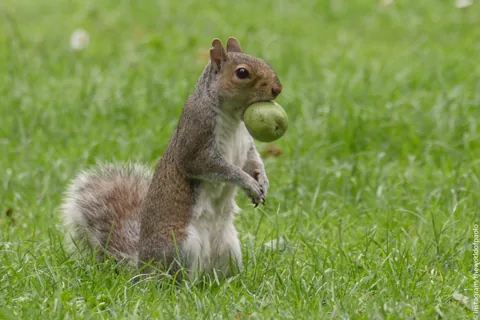 Tree squirrels (eastern gray and fox squirrels)
Sciurus species (shown: eastern gray squirrel, S. carolinensis)
Tree squirrels such as the eastern gray squirrel and fox squirrel are bushy-tailed, daytime rodents. Around homes they raid fruit, nuts and bird feeders, dig up lawns and gardens, and chew their way into attics.
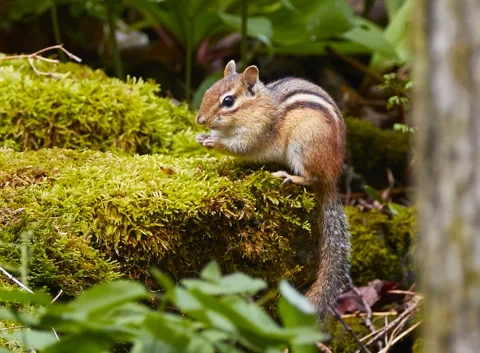 Eastern chipmunk
Tamias striatus
The eastern chipmunk is a small, striped ground squirrel that lives in woodland edges and around homes. Most problems are a nuisance, but many chipmunks burrowing near a house can undermine patios, stairs, retaining walls and foundations.
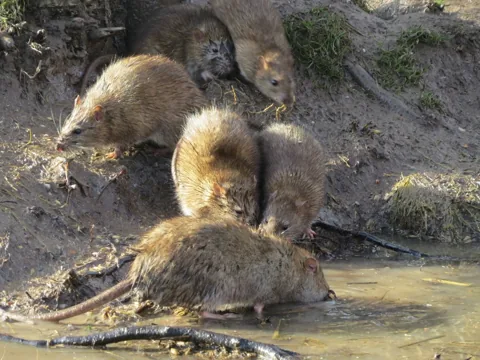 Norway Rat
Rattus norvegicus
The Norway rat, also called the brown or sewer rat, is a large, burrowing rat found throughout the contiguous United States wherever people live.
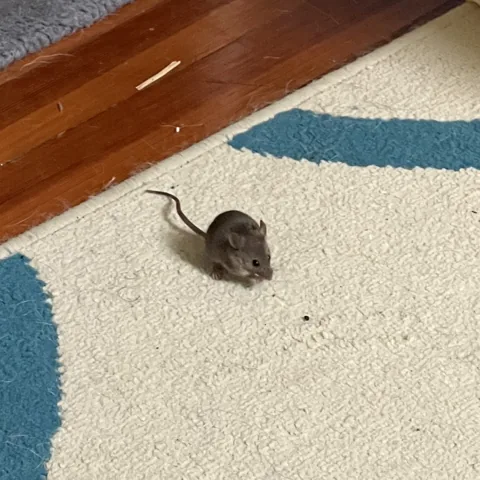 House Mouse
Mus musculus
The house mouse is a small, adaptable rodent that lives close to people in homes, schools and food businesses, eating and contaminating food, gnawing wiring and carrying disease.
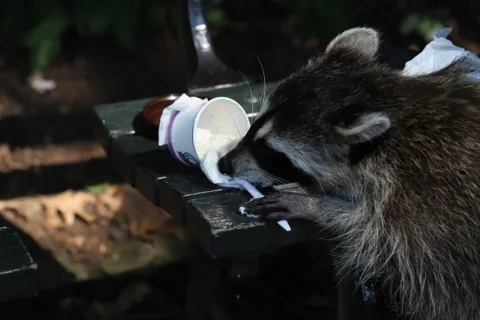 Raccoon
Procyon lotor
Raccoons are masked, ring-tailed mammals that adapt very well to towns and suburbs. They raid garbage and gardens, den in attics, chimneys and under decks, and can carry rabies and raccoon roundworm.
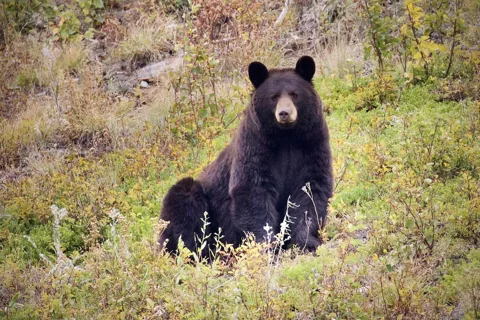 American Black Bear
Ursus americanus
The black bear is the smallest and most widespread bear in North America. Most avoid people, but bears that find garbage, birdseed or pet food around homes come back for more, causing damage and raising the risk of a close encounter.
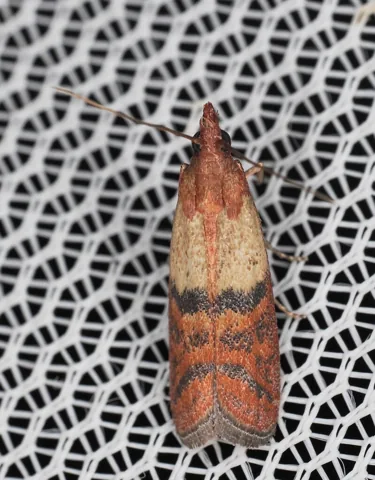 Indianmeal Moth
Plodia interpunctella
The Indianmeal moth is the most common moth infesting stored food in the home; all damage is done by the larvae, which feed in cereals, flour, nuts, dried fruit, chocolate and pet food.
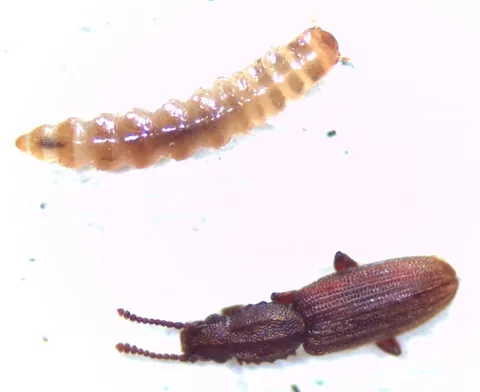 Sawtoothed Grain Beetle
Oryzaephilus surinamensis
The sawtoothed grain beetle is one of the most common beetles in home pantries; Georgia Extension rates it nearly as common as the Indianmeal moth. Both adults and larvae feed in dry foods of plant origin, and the first thing most people notice is small beetles crawling over shelves and counters.
What shows up at bird feeders
Spilled seed under a feeder, and the feeder itself, draw a range of animals. Sources name these visitors:[16][21][13]
- Tree squirrels: Penn State says they can reach almost any feeder and often damage feeders by chewing the openings larger and gnawing the perches. UC IPM calls them clever and agile enough that just about any feeder is at risk.[13][14]
- Chipmunks: ICWDM lists bird seed among the foods they take, along with bulbs, seeds and pet food that isn't in rodent-proof storage. Penn State says spilled seed can attract and support chipmunks near homes.[17][15]
- Rats and mice: CDC lists bird feeders among the things to manage outdoors to keep rodents away from the house. ICWDM says mice in garages feed on sacked or spilled pet food and grass seed.[5][10]
- Voles: ICWDM's vole advice includes removing or changing feeders to reduce spilled seed.[18]
- Raccoons and opossums: ICWDM says both eat birdseed, and UC IPM calls bird feeders a dependable food source for raccoons.[21][20][19]
- Black bears: the Pennsylvania Game Commission says bird feeders, garbage cans and grills can all draw bears into backyards, and that removing these attractants typically prevents the problem. ICWDM lists removing or securing feeders as part of bear prevention.[22][23]
Set up feeders so less seed hits the ground
ICWDM lists removing or changing bird feeders among its first steps for chipmunks, tree squirrels, opossums and raccoons. If you want to keep feeding birds, these changes reduce what lands on the ground.[16][11][19][21]
- Use feeders that catch fallen seed. ICWDM recommends them for chipmunks and raccoons.[16][21]
- Use one kind of seed per feeder. ICWDM suggests skipping mixed seed as a way to cut the amount that falls to the ground.[21]
- Put out only as much seed as birds will eat in a day, Mississippi State advises, and throw wet seed in the trash instead of dumping it on the ground.[2]
- Clean up what falls. Mississippi State and Utah State both recommend regularly removing seed from the ground under feeders.[3][4]
- Place feeders away from buildings: CDC says away from the house, and Penn State gives 15 to 30 feet from buildings for chipmunks.[5][15]
- Move them now and then. Mississippi State suggests having two feeding areas and moving feeders about once a week, even just 20 to 30 feet. It gives this mainly as a bird-disease measure.[3][2]
Keeping squirrels off feeders
Squirrels are the hardest feeder pest to stop. Virginia's wildlife agency says that with sunflower seed as the reward, squirrels will learn to get around almost any obstacle. These are the methods sources describe:[12]
- Distance plus a baffle: Virginia's wildlife agency says to place the feeder at least 15 feet from anything a squirrel can jump from and put a metal exclusion device on the post.[12]
- Pole collars: Penn State describes a 2-foot-wide metal collar 6 feet off the ground, and says these baffles can go on poles that hold feeders or birdhouses.[13]
- Wire hangers: if there isn't room for that distance, Virginia suggests hanging the feeder from a wire between two trees or posts, with sections of PVC pipe or plastic bottles threaded on the wire so they spin when a squirrel steps on them. It says this works at least for a while.[12]
- Seed choice: Virginia says squirrels tend not to like safflower seed and will avoid it at feeders.[12]
- A food decoy: Penn State and ICWDM suggest wiring or nailing an ear of corn to a tree or fence post away from the feeder.[13][11]
- What doesn't help much: UC IPM says repellents added to birdseed to stop squirrels have not been shown to work, and that squirrels get used to visual and sound scare devices within a couple of days.[14]
Rats and mice around feeders
If rats or mice are feeding under your feeder, the first fix is the seed itself: feed less, catch the spill, and keep feeders away from the house. Store seed sealed so the garage or shed isn't a second food source.[5][10][16]
Traps set near a feeder can catch birds. UC IPM says to put traps inside boxes or stations, or behind a barrier, wherever birds, pets or children might reach them, and that trapping at night can cut down on contact with birds. ICWDM notes that ordinary snap traps used outdoors sometimes take birds.[9][8]
Never use glue boards outdoors. UC IPM says wild animals can get stuck on them.[9]
If you use rodenticide bait outside, UC IPM says that in general tamper-resistant bait stations must be used where children, pets, other mammals or birds could get to it. Trap placement, bait stations and exclusion are covered in the rat and mouse guides.[9]
Storing bird seed
A bag of seed in the garage feeds rodents as well as insects. CDC says to keep grains and animal feed in thick plastic or metal containers with tight lids. ICWDM says a good container is heavy-duty, resists rust and damage, and has a tight-fitting lid, and that galvanized steel in good condition stops rats better than vinyl or plastic.[5][7]
Storage location matters for insects too. Clemson says bird seed and dry pet food are usually kept in large amounts in places nobody checks, so infestations can go unnoticed for a long time, and that pantry pests sometimes build up in the garage and then move into the kitchen. Georgia suggests storing bird seed away from the kitchen.[24][25][26]
Georgia's bulletin shows an infestation traced to corn kept as bird and squirrel food in a utility closet and forgotten. It also lists seed stashes hidden by birds and rodents in wall voids, attics, crawlspaces and chimneys as a source of pantry insects.[26]
Moths, beetles and weevils in bird seed
Several common pantry insects breed in bird seed. Finding them in the kitchen doesn't always mean the kitchen food is the source.[26][27]
- Indianmeal moth: Georgia calls it the most common stored-product pest in homes and lists bird seed among the foods it infests. Clemson says household infestations are often traced to bird seed and dry pet food, and that pinkish-white caterpillars crawling on counters, walls or ceilings may be the first sign.[26][24]
- Sawtoothed grain beetle: Georgia says it is nearly as common as the Indianmeal moth and especially favors bird seed, cereal, chocolate, dried fruit and nuts. Georgia says many of these beetle problems start with infested bird seed bought and brought into the home. Adults are about 1/16 to 1/8 inch long; UC IPM gives about 1/10 inch and says these beetles are commonly found in pet food, bird seed and rodent bait.[26][28]
- Weevils: Georgia says weevil larvae need a food with a hard or semi-hard coating, such as corn kernels, wheat, dried peas, beans, nuts, bird seed or rice. Illinois says these internal feeders live inside popcorn, birdseed, decorative Indian corn and nuts.[26][29]
- Where to look: Kentucky lists bird seed among the Indianmeal moth's foods and says that if the source isn't in the pantry or cupboards, check decorative items and bird seed next.[27]
What to do with infested seed
Throw out seed that's heavily infested, sealed in a bag, and check every other bag and container of seed, grain and pet food in the house, garage and shed. The pantry moth and pantry beetle guides walk through the full cleanup.[25][27][26]
Seed that looks lightly infested, or seed you want to protect before storing, can be treated with cold or heat. The sources give different times and temperatures:[27][30][29][25]
- Kentucky: a non-self-defrosting freezer at 0°F for 4 days, or an oven at 155°F for about 20 minutes with the door propped open. It gives these for decorative items and bird feed.[27]
- Iowa State: freezing at 0°F for 3 days, or heating to 140°F for 15 minutes, kills all stages of weevils in small amounts of grain. It says larger amounts may need to be thrown out or professionally fumigated.[30]
- Illinois: 27°F or colder for at least 3 to 7 days, and longer and colder is better.[29]
- Clemson: a few days in the freezer for items not meant for people to eat.[25]
- Afterward, store the seed in sealed glass, metal or heavy plastic containers. Iowa State says washing shelves with detergent, bleach, ammonia or disinfectant has no effect on these insects, and UC IPM suggests keeping susceptible food sealed for several months after an infestation.[30][28]
Cleaning feeders and the ground beneath them
Wild birds can carry Salmonella while looking healthy, and CDC says people can get sick by touching their mouth after handling feeders, bird baths or pets that have been around wild birds. In a 2021 outbreak CDC counted 29 illnesses and 14 hospitalizations in 12 states. CDC's cleaning steps:[1]
- Clean feeders outdoors if you can. If you clean indoors, use a laundry sink or bathtub and disinfect it right afterward; never use the kitchen or anywhere food is prepared or stored.[1][2]
- Scrub with warm soapy water and rinse. Mississippi State suggests an old toothbrush for droppings and seed residue.[1][3]
- Soak in a bleach solution of 9 parts water to 1 part bleach for at least 10 minutes, rinse, and let the feeder dry before refilling. Utah State's version is a 10% bleach solution with a 30-minute soak.[1][2][4]
- Wash your hands with soap and water afterward. Utah State adds that young children shouldn't handle feeders without washing their hands after.[1][4]
- Keep pets away from feeders, bird baths and the ground under them.[1][2]
How often to clean, and when to take feeders down
CDC says to clean feeders and bird baths at least monthly, more often as droppings and dirt build up, and to clean and refill bird baths weekly. Mississippi State says droppings on the feeder mean it's time to clean. During a 2021 songbird outbreak Utah State advised taking feeders down for a month, or cleaning them at least once a week if they stay up.[1][2][4]
If you find a sick or dead bird in your yard, CDC says to take down feeders and bird baths for two weeks and clean them outdoors. Call your state wildlife agency or a wildlife rehabilitator about a sick bird, and ask the state agency whether it wants dead birds reported.[1]
If you're told to throw a dead bird away, CDC says to pick it up with gloves or a plastic bag over your hand, seal it in a plastic bag, and wash your hands even if you wore gloves.[1]
Utah State suggests people who keep poultry change shoes or disinfect their soles after time around feeders.[4]
If rodents have been in the seed
Spilled seed under a feeder can be swept up and thrown away, as Mississippi State and Utah State advise. Rodent droppings are different. CDC says not to sweep or vacuum rodent urine, droppings or nesting material, because that can put virus-laden particles into the air.[2][4][6]
For droppings in a seed bin, shed or garage, CDC says to wear rubber or plastic gloves, spray the droppings with an EPA-registered disinfectant or a bleach solution of 1 part bleach to 9 parts water until very wet, let it soak 5 minutes, and wipe it up with paper towels. Don't sweep or vacuum it first. Plastic, glass or metal containers can be disinfected; cardboard soiled with urine or droppings should be thrown out.[6]
Put used paper towels in a covered garbage can, CDC adds. The mouse guide covers cleanup of a larger infestation.[6]
Common questions
- Do bird feeders attract rats?
- They can. CDC lists bird feeders among the outdoor food sources to manage, and says to keep them away from the house with squirrel guards. Spilled seed is the main draw, so use feeders that catch fallen seed, feed only what birds eat in a day, and store seed in tight metal or thick plastic containers.[5][16][2]
- Where do the little moths in my kitchen come from if my pantry is clean?
- Check the bird seed and pet food. Clemson says household Indianmeal moth infestations are often traced to them, and that infestations can build up in the garage before spreading to the kitchen.[24][25]
- Can I freeze bird seed to kill bugs?
- Yes. Kentucky gives 0°F for 4 days in a freezer that doesn't self-defrost, Iowa State says 0°F for 3 days kills all weevil stages, and Illinois gives 27°F or colder for 3 to 7 days.[27][30][29]
- Do squirrel repellents mixed into birdseed work?
- UC IPM says repellents added to birdseed to stop squirrels have not been shown to work. Virginia's wildlife agency says squirrels tend to avoid safflower seed, and physical barriers such as baffles and distance from jump-off points do most of the work.[14][12]
- How far from the house should a bird feeder be?
- CDC simply says away from the house. Penn State gives 15 to 30 feet from buildings so spilled seed doesn't feed chipmunks near the house, and Virginia's wildlife agency says at least 15 feet from anything a squirrel can jump from.[5][15][12]
- What bleach ratio do I use to clean a bird feeder?
- CDC says 9 parts water to 1 part bleach, soaking for at least 10 minutes after scrubbing with soapy water, then rinsing and drying. Utah State uses a 10% bleach solution and a 30-minute soak.[1][4]
Photo credits
- Tree squirrels (eastern gray and fox squirrels): (c) Paolo Zucca, some rights reserved (CC BY) — via iNaturalist, CC BY 4.0
- Eastern chipmunk: David Bird, public domain (CC0), via iNaturalist
- Norway Rat: petehawkins, public domain (CC0), via iNaturalist
- House Mouse: (c) Carrie Seltzer, some rights reserved (CC BY) — via iNaturalist, CC BY 4.0
- Raccoon: (c) Steven Bodzin, some rights reserved (CC BY) — via iNaturalist, CC BY 4.0
- American Black Bear: (c) John Krampl, some rights reserved (CC BY) — via iNaturalist, CC BY 4.0
- Indianmeal Moth: (c) Rosario Douglas, some rights reserved (CC BY) — via iNaturalist, CC BY 4.0
- Sawtoothed Grain Beetle: (c) aubrey_moore, some rights reserved (CC BY) — via iNaturalist, CC BY 4.0
Sources
- Centers for Disease Control and Prevention, “Salmonella Outbreak Linked to Wild Songbirds (posted Aug. 23, 2021).” archive.cdc.gov/www_cdc_gov/salmonella/typhimurium-04-21/index.html (accessed 2026-11-10)
- Mississippi State University Extension, “Follow best practices with backyard bird feeders (Rohnke, 2021).” extension.msstate.edu/news/extension-outdoors/2021/follow-best-practices-backyard-bird-feeders (accessed 2026-11-10)
- Mississippi State University Extension, “Best practices can protect birds, humans from illness (2021).” extension.msstate.edu/news/feature-story/2021/best-practices-can-protect-birds-humans-illness (accessed 2026-11-10)
- Utah State University Extension, “USU Extension: Steps to Limit Salmonella Outbreak from Bird Feeders.” www.usu.edu/today/story/usu-extension-steps-to-limit-salmonella-outbreak-from-bird-feeders (accessed 2026-11-10)
- Centers for Disease Control and Prevention, “How to Seal Up to Prevent Rodents.” www.cdc.gov/healthy-pets/rodent-control/seal-up.html (accessed 2026-11-10)
- Centers for Disease Control and Prevention, “Clean Up After Rodents.” www.cdc.gov/healthy-pets/rodent-control/clean-up.html (accessed 2026-11-10)
- Internet Center for Wildlife Damage Management, “Norway Rat Damage Prevention and Control Methods.” icwdm.org/species/rodents/norway-rats/norway-rat-damage-prevention-and-control-methods/ (accessed 2026-11-10)
- Internet Center for Wildlife Damage Management, “Roof Rat Prevention and Control Methods.” icwdm.org/species/rodents/roof-rats/roof-rat-prevention-and-control-methods/ (accessed 2026-11-10)
- University of California Statewide IPM Program, “Pest Notes: Rats, Publication 74106 (revised June 2024).” ipm.ucanr.edu/legacy_assets/PDF/PESTNOTES/pnrats.pdf (accessed 2026-11-10)
- Internet Center for Wildlife Damage Management, “House Mouse Damage Prevention and Control Methods.” icwdm.org/species/rodents/house-mice/house-mouse-damage-prevention-and-control-methods/ (accessed 2026-11-10)
- Internet Center for Wildlife Damage Management, “Tree Squirrel Damage Prevention and Control Methods.” icwdm.org/species/rodents/tree-squirrels/tree-squirrel-damage-prevention-and-control-methods/ (accessed 2026-11-10). Run by university wildlife damage specialists (maintained at the University of Wisconsin-Stevens Point); species modules are based on Prevention and Control of Wildlife Damage (University of Nebraska Cooperative Extension, 1994).
- Virginia Department of Wildlife Resources, “Problems with Squirrels.” dwr.virginia.gov/wildlife/nuisance/squirrels/ (accessed 2026-11-10)
- Penn State Extension, “Tree Squirrels.” extension.psu.edu/tree-squirrels (accessed 2026-11-10)
- University of California Statewide IPM Program, “Pest Notes: Tree Squirrels.” ipm.ucanr.edu/home-and-landscape/tree-squirrels/ (accessed 2026-11-10)
- Penn State Extension, “Chipmunks (updated June 23, 2006).” extension.psu.edu/chipmunks (accessed 2026-11-10)
- Internet Center for Wildlife Damage Management, “Chipmunk Damage Prevention and Control Methods.” icwdm.org/species/rodents/chipmunks/chipmunk-damage-prevention-and-control-methods/ (accessed 2026-11-10). Run by university wildlife damage specialists (maintained at the University of Wisconsin-Stevens Point); species modules are based on Prevention and Control of Wildlife Damage (University of Nebraska Cooperative Extension, 1994).
- Internet Center for Wildlife Damage Management, “Chipmunk Damage Identification.” icwdm.org/species/rodents/chipmunks/chipmunk-damage-identification/ (accessed 2026-11-10). Run by university wildlife damage specialists (maintained at the University of Wisconsin-Stevens Point); species modules are based on Prevention and Control of Wildlife Damage (University of Nebraska Cooperative Extension, 1994).
- Internet Center for Wildlife Damage Management, “Vole Damage Prevention and Control Methods.” icwdm.org/species/rodents/voles/vole-damage-prevention-and-control-methods/ (accessed 2026-11-10). Run by university wildlife damage specialists (maintained at the University of Wisconsin-Stevens Point); species modules are based on Prevention and Control of Wildlife Damage (University of Nebraska Cooperative Extension, 1994).
- Internet Center for Wildlife Damage Management, “Opossum Damage Prevention and Control Methods.” icwdm.org/species/other-mammals/opossums/opossum-damage-prevention-and-control-methods/ (accessed 2026-11-10). Run by university wildlife damage specialists (maintained at the University of Wisconsin-Stevens Point); species modules are based on Prevention and Control of Wildlife Damage (University of Nebraska Cooperative Extension, 1994).
- University of California Statewide IPM Program, “Pest Notes: Raccoons.” ipm.ucanr.edu/home-and-landscape/raccoons/ (accessed 2026-11-10)
- Internet Center for Wildlife Damage Management, “Raccoon Damage Prevention and Control Methods.” icwdm.org/species/carnivores/raccoons/raccoon-damage-prevention-and-control-methods/ (accessed 2026-11-10)
- Pennsylvania Game Commission, “Black Bear.” www.pa.gov/agencies/pgc/wildlife/discover-pa-wildlife/black-bear (accessed 2026-11-10)
- Internet Center for Wildlife Damage Management, “Black Bear Damage Prevention and Control Methods.” icwdm.org/species/carnivores/black-bears/black-bear-damage-prevention-and-control-methods/ (accessed 2026-11-10)
- Clemson Cooperative Extension, Home & Garden Information Center, “Indian Meal Moth.” hgic.clemson.edu/factsheet/indian-meal-moth/ (accessed 2026-11-10)
- Clemson Cooperative Extension, Home & Garden Information Center, “HGIC 2439: Pantry Pests.” hgic.clemson.edu/factsheet/pantry-pests/ (accessed 2026-11-10)
- University of Georgia Cooperative Extension, “Bulletin 1378: Stored Product Pests in the Home (Suiter, Toews and Ames).” fieldreport.caes.uga.edu/publications/B1378/ (accessed 2026-11-10)
- University of Kentucky Entomology, “ENTFACT-612: Stored Product Pests in the Pantry.” entomology.mgcafe.uky.edu/ef612 (accessed 2026-11-10)
- University of California Statewide IPM Program, “Pest Notes: Pantry Pests (Home and Landscape).” ipm.ucanr.edu/home-and-landscape/pantry-pests/ (accessed 2026-11-10)
- University of Illinois Extension, “Common Pantry Pests.” extension.illinois.edu/sites/default/files/common_pantry_pests.pdf (accessed 2026-11-10)
- Iowa State University Extension and Outreach, Yard and Garden, “Rice Weevil and Granary Weevil.” yardandgarden.extension.iastate.edu/encyclopedia/rice-weevil-and-granary-weevil (accessed 2026-11-10)