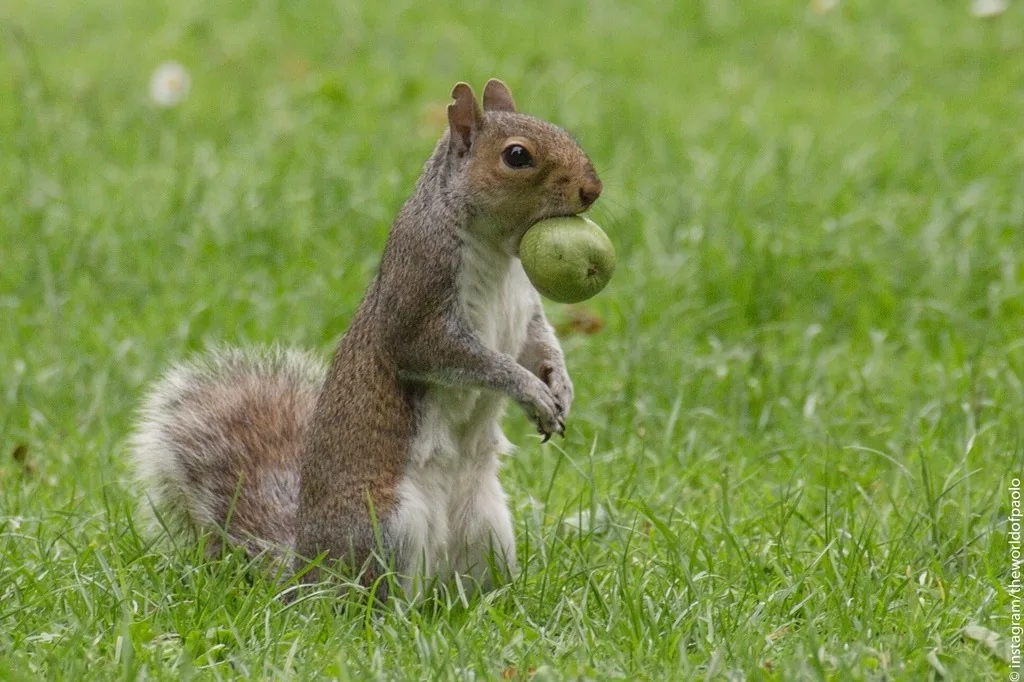
How to identify it
- A long, bushy tail and no stripes or spots on the body; when chased, tree squirrels escape by climbing trees or buildings.[1]
- Eastern gray squirrels are usually gray, sometimes with a reddish cast or all black, and measure about 16 to 20 inches from nose to tail tip.[2]
- Fox squirrels are larger, about 18 to 27 inches long, and often orange-brown or grizzled gray-brown with an orange belly.[2]
- Large tree squirrels use entry holes about the size of a baseball, and they build bulky leaf nests high in trees.[4][3][1]
Look-alikes
| Look-alike | How to tell them apart |
|---|---|
| Eastern chipmunk | Chipmunks are much smaller, have black and tan stripes on the face and back, and spend most of their time on the ground.[1][6] |
| Ground squirrels | Unlike ground squirrels, tree squirrels have long bushy tails, no spots or stripes, and escape by climbing trees and structures.[1] |
| Flying squirrels | Flying squirrels are active at night, have skin folds between their legs and a flat tail, and can use holes as small as a quarter.[2][3][4] |
Where it lives
Fox squirrels live across much of the eastern and central U.S., and eastern gray squirrels share much of that range; both have been introduced to western cities, including in California.[2][1]
Biology and life cycle
Tree squirrels are active by day all year and do not hibernate; they are busiest in early morning and late afternoon.[1][3]
Fox and gray squirrels mate mainly in mid-December or early January, with some breeding again in June; gestation lasts 42 to 45 days and litters average about 3 young.[3]
Young are weaned at 10 to 12 weeks; about half of a squirrel population dies each year, and few wild squirrels live past 4 years.[3]
They nest in tree cavities, attics and other building spaces, or in leaf nests made of sticks and dry leaves.[3][1]
Gray and fox squirrels bury nuts one at a time around their home range and eat mast, tree buds, fruit, fungi, corn and seeds.[3]
Damage and signs
- Squirrels enter attics through gaps under eaves and broken vent screens, enlarge small openings by gnawing, and can chew new holes in wood.[1][4]
- They gnaw on wires and cables, which can lead to fires, and they short out transformers when traveling power lines.[4][1]
- Mostly in fall, they dig holes in lawns and garden soil to bury nuts and seeds, tearing up turf and beds.[1][4]
- They eat nuts and fruit from yard trees, take strawberries, tomatoes and corn, and can strip a tree of its crop quickly.[1]
- Squirrels strip bark to reach the inner layer, damaging branches, and they raid bird feeders and sometimes eat nestlings.[1][4]
Health risk
Tree squirrels can carry tularemia and ringworm and often have fleas, mites and ticks; wear gloves and bag dead squirrels to contain parasites.[1][4]
Control
Prevention
Trim tree limbs and vines back 6 to 8 feet from buildings so squirrels cannot jump onto the roof.[5][1]
Keep them out
Close gaps under eaves, knotholes and torn vent screens with sheet metal or hardware cloth, and cap the chimney.[1][5]
Before sealing a hole, stuff it loosely with newspaper; if the plug is pushed out, a squirrel is still inside and must leave first.[1][5]
Avoid sealing in or abandoning young, which may be present from February through August; one-way doors work only when no young are inside.[5]
Keep squirrels out of isolated trees with a 2-foot-wide metal collar about 6 feet up the trunk, held with springs so the tree can grow.[5]
Protect seed rows with freestanding cages of 1-inch chicken wire, and net a single fruit tree as you would against birds.[1]
Traps and physical control
Where trapping is legal, place traps on travel routes, in trees or on roofs, and enclose kill traps in boxes with small entrances to protect pets and birds.[1][5]
Pesticides
Some taste repellents and sticky polybutene barriers are registered for squirrels, but UC IPM rates repellent results as questionable.[5][1]
Squirrel stuck in a chimney
Squirrels that fall into a chimney often cannot climb the smooth flue and rarely survive more than 3 days.[5]
A healthy squirrel may climb out on a 1-inch-thick rope hung down the flue; otherwise, close off the fireplace opening and use a trap before opening the damper.[5]
What doesn't work on tree squirrels
Squirrels get used to frightening devices within a couple of days, and no such device has proven effective.[1][5]
Ordinary rat snap traps are often too weak for adult gray or fox squirrels.[1]
No toxicants are registered for tree squirrels, and California prohibits poison baits for any tree squirrel.[5][1]
Predators in towns and suburbs have little effect on tree squirrel numbers.[1]
Legal status
Fox and gray squirrels are game animals in most states, so trapping may require a permit; flying and tassel-eared squirrels usually cannot be killed.[2][5]
Rules vary widely. In California, only eastern fox squirrels damaging property may be removed without a permit, and releasing any tree squirrel elsewhere is illegal without one.[1]
Common questions
- Why are squirrels digging holes in my lawn?
- They are burying nuts and seeds for later, mostly in fall, and digging up earlier caches.[1][4]
- When might baby squirrels be in my attic?
- Young may be present from February through August, so confirm no young are inside before sealing entry holes.[5]
- Is a squirrel in the attic dangerous?
- It can be. Squirrels gnaw electrical wiring, which can lead to fires, and long-term chewing can weaken rafters.[4]
Sources
- University of California Statewide IPM Program, “Tree Squirrels (Pest Notes, Home and Landscape).” ipm.ucanr.edu/home-and-landscape/tree-squirrels/ (accessed 2026-10-06)
- Internet Center for Wildlife Damage Management, “Tree Squirrels: Identification.” icwdm.org/species/rodents/tree-squirrels/ (accessed 2026-10-06). Run by university wildlife damage specialists (maintained at the University of Wisconsin-Stevens Point); species modules are based on Prevention and Control of Wildlife Damage (University of Nebraska Cooperative Extension, 1994).
- Internet Center for Wildlife Damage Management, “Tree Squirrel Biology.” icwdm.org/species/rodents/tree-squirrels/tree-squirrel-biology/ (accessed 2026-10-06). Run by university wildlife damage specialists (maintained at the University of Wisconsin-Stevens Point); species modules are based on Prevention and Control of Wildlife Damage (University of Nebraska Cooperative Extension, 1994).
- Internet Center for Wildlife Damage Management, “Tree Squirrel Damage Identification.” icwdm.org/species/rodents/tree-squirrels/tree-squirrel-damage-identification/ (accessed 2026-10-06). Run by university wildlife damage specialists (maintained at the University of Wisconsin-Stevens Point); species modules are based on Prevention and Control of Wildlife Damage (University of Nebraska Cooperative Extension, 1994).
- Internet Center for Wildlife Damage Management, “Tree Squirrel Damage Prevention and Control Methods.” icwdm.org/species/rodents/tree-squirrels/tree-squirrel-damage-prevention-and-control-methods/ (accessed 2026-10-06). Run by university wildlife damage specialists (maintained at the University of Wisconsin-Stevens Point); species modules are based on Prevention and Control of Wildlife Damage (University of Nebraska Cooperative Extension, 1994).
- Internet Center for Wildlife Damage Management, “Chipmunks: Identification.” icwdm.org/species/rodents/chipmunks/ (accessed 2026-10-06). Run by university wildlife damage specialists (maintained at the University of Wisconsin-Stevens Point); species modules are based on Prevention and Control of Wildlife Damage (University of Nebraska Cooperative Extension, 1994).
- iNaturalist, “Sciurus carolinensis taxon page (order and family).” www.inaturalist.org/taxa/46017 (accessed 2026-10-06)