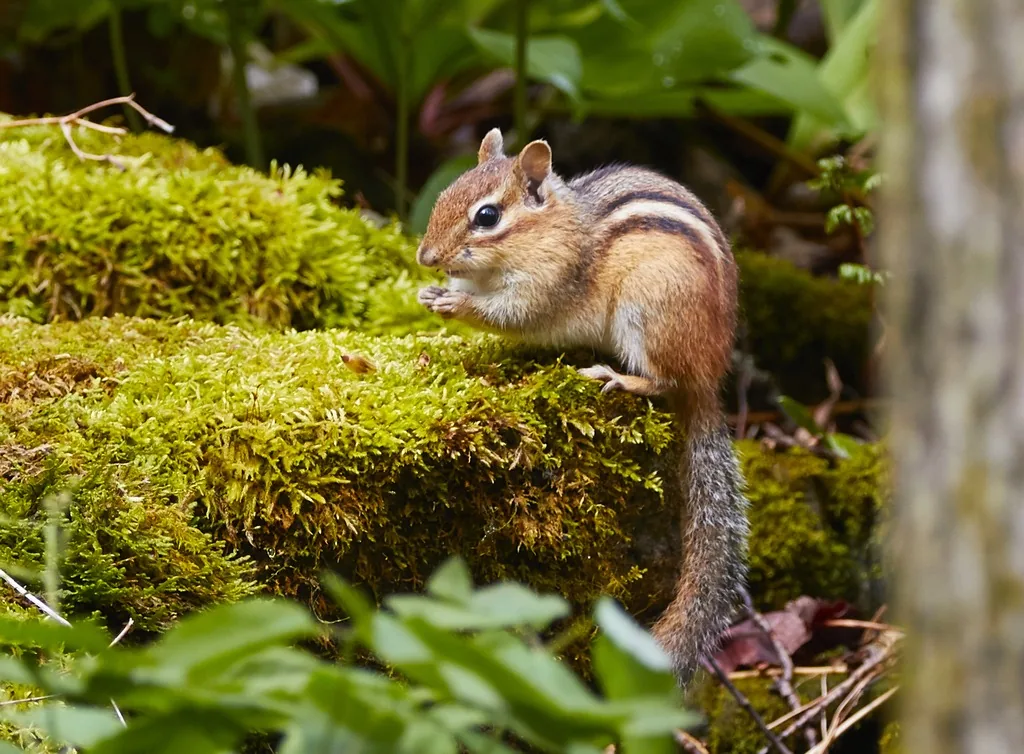
How to identify it
- A small brown squirrel about 5 to 6 inches long and weighing about 3 ounces, with a hairy but not bushy tail 3 to 4 inches long.[1][2]
- Two tan and five blackish stripes run down the back and end at a reddish rump, and tan and brown stripes mark each side of the face.[1][2]
- Burrow openings are about 2 inches across with no mound of dirt around them, often hidden next to stumps, woodpiles, steps or foundations.[1][3]
- A sharp chuck-chuck-chuck call, and a tail held straight up when the chipmunk is startled.[1][2]
Look-alikes
| Look-alike | How to tell them apart |
|---|---|
| Red squirrel and other tree squirrels | Tree squirrels are larger, with bushier tails and no back stripes, and they spend much more time in trees than chipmunks do.[2][1] |
| Thirteen-lined ground squirrel | A startled ground squirrel carries its tail flat along the ground, while a chipmunk holds its tail upright.[2] |
Where it lives
The eastern chipmunk ranges over most of the eastern U.S. except the southeastern coast and Florida; the smaller least chipmunk covers much of Canada, the Rocky Mountains and the Great Basin.[2]
Biology and life cycle
Chipmunks are active by day, mostly in early morning and late afternoon, and spend most of their time on the ground, though they climb trees for nuts and seeds.[1][3]
They mate twice a year; after a 31-day gestation, 2 to 5 young are born in April or May and again from August to October.[1][3]
A burrow's main tunnel usually runs 20 to 30 feet, with a nest chamber, food storage chambers and escape tunnels.[1][3]
They store food in their burrows all year and spend winter in a light torpor rather than deep hibernation, waking on some warm days.[1][3]
Typical numbers are 2 to 4 chipmunks per acre, but up to 10 where food and cover are plentiful.[1][3]
Damage and signs
- Where numbers are high, burrowing under patios, stairs, retaining walls and foundations can cause structural damage.[1][5][4]
- They eat flower bulbs, seeds, seedlings, bird seed, grass seed and pet food that is not stored in rodent-proof containers.[1][4]
- Burrows can damage pool liners, and chipmunks sometimes get into buildings along the sill plate, through dryer vents or under siding.[4]
- They do little damage to lawns.[4]
Health risk
Chipmunks usually flee when approached and are not significant carriers of diseases harmful to people, so they pose little direct threat to people or pets.[4]
Control
Prevention
Place bird feeders 15 to 30 feet from buildings and use feeders that catch fallen seed.[1][5]
Avoid continuous plantings of ground cover or shrubs linking wooded areas to the foundation, keep firewood away from the house, and keep grass short along building edges.[1][5]
Keep them out
Close openings into buildings with caulk or 1/4-inch hardware cloth, add gutter guards and downspout covers, and screen dryer vents with manufactured vent screens.[1][5]
Protect bulbs and seeds by covering them with 1/4-inch hardware cloth under the soil, extending at least a foot past each edge of the planting.[1][5]
Traps and physical control
Trapping is the most practical removal method around most homes; bait live traps or rat snap traps with peanut butter, nuts or seeds along the paths chipmunks use.[1][5]
Prebait traps for 2 or 3 days, and place snap traps under a box with small openings so birds and pets cannot reach them.[1][5]
Pesticides
Taste repellents such as thiram, capsaicin or ammonium soaps of fatty acids can protect bulbs, seeds and foliage not meant for eating, but they need repeat applications and give partial protection.[1][5]
What doesn't work on chipmunks
No frightening devices are effective against chipmunks.[5]
No toxic baits are registered for chipmunk control.[1]
Burrow fumigants must never be used in or around buildings, and aluminum phosphide is highly regulated and limited to agricultural and non-crop areas.[5]
Legal status
Chipmunks are not federally protected, and most states let landowners remove chipmunks that are causing or about to cause damage.[2][1]
Some states, such as Georgia and Arkansas, require a permit to kill nongame animals, so check state and local rules first.[2]
Common questions
- Can chipmunks damage my patio or foundation?
- Yes, when many are present. Their burrows under patios, stairs, retaining walls and foundations can undermine them.[1][4]
- Do chipmunks hibernate?
- Not deeply. They become inactive from late fall through winter, living on food stored in their burrows, and some come out on warm, sunny days.[1][3]
- Do chipmunks carry diseases?
- They are not considered significant carriers of diseases harmful to people and usually run away when approached.[4]
Sources
- Penn State Extension, “Chipmunks (updated June 23, 2006).” extension.psu.edu/chipmunks (accessed 2026-10-06)
- Internet Center for Wildlife Damage Management, “Chipmunks: Identification.” icwdm.org/species/rodents/chipmunks/ (accessed 2026-10-06). Run by university wildlife damage specialists (maintained at the University of Wisconsin-Stevens Point); species modules are based on Prevention and Control of Wildlife Damage (University of Nebraska Cooperative Extension, 1994).
- Internet Center for Wildlife Damage Management, “Chipmunk Biology.” icwdm.org/species/rodents/chipmunks/chipmunk-biology/ (accessed 2026-10-06). Run by university wildlife damage specialists (maintained at the University of Wisconsin-Stevens Point); species modules are based on Prevention and Control of Wildlife Damage (University of Nebraska Cooperative Extension, 1994).
- Internet Center for Wildlife Damage Management, “Chipmunk Damage Identification.” icwdm.org/species/rodents/chipmunks/chipmunk-damage-identification/ (accessed 2026-10-06). Run by university wildlife damage specialists (maintained at the University of Wisconsin-Stevens Point); species modules are based on Prevention and Control of Wildlife Damage (University of Nebraska Cooperative Extension, 1994).
- Internet Center for Wildlife Damage Management, “Chipmunk Damage Prevention and Control Methods.” icwdm.org/species/rodents/chipmunks/chipmunk-damage-prevention-and-control-methods/ (accessed 2026-10-06). Run by university wildlife damage specialists (maintained at the University of Wisconsin-Stevens Point); species modules are based on Prevention and Control of Wildlife Damage (University of Nebraska Cooperative Extension, 1994).
- iNaturalist, “Tamias striatus taxon page (order and family).” www.inaturalist.org/taxa/46217 (accessed 2026-10-06)