The short answer
- Identify the rat. A roof rat's tail is longer than its head and body and reaches at least to the snout when pulled forward; a Norway rat is heavier, with a blunt muzzle and a shorter tail.[1][6]
- Set rat-sized snap traps, not mouse traps, and leave them baited but unset until the rats have taken the bait. Rats avoid new objects, often for several days.[11][1][3]
- Put traps against walls for Norway rats. For roof rats, put most of them up high on beams, ledges, fences and rafters, fastened down.[1][7]
- Seal openings into the house. UC IPM says to close every hole larger than 1/4 inch; ICWDM gives 1/2 inch for rats. Use concrete mortar, sheet metal or heavy hardware cloth, never chicken wire.[1][4]
- Remove what feeds them: fallen fruit and nuts, pet food left out, open garbage, and compost with meat or eggs in it. Cut back vines on walls and fences and tree limbs within 6 feet of the roof.[1][7]
- Treat rodenticides as a last step. Homeowner products come only as ready-to-use bait stations, and poisoned rats can poison pets, hawks and owls that eat them.[11][15][16]
Rat and rodent profiles
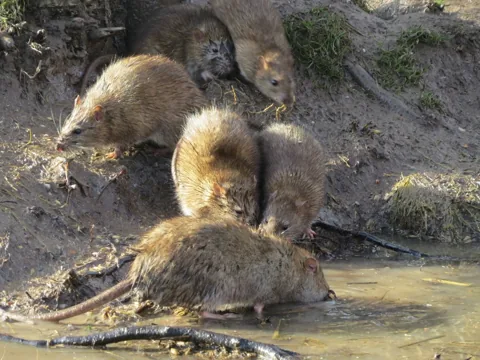 Norway Rat
Rattus norvegicus
The Norway rat, also called the brown or sewer rat, is a large, burrowing rat found throughout the contiguous United States wherever people live.
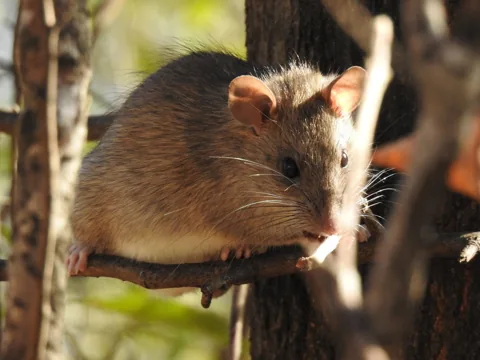 Roof Rat
Rattus rattus
The roof rat, also called the black or ship rat, is a sleek, agile climber that nests above ground in trees, ivy, attics and wall voids.
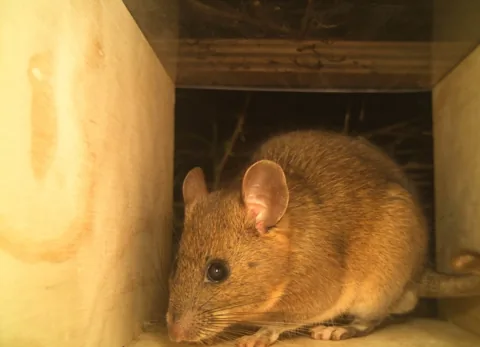 Woodrats
Neotoma species (e.g., N. fuscipes, N. lepida, N. floridana)
Woodrats, also called pack rats or trade rats, are native rats about the size of a Norway rat. They are a nuisance mainly around cabins, sheds and other little-used buildings and in parked vehicles, where they shred furnishings for nests and chew wires.
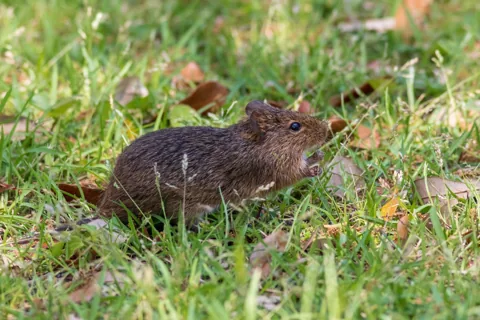 Hispid cotton rat
Sigmodon hispidus
The hispid cotton rat is a common native rat of dense, grassy fields, overgrown roadsides and fencerows across the southern U.S. It breeds year-round, and when populations peak it can damage crops, vegetables and fruit.
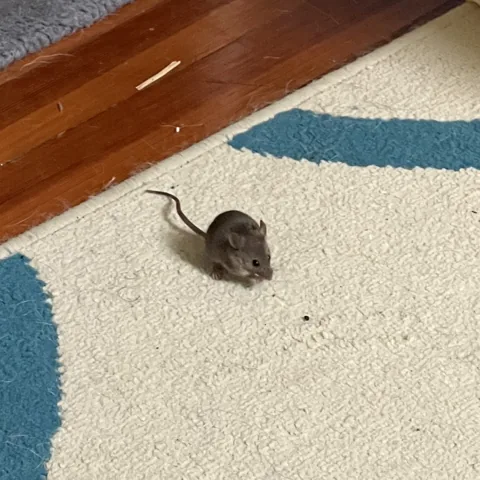 House Mouse
Mus musculus
The house mouse is a small, adaptable rodent that lives close to people in homes, schools and food businesses, eating and contaminating food, gnawing wiring and carrying disease.
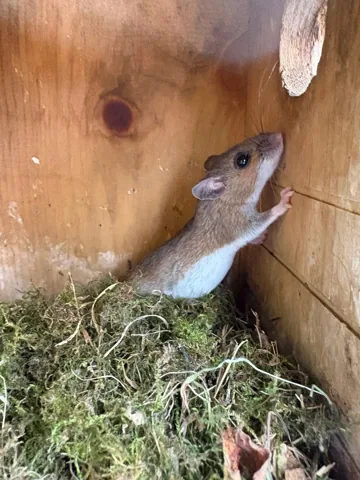 Deer Mouse
Peromyscus species (shown: P. maniculatus)
The deer mouse is a wild mouse with a white belly and a furred, two-toned tail that sometimes moves into cabins, sheds and homes. In the United States it spreads the most common hantavirus that causes hantavirus pulmonary syndrome (HPS), a severe and potentially deadly lung disease, so the droppings and nests it leaves need careful cleanup.
Norway rat or roof rat?
Two introduced rats cause nearly all rat problems around US homes: the Norway rat (Rattus norvegicus) and the roof rat (Rattus rattus). The two species can't interbreed. UC IPM says it's important to know which one is present because control strategies differ. Native pack rats, or woodrats, also turn up around homes; they have furry tails, while the two introduced rats have scaly, mostly hairless tails.[1][5]
- Norway rat (also called brown rat, sewer rat or barn rat): large and stocky with a blunt muzzle and coarse brown or reddish-gray fur. Ears don't reach the eyes when folded forward, and the tail, dark above and pale below, is shorter than the head and body. UC IPM gives adult weights of 7 to 18 ounces; ICWDM says adults average 12 to 16 ounces.[1][2][6]
- Roof rat (also called black rat or ship rat): sleek and agile with a pointed muzzle, large ears that reach the eyes when folded over, and soft brown fur mixed with black. The uniformly dark, finely scaled tail is longer than the head and body. ICWDM gives a body of 6 to 8 inches plus a 6- to 8-inch tail, and adult weights of 5 to 10 ounces.[1][5][6]
- Quick field test: on a trapped rat, pull the tail back over the body toward the head. A roof rat's tail reaches at least to the snout; a Norway rat's reaches only about the middle of the skull.[1]
- Range: Norway rats live throughout the 48 contiguous states (ICWDM adds Alaska and Hawaii), mostly at lower elevations but wherever people live. Roof rats favor warm and coastal areas: the lower half of the East Coast, the Gulf States north into Arkansas, the Pacific Coast and Hawaii. UC IPM notes the roof rat's documented range is expanding.[1][2][5]
- Young rat or mouse? A young rat has a large head and large feet for its body, while an adult mouse's head and feet are proportionately much smaller. If it's a mouse, see the mouse guide linked below; CDC notes that mice and rats need different snap traps.[1][11]
- Not sure? ICWDM says catching a few rats in traps may be the only sure way to tell which species you have, and both can live on the same property.[8]
Where each rat nests and how rats behave
Knowing where rats live and how they react to new things explains most failed control attempts.[6]
- Norway rats live low. They dig burrows along foundations, under rubbish and woodpiles and around gardens, lining nests with leaves, shredded paper or cloth. Indoors they usually live in basements and on ground floors, though they also turn up in ceiling voids.[1][3]
- Roof rats live high. Outdoors they nest in trees, shrubs and dense vegetation such as ivy; ICWDM mentions palm trees and vine-covered fences. Indoors they nest in attics, wall and ceiling voids and cabinets. They rarely dig burrows when off-ground nest sites exist.[1][6]
- Sharing a building: when both species are present, Norway rats usually hold the basement and ground floor and roof rats the upper floors.[1][6]
- Night travel: rats are mostly active at night. Roof rats are often seen after dark running along overhead utility lines and fence tops, using their tails for balance. Norway rats are the stronger swimmers, and rats of either species can enter buildings through sewers, toilets or broken drains.[1][6]
- Foraging distance: roof rats routinely travel 100 to 300 feet or more for food and may live in one yard and feed in another. UC IPM says Norway rats forage anywhere from 100 to 500 feet from their nests, but stay as close as they can when food is nearby; ICWDM says they seldom go more than 400 feet from the burrow.[1][6][3]
- Fear of new things (neophobia): rats memorize their surroundings and avoid new objects and new foods, so traps and bait stations are often ignored for the first several days, sometimes weeks. Neophobia is stronger in roof rats than in Norway rats.[1][6][3]
- Bait shyness: a rat that eats a little of something that makes it sick without killing it can learn to avoid that food, which is a problem with fast-acting poisons.[3]
- Breeding: UC IPM says a female Norway rat averages 4 to 6 litters a year and can wean 20 or more young annually; ICWDM gives 3 to 6 litters of 6 to 12 young, with rats able to breed at about 3 months old. Roof rats average 3 to 5 litters of up to 8 young. ICWDM warns that a population not knocked down to very low numbers can rebound quickly.[1][3][6][7]
Signs of rats
People rarely see rats except in heavy infestations, but the signs are easy to find once you know them. Start control early: UC IPM says it takes less time, fewer traps and less bait when numbers are low.[1]
- Droppings: Norway rat droppings can be up to 3/4 inch long and 1/4 inch wide with blunt ends, usually clumped in small groups. Roof rat droppings are about 1/2 inch long with pointed ends. Fresh droppings are soft. Look near pet food dishes and pet food storage, along runways and feeding areas, and in recycling bins.[2][5][1]
- Old or active? CDC suggests cleaning up droppings safely and checking back: new droppings mean rodents are still there.[9]
- Rub marks: greasy smudges of oil and dirt on beams, rafters, pipes and walls where rats brush along the same routes night after night. In attics and storage areas used by roof rats, these may be the most obvious sign.[2][1][8]
- Burrows: active Norway rat holes are 2 to 3 inches across, free of debris, often with rat hairs at the entrance, found along foundations, fences, under bushes and debris, beneath compost piles and garbage cans, and under sheds and doghouses.[2][1]
- Gnawing: rats gnaw on wood, plastic, wiring and even soft metals like copper and lead. Their tooth marks are about twice as wide as a mouse's: UC IPM gives 1/6 inch (4 mm) for rats versus 1/12 inch (2 mm) for mice, while ICWDM describes Norway rat grooves as 1/16 inch wide. Fresh shavings of wood or insulation mean active rats.[1][2]
- Sounds: scurrying in the attic at night, after the house goes quiet, is often the first sign of roof rats. Rats also squeak and make gnawing and climbing noises.[8][2][1]
- Outdoor clues: fruit hollowed out on the tree (roof rats empty oranges and leave the rind hanging; they eat lemon rinds and leave the flesh), nests in firewood stacks or behind boxes in the garage, rats on fences or wires at dusk, and drowned rats in a pool or hot tub.[1][8]
- Tracks: footprints and tail drags show on dusty surfaces or mud. A thin patch of flour on a suspected path overnight will show tracks.[2]
Step 1: Rat-proof the building
UC IPM calls exclusion, or building rats out, the most successful and longest-lasting rat control around structures. It also takes longer for roof rats, because they climb and you have to search the whole roofline for entry points.[1][7]
Sources differ on the gap size to close. UC IPM says to seal all holes larger than 1/4 inch, which keeps out both rats and mice. ICWDM's Norway and roof rat pages say openings larger than 1/2 inch. UC IPM adds that rats, especially young ones, can squeeze under a door with a 1/2-inch gap and may gnaw a wooden door to widen it.[1][4][7]
- Materials that hold: concrete mortar, 24-gauge galvanized sheet metal and 18-gauge hardware cloth, per ICWDM. For roof rat openings ICWDM also lists steel wool and metal flashing.[4][7]
- Vents: UC IPM says to enclose vent grills with 18-gauge, 1/2-inch galvanized expanded metal or 16-gauge, 1/2-inch galvanized wire cloth, and to repair damaged foundation, attic and eave vent screens. Low windows that open can be covered with 19-gauge, 1/2-inch galvanized wire cloth.[1]
- Never use lightweight chicken wire. UC IPM says rats pass easily through the openings.[1]
- Pipes and wires: seal around every pipe, cable and wire that enters through walls or the foundation, plus drain spouts and sewer pipes. Screen the tops of rooftop plumbing vents more than 2 inches across, and cover chimneys with a spark arrester.[1]
- Doors: exterior doors should fit tightly and be sealed at the threshold; double doors also need the gap between the two doors sealed. UC IPM warns that ordinary weatherstripping may not stop rats, and door and window edges can be covered with sheet metal where rats gnaw.[1]
- Crawl spaces: give the crawl space a tight-fitting cover.[1]
- Find the active holes first: ICWDM suggests loosely plugging holes with paper and seeing which ones get opened before sealing them for good.[4]
- Roof rat routes: remove tree limbs within 6 feet of the roof, take vines off walls and fences, and thin climbing plants such as English or Algerian ivy, star jasmine and honeysuckle. Prune dense shrubs like pyracantha and juniper back at least 2 feet from buildings.[1][7]
- Utility lines: if roof rats are using overhead wires, UC IPM says to contact a pest professional or the utility company. ICWDM notes rat guards on wires need regular upkeep and can fray insulation and cause short circuits.[1][7]
- Burrowing Norway rats: ICWDM says a band of coarse gravel (at least 1-inch stones, 2 feet wide and 6 inches deep) along a foundation can reduce burrowing.[4]
- Vehicles: rats chew engine wiring. UC IPM suggests a weighted car cover that touches the ground all the way around.[1]
Step 2: Cut off food, water and shelter
Sanitation alone won't always eliminate rats, but UC IPM says the benefits of every other step are lost without it, and rats quickly return. It has to be ongoing.[1][4]
ICWDM warns that roof rats may shift their travel routes when disturbed, and suggests holding off on major habitat changes such as heavy pruning until the population is under control. UC IPM notes roof rats are strongly attached to their nest sites and will return to them if the nests aren't removed.[6][1]
- Pet food: feed pets only what they eat at one meal, don't leave food out overnight, and store it in rodent-proof containers. Pick up dog and cat feces, which rats also eat. ICWDM notes rat problems often go with dogs fed outdoors.[1][7][6]
- Fruit and nut trees: pick up fallen fruit and nuts promptly, and strip and destroy unwanted fruit at the end of the harvest.[1][7]
- Bird feeders: CDC says to keep them away from the house and use squirrel guards to limit access by squirrels and other rodents.[10]
- Compost: UC IPM says rats burrow under compost piles, especially when meat, fish, eggs or eggshells go in. Use rigid plastic or metal bins with tight lids, keeping in mind rats can gnaw plastic. CDC recommends keeping compost bins at least 100 feet from the house.[1][10]
- Garbage: use cans with tight-fitting lids, collect trash often, and keep cans clean of food residue and grease, full or empty. ICWDM says galvanized steel containers resist rats better than plastic, and racks that hold cans off the ground remove shelter underneath.[1][4]
- Clutter and woodpiles: store lumber, pipes, firewood and boxes tidily and off the ground. CDC suggests moving woodpiles 100 feet or more from the house and raising wood at least a foot off the ground.[1][10]
- Vegetation: thin dense, low ground cover and keep grass mowed so rats have less cover and seed to eat.[1][4]
Step 3: Trap the rats
For a home with a few rats, trapping is the method ICWDM recommends trying first. It doesn't rely on poisons, you can see results, and you remove the bodies, so you don't get the smell of a rat dying inside a wall. CDC also recommends traditional snap traps around the home. Expect it to take more skill and labor than most other methods.[4][7][11]
- Trap size: use rat-sized snap traps. UC IPM notes mice and small young rats often won't set off a rat trap, and CDC says there are different snap traps for mice and rats.[1][11]
- Trigger: choose traps with an expanded trigger plate. ICWDM cites research in which expanded-trigger traps caught almost twice as many rats as narrow-trigger traps and lost less bait.[4][1]
- Pre-bait: leave traps baited but unset until rats have taken the bait. UC IPM says to wait until the bait has been taken several times; CDC says to set the traps once you see the bait being eaten. A rat that springs a trap and escapes becomes very hard to catch.[1][11][4]
- Bait: nuts, dried fruit, bacon or dry pet food tied to the trigger with thread or fine wire, or peanut butter. Use about a pea-sized amount. For roof rats ICWDM lists raisins, prunes, peanut butter, nutmeats and gumdrops, often better than meat.[1][7]
- Norway rat placement: along walls, behind objects, in dark corners and where you see droppings, rub marks or burrows. Set traps at right angles to the wall with the trigger end nearly touching it, or in pairs parallel to the wall facing opposite directions. ICWDM suggests not setting them directly in front of holes.[1][4]
- Roof rat placement: set traps on the ground and up high, on ledges, shelves, branches, fences, pipes and beams, and put more of them above floor level than on it. In homes, ICWDM says attic and garage rafters near the activity are the best sites. Fasten traps to the beam or pipe with screws or wire so the trigger sits right in the rat's path.[1][7]
- How many: use as many traps as practical so trapping is short. UC IPM says a heavily infested home may need a dozen or more, about 10 to 20 feet apart. If every trap's bait is taken, double the number of traps until some bait is left, then bait and set them all.[1]
- Protect pets, kids and birds: where they might reach a trap, put it in a box or station or behind a barrier. UC IPM notes that trapping at night reduces bird catches.[1][4]
- Check traps daily and keep going: CDC says to refill or move bait as needed for at least 15 days and to keep trapping until nothing is caught for a week with no new droppings, urine or gnawing.[11]
- Electric traps: battery-powered electrocution traps cost considerably more. UC IPM says they also need pre-baiting and frequent checks.[1]
- Glue boards: CDC advises against them, partly because trapped rodents urinate, which raises disease risk. UC IPM says they're not generally recommended for nonprofessionals and should never be used outdoors, where wildlife gets stuck. ICWDM says rats often pull free.[11][1][4]
- Live traps: CDC advises against them too. UC IPM says trapped rats must legally be humanely euthanized or released immediately where caught, and doesn't recommend live trapping for homeowners; ICWDM says captured rats shouldn't be released elsewhere because of disease, damage and harm to native wildlife.[11][1][7]
Bait stations and rodenticides: the rules
CDC says to use poison or bait stations only for rat and mouse infestations that persist, and to choose EPA-registered products. UC IPM adds that rats' wariness means it can take several days to weeks before they feed from a bait station, and research has found roof rats may not enter stations at all, even on established runways.[11][1]
- What homeowners can buy: EPA says consumer rodenticides are sold only as ready-to-use bait stations with block or paste bait; loose pellets are no longer allowed in consumer products. The consumer active ingredients EPA lists are bromethalin, chlorophacinone and diphacinone. Each product is labeled for indoor use only or for indoors and outdoors within 50 feet of buildings, depending on whether its station passed tamper tests with young children and dogs and weather tests.[15]
- Professional-only products: second-generation anticoagulants (brodifacoum, bromadiolone, difenacoum and difethialone) are not sold for consumer use. On professional and farm products, labels require tamper-resistant stations wherever children under 6, pets or nontarget wildlife could reach the bait, and burrow baiting is limited to pellets placed at least 6 inches down active rat burrows.[15]
- Station ratings: ICWDM describes four EPA tiers, from stations tested as tamper-resistant to children and dogs and weather-resistant (indoor and outdoor use) down to untested stations for indoor places that young children and pets never visit. Tamper-resistant is not tamper-proof, so place stations where kids and pets won't play with them, and fasten them to walls or floors.[4]
- State rules can be stricter: UC IPM notes that California prohibits most uses of first- and second-generation anticoagulants, leaving bromethalin, cholecalciferol and zinc phosphide. Check your state's rules and the label.[1]
- Placement: for Norway rats, put stations near burrows, against walls and along travel routes between shelter and food. For roof rats, UC IPM says to place bait up high, such as in a tree crotch, on a fence top or in a vine, fastened securely so it can't fall where children or pets could find it. Rats won't go out of their way to find bait.[1][4]
- How long: anticoagulants usually kill 4 days to 2 weeks after rats begin feeding. ICWDM says labels commonly call for a continuous supply of bait for 10 days or until feeding stops, with stations within 20 to 30 feet of each other where rats are active.[15][4]
- When baiting fails: ICWDM says the usual causes are too little bait, bait not kept fresh, too few stations, too short a baiting period or rats moving in from next door. Anticoagulant-resistant Norway rats have been found in several US locations; suspect it if the same amount of bait disappears every day for weeks.[4]
- Dead rats in walls: poisoned rats can die in places you can't reach and cause odor problems, one reason ICWDM recommends trapping in homes.[7][4]
- Finish the job: remove and properly dispose of uneaten bait when the program ends, and collect dead rats with a plastic bag over your hand or gloves, never bare hands.[1]
Pets, hawks and owls: secondary poisoning
Rodenticides work the same way in any mammal and can also affect birds. Baits are flavored to attract animals, so pets and wildlife may eat the bait directly (primary poisoning) or eat a poisoned rat (secondary poisoning).[16]
- Dead rats can carry several lethal doses. Because anticoagulants are cumulative and slow-acting, UC IPM says dead rats can contain several lethal doses. With second-generation baits, eating a single dead rodent might be enough to poison a pet. Most pet deaths involve dogs that ate the bait itself, or bait plus poisoned rodents.[1]
- Which products are riskiest: NPIC lists difethialone, brodifacoum and possibly bromadiolone as high secondary risks to hawks and owls, and chlorophacinone, diphacinone, bromadiolone and brodifacoum as the greatest secondary risks to wild mammals, dogs and cats. Bromethalin and cholecalciferol may pose secondary risks that haven't been measured, and UC IPM cites newer evidence that secondary bromethalin exposure can occur.[16][1]
- Why EPA restricted the strongest baits: EPA says second-generation anticoagulants remain in animal tissues longer and pose greater risks to animals that eat bait once or eat animals that ate it. UC IPM says those concerns led EPA to restrict their retail sale in mid-2011.[15][1]
- What studies found: at a Massachusetts wildlife clinic, 86% of 161 hawks and owls tested from 2006 to 2010 had anticoagulant rodenticide residues in their livers, nearly all of them brodifacoum. A follow-up of 94 birds from 2012 to 2016, after consumer sales were restricted, found second-generation residues in 96%, and the three second-generation compounds most used by pest management professionals in the state were found together in most of the birds.[17][18]
- Lower the risk: keep pets away from baits and from dead or dying rodents, search for and remove carcasses, and bag them or bury them where pets and scavengers can't dig them up. Don't feed pets outdoors, which also attracts rats.[1][16]
- If a child or pet eats bait: follow the first aid on the label and call Poison Control at 800-222-1222. NPIC (800-858-7378) answers questions about pesticide exposures. ICWDM notes vitamin K is an antidote for anticoagulant poisoning.[16][4]
Gadgets, repellents and smoke bombs
- Ultrasonic devices: ICWDM says ultrasound won't evict rats established in an area and commercial ultrasonic devices aren't recommended. Rats are frightened by strange sounds but get used to repeated ones quickly, and UC IPM calls frightening devices ineffective for rats in homes and gardens.[4][1]
- Lights and fake predators: ICWDM says rats quickly get used to flashing or constant lights, and model owls, snakes and cats are of no value.[7]
- Repellents: rats avoid some tastes and smells at first, but UC IPM says no repellent has solved a rat problem for more than a very short time, and ICWDM says no chemical repellents are specifically registered for rat control.[1][7]
- Smoke and gas cartridges: UC IPM doesn't recommend them around homes. Norway rat burrows can run under a house, so toxic gas can get into the living space, and the cartridges are a fire hazard. Carbon monoxide burrow devices are meant for professionals and can't be used within 65 feet of a structure for Norway rats.[1]
- Cats and dogs: some catch rats, but they rarely control an established population, and outdoor pet food feeds the rats.[1][4]
Disease risk and safe cleanup
Rats can spread disease through bites and scratches, through contact with their droppings, urine or saliva, and through food or air contaminated with their waste. They also carry fleas, mites and ticks. UC IPM lists typhus, leptospirosis, foodborne illness such as salmonella, and rat-bite fever as the most common rat-transmitted diseases. Commensal rats do not carry or transmit rabies.[9][1]
- Leptospirosis: the bacteria spread in the urine of infected animals and can survive in water or soil for weeks to months. CDC says risk rises after floods and heavy rain.[14]
- Rat-bite fever: spread by bites, scratches or contact with a rodent's saliva or urine. Symptoms usually start 3 to 10 days after contact (up to 21) with fever, vomiting, headache and muscle pain. CDC says it's rare in the US but must be treated quickly; see a doctor right away if you get sick after rodent contact.[13]
- Don't sweep or vacuum droppings, urine or nests. CDC says this puts tiny contaminated droplets into the air, which is the main way rodent diseases reach people.[12]
- Ventilate first: in a closed-up space, open doors and windows for 30 minutes and leave while it airs out.[12]
- Disinfect and wipe: wearing rubber or plastic gloves, spray droppings, urine and nests with an EPA-registered disinfectant or fresh bleach solution (1.5 cups of bleach per gallon of water) until very wet, let it soak 5 minutes or as the label says, then wipe up with paper towels and throw them in a covered garbage can.[12]
- Dead rats: spray with disinfectant, then put the rat and any used trap in a plastic bag, knot it, put that in a second bag, knot it, and throw it in a covered garbage can. To reuse a snap trap, soak it with the rat in disinfectant for 5 minutes before dropping the rat into a bag.[12]
- Wash gloved hands before taking the gloves off, then wash bare hands with soap and warm water.[12]
- Heavy infestations call for more protective gear: CDC lists coveralls, rubber boots or shoe covers, gloves, goggles and a half-mask air-purifying respirator with a HEPA filter.[12]
When to call a pro
- Trapping hasn't worked: CDC says to consider a bait station or professional help if trapping doesn't solve the infestation.[11]
- Roof rats on utility lines: UC IPM recommends a pest professional or the utility company.[1]
- Rats in heating and cooling ducts: CDC says to call a professional rodent control service.[12]
- Tools homeowners can't use: second-generation anticoagulants, burrow baiting and tracking powders are limited to professionals and licensed applicators, and ICWDM says tracking powders generally aren't recommended around homes because of the hazard to children and pets.[15][4]
Common questions
- What's the fastest way to get rid of rats?
- Pre-bait plenty of rat-sized snap traps where you see signs, set them once the bait is being taken, and seal entry points at the same time. Speed comes from using enough traps: UC IPM says a heavily infested home may need a dozen or more.[1][11]
- Why are the rats ignoring my traps?
- Rats avoid new objects, often for several days and sometimes weeks, and roof rats are warier than Norway rats. Leave traps baited but unset until the bait is taken, and for roof rats move traps up onto beams, fences and rafters where they travel.[1][6][7]
- How do I tell a Norway rat from a roof rat?
- Check the tail and face. A roof rat's tail is longer than its head and body and reaches the snout when pulled forward; its muzzle is pointed and its ears reach the eyes. A Norway rat is heavier and stockier, with a blunt muzzle, smaller ears and a shorter tail.[1][6]
- Is rat poison safe around pets?
- No. Rodenticides poison any mammal and can affect birds, baits are flavored to attract animals, and dogs and cats can be poisoned by eating poisoned rats. Use only the ready-to-use stations EPA allows for homeowners, place them where the label allows, and consider traps first.[16][15][1]
- How do I know the rats are gone?
- CDC says the rats are gone when nothing has been caught for a week and there are no new droppings, urine spots or gnawing. Cleaning old droppings first makes new ones easy to spot.[11][9]
Photo credits
- Norway Rat: petehawkins, public domain (CC0), via iNaturalist
- Roof Rat: (c) Laura Mae, some rights reserved (CC BY) — via iNaturalist, CC BY 4.0
- Woodrats: Andy Kleinhesselink, public domain (CC0), via iNaturalist
- Hispid cotton rat: (c) Joshua Liverman, some rights reserved (CC BY) — via iNaturalist, CC BY 4.0
- House Mouse: (c) Carrie Seltzer, some rights reserved (CC BY) — via iNaturalist, CC BY 4.0
- Deer Mouse: (c) Derek Duplessis, some rights reserved (CC BY) — via iNaturalist, CC BY 4.0
Sources
- University of California Statewide IPM Program, “Pest Notes: Rats (Publication 74106, rev. June 2024).” ipm.ucanr.edu/legacy_assets/PDF/PESTNOTES/pnrats.pdf (accessed 2026-11-10)
- Internet Center for Wildlife Damage Management, “Norway Rats: Identification.” icwdm.org/species/rodents/norway-rats/ (accessed 2026-11-10)
- Internet Center for Wildlife Damage Management, “Norway Rat Biology.” icwdm.org/species/rodents/norway-rats/norway-rat-biology/ (accessed 2026-11-10)
- Internet Center for Wildlife Damage Management, “Norway Rat Damage Prevention and Control Methods.” icwdm.org/species/rodents/norway-rats/norway-rat-damage-prevention-and-control-methods/ (accessed 2026-11-10)
- Internet Center for Wildlife Damage Management, “Roof Rats: Identification.” icwdm.org/species/rodents/roof-rats/ (accessed 2026-11-10)
- Internet Center for Wildlife Damage Management, “Roof Rat Biology.” icwdm.org/species/rodents/roof-rats/roof-rat-biology/ (accessed 2026-11-10)
- Internet Center for Wildlife Damage Management, “Roof Rat Prevention and Control Methods.” icwdm.org/species/rodents/roof-rats/roof-rat-prevention-and-control-methods/ (accessed 2026-11-10)
- Internet Center for Wildlife Damage Management, “Roof Rat Damage Identification.” icwdm.org/species/rodents/roof-rats/roof-rat-damage-identification/ (accessed 2026-11-10)
- U.S. Centers for Disease Control and Prevention, “Controlling Wild Rodent Infestations.” www.cdc.gov/healthy-pets/rodent-control/index.html (accessed 2026-11-10)
- U.S. Centers for Disease Control and Prevention, “How to Seal Up to Prevent Rodents.” www.cdc.gov/healthy-pets/rodent-control/seal-up.html (accessed 2026-11-10)
- U.S. Centers for Disease Control and Prevention, “How to Trap Up to Remove Rodents.” www.cdc.gov/healthy-pets/rodent-control/trap-up.html (accessed 2026-11-10)
- U.S. Centers for Disease Control and Prevention, “How to Clean Up After Rodents.” www.cdc.gov/healthy-pets/rodent-control/clean-up.html (accessed 2026-11-10)
- U.S. Centers for Disease Control and Prevention, “About Rat Bite Fever (RBF).” www.cdc.gov/rat-bite-fever/about/index.html (accessed 2026-11-10)
- U.S. Centers for Disease Control and Prevention, “About Leptospirosis.” www.cdc.gov/leptospirosis/about/index.html (accessed 2026-11-10)
- U.S. Environmental Protection Agency, “Restrictions on Rodenticide Products.” www.epa.gov/rodenticides/restrictions-rodenticide-products (accessed 2026-11-10)
- National Pesticide Information Center, “Rodenticides Fact Sheet.” npic.orst.edu/factsheets/rodenticides.html (accessed 2026-11-10)
- Journal of Zoo and Wildlife Medicine, abstract via PubMed, “Murray 2011, Anticoagulant rodenticide exposure and toxicosis in four species of birds of prey in Massachusetts, 2006-2010.” pubmed.ncbi.nlm.nih.gov/22946375/ (accessed 2026-11-10)
- Ecotoxicology, abstract via PubMed, “Murray 2017, Anticoagulant rodenticide exposure and toxicosis in four species of birds of prey in Massachusetts, 2012-2016.” pubmed.ncbi.nlm.nih.gov/28669046/ (accessed 2026-11-10)