The short answer
- Make the garage hard to enter: seal holes larger than 1/4 inch with metal, steel wool or concrete, fit doors tightly at the threshold, and keep the side door closed, especially at night.[7][6][8][2]
- Take away food and cover in and around the garage: pet food, birdseed and feed in metal or heavy plastic containers with tight lids, no food left in the car, and less clutter.[10][11][1][12]
- Trap with snap traps set along the garage walls, and check a car that has been sitting for nests, droppings and chewed wires before you drive it.[1][3][10][12]
- A weighted car cover that touches the ground all the way around can keep rodents out of the engine. Ultrasonic devices and scent repellents have little evidence behind them.[6][7][11]
- If you find a nest, don't vacuum it or blow it out. Air the car out with the hood, doors and trunk open for 20 minutes, disconnect the battery, soak the nest with disinfectant, and replace an air filter that had nest material in it.[1]
Rodents that nest in cars and garages
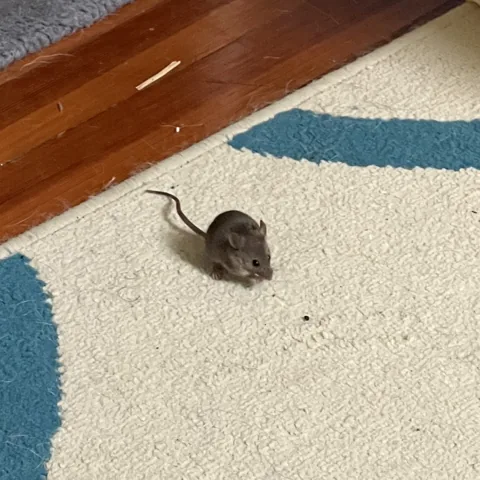 House Mouse
Mus musculus
The house mouse is a small, adaptable rodent that lives close to people in homes, schools and food businesses, eating and contaminating food, gnawing wiring and carrying disease.
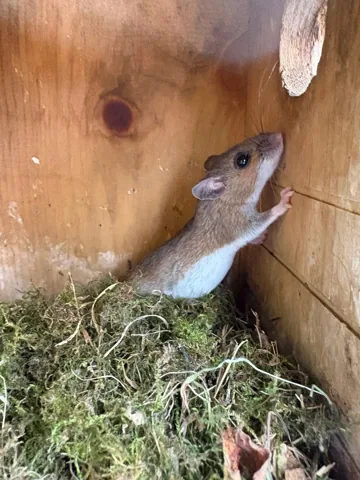 Deer Mouse
Peromyscus species (shown: P. maniculatus)
The deer mouse is a wild mouse with a white belly and a furred, two-toned tail that sometimes moves into cabins, sheds and homes. In the United States it spreads the most common hantavirus that causes hantavirus pulmonary syndrome (HPS), a severe and potentially deadly lung disease, so the droppings and nests it leaves need careful cleanup.
 Norway Rat
Rattus norvegicus
The Norway rat, also called the brown or sewer rat, is a large, burrowing rat found throughout the contiguous United States wherever people live.
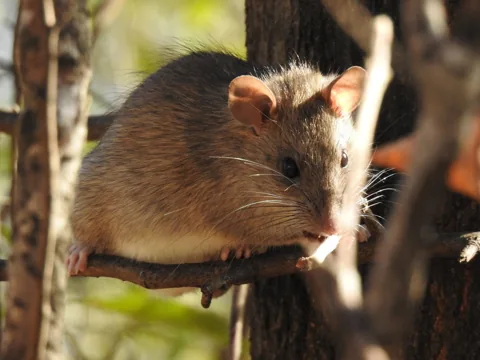 Roof Rat
Rattus rattus
The roof rat, also called the black or ship rat, is a sleek, agile climber that nests above ground in trees, ivy, attics and wall voids.
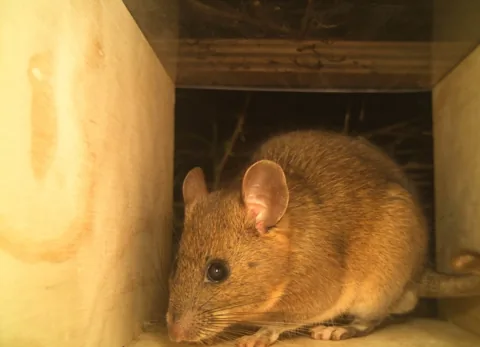 Woodrats
Neotoma species (e.g., N. fuscipes, N. lepida, N. floridana)
Woodrats, also called pack rats or trade rats, are native rats about the size of a Norway rat. They are a nuisance mainly around cabins, sheds and other little-used buildings and in parked vehicles, where they shred furnishings for nests and chew wires.
Why rodents end up in cars
CDC notes that rodents may nest in cars, trucks, campers and other vehicles, especially ones that are used infrequently, and that they can reach the passenger compartment through ducting, rusted areas and cable conduit. The garage around the car often supplies food: ICWDM notes that house mice in garages eat sacked or spilled pet food, grass seed and insects.[1][10]
- Wiring: Mississippi State Extension says mice and rats gnaw on wiring of any kind, in vehicles, equipment or buildings, causing shorts and electrical hazards. UC IPM says rats commonly gnaw the insulating sheaths of engine wires and cause similar damage to trucks, tractors and farm equipment.[14][6]
- Other parts: UC IPM's 2025 home and garden newsletter lists costly vehicle damage among the risks of urban rats and mice and shows a fuel line gnawed by rodents. NPIC advises checking unused cars for mice, which can damage wires and other parts.[9][12]
- Season: UC IPM says house mice often move into buildings in autumn when nights get colder, and that deer mice tend to enter vacated homes, cabins and other structures, where they nest and store food.[7][8]
The health risk: hantavirus and other diseases
People catch hantavirus mainly from contact with rodent urine, droppings and saliva, and CDC says rodent-borne diseases spread to people mostly when they breathe in contaminated air. Sweeping or vacuuming urine, droppings or nesting material can put tiny droplets containing virus into the air. That's why the cleanup steps below matter more than the trapping.[4][1][8]
- In the U.S., the hantavirus that most often causes hantavirus pulmonary syndrome is spread by the deer mouse. UC IPM calls deer mice the principal reservoir of Sin Nombre virus and notes that human cases are rare.[4][8]
- Hantavirus pulmonary syndrome can be deadly. CDC says 38 percent of people who develop respiratory symptoms may die; UC IPM gives a fatality rate of about 36 percent.[4][8]
- Symptoms usually start 1 to 8 weeks after contact with an infected rodent, with fatigue, fever and muscle aches, especially in the thighs, hips and back. Coughing and shortness of breath follow 4 to 10 days later. CDC says there is no specific treatment; patients get supportive care such as rest, hydration and treatment of symptoms.[4]
- CDC's prevention page says that if you have mice or rats in or around your home or vehicle, all urine, droppings, dead rodents and nesting material should be cleaned up safely. Our hantavirus safety page has the full CDC method for homes, sheds and cabins.[5][1]
Check a car that has been sitting
Before starting a vehicle that has been idle for a long time, CDC says to air it out first and inspect the air intakes and filters before starting the engine. Work in a well-ventilated space, wear plastic gloves and a long-sleeved shirt, and look in the interior as well as under the hood.[1]
- Open the hood, doors and trunk and let the interior and engine compartment air out for 20 minutes.[1]
- Remove the cables from the battery before inspecting the engine compartment, to avoid a shock. CDC suggests asking a qualified mechanic or automotive professional for help.[1]
- Look for nesting material, droppings, urine and dead rodents, and for chewed wires and other parts.[1][12][9]
- In the garage, signs include rat nests behind boxes or in drawers, droppings around pet food dishes or storage containers, and smudge marks where rats rub against beams, rafters, pipes and walls.[6]
- Gnawed wiring can cause shorts and electrical hazards, Mississippi State notes, so have a qualified mechanic look at any damage.[14][1]
Cleaning a nest out of the engine bay or cabin air filter
CDC's vehicle steps: don't use a vacuum or a high-pressure sprayer on rodent urine, droppings or contaminated surfaces until they have been disinfected. Use a household cleaner labeled as a disinfectant, or a fresh bleach solution of 1.5 cups of household bleach in 1 gallon of water (1 part bleach to 9 parts water).[1]
- Spray the nest, droppings and surrounding area with disinfectant until fully soaked, and let it sit for 5 minutes or as long as the label says.[1]
- Pick up the material with paper towels and put it in the garbage. For a dead rodent or a nest, CDC says to seal it in a plastic bag, tie it, place it in a second bag and put it in a covered garbage can that is emptied regularly.[1]
- Once droppings and nesting material are out, clean the rest of the area with more disinfectant. Reconnect the battery only when the area is dry.[1]
- Air intake and cabin air filter: if you find nesting material in the air intake system, CDC says to remove both the nest and the air filter, throw the nest in the garbage, and put in a new replacement filter.[1]
- Seats and carpets: CDC says to shampoo rugs and upholstered furniture with a commercial disinfectant or a commercial-grade steam cleaner or shampoo.[1]
- Fleas are common on rodents. CDC suggests an EPA-registered insect repellent such as DEET on clothing, shoes and hands when picking up dead rodents and nesting material.[1]
- Wash gloved hands with soap and water or disinfectant before taking the gloves off, then wash your hands with soap and warm water.[1]
- A heavy infestation calls for more protection. CDC lists coveralls, rubber boots or shoe covers, gloves, goggles and a half-mask air-purifying respirator with a HEPA filter. UC IPM says a cloth or paper mask gives some protection, but only an approved respirator with HEPA filters gives full respiratory protection against airborne viruses.[1][8]
Rodent-proof the garage
Exclusion lasts longest. UC IPM says all holes larger than 1/4 inch should be sealed to keep out both rats and mice, and CDC's seal-up advice includes outbuildings and garages as well as the house. House mice can squeeze under gaps 1/4 inch tall and through openings 3/8 inch wide; young rats can get under a door with a 1/2-inch gap and may gnaw a wooden door to widen it.[6][2][7]
- Doors: exterior doors should fit tightly and be sealed at the threshold, and UC IPM says entrances to garages should fit tightly too. Edges that get gnawed can be covered with sheet metal. Keep side doors to the garage closed, especially at night when deer mice and other rodents are most active.[6][8]
- Materials: use steel wool, hardware cloth, metal or concrete. Fill small holes with steel wool held in place with caulk; patch larger holes with hardware cloth, lath screen, metal sheeting or cement. Plastic screening, rubber, vinyl, expanding foam and wood are gnawable and won't stop mice.[2][7][10]
- Where to look: around pipes, vents and utility lines, gaps between the foundation and the ground, and in the rafters and eaves. Roof rats climb, so openings above ground level need sealing too.[2][6]
- Never use lightweight chicken wire on vents or openings: UC IPM says rats pass easily through it.[6]
- Our guides on getting rid of mice in the house and getting rid of rats cover sealing the rest of the building.[7][6]
Take away food and cover
ICWDM notes that in garages, house mice eat sacked or spilled pet food, grass seed and insects. Pet food is often the food source for rats around homes too.[10][11]
- Store pet food, birdseed, grains and animal feed in thick plastic, metal or glass containers with tight lids. ICWDM says galvanized steel cans in good condition resist rats better than vinyl or plastic.[2][11][12]
- Don't leave any kind of food anywhere in the car. CDC says it can attract rodents.[1]
- Reduce clutter. NPIC says clutter lets mouse activity go unnoticed and recommends removing cardboard boxes and newspapers that mice can nest in. UC IPM recommends tidy, off-the-ground storage, which also makes rats easier to spot.[12][6]
- Outside: CDC advises keeping woodpiles 100 feet or more from the house and raised at least a foot off the ground, trimming brush and weeds, and moving abandoned vehicles more than 100 feet from the home.[2]
Trapping in the garage
ICWDM and UC IPM call trapping the preferred method in homes, garages and other structures where only a few mice or rats are present. CDC recommends traditional snap traps and lists snap traps among the ways to stop rodents from getting into vehicles.[10][7][3][1]
- Set traps on the floor against the wall with the baited end next to the wall, forming a T. A small amount of chunky peanut butter works as bait. Rodents prefer to run along walls.[3]
- For mice, UC IPM suggests spacing traps no more than about 10 feet apart where mice are active, since house mice seldom go more than 30 feet from their nest and food.[7]
- Rats avoid new objects. CDC suggests baiting the traps without setting them until the bait is being taken, then setting them. Use traps sized for rats.[3]
- Check traps daily, and keep traps and baits out of reach of children and pets. CDC says not to use glue traps or live traps, because frightened rodents urinate, which raises the chance of getting sick.[3]
- If nothing is caught for a week and there are no new signs, CDC says the rodents are gone.[3]
- Our snap trap guide covers trap choice and setting in more detail.[3][7]
Poison baits near vehicles
CDC lists poison baits along with snap traps as effective for stopping rodents getting into vehicles, but advises using bait stations only for infestations that persist, with EPA-registered products used according to the label. Poison baits can be dangerous to people and animals.[1][3]
- ICWDM notes that mice hoard food and can carry grain or pelleted bait to places where it isn't found and can harm non-target animals; wax blocks can be secured inside stations. Choose tamper-resistant stations where children, pets or livestock are present.[10]
- NPIC says to read and follow rodenticide label directions, which is the law, and to try a lower-toxicity product first. Our bait station guide covers the rules for homeowners.[12]
Car covers, repellents and gadgets: what the sources say
Most deterrents sold for cars haven't held up when tested. The one physical option an extension source recommends is a barrier.[6][7][11]
- Weighted car cover: UC IPM suggests a weighted cover to keep rodents away from the engine and wires. It has to touch the ground and form a seal all the way around the vehicle, and UC IPM warns that longer-term control still depends on managing rats around the yard and neighborhood.[6]
- Ultrasonic devices: UC IPM says ultrasound is directional, doesn't reach behind objects and fades quickly with distance, and that there's little evidence sound, magnetic or vibrating devices drive out established mice or rats. ICWDM says some tests found rodents avoided the immediate area for a few days or longer, but ultrasound won't evict established rats and it doesn't recommend commercial ultrasonic devices.[7][11][8]
- Scent repellents: UC IPM says rats have an initial aversion to some odors and tastes but no repellent has solved a rat problem for more than a very short time, and that chemical repellents for deer mice aren't effective enough to justify the cost. ICWDM says little information exists on how well mint oil and other natural oils repel mice.[6][8][10]
- Mothballs: NPIC says naphthalene mothballs are solids that turn into a toxic gas, and their odor is thought to drive animals away in repellent products. Breathing the vapor has caused headaches, nausea, dizziness and vomiting, and enough exposure can cause hemolytic anemia. NPIC says to always follow label instructions, and loose mothballs are a hazard to children and pets, who may eat them.[13][12]
- Our bug zapper and electronic repeller page goes through the evidence on ultrasonic devices in more detail.[7][11]
Habits that help
Because rodents favor vehicles that aren't used often, the car that sits all winter or the camper in storage is the one to check most. A few routine steps catch problems early.[1][12]
- Before driving a vehicle that has been sitting, check the engine bay, air intake and cabin for nests.[1][12]
- House mice often move into buildings in autumn as nights turn colder, so fall is a good time to check the garage and set snap traps along the walls.[7][3]
- Keep trapping and sealing until signs stop. NPIC notes that mice learn by trial and error and that mouse control may take constant effort and a variety of methods.[12][3]
Common questions
- Why do mice and rats chew car wires?
- UC IPM says rats commonly chew the insulating sheaths of engine wires. A parked car gives them shelter, and Mississippi State notes they chew wiring of any kind in vehicles and equipment.[6][14]
- Is a mouse nest in my car's air filter dangerous?
- It can be. Rodent urine and droppings can carry hantavirus and other diseases, which spread mainly when contaminated dust is breathed in. CDC says to remove both the nest and the air filter after soaking the material with disinfectant, and to install a new filter.[1][4]
- Can I vacuum mouse droppings out of my car?
- Not until they have been disinfected. CDC says not to use a vacuum or high-pressure sprayer on rodent urine, droppings or contaminated surfaces until they have been soaked with disinfectant and wiped up.[1]
- Does peppermint oil keep mice out of cars?
- There's little evidence. ICWDM says little information exists on how well mint oil and similar natural oils repel mice, and UC IPM says no repellent has solved a rat problem for more than a very short time.[10][6]
- Do ultrasonic repellers work under the hood?
- Not reliably. UC IPM says ultrasound doesn't reach behind objects and there's little evidence such devices drive out established rodents, and ICWDM doesn't recommend commercial ultrasonic devices.[7][11]
- Should I put mothballs in my engine?
- NPIC describes naphthalene mothballs as solids that turn into a toxic gas that can make people ill, and says to always follow label instructions.[13][12]
Photo credits
- House Mouse: (c) Carrie Seltzer, some rights reserved (CC BY) — via iNaturalist, CC BY 4.0
- Deer Mouse: (c) Derek Duplessis, some rights reserved (CC BY) — via iNaturalist, CC BY 4.0
- Norway Rat: petehawkins, public domain (CC0), via iNaturalist
- Roof Rat: (c) Laura Mae, some rights reserved (CC BY) — via iNaturalist, CC BY 4.0
- Woodrats: Andy Kleinhesselink, public domain (CC0), via iNaturalist
Sources
- Centers for Disease Control and Prevention, “How to Clean Up After Rodents (includes How to Inspect and Disinfect a Vehicle).” www.cdc.gov/healthy-pets/rodent-control/clean-up.html (accessed 2026-11-10)
- Centers for Disease Control and Prevention, “How to Seal Up to Prevent Rodents.” www.cdc.gov/healthy-pets/rodent-control/seal-up.html (accessed 2026-11-10)
- Centers for Disease Control and Prevention, “How to Trap Up to Remove Rodents.” www.cdc.gov/healthy-pets/rodent-control/trap-up.html (accessed 2026-11-10)
- Centers for Disease Control and Prevention, “About Hantavirus.” www.cdc.gov/hantavirus/about/index.html (accessed 2026-11-10)
- Centers for Disease Control and Prevention, “Hantavirus Prevention.” www.cdc.gov/hantavirus/prevention/index.html (accessed 2026-11-10)
- University of California Statewide IPM Program, “Pest Notes: Rats.” ipm.ucanr.edu/home-and-landscape/rats/ (accessed 2026-11-10)
- University of California Statewide IPM Program, “Pest Notes: House Mouse, Publication 7483.” ipm.ucanr.edu/legacy_assets/PDF/PESTNOTES/pnhousemouse.pdf (accessed 2026-11-10)
- University of California Statewide IPM Program, “Pest Notes: Deer Mouse.” ipm.ucanr.edu/legacy_assets/PDF/PESTNOTES/pndeermouse.pdf (accessed 2026-11-10)
- University of California Statewide IPM Program, “Home & Garden Pest Newsletter, Fall 2025 (rodent management).” ipm.ucanr.edu/legacy_assets/pdf/pubs/fall_2025-home-garden-pest-newsletter.pdf (accessed 2026-11-10)
- Internet Center for Wildlife Damage Management, “House Mouse Damage Prevention and Control Methods.” icwdm.org/species/rodents/house-mice/house-mouse-damage-prevention-and-control-methods/ (accessed 2026-11-10)
- Internet Center for Wildlife Damage Management, “Norway Rat Damage Prevention and Control Methods.” icwdm.org/species/rodents/norway-rats/norway-rat-damage-prevention-and-control-methods/ (accessed 2026-11-10)
- National Pesticide Information Center, “Mice.” npic.orst.edu/pest/mice.html (accessed 2026-11-10)
- National Pesticide Information Center, “Naphthalene General Fact Sheet.” npic.orst.edu/factsheets/naphgen.html (accessed 2026-11-10)
- Mississippi State University Extension Service, “Controlling Mice & Big Ole Rats (Dawg Tracks Safety Talk, 2021).” extension.msstate.edu/newsletters/dawg-tracks-safety-talk/2021/controlling-mice-big-ole-rats (accessed 2026-11-10)