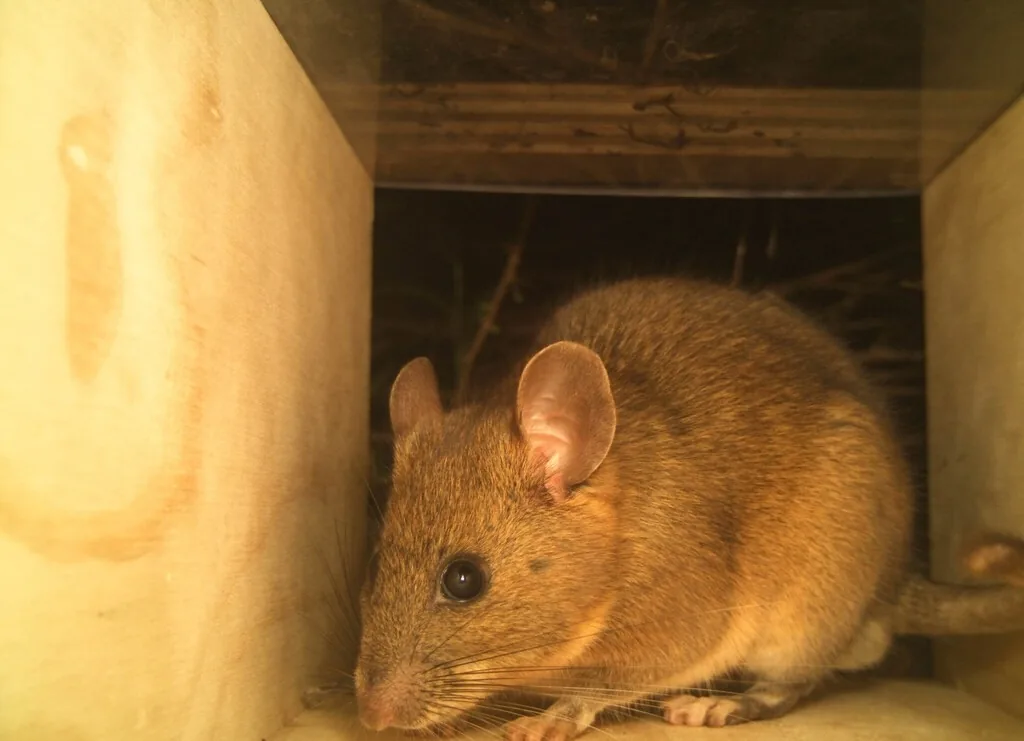
How to identify it
- A hairy tail rather than a scaly one, plus soft, fine fur and large ears, separates woodrats from Norway and roof rats.[1][5]
- They usually have light-colored feet and bellies.[1]
- Large houses or dens of sticks, built on the ground, in trees or among rocks, with a nest of finely shredded plant material inside.[2]
- Piles of collected objects near the den, called middens, often including shiny items such as can tabs, utensils or jewelry.[2][3]
- Trails 3 to 4 inches wide may run from a building where they nest to their outdoor feeding areas.[2]
Look-alikes
| Look-alike | How to tell them apart |
|---|---|
| Norway rat | Similar in size, but the Norway rat has a scaly, mostly hairless tail and coarser fur.[1][5] |
| Roof rat | Also has a scaly, mostly hairless tail, unlike the furry tail of a woodrat.[5] |
Where it lives
Eight woodrat species occur in North America, from low, hot deserts to rocky slopes above timberline; in California the dusky-footed and desert woodrats are the most common.[1][2][5]
Biology and life cycle
Woodrats climb readily and are usually active at night.[2]
Breeding usually happens in spring, with 1 to 4 young per litter and sometimes more than one litter a year in the southern U.S.[2]
Each den is usually occupied by one animal or a female and her young, and one woodrat may use several dens.[2]
Diets differ by species, from green plants, twigs and shoots to seeds, fruits, acorns and cactus, and they may raid human food in buildings.[2]
They show little fear of new objects, which makes them easy to trap.[4]
Damage and signs
- They pack away small objects such as jewelry, utensils and can tabs, which can annoy cabin owners and backpackers.[3]
- They shred upholstered furniture and mattresses to line their nests.[3]
- They move into parked vehicles and gnaw on wires and other mechanical parts.[3]
- In some areas they clip twigs and strip bark from citrus, fruit trees and young conifers, sometimes killing trees.[3]
Health risk
Woodrats can help spread plague where the disease occurs, mostly in rural and semi-rural parts of the western U.S., usually through flea bites; don't handle dead or dying woodrats.[3][6][5]
Control
Keep them out
Exclusion is the most effective way to stop damage in buildings: seal every gap larger than 1/2 inch, including attic vents, broken shingles and gaps near the eaves, because woodrats climb well.[4]
Plug holes with coarse steel wool, wire screen or light sheet metal, not plastic or wood, which they gnaw through, and fit doors, windows and screens tightly.[4]
Make sure no woodrat is shut inside; a hinged one-way flap over the entry lets it push out but not return.[4]
Sanitation
Store food in rodent-proof containers and keep garbage and refuse properly stored.[4]
Traps and physical control
Most problems in buildings can be solved with one or a few standard rat snap traps baited with nuts, peanut butter and oatmeal, or dried fruit tied to the trigger.[4]
Releasing live-trapped woodrats is not recommended and may break local wildlife rules; relocated animals often die anyway.[4]
Pesticides
Anticoagulant baits made for Norway and roof rats generally control woodrats; use meal or paraffin block baits fastened down, since woodrats cache pellets, and keep baits away from children and pets.[4]
Legal status
Woodrats are nongame animals that most states allow landowners to control when they damage property, but some subspecies are protected, such as the federally endangered Key Largo woodrat.[1]
Check with your state wildlife or agriculture department before starting control.[1]
What doesn't work
No woodrat repellents are registered by the EPA, and repellents in general aren't a practical fix.[4]
Tearing apart nests is time-consuming and of limited value, though it can help discourage new woodrats once the residents are controlled.[4]
Common questions
- How can I tell a packrat from a regular rat?
- Look at the tail. Woodrats, or pack rats, have furry tails, while Norway and roof rats have scaly, mostly hairless tails.[5][1]
- Why are rats chewing wires in my parked car?
- Woodrats often move into parked vehicles, especially at cabins and other little-used sites, and gnaw on wires and other parts.[3]
- Do woodrats carry plague?
- They can. Woodrats are among the wild rodents that carry plague in the western U.S., so never handle dead or dying woodrats.[6][3]
Sources
- Internet Center for Wildlife Damage Management, “Woodrats: Identification.” icwdm.org/species/rodents/woodrats/ (accessed 2026-10-06). Run by university wildlife damage specialists (maintained at the University of Wisconsin-Stevens Point); species modules are based on Prevention and Control of Wildlife Damage (University of Nebraska Cooperative Extension, 1994).
- Internet Center for Wildlife Damage Management, “Woodrat Biology.” icwdm.org/species/rodents/woodrats/woodrat-biology/ (accessed 2026-10-06). Run by university wildlife damage specialists (maintained at the University of Wisconsin-Stevens Point); species modules are based on Prevention and Control of Wildlife Damage (University of Nebraska Cooperative Extension, 1994).
- Internet Center for Wildlife Damage Management, “Woodrat Damage Identification.” icwdm.org/species/rodents/woodrats/woodrat-damage-identification/ (accessed 2026-10-06). Run by university wildlife damage specialists (maintained at the University of Wisconsin-Stevens Point); species modules are based on Prevention and Control of Wildlife Damage (University of Nebraska Cooperative Extension, 1994).
- Internet Center for Wildlife Damage Management, “Woodrat Damage Prevention and Control Methods.” icwdm.org/species/rodents/woodrats/woodrat-damage-prevention-and-control-methods/ (accessed 2026-10-06). Run by university wildlife damage specialists (maintained at the University of Wisconsin-Stevens Point); species modules are based on Prevention and Control of Wildlife Damage (University of Nebraska Cooperative Extension, 1994).
- University of California Statewide IPM Program, “Pest Notes: Rats, Publication 74106 (revised June 2024).” ipm.ucanr.edu/legacy_assets/PDF/PESTNOTES/pnrats.pdf (accessed 2026-10-06)
- Centers for Disease Control and Prevention, “How Plague Spreads (updated May 15, 2024).” www.cdc.gov/plague/causes/index.html (accessed 2026-10-06)
- iNaturalist, “Neotoma taxon page (order and family).” www.inaturalist.org/taxa/44737 (accessed 2026-10-06)