The short answer
- Confirm it's mice: look for droppings in cabinets, drawers and along walls, gnaw marks, shredded nesting material and a musky smell.[8][3][1]
- Set snap traps along walls where you see droppings, with the trigger end against the wall. Use plenty of traps, a small dab of bait, and check them daily.[10][1][4]
- Seal every gap larger than 1/4 inch. Steel wool, hardware cloth, sheet metal and cement keep mice out; foam, rubber, vinyl and wood alone get chewed through.[1][9][4]
- Keep food, pet food and garbage in containers with tight lids, and don't leave pet bowls out overnight.[9][1]
- Never sweep or vacuum droppings. Spray them with a bleach solution or disinfectant, let it soak, and wipe up with paper towels while wearing gloves.[7][2]
- Poison baits are a last step for infestations that persist. Homeowner products come only in ready-to-use bait stations, and they are dangerous to children, pets and wildlife.[10][11][12]
Rodent profiles
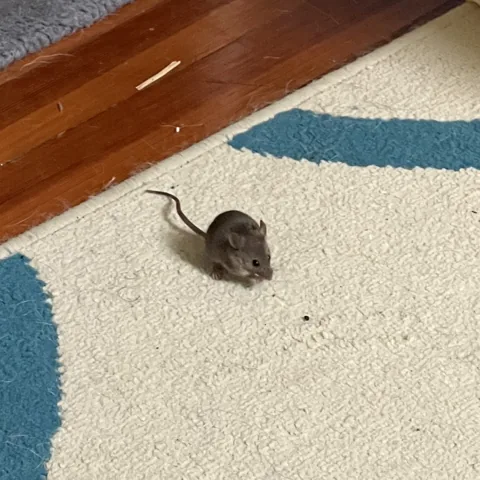 House Mouse
Mus musculus
The house mouse is a small, adaptable rodent that lives close to people in homes, schools and food businesses, eating and contaminating food, gnawing wiring and carrying disease.
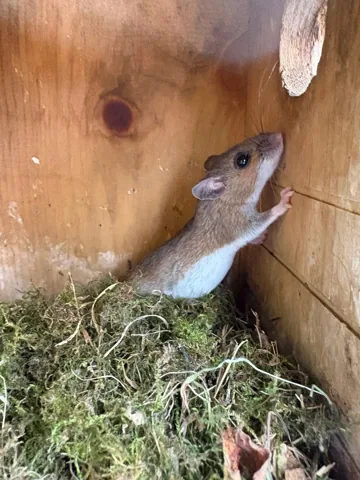 Deer Mouse
Peromyscus species (shown: P. maniculatus)
The deer mouse is a wild mouse with a white belly and a furred, two-toned tail that sometimes moves into cabins, sheds and homes. In the United States it spreads the most common hantavirus that causes hantavirus pulmonary syndrome (HPS), a severe and potentially deadly lung disease, so the droppings and nests it leaves need careful cleanup.
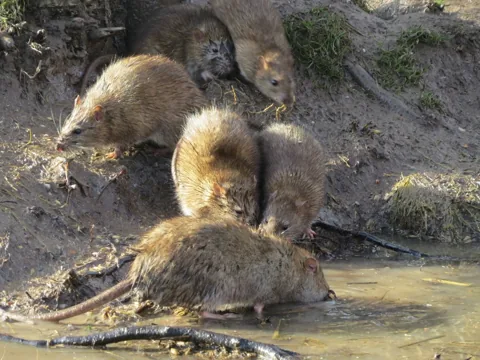 Norway Rat
Rattus norvegicus
The Norway rat, also called the brown or sewer rat, is a large, burrowing rat found throughout the contiguous United States wherever people live.
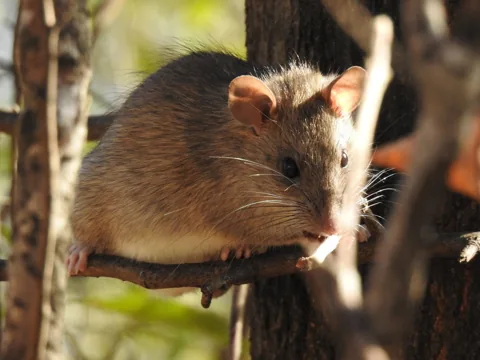 Roof Rat
Rattus rattus
The roof rat, also called the black or ship rat, is a sleek, agile climber that nests above ground in trees, ivy, attics and wall voids.
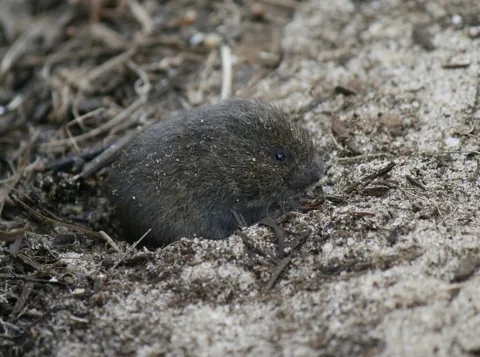 Voles (meadow mice)
Microtus species (shown: meadow vole, M. pennsylvanicus)
Voles, often called meadow mice, are small burrowing rodents that live in dense grass and ground cover. Their clearest sign is a maze of narrow surface runways, and they damage lawns, garden plants and the bark of young trees.
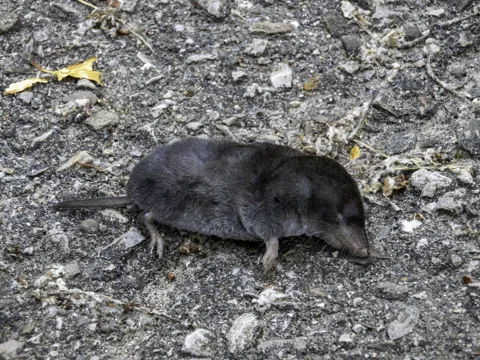 Shrews (northern short-tailed shrew)
Soricidae (e.g., Blarina brevicauda)
Shrews are small insect-eating mammals with long, pointed snouts and tiny eyes. They are mouselike but not mice, and the wildlife damage handbook notes that most species have no significant negative impact and aren't abundant enough to be pests. They eat large numbers of insects, including lawn and crop pests. This page uses the common northern short-tailed shrew as its main example.
Signs you have mice
The first signs of rodents usually show up before you ever see one. House mice are active mostly at night, though you may occasionally see one during the day.[8][1]
- Droppings: house mouse droppings average 1/4 inch long. CDC describes rodent droppings as pointed at one end and often containing hair, and says they're common in cabinets, drawers and other places out of plain sight. Cockroach droppings can be the same size but have ridges along their length and squared-off ends.[3][8]
- Old or new? Droppings alone don't tell you whether mice are still there. CDC suggests cleaning the area safely and checking again: droppings that reappear mean mice are active.[8]
- Gnawing: mice gnaw to get through materials and keep their teeth worn down. Look for gnaw marks in corners, on doors, ledges and stored items, and for fresh shavings of wood or insulation. Gnaw marks alone may only mean mice were there at some point.[3][8]
- Sounds: gnawing and climbing inside walls, running across the top of ceilings, and squeaks.[3]
- Nests: finely shredded paper or other fibrous material in sheltered spots such as garages, closets, attics and basements.[1][3]
- Smell and smudges: a musky odor is typical of house mice, especially in large or long-term infestations. Smudge marks from oil and dirt on their fur can build up along routes where mice rub against beams, pipes and walls.[1][3]
- Tracks: footprints and tail marks show up on dusty surfaces. A thin layer of flour smoothed over a suspected path overnight can confirm activity.[3]
Why a few mice become many
House mice are small, agile and fast-breeding. Outdoor mice often move indoors in autumn as nights get colder, and with steady food and shelter they breed year-round.[1]
- Breeding: a female may have 5 to 10 litters of about 5 or 6 pups in a year, and young mice can breed at 5 to 6 weeks old.[1]
- Small gaps: UC IPM says house mice squeeze under gaps 1/4 inch tall and through openings 3/8 inch wide. CDC puts it as a hole the width of a pencil (1/4 inch, or 6 millimeters).[1][9]
- Climbing: mice climb rough vertical surfaces, run along wires and ropes and can jump up to 12 inches onto a flat surface.[1]
- Small territory: house mice seldom travel more than 30 feet from their nest and food, which is why traps and baits have to go where the mice actually are.[1]
- Little need for water: house mice can get by on the moisture in their food.[1]
- Health and damage: house mice contaminate food and can carry leptospirosis, salmonella and lymphocytic choriomeningitis (LCM). Their urine is a major source of allergens linked to asthma in sensitive children, and gnawed wires are believed to start some fires.[1][8]
House mouse or deer mouse? Why it matters (hantavirus)
Most mice in homes are house mice, but deer mice also get into buildings, especially cabins, sheds and homes near fields or woods. Telling them apart matters because the deer mouse spreads the most common hantavirus that causes hantavirus pulmonary syndrome (HPS) in the United States.[1][2][5]
- House mouse: gray-brown overall with a gray or buff belly, small black eyes, fairly large ears and a tail with almost no fur. Adults are about 5 to 7 inches long, including a 3- to 4-inch tail.[1][3]
- Deer mouse: brown back with a white belly, legs and feet, and a sharp line where the colors meet. The tail is furred and two-toned, dark on top and white underneath, and the eyes and ears are larger. UC IPM calls the bicolored tail the easiest feature to check.[1][2]
- Habits: deer mice aren't usually found in towns unless parks, fields or forests are nearby, and they often move into vacant homes, cabins and outbuildings. They store seeds, acorns and nuts more than house mice do, which can help tell whose damage you're seeing.[2]
- How hantavirus spreads: when fresh urine, droppings or nesting material from an infected rodent is stirred up, the virus gets into the air and people breathe it in. It can also enter through cuts or the eyes, nose or mouth, and rarely through a bite.[6][5]
- How serious: HPS symptoms usually start 1 to 8 weeks after contact with an infected rodent and begin with fatigue, fever and muscle aches that are easily confused with the flu; coughing and shortness of breath follow. CDC says 38% of people who develop respiratory symptoms may die; UC IPM gives a fatality rate of about 36%. Human cases are rare.[5][2]
- What to do: if you get sick after cleaning up after rodents, see a doctor right away and mention the rodent exposure.[5][7]
- Either way, clean carefully. Hantavirus is linked to deer mice, not house mice, but droppings and urine from any mouse can carry other germs, so use the same cleanup steps for both.[4][8]
Step 1: Seal the gaps (exclusion)
UC IPM calls exclusion the most successful and permanent form of house mouse control. Trapping without sealing leaves the door open for the next mice.[1][2]
Inside, CDC says to check under and behind kitchen cabinets, closet corners, around pipes under sinks and washing machines and those leading to water heaters and furnaces, around floor vents and dryer vents, floor drains, and where floors meet walls. Outside, check rafters, gables, eaves and soffits, windows and doors without weather stripping, the joint between foundation and ground, attic and crawl space vents, and holes for electrical, plumbing, cable and gas lines.[9]
- Size to seal: any gap or opening larger than 1/4 inch.[1][4][2]
- Small holes: stuff with steel wool. CDC says to put caulk around it or use spray foam to hold it in place. UC IPM notes steel wool makes a good temporary plug but may rust; ICWDM suggests stainless steel or copper wool.[9][1][4]
- Larger holes: cover with hardware cloth (1/4-inch mesh), lath screen, sheet metal or cement, cut to fit around pipes.[9][4]
- Foundation and utility openings: seal cracks in the foundation and around water pipes, vents and utility cables with metal or concrete.[1]
- Doors and windows: make sure doors, windows and screens fit tightly; CDC lists doors and windows without weather stripping among the places to check. The edges of doors and windows may need a metal covering to stop gnawing.[1][9]
- What doesn't hold: plastic screening, rubber, vinyl, insulating foam and wood can be gnawed and don't work as plugs on their own. ICWDM says expanding foam reduces heat loss but won't stop mice, which is why CDC uses foam only to hold steel wool in place.[1][4][9]
- Don't forget the garage, shed and other outbuildings, and fix gaps in trailer skirting.[9]
Step 2: Take away food and shelter
Cleaning up seldom gets rid of mice on its own, since they can live on very little food. But poor sanitation lets them thrive in larger numbers, and removing other food makes traps and baits work better.[1][4]
- Food: keep it in thick plastic, metal or glass containers with tight lids, clean up spills right away and wash dishes soon after use.[9]
- Pet food: put it away after feeding and don't leave food or water bowls out overnight. Store bulk pet food, grain and animal feed in metal or thick plastic containers with tight lids.[9][4]
- Garbage: use thick plastic or metal cans with tight lids, inside and out, and empty them often.[9]
- Clutter: reduce the places mice can hide, rest and build nests. If they have few places to shelter, they can't survive in large numbers.[1][8]
- Outside: CDC recommends keeping compost bins and woodpiles at least 100 feet from the house, raising firewood at least a foot off the ground, keeping bird feeders away from the house, and trimming grass and shrubs near the home.[9]
Step 3: Trap with snap traps
For a home with a few mice, trapping is the preferred method. It doesn't rely on poisons, you can see that it's working, and you remove the bodies instead of having mice die and smell inside the walls. CDC recommends traditional snap traps for reducing rodents around the home.[1][4][10]
- Bait: UC IPM says the best bait is often the food the mice are already eating. Peanut butter is popular and easy to use, though it can be a problem for people with peanut allergies. ICWDM also lists marshmallows, hot dog, bacon and nutmeats, and CDC suggests chunky peanut butter.[1][4][10]
- Nest material as bait: a small ball of cotton or dental floss on the trigger can work, because females building nests are drawn to it.[1]
- Use a small amount on the trigger. Too much lets the mouse lick the bait off without setting off the trap.[1]
- Placement: put traps against the wall with the trigger end touching the wall, so the trap forms a T with it, in dark corners, behind appliances and objects, in the back of cabinets and drawers, and anywhere you've found droppings or gnawing.[10][1][4]
- Doubles: set two traps side by side 1 to 2 inches apart to catch mice that jump over the first one.[1]
- How many and how far apart: use enough traps to make trapping short and decisive. UC IPM says to space them no more than about 10 feet apart where mice are active; ICWDM says no more than 6 feet. For deer mice, UC IPM says a dozen or more traps may be needed for a large population.[1][4][2]
- Trigger: traps with a wide or expanded trigger plate catch more mice. Set the trigger lightly so it springs easily.[1][4]
- Optional pre-baiting: ICWDM suggests leaving traps baited but unset until the bait has been taken once, so fewer mice escape and become trap-shy. Mice are less wary of new objects than rats.[4][10]
- Safety: keep traps out of reach of children and pets, in spots where they're unlikely to touch them.[10][1]
- Checking: check traps every day and remove dead mice using the cleanup steps below. Keep resetting until activity stops. CDC considers the problem solved when nothing is caught for a week and no new droppings or gnawing appear.[10][7]
- Other kill traps: battery-powered electrocution traps cost more but some homeowners find they control mice well. Check them often too.[1][2]
- Live traps: multiple-catch live traps are sold, but CDC advises against live traps because frightened mice urinate. UC IPM says releasing mice is ineffective, since mice moved as far as half a mile can find their way back, and in California it's illegal to relocate them without a permit.[10][1]
Glue traps: why sources discourage them
Glue boards catch mice that walk across them, the way flypaper catches flies. CDC advises against them, and extension sources list several drawbacks.[1][4]
- Slow death: UC IPM says mice caught on glue boards may not die quickly and will need to be euthanized. It says drowning isn't humane even though some manufacturers suggest it, and that few options meet ethical guidelines for euthanizing trapped animals.[1]
- Disease risk: CDC says not to use glue traps or live traps because they scare rodents into urinating, which can raise your risk of getting sick. UC IPM says to avoid glue boards for deer mice because struggling mice increase the chance of hantavirus exposure.[10][2]
- Poor results: ICWDM says glue boards catch fewer mice than other traps and shouldn't be the main tool. UC IPM adds that adult mice often detect and avoid the glue, so glue boards catch mostly young mice. Dust and extreme temperatures reduce their stickiness.[4][1]
- Nontarget catches: keep them away from children, pets and wildlife. Vegetable oil loosens the glue to free an animal caught by mistake. ICWDM notes that some organizations oppose glue boards altogether.[1][4]
Bait stations and rodenticides: rules and risks
CDC advises using poison baits only for mouse infestations that persist after trapping. Before using them, think about where the mice will die: house mice stay within about 30 feet of their nest, so poisoned mice often die inside walls and ceilings, where they can cause odor problems. In that case trapping may be the better approach.[10][1]
Rodenticides work the same way in any mammal, so they can poison children, dogs and cats, and they can also affect birds. Baits are flavored to attract animals, sometimes with fish oil, molasses or peanut butter, and NPIC notes that dogs may dig them up.[12]
- What homeowners can buy: EPA says consumer rodenticides are sold only as ready-to-use bait stations holding block or paste bait. Pelleted baits are no longer allowed in consumer products. The consumer active ingredients EPA lists are bromethalin, chlorophacinone and diphacinone.[11]
- Where they can go: consumer bait stations are labeled for indoor use, or for indoors and outdoors within 50 feet of buildings, depending on whether the station passed tests for tamper resistance by young children and dogs and for weather resistance. Read the label before you buy.[11]
- Station types: NPIC notes that some stations resist only children, some resist children and pets, and others resist children, pets and weather. ICWDM says to fasten stations to a wall or floor so they can't be knocked over and spill bait.[12][4]
- Professional-only products: second-generation anticoagulants (brodifacoum, bromadiolone, difenacoum and difethialone) are no longer registered for consumer products because they stay in animal tissues longer and pose greater risks to nontarget animals. They are sold only for professional and agricultural use. Labels on professional and agricultural rodenticides require tamper-resistant stations wherever children under 6, pets or nontarget wildlife could reach the bait.[11]
- How long it takes: anticoagulants usually kill 4 days to 2 weeks after rodents start feeding. ICWDM notes labels commonly direct users to keep a continuous supply of bait for 15 days or until feeding stops, and that stations should be within 20 to 30 feet of each other where mice are active.[11][4]
- Secondary poisoning: pets and wildlife can be poisoned by eating a poisoned mouse. NPIC lists difethialone, brodifacoum and possibly bromadiolone as high secondary risks to birds such as hawks and owls, and chlorophacinone, diphacinone, bromadiolone and brodifacoum as the greatest secondary risks to wild mammals, dogs and cats. Bromethalin and cholecalciferol may pose secondary risks that haven't been measured, and UC IPM cites evidence that bromethalin can pass up the food chain to predators.[12][1]
- Reduce the risk: store rodenticides out of reach of children and pets, follow the label, and search for and dispose of dead rodents (with gloves) so pets and wildlife don't eat them.[12][1]
- Tracking powders: ICWDM says these are available only to licensed applicators and generally aren't recommended in and around homes because of the hazard to children and pets.[4]
- If a child or pet eats bait: follow the first aid on the label and call Poison Control at 800-222-1222. NPIC (800-858-7378) can answer questions about a suspected pet or wildlife poisoning.[12]
Do ultrasonic and electronic repellers work?
The evidence says no, not as a fix for mice already living in the house. UC IPM says there is little evidence that sound, magnetic or vibrating devices of any kind drive established mice or rats out of buildings or prevent them.[1]
Ultrasound is directional, doesn't reach behind objects or around corners, and fades quickly with distance. Mice are frightened by strange noises but get used to sounds they hear repeatedly. ICWDM says some tests found rodents avoided the immediate area for a few days, and that commercial ultrasonic devices aren't recommended as a solution. UC IPM's deer mouse guide says ultrasonic and other frightening devices aren't effective, and outdoor chemical repellents aren't effective enough to justify the cost.[1][4][2]
Cats and dogs don't solve it either. Some catch mice, but they rarely control a population, because mice find plenty of places to hide and raise young out of reach.[1][4]
Step 4: Clean up droppings and nests safely (CDC method)
Don't sweep or vacuum mouse droppings, urine or nests. Disease spreads mainly when people breathe in contaminated dust, and sweeping or vacuuming puts tiny particles into the air.[7][2]
- Air it out: in a cabin, shed or other building that has been closed up, open the doors and windows for 30 minutes before cleaning and leave while it airs out.[7][2]
- Gear: wear rubber, latex, vinyl or nitrile gloves. Use extra precautions for heavy infestations. UC IPM notes that only an approved respirator with HEPA filters gives full protection against airborne viruses; a cloth or paper mask gives some protection.[7][2]
- Disinfectant: use a household disinfectant whose label says "disinfectant," or mix fresh bleach solution: 1.5 cups of household bleach in 1 gallon of water (1 part bleach to 9 parts water).[7][2]
- Soak: spray droppings, urine, nests and dead mice until very wet. CDC says to let it soak for 5 minutes or as the disinfectant label directs; UC IPM's deer mouse guide says 10 minutes.[7][2]
- Wipe and bag: pick up the waste with paper towels and throw them in a covered trash can. Mop or sponge floors, counters, cabinets and drawers with disinfectant.[7]
- Dead mice and nests: after soaking, put the mouse or nest in a plastic bag with any used trap, tie it shut, put it in a second bag, tie that too, and throw it in a covered trash can. CDC suggests insect repellent on clothes and hands, since rodents often carry fleas.[7]
- Reusing snap traps: wearing gloves, soak the trap with the mouse in disinfectant in a bucket for 5 minutes, drop the mouse into a bag, then rinse and dry the trap.[7]
- Finish: wash gloved hands with soap and water or disinfectant before taking the gloves off, then wash your hands with soap and warm water.[7][2]
- Soft items: UC IPM says upholstered furniture and carpets can be shampooed or steam-cleaned. CDC says to throw out cardboard boxes soiled with urine or droppings and bag contaminated insulation.[2][7]
When to call a pro
- Traps aren't working: CDC says if trapping doesn't resolve the infestation, consider a bait station or professional help.[10]
- Mice in places you can't reach: CDC suggests a pest control specialist when rodents have gotten into areas you can't clean, and a professional when they've been in heating and cooling ducts.[9][7]
- Heavy infestations: CDC says heavy infestations need extra cleanup precautions. Second-generation anticoagulant baits are sold only for professional use, and tracking powders only to licensed applicators.[7][11][4]
- Hiring: ICWDM notes that most states require a commercial pesticide applicator license to apply rodenticides as a business.[4]
- Questions about your situation: your local or state health department can help if you're concerned about a rodent infestation.[9][7]
Common questions
- What's the fastest way to get rid of mice in the house?
- Set plenty of snap traps against walls where you find droppings, check them daily, and seal gaps larger than 1/4 inch at the same time. UC IPM calls trapping a great first step for homes with a few mice and exclusion the most permanent fix.[1][10]
- How do I know the mice are gone?
- CDC says the problem is solved when no rodents have been caught for a week and there are no new droppings, urine spots or gnawing. Cleaning old droppings first makes new ones easy to spot.[10][8]
- Is it safe to vacuum mouse droppings?
- No. CDC says not to vacuum or sweep rodent droppings, urine or nests because it can put virus particles into the air. Spray with disinfectant or bleach solution, let it soak, and wipe up with paper towels while wearing gloves.[7][2]
- Do house mice carry hantavirus?
- The hantavirus that most often causes HPS in the United States is spread by deer mice, not house mice. House mice can carry other diseases, such as LCM and salmonella, so clean up after any mouse the same careful way.[5][4][1]
- Are mouse poisons safe around kids and pets?
- No rodenticide is safe for them. Rodenticides affect any mammal, and baits are flavored to attract animals. Homeowner products come only in ready-to-use bait stations, which must be placed where the label allows. Pets and wildlife can also be poisoned by eating poisoned mice. UC IPM notes that trapping avoids relying on potentially hazardous rodenticides.[12][11][1]
Photo credits
- House Mouse: (c) Carrie Seltzer, some rights reserved (CC BY) — via iNaturalist, CC BY 4.0
- Deer Mouse: (c) Derek Duplessis, some rights reserved (CC BY) — via iNaturalist, CC BY 4.0
- Norway Rat: petehawkins, public domain (CC0), via iNaturalist
- Roof Rat: (c) Laura Mae, some rights reserved (CC BY) — via iNaturalist, CC BY 4.0
- Voles (meadow mice): (c) David LaMagna, some rights reserved (CC BY) — via iNaturalist, CC BY 4.0
- Shrews (northern short-tailed shrew): (c) Shaun Coleman, some rights reserved (CC BY) — via iNaturalist, CC BY 4.0
Sources
- University of California Statewide IPM Program, “Pest Notes: House Mouse (Publication 7483, rev. July 2025).” ipm.ucanr.edu/legacy_assets/PDF/PESTNOTES/pnhousemouse.pdf (accessed 2026-11-10)
- University of California Statewide IPM Program, “Pest Notes: Deer Mouse (Publication 74161).” ipm.ucanr.edu/legacy_assets/PDF/PESTNOTES/pndeermouse.pdf (accessed 2026-11-10)
- Internet Center for Wildlife Damage Management, “House Mice: Identification and Damage Signs.” icwdm.org/species/rodents/house-mice/ (accessed 2026-11-10)
- Internet Center for Wildlife Damage Management, “House Mouse Damage Prevention and Control Methods.” icwdm.org/species/rodents/house-mice/house-mouse-damage-prevention-and-control-methods/ (accessed 2026-11-10)
- U.S. Centers for Disease Control and Prevention, “About Hantavirus.” www.cdc.gov/hantavirus/about/index.html (accessed 2026-11-10)
- U.S. Centers for Disease Control and Prevention, “Hantavirus Prevention.” www.cdc.gov/hantavirus/prevention/index.html (accessed 2026-11-10)
- U.S. Centers for Disease Control and Prevention, “How to Clean Up After Rodents.” www.cdc.gov/healthy-pets/rodent-control/clean-up.html (accessed 2026-11-10)
- U.S. Centers for Disease Control and Prevention, “Controlling Wild Rodent Infestations.” www.cdc.gov/healthy-pets/rodent-control/index.html (accessed 2026-11-10)
- U.S. Centers for Disease Control and Prevention, “How to Seal Up to Prevent Rodents.” www.cdc.gov/healthy-pets/rodent-control/seal-up.html (accessed 2026-11-10)
- U.S. Centers for Disease Control and Prevention, “How to Trap Up to Remove Rodents.” www.cdc.gov/healthy-pets/rodent-control/trap-up.html (accessed 2026-11-10)
- U.S. Environmental Protection Agency, “Restrictions on Rodenticide Products.” www.epa.gov/rodenticides/restrictions-rodenticide-products (accessed 2026-11-10)
- National Pesticide Information Center, “Rodenticides Fact Sheet.” npic.orst.edu/factsheets/rodenticides.html (accessed 2026-11-10)