The short answer
- Cluster flies, Asian lady beetles, brown marmorated stink bugs and boxelder bugs spend the winter in wall voids and attics. Warm days or a turned-up thermostat wake them and they wander into rooms. They do not reproduce indoors; every one you see came in the previous fall.[6][8][2][3][10][9]
- For those overwintering insects, vacuum them up as they appear. Indoor sprays and bug bombs don't help, and sealing the house is a late-summer job, not a winter one.[1][2][11][3]
- Mice are different. House mice often move into homes in autumn when nights turn cold, and with steady food and shelter they can breed year-round, so act as soon as you see signs.[12][14]
- Carpet beetles, clothes moths and pantry moths or beetles breed in the house itself. UC IPM says heated buildings let clothes moths keep developing through the winter. Finding and removing the infested item is the fix.[21][22][25]
- Spiders seen in winter are mostly house-dwelling species or wanderers looking for shelter. They follow the insects, so fewer bugs indoors means fewer spiders.[19][11][20]
Winter pest profiles on this site
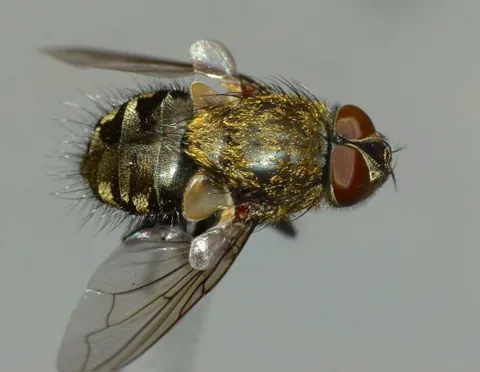 Cluster Fly
Pollenia species (e.g., P. rudis)
Cluster flies gather on the sunny sides of buildings in fall to find places to overwinter and then appear indoors, often in large numbers, on warm days through winter and spring. They do not breed indoors.
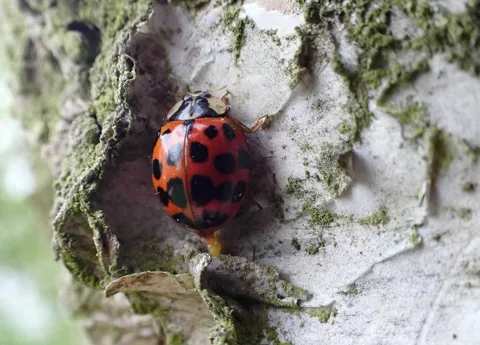 Multicolored Asian Lady Beetle
Harmonia axyridis
The multicolored Asian lady beetle is a beneficial aphid predator outdoors but becomes a nuisance when it flies to buildings in fall to overwinter and ends up indoors. Clemson and Colorado State extension both describe it as a valuable aphid predator on crops, trees and shrubs.
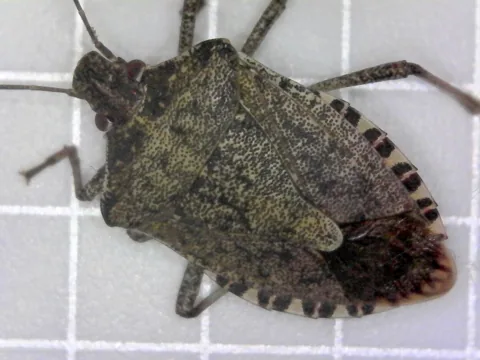 Brown Marmorated Stink Bug
Halyomorpha halys
The brown marmorated stink bug is an invasive insect from east Asia that damages fruit and vegetable crops and invades homes in fall looking for overwintering sites. Minnesota Extension says it feeds on about 200 plant species and, unlike the native stink bugs there, prefers to spend the winter in homes. Clemson notes that the bugs gather on outside walls before they move in.
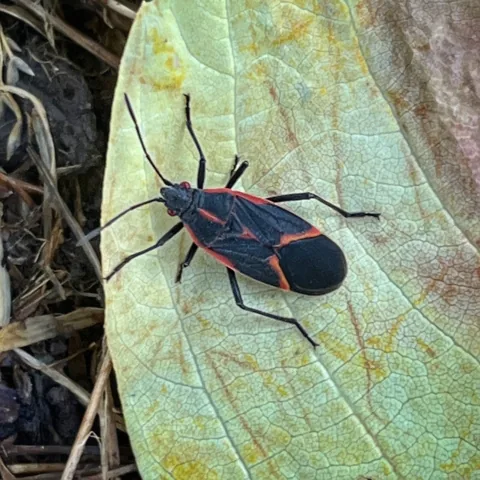 Boxelder Bug
Boisea trivittata
Boxelder bugs feed mainly on the seeds of female boxelder trees and become a nuisance in fall, when large numbers gather on and around homes looking for a place to spend the winter. Indoors they can stain fabrics and smell when crushed, but they don't damage the structure and don't breed inside.
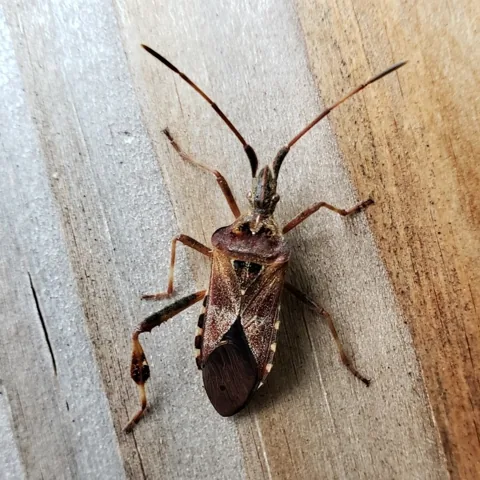 Western Conifer Seed Bug
Leptoglossus occidentalis
The western conifer seed bug is a leaf-footed bug that feeds on the seeds and cones of pines and other conifers. In fall, adults look for sheltered places to spend the winter, and many end up inside houses, where they are a nuisance but harmless.
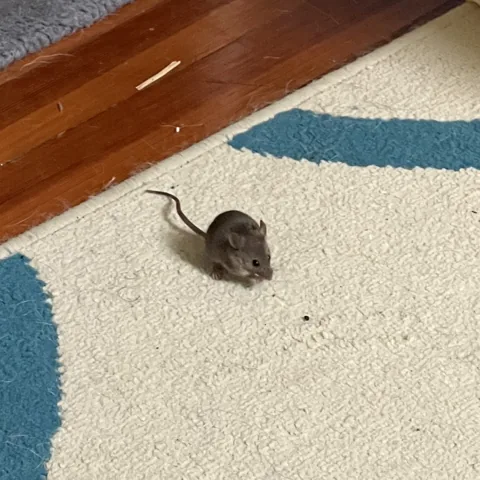 House Mouse
Mus musculus
The house mouse is a small, adaptable rodent that lives close to people in homes, schools and food businesses, eating and contaminating food, gnawing wiring and carrying disease.
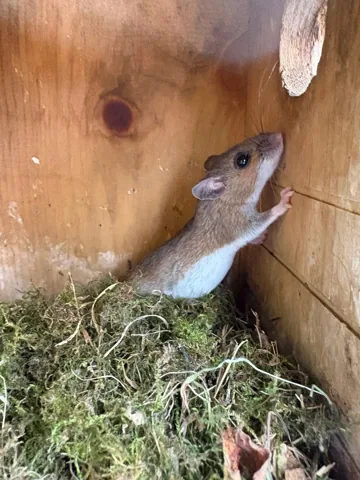 Deer Mouse
Peromyscus species (shown: P. maniculatus)
The deer mouse is a wild mouse with a white belly and a furred, two-toned tail that sometimes moves into cabins, sheds and homes. In the United States it spreads the most common hantavirus that causes hantavirus pulmonary syndrome (HPS), a severe and potentially deadly lung disease, so the droppings and nests it leaves need careful cleanup.
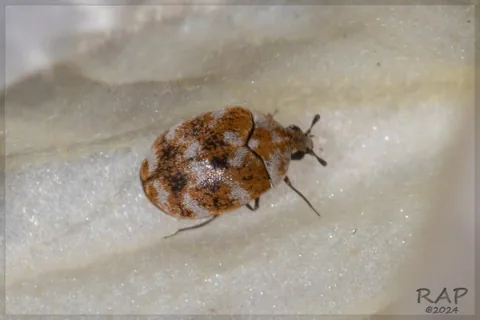 Varied Carpet Beetle
Anthrenus verbasci
Carpet beetles are small beetles whose larvae damage wool, silk, fur, feathers, leather and other animal products; the adults feed on pollen outdoors and often fly in through windows.
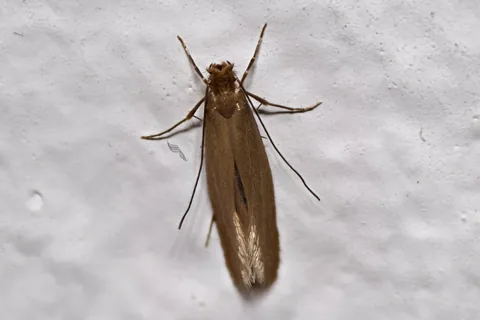 Webbing Clothes Moth
Tineola bisselliella
The webbing clothes moth is probably the most commonly encountered clothes moth in the United States. Its larvae feed on wool, fur, feathers and other animal fibers in hidden spots, and the moths are seldom seen because they avoid light.
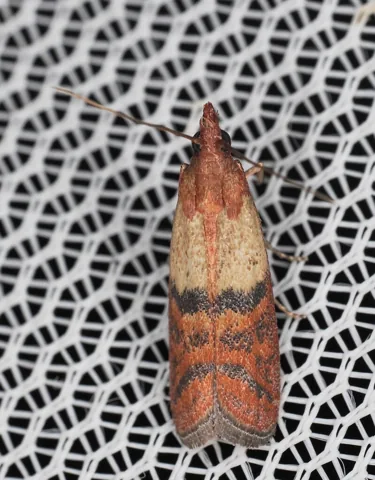 Indianmeal Moth
Plodia interpunctella
The Indianmeal moth is the most common moth infesting stored food in the home; all damage is done by the larvae, which feed in cereals, flour, nuts, dried fruit, chocolate and pet food.
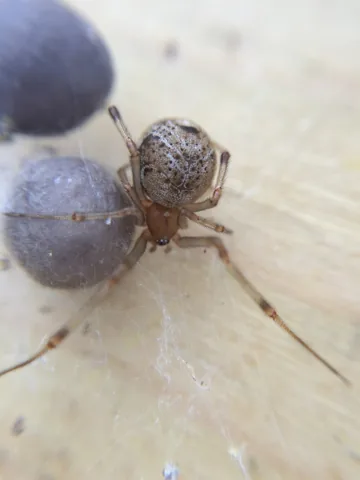 Common House Spider
Parasteatoda tepidariorum
The common house spider is a cobweb weaver found through most of the world. It builds its tangled webs in the corners of walls and windows, along floor joists and in basements, barns and crawl spaces.
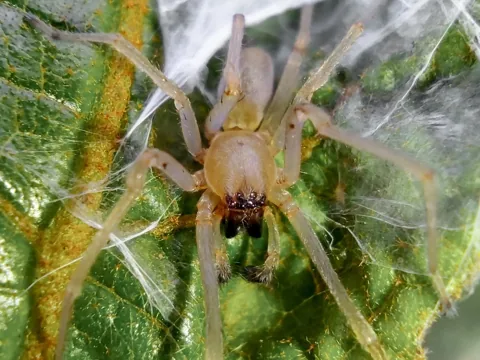 Yellow Sac Spider
Cheiracanthium species (shown: C. inclusum)
Yellow sac spiders are small, pale hunting spiders that rest by day in silk sacs in the corners of walls and ceilings, under siding or among leaves, and come out at night to hunt instead of building a web.
Two kinds of winter pests
The first group is overwintering insects. In late summer and fall, cluster flies, Asian lady beetles, stink bugs and boxelder bugs gather on the sunny south and west sides of buildings and squeeze into cracks to spend the winter in attics, wall voids and other protected spaces. Minnesota Extension says all the lady beetles and boxelder bugs seen inside during winter and spring must have entered the previous fall, and Penn State says the same of cluster flies: they are not reproducing in the structure.[8][3][2][6][9]
The second group is pests that live and breed indoors regardless of season. House mice that find steady food and shelter can reproduce year-round, according to UC IPM. Clothes moths, carpet beetles and pantry pests feed on wool, stored food and debris inside the house, and UC IPM says heated buildings let clothes moths continue developing during winter months.[12][21][22][25]
The difference matters because the overwintering insects will leave on their own in spring and cannot start an infestation indoors, while the indoor breeders keep multiplying until you find and remove their source.[1][4][3][25][21]
Why they appear on warm winter days
Overwintering insects sit inactive in the walls and attic. On mild, sunny days, or when the heat comes up indoors, some of them warm up and move toward the light and warmth, which leads them into living spaces instead of back outside. Penn State describes cluster flies crawling out of wall voids and attics in a confused attempt to go back outside, and Minnesota Extension says boxelder bugs follow the warmth into living areas.[6][3][2][10]
Not all of them wake at once. Minnesota Extension notes that warmth may not reach all the insects, and they don't all become active at the same time. By spring the survivors all become active, and Minnesota Extension says boxelder bugs and cluster flies seen on the outside of the house in spring are moving away from the building, so no control is needed then.[3][8]
A burst of activity after a warm spell or a thermostat change is normal and does not mean the problem is getting worse. Minnesota Extension says stink bugs hidden in the house can be seen on warm days or when the thermostat is turned up.[10][7][1]
The overwintering insects, one by one
Each of these has its own guide with the full plan. Here is how to tell them apart and what matters in winter.[8][2][3][10]
- Cluster flies: sluggish flies slightly larger than a house fly, often gathered at windows on warm winter days. New Hampshire Extension says they don't damage the building, furniture or occupants. Montana State says they are not drawn to most food-baited fly traps. See how to get rid of cluster flies.[6][7][11]
- Asian lady beetles: Kentucky Entomology says they give off an odor and yellowish fluid that can stain surfaces, and occasionally pinch. Minnesota Extension says exposure to dead beetles in buildings can cause allergic reactions in some people. See how to get rid of Asian lady beetles.[1][2]
- Brown marmorated stink bugs: Penn State says they smell when many are crushed or vacuumed, and says they will not reproduce inside or cause damage. Minnesota Extension says they prefer to overwinter in homes. See how to get rid of stink bugs.[9][10]
- Boxelder bugs: the black and red bugs that Montana State links to nearby female boxelder trees. Minnesota Extension says their excrement can stain walls and curtains, and Kentucky Entomology says they cannot form a long-term indoor infestation because females need boxelder trees to lay eggs. Sources differ on bites: Kentucky says they do not bite or sting, while Montana State says they have been reported to bite people on rare occasions. See how to get rid of boxelder bugs.[3][4][11]
- Western conifer seed bugs and other occasional invaders: Montana State says the western conifer seed bug does not bite people or harm homes and often dies within a week or two indoors. The fall home invaders guide covers this and other seasonal visitors.[11]
What to do about overwintering insects now
In winter the job is removal, not prevention. Minnesota Extension says that once boxelder bugs are inside, the only practical control is physical removal.[3][1]
- Vacuum them as they appear. Kentucky Entomology calls a vacuum the easiest and most sanitary way to remove lady beetles indoors; Penn State and Minnesota Extension recommend it for stink bugs and boxelder bugs as well.[1][9][10][3]
- Keep the catch from escaping. Minnesota Extension suggests a knee-high nylon stocking held in the vacuum hose with a rubber band, removed after vacuuming. New Hampshire Extension says to take the bag outdoors after vacuuming cluster flies, or they may crawl back out.[2][7]
- Expect a smell with stink bugs. Penn State says a vacuum may pick up the odor of stink bugs for a while. Sweeping lady beetles is more likely to cause staining, according to Kentucky Entomology.[9][1]
- Use the light. Minnesota Extension suggests drawing flies to a bright window in a darkened room, where they are easier to vacuum or swat.[8]
- Skip indoor sprays and bug bombs. Kentucky Entomology says indoor foggers and sprays are generally not recommended for lady beetles and can stain or leave residues; Minnesota Extension says spraying pesticides indoors is not effective; Montana State says bug bombs inside are not effective against cluster flies.[1][2][11]
- Don't dust the wall voids. Penn State warns that insecticide dust in voids may kill thousands of insects, but carpet beetles can feed on the dead bodies and then move on to woolens and stored goods. UC IPM and Clemson both list dead insects as carpet beetle food.[6][5][22][23]
Fix it before next fall
Once these insects are in the walls, nothing done in winter will keep them from coming out. Minnesota Extension says you cannot prevent lady beetles from emerging later in winter or spring once they are in wall voids, and that treating cluster flies in spring will not reduce the numbers next fall. Kentucky Entomology says exterior barrier sprays in late winter or early spring are ineffective for the same reason.[2][8][1]
The work that pays off happens in late summer. Minnesota Extension advises making repairs before the end of August for boxelder bugs and by the end of September for lady beetles. Montana State says to check window and door seals, vents and siding in late summer for cluster flies. Minnesota Extension's stink bug advice is to check seals around doors, windows and screens and where cords, pipes and cables enter. The fall home invaders guide has a sealing calendar and a list of places to seal.[3][2][11][10]
Mice in winter
Where house mice live outdoors, UC IPM says they frequently enter homes in autumn when nighttime temperatures become colder. Once inside with plentiful, stable food and shelter, they can reproduce year-round. The Internet Center for Wildlife Damage Management says mice are active year-round and should be controlled as soon as they are noticed.[12][14]
Look for droppings, fresh gnaw marks and tracks, which UC IPM says show where mice are active. UC IPM, CDC and NPIC all say mice can get through openings about 1/4 inch wide, so sealing gaps is part of the fix even in winter.[12][15][18]
Deer mice are the bigger health concern. UC IPM says they often enter vacated homes, cabins and other buildings to nest and store food, and CDC says the deer mouse spreads the most common hantavirus that causes hantavirus pulmonary syndrome in the United States. Opening a closed cabin or shed after winter calls for CDC's cleanup method: ventilate for 30 minutes first, and don't vacuum or sweep rodent droppings, urine or nesting material.[13][17][16]
The guide to getting rid of mice in the house covers sealing, trapping, bait station rules and safe cleanup step by step.[12][15][16]
Carpet beetles, clothes moths and pantry pests
These insects don't come in for the winter; they are already living on something in the house. Clothes moth and carpet beetle larvae feed in dark, undisturbed places such as closets, chests and boxes of stored woolens, and infestations can also start in bird or animal nests in an attic, chimney or wall. UC IPM says heated buildings let clothes moths keep developing through winter.[24][23][21]
Adult carpet beetles fly toward light. UC IPM says they are typically seen near windows on sills, drapes or panes, and that adults usually appear in spring or early summer. Small beetles on a windowsill in late winter or spring are worth identifying, since their larvae may be feeding somewhere nearby.[22]
Pantry pests live in the food. UC IPM says most home infestations maintain themselves on spills in cupboard crevices and on opened packages stored for a long time. Kentucky Entomology and Clemson both point to sources outside the pantry: bird seed, dried flower arrangements and decorative ear corn, or a bag of dog food in the garage.[25][26][27]
For both groups the fix is finding and removing the infested item, then cleaning. The clothes moth and carpet beetle guide and the pantry moth guide give the full steps, including freezing and heat treatment.[21][22][25]
Spiders indoors in winter
Montana State Extension says many spiders, like insects, look for a protected place to spend the winter. Colorado State says funnel weaver spiders are the most common spiders in homes, typically found in early fall as temperatures cool, and that yellow sac spiders commonly live and breed in homes, especially in fall. UC IPM says the common house spider builds cobwebs in room corners and windows.[11][20][19]
UC IPM says the more insects there are inside a building, the more likely it is to have spiders. Vacuuming spiders and webs, cutting clutter, and sealing cracks in the foundation and gaps around windows and doors are the steps UC IPM and Colorado State recommend; Colorado State adds that sticky traps along baseboards can catch wandering spiders. The guides to house spiders and types of spiders in homes cover identification and the few species of medical concern.[19][20]
Common questions
- Why are there bugs in my house in winter?
- Usually because insects such as cluster flies, Asian lady beetles, stink bugs and boxelder bugs moved into the walls and attic last fall and are waking up on warm days. They don't reproduce indoors. Mice, fabric pests and pantry pests are the exception: they can breed inside through the winter.[6][2][3][12][21]
- Will the bugs coming out of my walls in winter lay eggs in the house?
- No. Minnesota Extension and Penn State say lady beetles, boxelder bugs, cluster flies and brown marmorated stink bugs do not reproduce indoors. The ones you see entered the previous fall.[2][3][6][9]
- Should I spray for bugs in winter?
- Not indoors. Kentucky Entomology, Minnesota Extension and Montana State say indoor sprays and bug bombs are not effective against overwintering insects, and Kentucky says exterior barrier sprays in late winter are ineffective because the insects got in the previous fall. Vacuum now and seal in late summer.[1][2][11]
- Why do I see mice more in the winter?
- UC IPM says house mice frequently enter homes in autumn when nights get colder, and with steady food they can breed year-round indoors.[12]
- Are the bugs that come out in winter harmful?
- Mostly they are a nuisance. Cluster flies, stink bugs and boxelder bugs don't damage the house, though lady beetles and boxelder bugs can stain surfaces and Minnesota Extension says dead lady beetles can cause allergic reactions in some people. Carpet beetles and clothes moths do damage fabrics, and mice can carry disease.[7][9][3][1][2][22][12]
Photo credits
- Cluster Fly: (c) Steve Kerr, some rights reserved (CC BY) — via iNaturalist, CC BY 4.0
- Multicolored Asian Lady Beetle: (c) Sascha Nunheim, some rights reserved (CC BY) — via iNaturalist, CC BY 4.0
- Brown Marmorated Stink Bug: (c) Stan Rullman, some rights reserved (CC BY) — via iNaturalist, CC BY 4.0
- Boxelder Bug: (c) Alfonso Benítez-Mora, some rights reserved (CC BY) — via iNaturalist, CC BY 4.0
- Western Conifer Seed Bug: (c) Gavin Slater, some rights reserved (CC BY) — via iNaturalist, CC BY 4.0
- House Mouse: (c) Carrie Seltzer, some rights reserved (CC BY) — via iNaturalist, CC BY 4.0
- Deer Mouse: (c) Derek Duplessis, some rights reserved (CC BY) — via iNaturalist, CC BY 4.0
- Varied Carpet Beetle: (c) RAP, some rights reserved (CC BY) — via iNaturalist, CC BY 4.0
- Webbing Clothes Moth: (c) David Kleuker, some rights reserved (CC BY) — via iNaturalist, CC BY 4.0
- Indianmeal Moth: (c) Rosario Douglas, some rights reserved (CC BY) — via iNaturalist, CC BY 4.0
- Common House Spider: (c) Erin Lalime, some rights reserved (CC BY) — via iNaturalist, CC BY 4.0
- Yellow Sac Spider: (c) Jhonatan Matheus, some rights reserved (CC BY) — via iNaturalist, CC BY 4.0
Sources
- University of Kentucky Entomology, “ENTFACT-416: Asian Lady Beetle.” entomology.mgcafe.uky.edu/ef416 (accessed 2026-11-10)
- University of Minnesota Extension, “Multicolored Asian lady beetles.” extension.umn.edu/nuisance-insects/multicolored-asian-lady-beetles (accessed 2026-11-10)
- University of Minnesota Extension, “Boxelder bugs.” extension.umn.edu/nuisance-insects/boxelder-bugs (accessed 2026-11-10)
- University of Kentucky Entomology, “Boxelder Bugs (ENTFACT-444).” entomology.mgcafe.uky.edu/ef444 (accessed 2026-11-10)
- Penn State Extension, “Boxelder Bug.” extension.psu.edu/boxelder-bug (accessed 2026-11-10)
- Penn State Extension, “Cluster Flies.” extension.psu.edu/cluster-flies (accessed 2026-11-10)
- University of New Hampshire Cooperative Extension, “Cluster Flies [fact sheet] (A. Eaton and R. Maccini).” extension.unh.edu/resource/cluster-flies-fact-sheet (accessed 2026-11-10)
- University of Minnesota Extension, “Flies.” extension.umn.edu/garden-and-home/home-maintenance/household-insects/flies (accessed 2026-11-10)
- Penn State Extension, “Brown Marmorated Stink Bug.” extension.psu.edu/brown-marmorated-stink-bug (accessed 2026-11-10)
- University of Minnesota Extension, “Brown marmorated stink bug.” extension.umn.edu/garden-and-home/yard-and-garden/yard-and-garden-insects/brown-marmorated-stink-bug (accessed 2026-11-10)
- Montana State University Extension, “Fall Home Invaders (LILA, Fall 2023).” www.montana.edu/extension/lila_extn/lila_fall_23/FallHomeInvaders.html (accessed 2026-11-10)
- University of California Statewide IPM Program, “House Mouse (Pest Notes, Home and Landscape).” ipm.ucanr.edu/home-and-landscape/house-mouse/ (accessed 2026-11-10)
- University of California Statewide IPM Program, “Pest Notes: Deer Mouse, Publication 74161 (June 2012).” ipm.ucanr.edu/legacy_assets/PDF/PESTNOTES/pndeermouse.pdf (accessed 2026-11-10)
- Internet Center for Wildlife Damage Management, “House Mouse Damage Prevention and Control Methods.” icwdm.org/species/rodents/house-mice/house-mouse-damage-prevention-and-control-methods/ (accessed 2026-11-10)
- Centers for Disease Control and Prevention, “How to Seal Up to Prevent Rodents.” www.cdc.gov/healthy-pets/rodent-control/seal-up.html (accessed 2026-11-10)
- Centers for Disease Control and Prevention, “Clean Up After Rodents.” www.cdc.gov/healthy-pets/rodent-control/clean-up.html (accessed 2026-11-10)
- U.S. Centers for Disease Control and Prevention, “About Hantavirus.” www.cdc.gov/hantavirus/about/index.html (accessed 2026-11-10)
- National Pesticide Information Center, “Mice.” npic.orst.edu/pest/mice.html (accessed 2026-11-10)
- University of California Statewide IPM Program, “Pest Notes: Spiders, UC ANR Publication 7442.” ipm.ucanr.edu/home-and-landscape/spiders/ (accessed 2026-11-10)
- Colorado State University Agricultural Biology, “Spiders in the Home.” agsci.colostate.edu/agbio/ipm-pests/spiders-in-the-home (accessed 2026-11-10)
- University of California Statewide IPM Program, “Clothes Moths (Pest Notes, Home and Landscape).” ipm.ucanr.edu/home-and-landscape/clothes-moths/ (accessed 2026-11-10)
- University of California Statewide IPM Program, “Pest Notes: Carpet Beetles (Home and Landscape).” ipm.ucanr.edu/home-and-landscape/carpet-beetles/ (accessed 2026-11-10)
- Clemson Cooperative Extension Home & Garden Information Center, “Fabric Pest Control (HGIC 2416).” hgic.clemson.edu/factsheet/controlling-fabric-pests/ (accessed 2026-11-10)
- University of Kentucky Entomology, “Clothes Moths (ENTFACT-609).” entomology.mgcafe.uky.edu/ef609 (accessed 2026-11-10)
- University of California Statewide IPM Program, “Pest Notes: Pantry Pests (Home and Landscape).” ipm.ucanr.edu/home-and-landscape/pantry-pests/ (accessed 2026-11-10)
- University of Kentucky Entomology, “ENTFACT-612: Stored Product Pests in the Pantry.” entomology.mgcafe.uky.edu/ef612 (accessed 2026-11-10)
- Clemson Cooperative Extension, Home & Garden Information Center, “HGIC 2439: Pantry Pests.” hgic.clemson.edu/factsheet/pantry-pests/ (accessed 2026-11-10)