The short answer
- Indoors, vacuum them or swat them. They are sluggish and easy to catch. Empty the vacuum bag outdoors, because flies picked up alive can crawl back out.[3][2][4][5][7]
- Make it easier by darkening the room except for one bright window. Minnesota Extension notes the flies are drawn to light, and Montana State says flies coming out of hibernation often head for the nearest window or glass door.[2][5]
- Find where they come out (cracks behind baseboards, around window and door trim, around ceiling lights and exhaust fans) and caulk those gaps.[1][7]
- Don't treat the attic or wall voids. Penn State says dusts can kill thousands of flies there, but the dead flies can feed carpet beetles that later move on to woolens and stored foods; Kentucky's carpet beetle fact sheet names dead cluster flies among the things carpet beetles breed on.[1][8]
- The lasting fix is sealing the outside in late summer: gaps in siding, around windows, under eaves, around pipes and chimneys, and screening attic vents. New Hampshire Extension says to finish before September 10.[1][2][3][6][10]
Flies and overwintering invaders
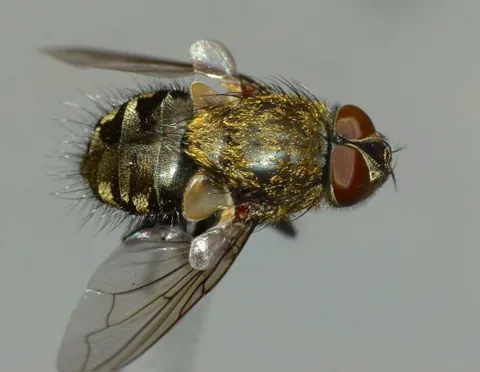 Cluster Fly
Pollenia species (e.g., P. rudis)
Cluster flies gather on the sunny sides of buildings in fall to find places to overwinter and then appear indoors, often in large numbers, on warm days through winter and spring. They do not breed indoors.
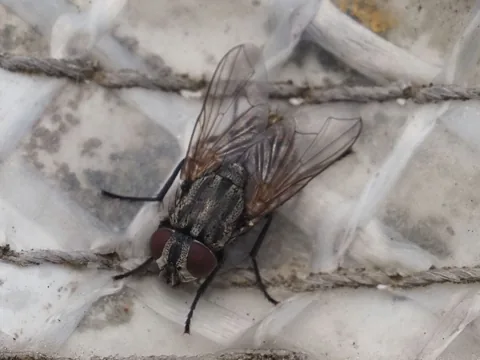 Face Fly
Musca autumnalis
The face fly is a serious pest of pastured cattle that also invades homes and barns near pastures. In fall the adults look for sheltered places to spend the winter, often inside attics and wall voids, much like cluster flies.
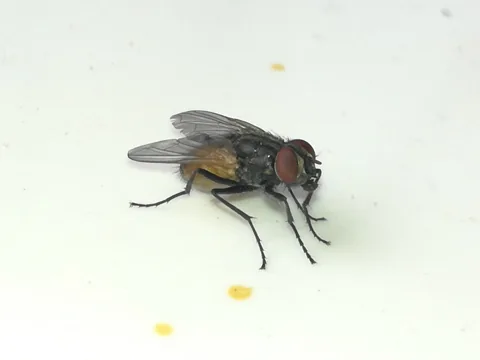 House Fly
Musca domestica
The house fly is a worldwide companion of people and domestic animals; it breeds in garbage, manure and other moist organic matter and is most numerous in hot summer months.
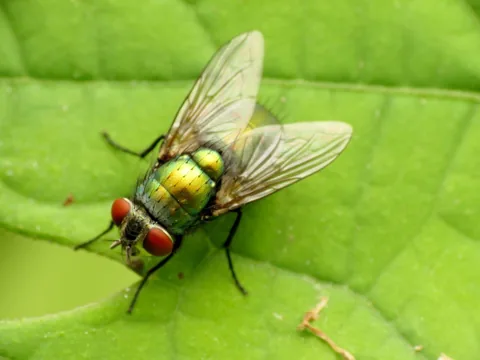 Common Green Bottle Fly
Calliphoridae (shown: Lucilia sericata)
A sudden crowd of shiny green or blue flies indoors often means an animal has died in a chimney, wall or ceiling. Outdoors, most blow flies come from garbage with food waste and from pet waste.
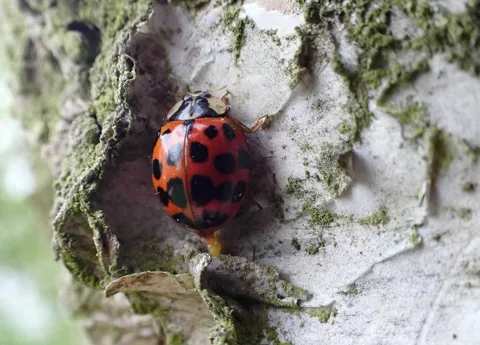 Multicolored Asian Lady Beetle
Harmonia axyridis
The multicolored Asian lady beetle is a beneficial aphid predator outdoors but becomes a nuisance when it flies to buildings in fall to overwinter and ends up indoors. Clemson and Colorado State extension both describe it as a valuable aphid predator on crops, trees and shrubs.
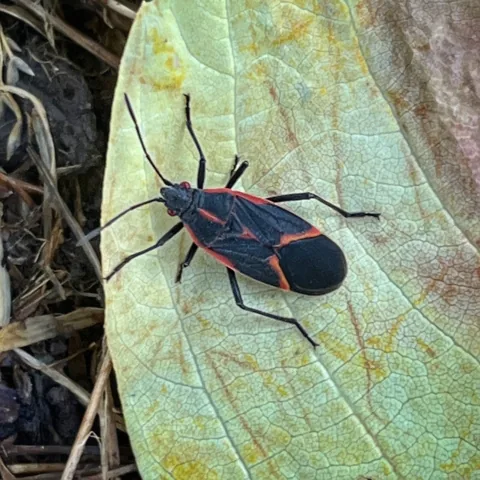 Boxelder Bug
Boisea trivittata
Boxelder bugs feed mainly on the seeds of female boxelder trees and become a nuisance in fall, when large numbers gather on and around homes looking for a place to spend the winter. Indoors they can stain fabrics and smell when crushed, but they don't damage the structure and don't breed inside.
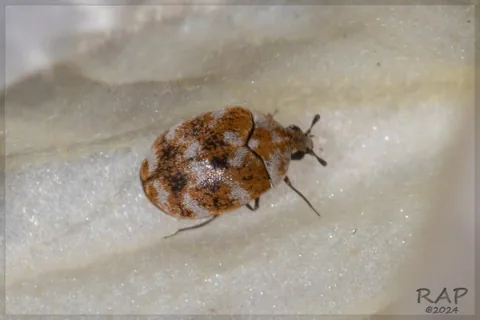 Varied Carpet Beetle
Anthrenus verbasci
Carpet beetles are small beetles whose larvae damage wool, silk, fur, feathers, leather and other animal products; the adults feed on pollen outdoors and often fly in through windows.
How to tell you have cluster flies
Cluster flies (Pollenia rudis and related species) look a lot like house flies but are a bit larger and slower. Minnesota gives 3/8 to 1/2 inch long, Montana State about 1/3 inch and Washington State about 5/16 inch. Look for short golden-yellow hairs on the thorax, which Penn State says are thickest on the underside between the legs, and wings that overlap over the back at rest.[2][1][5][6][4][7]
Behavior is the easier clue. They show up in fall, winter or early spring rather than summer, gather in upper rooms and attics, cluster on sunny windowsills, and fly clumsily enough to swat by hand. Clemson describes them resting in corners, under curtains and behind pictures and furniture, and notes that a large indoor group can look like a swarm of bees. Kentucky adds that they often gather at windows in rooms that are not regularly used.[1][4][2][3][7]
Face flies often overwinter in the same attics. Minnesota describes them as nearly identical to house flies, found with cluster flies in attics, steeples and little-used rooms, and Kentucky says only an expert can tell them from house flies. Their maggots develop in fresh cattle dung, so Kentucky says they are most likely in farm homes and homes near pastures or cattle. The same outside sealing and timing applies to both. For other flies, see the house fly identification guide.[2][7]
Blow flies (blue and green bottle flies) can also turn up indoors in winter and early spring. Kentucky describes them as robust flies with shiny metallic bodies that develop in manure or carrion, usually show up in small numbers, and are strong fliers drawn to lamps. Minnesota says they don't cluster the way cluster flies do, so few are found indoors in winter or early spring.[7][2]
Why they keep appearing all winter
Cluster fly maggots are parasites of earthworms. Females lay eggs on or in cracks in the soil, or near the openings of earthworm burrows, and the hatching larvae enter the worms to feed, then pupate in the soil. Washington State points out that this rules out removing a breeding site, since earthworms are almost everywhere.[3][2][1][6][7][5]
There are several generations each summer: two or three per year according to Minnesota, three to four or more in Pennsylvania according to Penn State, and up to four according to New Hampshire. Minnesota says the final generation looks for winter shelter in August and September. Montana State's fall invaders article says they cluster on sun-warmed walls from mid-August to October, and Kentucky says the adults emerge in late summer and early fall to look for winter shelter.[2][1][3][10][7]
They gather on the sunny south and west sides of buildings, mostly in the upper half, and crawl into cracks around siding, windows, vents and chimneys. Many settle between the walls and in attics. On warm days through winter and spring they become active and work their way into rooms through gaps around window frames and light fixtures, in a confused attempt to get back outside.[2][1][3][5][7]
Because new flies keep emerging from the walls, it can look as if they are breeding indoors. They aren't: Penn State, New Hampshire, Kentucky and Montana State all say they are only using the house to spend the winter.[1][3][7][5]
Montana State notes they can turn up anywhere but are often more of a problem at higher elevations and at homes with irrigated lawns or near water.[10]
Are cluster flies harmful?
No. They don't bite, damage the house or furniture, or harm people, and Penn State says they are not known to carry diseases of medical importance to humans, and Kentucky says they are no health hazard. Penn State notes they can leave small dark spots of excrement on windows and walls.[1][4][3][7]
The real risk comes from a large die-off in the attic or walls. Dead flies are food for carpet beetles, which can then move on to wool, stored dry goods and other natural materials in the house. Minnesota notes that piles of dead cluster flies are often found in late spring in northern vacation homes left empty during the months the flies come out.[1][2][8]
Getting rid of the flies already inside
Once flies are inside the walls there is no practical way to stop them from coming out, according to Minnesota. Clemson says there are no practical means of controlling cluster flies and points to keeping them out and vacuuming up the ones that get in. Removal, as you see them, is the main tool indoors. Kentucky agrees that these flies are hard to control once inside, because they hibernate in wall voids and other places you can't reach.[2][4][7]
- Vacuum. Montana State says vacuuming every adult you see also cuts down on future populations from flies that survive the winter in the house. Put the bag in a sealed container and take it outside, or empty the canister outdoors.[5][3][4][2][7][10]
- Use a flyswatter. The flies are sluggish and make little attempt to escape.[3][2][1][7]
- Use a bright window. In a darkened room the flies collect at the lit window, where they are easier to vacuum or swat.[2][5]
- Hang flypaper in a still room. New Hampshire suggests resin strips where there is little or no air movement. Don't count on baited fly traps: Montana State says cluster flies aren't attracted to most traditional fly traps that use food or chemical lures.[3][10]
- Seal where they come out. Look under and behind baseboards, around window and door trim, and around ceiling lights and exhaust fans, and caulk those gaps so flies stay in the walls rather than crawling into rooms. Kentucky also names window pulley holes.[1][7]
What not to do inside
Sources disagree about indoor insecticides, and most advise against them.[1][5][2][4][7][9]
Penn State says not to use insecticide inside the structure once flies are in the attic or wall voids. Insecticidal dusts in voids can kill thousands of flies but set up a carpet beetle problem, attic foggers kill the flies in the attic but don't stop flies coming out of the walls, and spraying cracks and crevices does not prevent emergence and is not recommended.[1]
Montana State says bug bombs are not effective for cluster flies and doesn't recommend them, in both its cluster fly fact sheet and its fall invaders article. Kentucky's fogger fact sheet calls foggers one of the least effective ways to fight pests, though it names attics infested with cluster flies as one of the few places a total-release fogger might be useful.[5][10][9]
Minnesota allows one exception: for large numbers of flies indoors, an insecticide labeled for indoor flying insects, such as pyrethrins. Kentucky describes pyrethrins as quick-kill sprays with little residual action, misted into the air of a closed room. Clemson says that if numbers are so large that spraying is needed, spray only where flies enter the home and where they are sheltering. Washington State cautions that killing adults with sprays won't make the problem go away, because new flies arrive the next year.[2][6][7][4]
Kentucky's cluster fly fact sheet goes further than the others, describing residual sprays on attic and basement surfaces and dusts injected into wall voids. The insecticides it names include diazinon, and according to the National Pesticide Information Center all residential uses of diazinon were cancelled (indoor uses in 2002, outdoor uses in 2004). Whatever you use has to be labeled for that site; Penn State's warning about dead flies feeding carpet beetles applies to any void treatment.[7][11][1]
Seal the house before the flies arrive
Penn State, New Hampshire and Clemson all name exclusion as the best defense, and timing matters: the work has to be done before the flies go looking for winter shelter in late summer. New Hampshire says to caulk and screen before September 10.[1][3][4][6][2][10]
Minnesota cautions that caulking alone gives some relief but won't solve the problem, which is why some homeowners add a fall exterior treatment. Kentucky warns that sealing is time consuming and may take a dedicated long-term effort.[2][7]
- Caulk cracks around windows, doors, siding, utility pipes, behind chimneys and under the fascia. Penn State recommends good-quality silicone or silicone-latex caulk.[1][3][6][10]
- Close gaps under eaves and around cable and meter attachments, and work on the sunny south and west sides first, where most flies gather.[2][5]
- Screen attic and crawl space vents with mesh fine enough to stop the flies.[6][3][4]
- Repair or replace damaged door and window screens and keep them tight-fitting, and weather-strip doors and windows. Screens alone won't keep cluster flies out, though: Kentucky says the flies crawl in through small openings in the walls, so window screens offer no protection.[1][6][4][7]
Outdoor sprays: timing and limits
Where sealing the whole outside isn't possible, an exterior insecticide applied just before the flies gather can reduce how many get in. It only works in late summer or early fall. Minnesota gives late August to mid-September in the northern half of the state and the first two weeks of September in the south.[1][2][5][10][7]
Products named by extension sources are pyrethroids such as bifenthrin, cyfluthrin, cypermethrin, deltamethrin, lambda-cyhalothrin and permethrin, and Penn State also lists the neonicotinoid dinotefuran. Use one labeled for building exteriors and follow the label.[1][5][2]
Montana State describes a band 2 to 6 feet wide on the soil around the foundation and 2 to 3 feet up the foundation walls, kept as continuous as possible and including areas around windows and doors, with attention to the south- and southwest-facing sides. Penn State and Minnesota suggest having a licensed pest control operator do the application. Kentucky also points to the areas under the eaves and around windows, where flies try to get in.[5][1][2][7]
How long it lasts is where sources disagree. Montana State says pyrethroids can leave a residue for 2 to 3 weeks on the outside of the house, and its fall invaders article says they are effective for 2-3 weeks; Penn State says sunlight breaks the insecticide down so the residual effect may not last much beyond several days or a week.[5][1][10]
Skip spraying flies on the outside walls in spring. Minnesota says those flies are leaving the building, killing them has little effect on how many you see inside, and spring treatment won't reduce the number of flies next fall. New Hampshire and Clemson both describe spring as the time the flies leave, moving outdoors and onto the sunny side of the house.[2][3][4]
Common questions
- Why do I have so many flies in my house in winter?
- Flies that are sluggish, slightly larger than house flies and gather at sunny windows in winter are most likely cluster flies, which Montana State calls the most common flies found indoors in the cool season. Face flies and blow flies can also overwinter in homes. Cluster flies move into the attic and walls in late summer and come out on warm days trying to get back outside.[1][2][3][10][7]
- Are cluster flies breeding in my house?
- No. Their maggots live in earthworms in the soil, so they can't breed indoors. New flies keep appearing because more are still coming out of the walls and attic.[1][3][5][7]
- What kills cluster flies inside?
- A vacuum or a flyswatter. They are slow and easy to catch. Empty the vacuum outdoors so live flies don't crawl back out.[3][2][4][7][5]
- Should I spray or fog the attic for cluster flies?
- Penn State advises against it. Foggers don't stop flies coming out of the walls, and the mass of dead flies can feed carpet beetles that later attack woolens and stored foods. Montana State says bug bombs aren't effective. Kentucky's fogger fact sheet is the one exception, naming cluster-fly attics as one of the few places a fogger might help.[1][5][9]
- When should I seal up for cluster flies?
- In late summer, before the flies look for winter shelter in August and September. New Hampshire Extension says to have caulking done and attic vents screened before September 10.[3][2][10]
- Do cluster flies bite or spread disease?
- No. They don't bite or harm people, and Penn State says they are not known to carry diseases of medical importance to humans.[1][4][7]
- Do fly traps work on cluster flies?
- Baited ones mostly don't. Montana State says cluster flies aren't attracted to most traditional fly traps that use food or chemical lures. New Hampshire suggests flypaper (resin strips) hung where there is little or no air movement.[10][3]
- Is it a cluster fly or a blow fly?
- Cluster flies are dull gray with golden hairs on the thorax and are sluggish. Blow flies (bottle flies) have shiny metallic blue or green bodies, are strong fliers and develop in manure or carrion, Kentucky says.[1][7]
Photo credits
- Cluster Fly: (c) Steve Kerr, some rights reserved (CC BY) — via iNaturalist, CC BY 4.0
- Face Fly: (c) Michael Knapp, some rights reserved (CC BY) — via iNaturalist, CC BY 4.0
- House Fly: ivan_humljani, public domain (CC0), via iNaturalist
- Common Green Bottle Fly: (c) Katja Schulz, some rights reserved (CC BY) — via iNaturalist, CC BY 4.0
- Multicolored Asian Lady Beetle: (c) Sascha Nunheim, some rights reserved (CC BY) — via iNaturalist, CC BY 4.0
- Boxelder Bug: (c) Alfonso Benítez-Mora, some rights reserved (CC BY) — via iNaturalist, CC BY 4.0
- Varied Carpet Beetle: (c) RAP, some rights reserved (CC BY) — via iNaturalist, CC BY 4.0
Sources
- Penn State Extension, “Cluster Flies (S. Jacobs).” extension.psu.edu/cluster-flies (accessed 2026-11-11)
- University of Minnesota Extension, “Flies (J. Hahn and V. Cervenka).” extension.umn.edu/garden-and-home/home-maintenance/household-insects/flies (accessed 2026-11-11)
- University of New Hampshire Cooperative Extension, “Cluster Flies [fact sheet] (A. Eaton and R. Maccini).” extension.unh.edu/resource/cluster-flies-fact-sheet (accessed 2026-11-11)
- Clemson Cooperative Extension Home & Garden Information Center, “Cluster Flies.” hgic.clemson.edu/factsheet/cluster-flies/ (accessed 2026-11-11)
- Montana State University Extension IPM, “Insect Fact Sheet: Cluster Flies (L. Kerzicnik).” montana.edu/extension/ipm/documents/entomology/ent-fact-sheets-2020-2021/insect_fact_sheet_cluster_flies_ada.pdf (accessed 2026-11-11)
- Washington State University Extension, “Cluster flies (Pestsense).” pestsense.cahnrs.wsu.edu/?p=1161 (accessed 2026-11-11)
- University of Kentucky Entomology, “ENTFACT-624: Cluster Flies, Face Flies, and Blow Flies in Homes (M. Potter).” entomology.ca.uky.edu/ef624 (accessed 2026-11-11)
- University of Kentucky Entomology, “ENTFACT-601: Carpet Beetles.” entomology.mgcafe.uky.edu/ef601 (accessed 2026-11-11)
- University of Kentucky Entomology, “ENTFACT-643: Limitations of Home Insect Foggers (Bug Bombs).” entomology.ca.uky.edu/ef643 (accessed 2026-11-11)
- Montana State University Extension, “Fall Home Invaders (LILA, Fall 2023).” www.montana.edu/extension/lila_extn/lila_fall_23/FallHomeInvaders.html (accessed 2026-11-11)
- National Pesticide Information Center, “Diazinon Technical Fact Sheet.” npic.orst.edu/factsheets/archive/diazinontech.html (accessed 2026-11-11)