The short answer
- Gray fly under 3/8 inch with four dark stripes on the back of the thorax, landing on food and people: house fly. A smaller, slimmer gray fly hovering in mid-air at about head height on a porch or in a garage: little house fly.[1][2]
- Looks like a house fly but has a pointed, bayonet-like beak and bites your ankles: stable fly. Shiny metallic green, blue or copper: blow fly (bottle fly). Large and gray with a striped thorax and, in some species, a red tail tip: flesh fly.[1][2][3]
- Sluggish flies slightly bigger than house flies, with golden hairs on the thorax, at sunny windows in fall, winter or early spring: cluster flies coming out of the walls or attic.[4][2]
- Tiny flies about 1/8 inch or less: red-eyed fruit flies around produce and trash, fuzzy moth-like drain flies by sinks and showers, humpbacked phorid flies that run instead of flying, or mosquito-like fungus gnats around houseplants. Small flies in the house has the full source-finding steps for these.[3][8]
- A sudden crowd of big flies in one room, sometimes after a bad smell or maggots on the floor, usually means an animal died in a wall, attic or chimney.[2][3][7]
Fly profiles
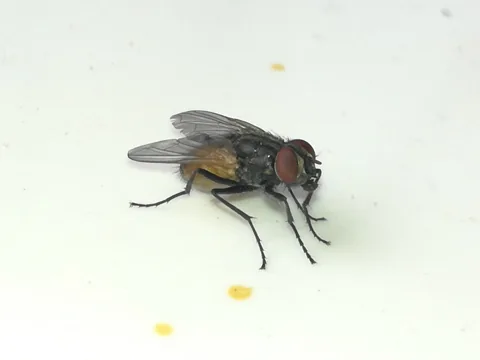 House Fly
Musca domestica
The house fly is a worldwide companion of people and domestic animals; it breeds in garbage, manure and other moist organic matter and is most numerous in hot summer months.
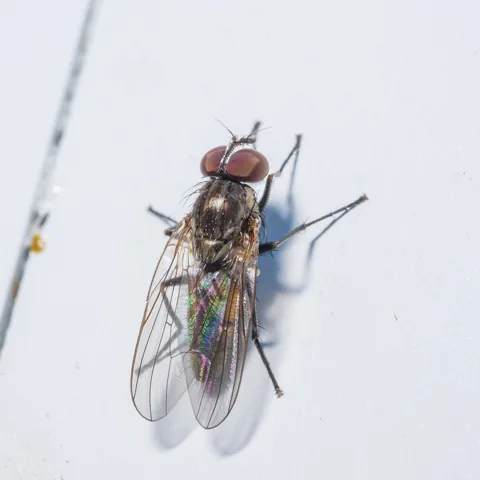 Lesser House Fly
Fannia canicularis
The lesser house fly, also called the little house fly, is a smaller relative of the house fly that breeds in manure, compost and fermenting grass clippings. Swarms of males circle at head height in shady porches and garages, so it is mainly a nuisance, and Texas A&M says it can annoy people living near poultry farms even more than the house fly does.
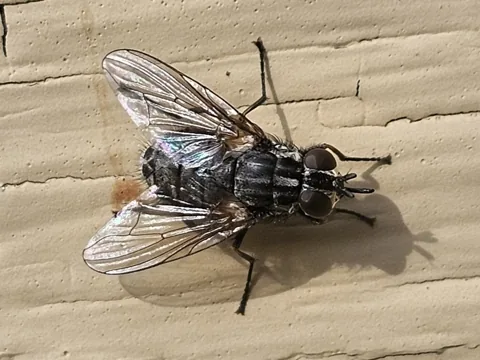 Stable Fly
Stomoxys calcitrans
The stable fly, also called the biting house fly or dog fly, looks much like a house fly but feeds on blood. Cattle are its main hosts, but it also bites horses, dogs and people, especially in neighborhoods near livestock.
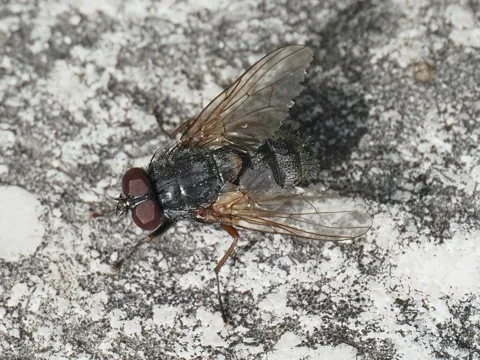 False stable fly
Muscina stabulans
The false stable fly looks much like a house fly, and Arkansas Extension lists it among the few flies that are persistent pests in and around buildings. It breeds in manure and rotting plant waste, and it is most plentiful in early spring, before house flies reach their peak.
 Face Fly
Musca autumnalis
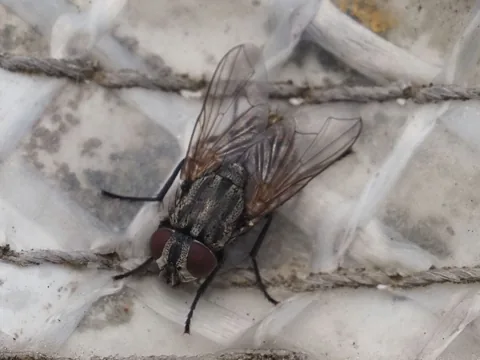
The face fly is a serious pest of pastured cattle that also invades homes and barns near pastures. In fall the adults look for sheltered places to spend the winter, often inside attics and wall voids, much like cluster flies.
 Cluster Fly
Pollenia species (e.g., P. rudis)
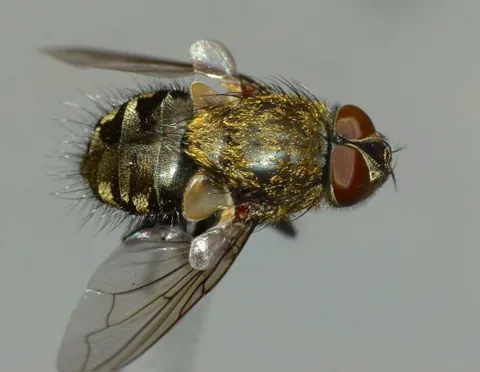
Cluster flies gather on the sunny sides of buildings in fall to find places to overwinter and then appear indoors, often in large numbers, on warm days through winter and spring. They do not breed indoors.
 Common Green Bottle Fly
Calliphoridae (shown: Lucilia sericata)
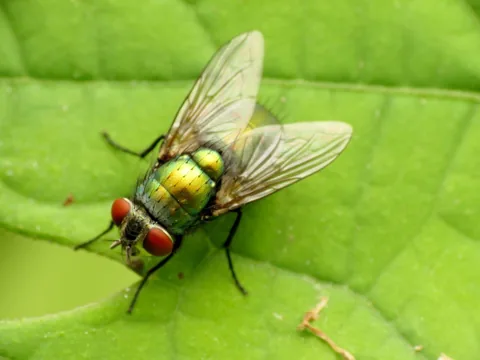
A sudden crowd of shiny green or blue flies indoors often means an animal has died in a chimney, wall or ceiling. Outdoors, most blow flies come from garbage with food waste and from pet waste.
 Flesh Flies
Sarcophaga species (family Sarcophagidae)
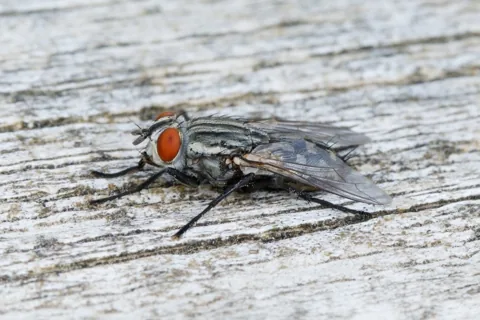
Flesh flies are large gray flies whose maggots develop in dead animals, excrement and other decaying matter. When a sudden crowd of them appears indoors in summer, a small animal has most likely died in a wall void, attic or similar hidden spot.
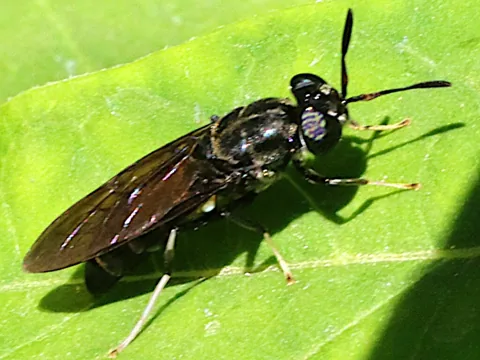 Black Soldier Fly
Hermetia illucens
The black soldier fly is best known for its larvae: flat, leathery brown maggots that churn through wet food scraps, compost and manure. Both larvae and adults are harmless to people, and the larvae are useful decomposers.
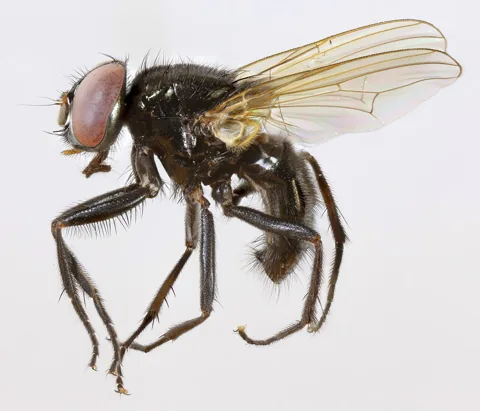 Black dump fly
Hydrotaea aenescens
The black dump fly, also called the black garbage fly, is a shiny black fly found around poultry houses alongside house flies. Its larvae prey on other fly larvae and can cut house fly numbers sharply, but large numbers can also build up, wander into nearby communities, and carry bacteria such as Salmonella and Campylobacter.
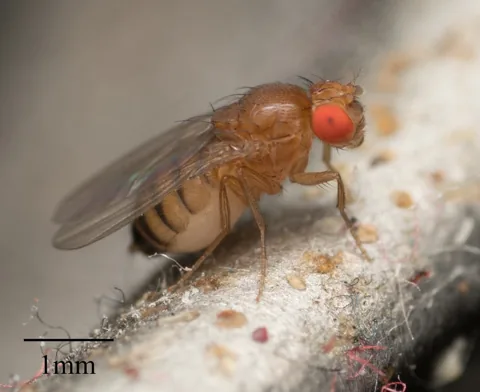 Fruit Fly
Drosophila melanogaster
Fruit flies, also called vinegar or pomace flies, are tiny flies drawn to ripe and fermenting fruits and vegetables. They can show up any time of year, but they are most common from summer into fall.
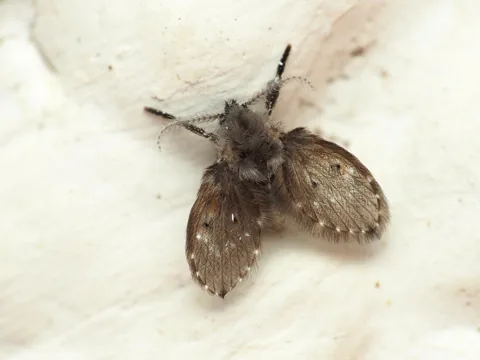 Drain Fly (Moth Fly)
Psychodidae (shown: Clogmia albipunctata)
Drain flies, also called moth flies or filter flies, are small, fuzzy, non-biting flies whose larvae live in the slimy film inside drains, toilets and other places where water stands.
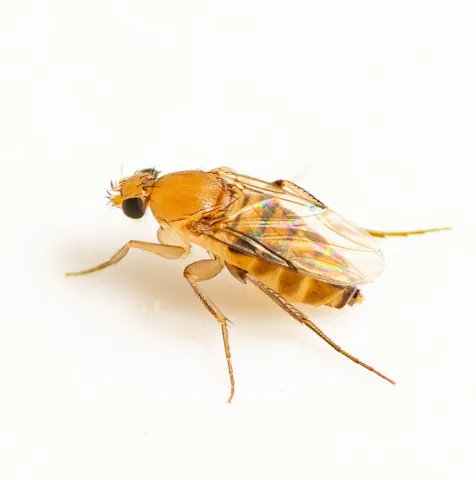 Phorid Fly
Megaselia scalaris
Phorid flies, also called humpbacked, scuttle or coffin flies, are small flies that breed in moist, decaying material. Indoors they most often come from drains and plumbing, and a hidden sewer leak can feed a large, stubborn infestation.
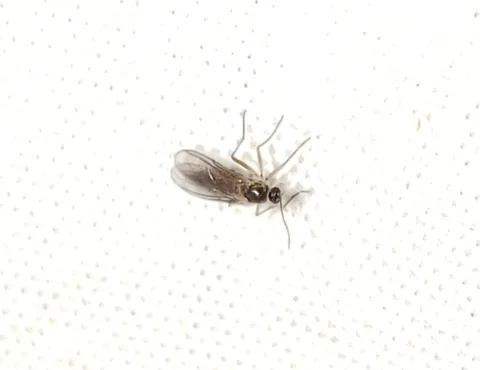 Fungus Gnat
Bradysia and related species
Fungus gnats are small flies whose larvae live in moist potting mix and organic matter. Indoors the adults emerge from houseplants and become a nuisance; they don't bite, and Colorado State calls the larvae minor pests of houseplants.
Why the breeding site matters more than the fly
All flies go through egg, larva (maggot), pupa and adult. The female lays eggs in feces, carrion or moist organic material, and the maggots develop there. In summer heat some flies go from egg to adult in as little as 7 days, and a mated female can lay several batches of eggs.[1]
Adults are the stage people notice, but larvae are the better target. Insecticides aimed at adults give only short-term relief because the breeding material is left to produce the next generation, and house flies are now resistant to many registered insecticides.[1][3]
Texas A&M divides indoor flies into small flies under about 1/8 inch, which can breed and complete their life cycle entirely indoors, and larger flies over about 1/4 inch, which live mostly outdoors. House flies rarely breed inside buildings; they come in through open doors and poorly screened windows.[3]
House fly (Musca domestica)
The common gray fly found around people and domestic animals worldwide, most numerous in hot summer months.[1][2]
- Size and marks: dull medium gray, with four dark stripes running down the thorax. Minnesota gives 1/6 to 1/4 inch long; UC IPM says less than 3/8 inch.[2][1]
- Breeds in: warm, moist organic material such as garbage, manure, lawn clippings, decaying fruits and vegetables, and soil contaminated with any of these. Poorly managed home compost piles can also produce house flies.[1][2][3]
- Why it's indoors: flies inside a building have almost always come in from outside. UC IPM names poor exclusion and lack of sanitation as the main causes; Texas A&M says they are rarely an indoor pest unless doors or windows are poorly screened or left open.[1][3]
- Health concern: house flies can't bite, but they feed on feces and garbage and then land on food. UC IPM lists bacteria and viruses they are known to carry that cause diarrhea, cholera, food poisoning, dysentery and eye infections; Texas A&M says they are thought to carry more than 100 diseases. They also leave dark fecal and regurgitation specks where they rest.[1][3]
- Life cycle: females lay several batches of about 100 to 150 eggs (UC IPM) or batches of 75 to 100 (Minnesota). Egg to adult takes about 45 days at 60°F and 7 days at 95°F. Adults live up to three weeks (Texas A&M) or three to four weeks (Minnesota).[1][2][3]
- Range: house flies can travel as far as 20 miles, but most stay within 1/2 to 1 mile (Texas A&M) or within 2 miles (Minnesota) of where they bred.[3][2]
Little house fly (Fannia canicularis)
Also called the lesser house fly. It prefers cooler weather and is most numerous in spring and fall in California.[1][5]
- Size and marks: about two-thirds the size of a house fly, 1/8 to 3/16 inch (Minnesota) or 5 to 6 mm (UC Riverside), with a slimmer abdomen. It lacks the house fly's four bold stripes; UC Riverside describes three faint stripes on a gray thorax. At rest the wings overlap over the back instead of forming a V.[1][2][5]
- Behavior: males hover in steady flight in still, shaded spots such as porches, breezeways and doorways, usually 5 to 6 feet off the ground, right at face height.[1][5]
- Breeds in: animal manure, especially poultry manure, and moist organic material such as fermenting grass clippings and compost. The larvae are brown, flattened and covered in fleshy spines, unlike house fly maggots.[1][2]
- Why it's indoors: it is more reluctant than the house fly to come inside and tends to stay on patios, in entryways and in garages. Minnesota notes males may hover in shaded rooms for long periods.[1][2]
- Health concern: it seldom lands on human food and UC IPM does not consider it a significant carrier of human disease agents. The problem is the hovering swarm.[1][5]
- Life cycle: four weeks or less (Minnesota), somewhat longer than the house fly at any temperature (UC IPM). Flies can be a nuisance up to two miles from where they bred.[2][1]
- Control note: little house flies are not drawn to the baits and traps that catch house flies. A strong fan where males swarm makes the spot less attractive to them.[1]
Stable fly (Stomoxys calcitrans)
A biting fly that looks like a house fly. It troubles people in neighborhoods near horses, cattle and other livestock, and backyard compost can supply a whole neighborhood.[1]
- Size and marks: about 1/4 inch, with a bayonet-like beak pointing forward from the head and checkerboard markings on the abdomen. It lacks the house fly's four thorax stripes.[1][2]
- Breeds in: livestock manure and moist, decaying plant material such as grass clippings, hay and silage, especially when mixed with manure and urine. Soiled animal bedding and backyard compost piles also produce them.[1][2]
- Health concern: both sexes feed on blood about once a day and give a painful bite, often on the ankles and even through clothing. On dogs they bite the edges of the ears. UC IPM says they are not known to be significant carriers of disease agents in the United States.[1][2]
- Life cycle: a female can lay 400 or more eggs in her lifetime. Egg to adult takes 12 days at the best temperatures (UC IPM); Minnesota gives 17 to 50 days depending on food and weather.[2][1]
- Season: they show up in mid to late spring, peak in early summer and decline in midsummer heat.[1]
Cluster flies (Pollenia)
The flies that crowd sunny windows in fall and come back out of the walls on warm winter days. They don't breed indoors; they are only sheltering for the winter.[2][4]
- Size and marks: a little larger than a house fly, 3/8 to 1/2 inch, dull gray to black, with golden-yellow hairs on the thorax that are thickest underneath. The wings overlap at rest. They fly sluggishly and are easy to swat.[4][2]
- Breeds in: earthworms. Females lay eggs in cracks in the soil and the maggots enter earthworms and feed inside them.[2][4]
- Why it's indoors: the last generation of the year looks for shelter in August and September, gathering on sunny south- and west-facing walls and crawling into attics and upper walls through gaps around siding, windows, vents and chimneys.[2][4]
- Health concern: none of medical importance known. They don't damage the house but can leave small dark excrement spots on windows and walls.[4]
- Life cycle: two or three generations a year (Minnesota), or three to four or more in Pennsylvania.[2][4]
- Look-alikes in the attic: face flies, which look almost exactly like house flies and breed in fresh cattle dung, also overwinter in buildings, often alongside cluster flies. A few blow flies do too.[2][1]
- Control note: Penn State advises against dusting wall voids, because carpet beetles can then feed on the dead flies and move on to woolens and stored goods. Seal outside gaps before fall and vacuum flies that get in.[4][2]
Blow flies and bottle flies (Calliphoridae)
Shiny green, blue or copper flies, called green bottle or blue bottle flies. In urban areas they are sometimes more abundant than house flies.[1][2]
- Size and marks: metallic blue, green or copper, often mixed. Minnesota gives 1/4 to 1/2 inch; Texas A&M gives 1/4 to 7/16 inch (6 to 11 mm).[1][2][3]
- Breeds in: dead animals, and around homes mostly in food waste, especially garbage with meat scraps, plus pet waste and animal wounds.[1][2][3]
- Why it's indoors: a sudden batch of blow flies indoors usually means an animal died in a chimney, wall void or ceiling. Some adults also come in during fall to overwinter but do not reproduce indoors.[2][3]
- Health concern: they don't bite, but they are strongly attracted to garbage and human food and may carry disease agents from garbage or feces to food.[1]
- Life cycle: egg to adult in as little as 7 days in ideal heat (UC IPM), usually 10 to 25 days (Minnesota). Maggots often reach full size two or three days after hatching, then crawl away to pupate, which is why maggots spill from trash cans.[1][2]
- Control note: put kitchen waste in sealed bags and get cans picked up at least weekly, because garbage that sits more than a week is likely to produce blow flies. Hanging sticky ribbons don't work well on them because they rarely rest on vertical surfaces.[1]
Flesh flies (Sarcophagidae)
Big gray flies that usually show up indoors for the same reason blow flies do: something died nearby.[3][7]
- Size and marks: 3/8 to 5/8 inch (10 to 16 mm), gray with black stripes on the thorax. The tip of the abdomen is red or pink in some species, such as the red-tailed flesh fly.[3][7]
- Breeds in: animal carcasses, feces and decaying plant material. The red-tailed flesh fly doesn't lay eggs; the eggs hatch inside the female and she deposits live maggots.[7][3]
- Why it's indoors: usually a rat, mouse, bird or other small animal that died in an attic or wall void. By the time a few dozen adults emerge and get noticed, the carcass may already be used up and drying.[7][3]
- Timing: adult flesh and blow flies usually appear 1 to 2 weeks after maggots show up in a home and keep emerging for 1 to 3 weeks, then stop once the carcass is used up.[3][7]
Soldier flies (Stratiomyidae)
Outdoor flies most often noticed as tough, flat larvae in compost, or wandering indoors.[3][6]
- Size and marks: the black soldier fly (Hermetia illucens) is black with clear patches on the first abdominal segment and smoky wings held flat over the back, about 5/8 inch (Oregon State) to 3/4 inch (Texas A&M). It is often mistaken for a black wasp.[6][3]
- Larvae: about 1 inch, flattened, gray to dark brown, with a tough, leathery skin and no legs. Full-grown larvae may wriggle several yards across a floor, patio or fireplace hearth looking for a place to pupate.[3][6]
- Breeds in: wet, rotting food, garbage, compost and manure; indoors, spoiled grain, a dead animal in an attic or chimney, a decaying bee nest in a wall, or an indoor worm bin.[6][3]
- Health concern: they don't bite or carry disease. Adults live only about two days.[6]
- Control note: Oregon State says they are rarely found indoors unless a compost pile is close to the house. Bury food scraps under 2 to 4 inches of dry material, and let the pile heat up; the larvae can't survive above 113°F.[6]
Fruit flies (Drosophilidae)
The tiny flies hovering over the fruit bowl and trash. Most common in late summer and fall, but they can breed indoors year round.[9][3]
- Size and marks: about 1/8 inch (2 to 4 mm), usually with red eyes, a tan front half and black rear. Dark-eyed fruit flies also occur.[3][9][8]
- Breeds in: the surface of fermenting fruits and vegetables (bananas, tomatoes, onions, potatoes), wet trash can bottoms, recycling bins with unrinsed bottles and cans, drains, mops and rags, and spilled juice or soda. Dark-eyed fruit flies breed more often in drains.[9][3]
- Why it's indoors: they come in on produce that already has eggs in it, or fly in through windows; they are small enough to pass through window screens. Kentucky recommends tight 16-mesh screens.[9][3]
- Health concern: mainly a nuisance, but they can carry bacteria onto food, so health departments treat them as unsanitary in food businesses.[9][8][3]
- Life cycle: a female can lay about 500 eggs. Egg to adult takes about a week, or 8 to 10 days at 77°F, and adults live around a month.[9][8][3]
Drain flies or moth flies (Psychodidae)
Small, fuzzy, moth-like flies resting on bathroom and kitchen walls. They make short, hopping flights and break up into a puff of fine dust when swatted.[10][8][2]
- Size and marks: 1/16 to 3/16 inch (Kentucky) or up to 1/5 inch (Texas A&M), gray to dark brown, with hairy bodies and broad wings held roof-like over the body.[8][3]
- Breeds in: the slimy film in sink, shower, tub and floor drains, rarely used toilets, refrigerator and air-conditioner drip pans, the bottoms of garbage cans and sewage leaks. Outdoors, in wet spots where air conditioners drain and in clogged gutters.[10][3][2]
- Why it's indoors: often a short-lived problem after a vacation, when water sits still in drains and toilets. Flies seen for weeks mean a steady breeding site.[10]
- Health concern: they don't bite. Kentucky says they don't transmit diseases but could carry bacteria from the drains they live in; Minnesota says they could potentially carry disease because of that association.[8][2]
- Life cycle: clusters of 10 to 100 eggs (Kentucky) or masses of 20 to 100 (Texas A&M) hatch in under 48 hours; larvae take 8 to 24 days. The whole cycle runs about 10 to 15 days at about 70°F.[8][3][10]
- Control note: scrub the slime out of pipes and traps with a stiff brush. Bleach, boiling water and chemical drain cleaners alone don't clear the film, and insecticides should not be poured down drains.[2][3][10]
Phorid flies (Phoridae)
Also called humpbacked or scuttle flies, because they tend to run in short dashes across a surface instead of flying away.[3][8]
- Size and marks: about 1/8 inch (2 to 4 mm), tan to dark brown or black, with a humped back and heavy veins along the front edge of the wing.[3][8]
- Breeds in: almost any moist, decaying material: garbage, drains, dead animals, broken garbage disposals, wet potting soil, flower vases and water from leaking appliances. Soil soaked by a leaking sewer line under a slab can produce severe indoor infestations.[3][8]
- Why it's indoors: a few are not unusual, but large numbers usually point to an unsanitary source somewhere in the building.[3]
- Health concern: they don't bite, but because they breed in sewage and decay they can carry disease-causing microbes to food and surfaces.[8][3]
- Life cycle: females lay about 100 eggs at a time. Development takes about 10 days near 93°F (Kentucky) or 14 to 37 days (Texas A&M), and adults live 1 to 2 months.[8][3]
Fungus gnats (Sciaridae and Mycetophilidae)
Small, dark, mosquito-like flies that hang around houseplants and fly up into faces and computer screens. They don't bite.[3][8][11]
- Size and marks: usually 1/16 to 1/8 inch, slender and dark, with long legs, long beaded antennae and clear to gray wings. Common Bradysia species have a Y-shaped wing vein.[11][3][8]
- Breeds in: moist potting soil, compost, mulch and other damp organic matter. The larvae are white and legless with a shiny black head, and feed on fungi, organic matter and roots.[11][3]
- Why it's indoors: usually overwatered houseplants, especially in winter, or plants brought in from outdoors. Bags of potting mix are sometimes already infested.[3][8]
- Health concern: they don't bite people; heavy larval numbers can damage roots and stunt houseplants.[11][8]
- Life cycle: females lay 100 to 200 eggs. At 75°F eggs hatch in about 3 days, larvae feed about 10 days and pupae take about 4 more, so a generation can take about 17 days. Adults live 7 to 10 days.[8][11]
Where are the flies coming from?
Where you see the flies, and when, narrows the list quickly. Moisture is the clue: fly larvae can't develop without it.[3]
- Kitchen, fruit bowl and trash: fruit flies first. Check ripe produce, the bottom of the trash can under the liner, recycling bins and spills under the refrigerator. Phorid flies also breed in garbage and broken disposals.[9][3][8]
- Sinks, showers, tubs and floor drains: drain flies, phorid flies or dark-eyed fruit flies. Lay clear tape across part of the drain or invert a clear cup over it for a few days; flies stuck to it confirm the source.[3][10][2]
- Houseplants and windows near them: fungus gnats from wet potting soil.[3][11]
- Sunny windows in fall, winter or early spring, and dead flies in the attic: cluster flies, face flies or a few blow flies that are overwintering in the walls. They don't breed indoors.[2][4]
- A sudden swarm of large metallic or gray flies in one room, maggots on the floor, or a dead-animal smell: blow or flesh flies from a carcass in a wall, attic or chimney.[2][3][7]
- Tough, flat larvae crawling across the floor or hearth: soldier fly larvae from a dead animal, old bee nest, spoiled grain or nearby compost.[3][6]
- Small flies that keep turning up in a basement or slab house with no other source found: a broken sewer line under the floor can feed phorid flies or drain flies.[3][2]
- Hovering on the porch, in the garage or at the door: little house flies, from manure or fermenting grass clippings and compost nearby.[1][5]
- Landing on you and your food outdoors, and coming in open doors: house flies and blow flies from garbage, pet waste, manure or compost. Biting at your ankles: stable flies from compost, grass clippings or livestock bedding.[1][2]
Getting rid of them
- Find and remove the breeding material first. Sprays and traps for adults give only temporary relief while the source keeps producing new flies.[1][3][8]
- Keep flies out: seal cracks around windows and doors and use tight screens; Minnesota recommends 14- to 16-mesh.[1][2]
- Outdoors, bag and tie garbage, use cans with tight lids placed away from doors, clean the cans, pick up pet waste at least weekly, and keep compost covered and turned.[1][2]
- For a few flies indoors, a flyswatter or sticky fly paper works; a vinegar trap catches leftover fruit flies once the source is gone. Don't use swatters or bug zappers near food preparation, because they scatter insect parts.[1][2][8]
- For overwintering cluster flies, seal exterior gaps in late summer and vacuum flies indoors. Penn State advises having exterior insecticide treatments applied by a licensed pest control operator.[2][4]
Common questions
- What is the most common fly in houses?
- The house fly, one of the most common of all insects. It rarely breeds inside, though; it comes in through doors and screens from garbage, manure or compost outdoors.[2][3]
- How can I tell a cluster fly from a house fly?
- A cluster fly is a little larger, has golden-yellow hairs on the thorax instead of four sharp dark stripes, holds its wings overlapping, and turns up at windows in fall and winter. House flies are most common in summer.[4][2][1]
- Why are there suddenly so many big flies in my house?
- A sudden burst of blow flies or flesh flies in one room usually means a bird or rodent died in a wall, attic or chimney. Flies appear about 1 to 2 weeks after the maggots and stop after 1 to 3 weeks.[2][3][7]
- Do house flies bite?
- No. House flies have sponging mouthparts and can't bite. A fly that looks like a house fly and bites your ankles is a stable fly.[1][2]
- How long do house flies live?
- Adults live up to three weeks (Texas A&M) or three to four weeks for females (Minnesota).[3][2]
Photo credits
- House Fly: ivan_humljani, public domain (CC0), via iNaturalist
- Lesser House Fly: (c) Dustin Edmundson, some rights reserved (CC BY) — via iNaturalist, CC BY 4.0
- Stable Fly: (c) Phoenix M.S, some rights reserved (CC BY) — via iNaturalist, CC BY 4.0
- False stable fly: (c) Michael Knapp, some rights reserved (CC BY) — via iNaturalist, CC BY 4.0
- Face Fly: (c) Michael Knapp, some rights reserved (CC BY) — via iNaturalist, CC BY 4.0
- Cluster Fly: (c) Steve Kerr, some rights reserved (CC BY) — via iNaturalist, CC BY 4.0
- Common Green Bottle Fly: (c) Katja Schulz, some rights reserved (CC BY) — via iNaturalist, CC BY 4.0
- Flesh Flies: (c) Lek Khauv, some rights reserved (CC BY) — via iNaturalist, CC BY 4.0
- Black Soldier Fly: (c) Peter Chen 2.0, some rights reserved (CC BY) — via iNaturalist, CC BY 4.0
- Black dump fly: Hydrotaea aenescens by Janet Graham (CC BY 2.0), via Wikimedia Commons — via Wikimedia Commons, CC BY 2.0
- Fruit Fly: Jesse Rorabaugh, public domain (CC0), via iNaturalist
- Drain Fly (Moth Fly): (c) Katja Schulz, some rights reserved (CC BY) — via iNaturalist, CC BY 4.0
- Phorid Fly: (c) Justin Williams, some rights reserved (CC BY) — via iNaturalist, CC BY 4.0
- Fungus Gnat: (c) aispinsects, some rights reserved (CC BY) — via iNaturalist, CC BY 4.0
Sources
- University of California Statewide IPM Program, “Pest Notes: Flies, UC ANR Publication 7457.” ipm.ucanr.edu/home-and-landscape/flies/ (accessed 2026-11-10)
- University of Minnesota Extension, “Flies (J. Hahn and V. Cervenka).” extension.umn.edu/garden-and-home/home-maintenance/household-insects/flies (accessed 2026-11-10)
- Texas A&M AgriLife Extension Service, “Indoor Flies and Their Control.” agrilifeextension.tamu.edu/library/insects/indoor-flies-and-their-control/ (accessed 2026-11-10)
- Penn State Extension, “Cluster Flies.” extension.psu.edu/cluster-flies (accessed 2026-11-10)
- University of California, Riverside, Veterinary Entomology, “Little House Fly (Fannia canicularis) (D. Theuret and A. Gerry).” veterinaryentomology.org/little-house-fly (accessed 2026-11-10)
- Oregon State University Extension Service, “Soldier fly larvae: Beneficial compost helpers.” extension.oregonstate.edu/news/soldier-fly-larvae-beneficial-compost-helpers (accessed 2026-11-10)
- Mississippi State University Extension Service, “Bug's Eye View: Red-tailed Flesh Fly, Vol. 8, No. 5.” extension.msstate.edu/newsletters/bugs-eye-view/2022/red-tailed-flesh-fly-vol-8-no-5 (accessed 2026-11-10)
- University of Kentucky Entomology, “ENTFACT-657: Small Flies.” entomology.mgcafe.uky.edu/ef657 (accessed 2026-11-10)
- University of Kentucky Entomology, “ENTFACT-621: Fruit Flies.” entomology.mgcafe.uky.edu/ef621 (accessed 2026-11-10)
- University of Kentucky Entomology, “ENTFACT-615: Drain Flies or Moth Flies.” entomology.mgcafe.uky.edu/ef615 (accessed 2026-11-10)
- University of California Statewide IPM Program, “Pest Notes: Fungus Gnats.” ipm.ucanr.edu/home-and-landscape/fungus-gnats/ (accessed 2026-11-10)