On this page
How to identify it
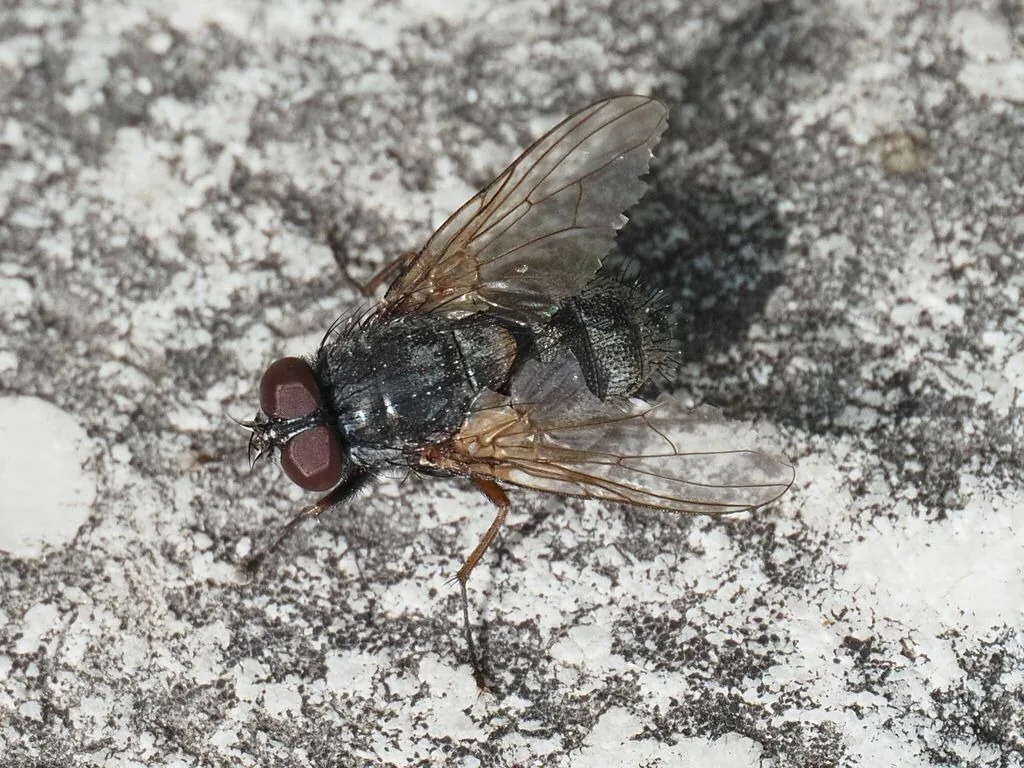
- Arkansas's identification key separates it from the house fly by two details: a pale or reddish tip on the scutellum, and a fourth long wing vein that curves only slightly upward near the wing tip.[1]
- On a house fly, that same vein is sharply angled, and the thorax is dull gray with four stripes.[1]
- The maggots are difficult to identify. Like other domestic fly larvae they are white, legless and carrot-shaped, and they grow to 1/2 to 3/4 inch long.[1]
Look-alikes
| Look-alike | How to tell them apart |
|---|---|
| House fly | The house fly has a sharply angled fourth wing vein and a dull gray thorax with four stripes. It can go from egg to adult in as few as 7 days and is most abundant in September and October.[1] |
| Stable fly | Stable flies are house-fly sized but carry long blood-sucking mouthparts, and when resting they hold the body slightly angled to the surface instead of parallel to it.[1] |
| Little house fly | Males hover in sheltered spots, and the abdominal segment next to the thorax is yellow. It is about house fly size but less robust.[1] |
Where it lives
Arkansas Extension counts the false stable fly among the few flies that are persistent pests in or around buildings, and two studies in Western Australia found it developing in poultry litter used as fertilizer on horticultural land.[1][2][3]
Biology and life cycle
Arkansas's fly tables give 140 to 220 eggs per female and 15 to 30 days from egg to adult.[1]
It is most abundant in early spring, ahead of the peak in house flies, and it turns up in many situations.[1]
The larvae develop in manure and in decaying plant waste such as culled fruit.[1]
As with the other domestic flies, females lay small white eggs, about 1/25 inch long, in or on moist organic matter. The eggs usually hatch in a day or less and dry out easily, and the larvae crawl to drier parts of the material when they are ready to pupate.[1]
The pupa forms inside a hard brown case. Empty cases can stay in the breeding material long after the flies are gone, so finding them does not by itself mean the problem is active.[1]
In the two Western Australian studies, false stable flies emerged from poultry litter along with house flies, stable flies and other nuisance flies. In the 2018 trial they made up 414 of the flies recovered, about 1.9 percent, far behind stable flies and house flies.[2][3]
Damage and signs
- Like the other domestic flies, it is a nuisance around and inside buildings, and flies of this group are also pests in outdoor eating areas, open-air markets and home yards.[1]
- Domestic flies leave spots of regurgitated food and excrement on walls, furniture, curtains and other belongings.[1]
- Poultry litter spread on cropland can produce false stable flies, though in smaller numbers than the stable flies and house flies coming from the same litter.[3]
Health risk
Arkansas Extension places the false stable fly among the domestic flies, a group it describes as able to transmit diseases. Neither Arkansas nor the two poultry-litter studies name a disease tied to this species in particular.[1][2][3]
Control
Prevention
Confirm which fly you have first. Arkansas notes that knowing the species often narrows down where it is breeding, and that domestic fly control rests on removing or preventing the places flies breed.[1]
Sanitation
Garbage cans and dumpsters are probably the biggest single source of domestic flies. Tight-fitting lids help somewhat, and collecting garbage twice a week and cleaning the containers thoroughly helps a great deal.[1]
Do not let grass clippings pile up and rot until the inside turns slimy. Removing clipping piles every other week should keep flies from breeding in them.[1]
On farms, manage manure and culled fruits and vegetables. Chicken, dairy, beef, hog and horse operations, and crop fields where manure is spread or produce is culled, can all breed large fly populations.[1]
Pesticides
Insecticides come second to sanitation. They cannot reach into the material where flies breed, and spraying anywhere other than the breeding site gives only temporary control.[1]
Common questions
- Why do these flies show up in early spring, before the house flies?
- Arkansas Extension notes that the false stable fly is most abundant in early spring, before house fly numbers peak, and it breeds in manure and decaying plant waste.[1]
- How far away could the flies be breeding?
- Most domestic flies live within half a mile of where they hatched and rarely travel more than two miles. With a large population around a building, Arkansas advises considering every possible source.[1]
- Will spraying get rid of them?
- Not by itself. Arkansas treats insecticides as secondary to sanitation, because sprays cannot penetrate breeding material and treating away from the breeding site is at best temporary.[1]
Sources
- University of Arkansas Cooperative Extension Service, “Household Pest and Rodent Control, Classification 2 Training Manual, AG1156.” uaex.uada.edu/farm-ranch/pest-management/docs/training-manuals/AG1156.pdf (accessed 2026-11-08)
- Journal of Economic Entomology, “Stable fly, house fly (Diptera: Muscidae), and other nuisance fly development in poultry litter associated with horticultural crop production (D. F. Cook, I. R. Dadour and N. J. Keals), Journal of Economic Entomology 92(6):1352-1357 (1999), abstract.” pubmed.ncbi.nlm.nih.gov/10633577/ (accessed 2026-11-08)
- Journal of Economic Entomology, “Amending Poultry Broiler Litter to Prevent the Development of Stable Fly, Stomoxys calcitrans (Diptera: Muscidae) and Other Nuisance Flies (D. F. Cook and others), Journal of Economic Entomology 111(6):2966-2973 (2018), abstract.” pubmed.ncbi.nlm.nih.gov/30256976/ (accessed 2026-11-08)
- iNaturalist, “Muscina stabulans taxon page (order and family).” www.inaturalist.org/taxa/322497 (accessed 2026-11-08)