On this page
How to identify it
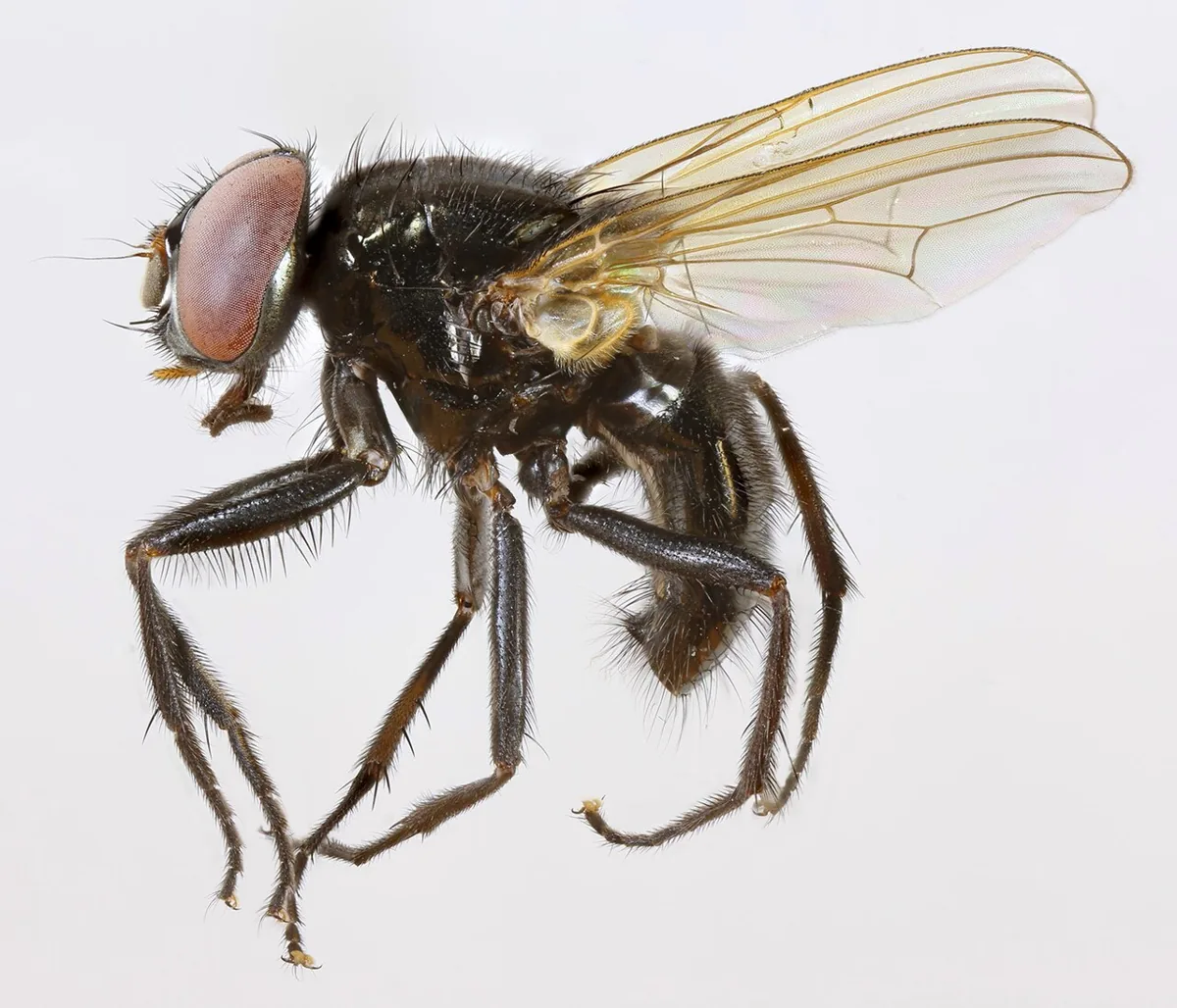
- A shiny black to bronze-black fly. Arkansas Extension calls it slightly smaller than a house fly; a Hungarian study describes adults as about half the size of a house fly.[1][2][7]
- Unlike the house fly, it has no stripes on the thorax and no bend in the wing vein.[2]
- At night it stays on its food source instead of resting on ceilings or outdoor vegetation the way house flies and little house flies do.[1]
- The larvae look much like house fly larvae.[1]
Look-alikes
| Look-alike | How to tell them apart |
|---|---|
| House fly | House flies are dull gray, with four black stripes on the thorax and a bent wing vein, which the shiny black dump fly lacks, and they rest on ceilings or outdoor plants at night.[2][1] |
| Little house fly | Another poultry-house fly, with three dark stripes on the thorax and no bent wing vein; the dump fly has no stripes. Male little house flies hover aimlessly for long periods in shaded, cooler areas, and like house flies they leave their food source at night.[2][1] |
Where it lives
A fly of poultry facilities, found in the same places as house flies. It cannot withstand freezing but can be found year-round where conditions suit it, and it travels a shorter distance, about 4 to 5 miles, than house flies or little house flies. Laboratory studies have also reared it in dairy calf and cow manure.[1][2][8]
Biology and life cycle
The life cycle resembles the house fly's; UMES puts it at around two weeks and Arkansas at 14 to 45 days. Eggs hatch in 12 to 16 hours, larvae feed for at least 5 days and pupae last at least 4 days, and adults live 14 to 20 days.[1][2]
The larvae are predators of other fly larvae, eating the developing young of house flies and other pest species.[1][2]
Very wet manure may not suit it. Larvae released in Florida pullet houses, where manure moisture generally topped 80%, failed to establish, though the flies did settle at a nearby caged-layer farm where crusted manure gave larvae places to develop.[6]
House flies, little house flies and black dump flies can all be present around a poultry facility at the same time.[2]
Damage and signs
- Sources weigh the nuisance differently. Arkansas Extension warns that large numbers can develop on poultry farms and disperse into nearby communities, which can overshadow their value as predators. A USDA release study in Florida found the adults dispersed from release sites and settled at preferred sites without becoming a nuisance.[1][6]
- UMES Extension calls it a less common pest than house flies, and sometimes a beneficial one.[2]
Health risk
Studies at U.S. poultry farms have found it carrying disease bacteria: Salmonella Infantis was isolated from dump flies at caged-layer houses linked to Salmonella outbreaks, and dump flies at Arkansas turkey farms carried Campylobacter and E. coli O157:H7.[4][5]
Control
Prevention
Identify which flies you have before choosing control measures, since the right IPM approach depends on the species and on the life stage targeted.[2]
Sanitation
Keep poultry manure dry. Arkansas notes that fly breeding in manure can be practically eliminated by holding its moisture at 30 percent or less, and that dry manure management is highly effective.[1]
Where practical, remove manure at least once a week to break the breeding cycle.[1]
Biological control
Dump fly larvae can decimate house fly populations, but adults are more sensitive to many insecticides than house flies, so sprays aimed at house flies may also kill off the dump flies. Plan any chemical use with that in mind.[1][7]
Common questions
- Is the black dump fly good or bad for my poultry operation?
- Both. Its larvae prey on house fly larvae and have been known to decimate house fly populations, but large numbers can build up and disperse, and it has been found carrying Salmonella and Campylobacter.[1][2][4][5]
- How can I tell a black dump fly from a house fly?
- The black dump fly is shiny black, smaller, and lacks the house fly's thorax stripes and bent wing vein. It also stays on its food source at night instead of resting on ceilings.[2][1]
- How far do black dump flies travel?
- Arkansas Extension puts their range at about 4 to 5 miles, shorter than that of house flies and little house flies.[1]
Sources
- University of Arkansas Cooperative Extension Service, “Biology and Control of Flies in Poultry Facilities, FSA7063.” www.uaex.uada.edu/publications/PDF/FSA-7063.pdf (accessed 2026-11-11)
- University of Maryland Eastern Shore Extension, “Poultry Facts: Nuisance Flies on Poultry Farms (J. Timmons).” wwwcp.umes.edu/extension/poultry-facts-nuisance-flies-on-poultry-farms/ (accessed 2026-11-11)
- iNaturalist, “Hydrotaea aenescens taxon page (order and family).” www.inaturalist.org/taxa/329898 (accessed 2026-11-11)
- Journal of Food Protection, via PubMed, “Olsen AR, Hammack TS (2000), Isolation of Salmonella spp. from the housefly, Musca domestica L., and the dump fly, Hydrotaea aenescens (Wiedemann), at caged-layer houses, Journal of Food Protection 63(7):958-960.” pubmed.ncbi.nlm.nih.gov/10914668/ (accessed 2026-11-11). Cited from the PubMed abstract.
- Medical and Veterinary Entomology, via PubMed, “Szalanski AL, Owens CB, McKay T, Steelman CD (2004), Detection of Campylobacter and Escherichia coli O157:H7 from filth flies by polymerase chain reaction, Medical and Veterinary Entomology 18(3):241-246.” pubmed.ncbi.nlm.nih.gov/15347391/ (accessed 2026-11-11). Cited from the PubMed abstract.
- Medical and Veterinary Entomology, via PubMed, “Hogsette JA, Jacobs RD (1999), Failure of Hydrotaea aenescens, a larval predator of the housefly, Musca domestica, to establish in wet poultry manure on a commercial farm in Florida, USA, Medical and Veterinary Entomology 13(4):349-354.” pubmed.ncbi.nlm.nih.gov/10608222/ (accessed 2026-11-11). Cited from the PubMed abstract.
- Parasitology Research, via PubMed, “Farkas R, Pap L (1996), Susceptibility of Hydrotaea aenescens (Wiedemann) to selected insecticides and its importance in integrated fly management, Parasitology Research 82(2):170-173.” pubmed.ncbi.nlm.nih.gov/8825213/ (accessed 2026-11-11). Cited from the PubMed abstract.
- Journal of Economic Entomology, via PubMed, “Hogsette JA, Farkas R, Coler RR (2002), Development of Hydrotaea aenescens in manure of unweaned dairy calves and lactating cows, Journal of Economic Entomology 95(2):527-530.” pubmed.ncbi.nlm.nih.gov/12020037/ (accessed 2026-11-11). Cited from the PubMed abstract.