On this page
How to identify it
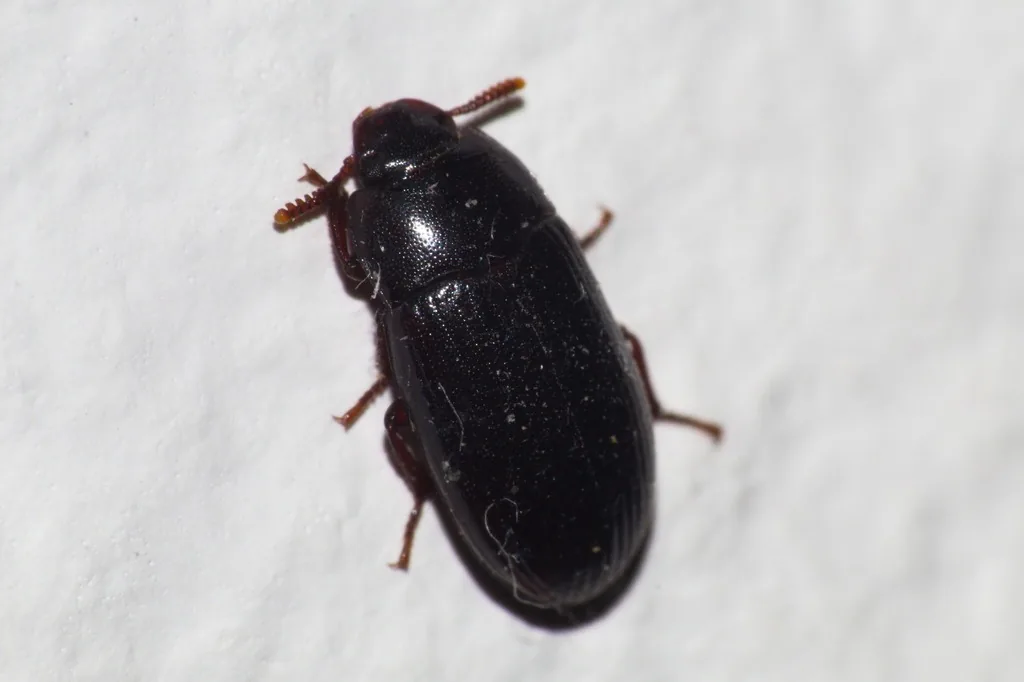
- Adults are shiny black or brownish black, broadly oval beetles about 1/4 inch long (5.8 to 6.3 mm).[2][1]
- Larvae are hard, segmented, light yellow to yellowish brown grubs with three pairs of legs that look like small wireworms or true mealworms; full grown they are about 7 to 11 mm (roughly 1/4 to just under 1/2 inch) long.[2][1]
- Both stages are most active at night and burrow quickly into the litter when disturbed, and they gather under feeders and anything else lying on the litter.[1][2]
Look-alikes
| Look-alike | How to tell them apart |
|---|---|
| Yellow mealworm | Lesser mealworm larvae superficially resemble true mealworms (Tenebrio species) and small wireworms. Full-grown lesser mealworm larvae are about 7 to 11 mm long, and both larvae and adults live in poultry litter and droppings.[2][1] |
| Black fungus beetle | A close relative also found in the United States, Alphitobius laevigatus, is less common. Its eyes are almost completely divided by a notch, while the lesser mealworm's eyes are notched about halfway.[2] |
Where it lives
Found worldwide, it probably originated in sub-Saharan Africa and reached North America from Europe; UF/IFAS lists confirmed records from Florida to Maine and west to Indiana, Michigan and Wisconsin.[2]
Biology and life cycle
It thrives in warm, humid conditions. In poultry houses adults and larvae eat spilled feed, manure, dead or dying birds and cracked eggs, and the beetle also infests flour, meal and other grain products, especially damp, musty material.[2][1][3]
Moisture is the key need: with feed everywhere, a leaking waterer or pipe is all a population needs to thrive in the litter.[1]
Females lay eggs in cracks, litter, manure, grain hulls and under feed and water lines, commonly 200 to 400 over an adult life of several months to more than a year.[2]
Eggs hatch in about 4 to 7 days, and larvae reach adulthood in about 40 to 100 days depending on temperature and food; Kentucky puts egg to adult at about 80 days, with development between 60 and 90 degrees F.[2][1]
Full-grown larvae leave the litter, especially when crowded, to pupate in a dry spot, often tunneling into insulation or wooden beams.[1][2]
Damage and signs
- Tunneling larvae ruin foam, fiberglass and polystyrene insulation in poultry houses; UF/IFAS cites energy costs about 67 percent higher in beetle-damaged broiler houses.[2][1][3]
- The beetles carry poultry diseases. They pick up organisms such as Salmonella and E. coli and the viruses of Marek's and infectious bursal disease, and birds become infected by eating them; eating many beetles can also block a bird's intestine.[1][2][3]
- When infested litter or manure is spread on fields in warm weather, adults can fly to nearby homes by the thousands, drawn to lights mostly between 8 p.m. and midnight, and such invasions have led to lawsuits against producers.[1][2]
- They sometimes become pests of stored foods inside homes.[3]
Health risk
Like other darkling beetles, lesser mealworms give off reactive defensive chemicals called quinones. UF/IFAS reports asthma symptoms, headaches, skin rashes, allergic swelling, runny nose and eye irritation in people exposed to them for long periods, and advises people with insect allergies to avoid them.[2]
Control
Prevention
Monitor with simple traps: a short length of PVC pipe holding a rolled sheet of corrugated cardboard, staked in the litter along the center line of the house and checked every week or two, shows whether numbers are rising or falling.[1]
Sanitation
Keep the litter dry: fix leaking pipes and waterers, and clean up spilled feed, since feed storage areas and spilled feed outside the house can be where an infestation starts.[1]
Clean out and dispose of litter regularly, ideally when temperatures are near or below freezing, which kills most of the insects; moving feeders and waterers to pack down loose litter also makes it less suitable.[1]
Biological control
UF/IFAS found no biological control in use as of 2006; the fungus Beauveria bassiana showed the most promise, with granular strains suppressing 60 to 90 percent of larvae in trials.[2]
Pesticides
Insecticides alone won't eliminate them, because the beetles are protected down in the litter, which can also bind the product. Some labeled products go on the floor litter and others only on walls as residual sprays, so read the label.[1]
Common questions
- Why are small black beetles swarming the lights of my house in the country?
- If poultry farms are nearby, lesser mealworms are one possibility. When infested litter or manure is spread on fields in warm weather, the adults fly toward house lights, mostly between 8 p.m. and midnight.[1][2]
- Are lesser mealworms harmful to chickens?
- Yes. They carry poultry disease organisms such as Salmonella and the virus of infectious bursal disease, and birds that eat infected beetles can become sick.[1][2]
- Can insecticides get rid of them?
- Not on their own. Kentucky calls it virtually impossible to eliminate them from a poultry house with insecticides, because they are protected in the litter; dry litter, regular clean-out and sanitation matter more.[1]
Sources
- University of Kentucky Entomology, “Lesser Mealworms or Litter Beetles, ENTFACT-507 (L. Townsend).” entomology.ca.uky.edu/ef507 (accessed 2026-11-08)
- UF/IFAS Extension EDIS, “Lesser Mealworm, Litter Beetle, Alphitobius diaperinus, EENY-367/IN662 (J. C. Dunford and P. E. Kaufman, 2006; archival copy).” journals.flvc.org/edis/article/download/115912/114113/166512 (accessed 2026-11-08)
- Maine Department of Agriculture, Conservation and Forestry, Board of Pesticides Control, “Lesser Mealworm (Got Pests?).” www.maine.gov/dacf/php/gotpests/bugs/lesser-mealworms.htm (accessed 2026-11-08)
- iNaturalist, “Alphitobius diaperinus taxon page (order and family).” www.inaturalist.org/taxa/53926 (accessed 2026-11-08)