On this page
How to identify it
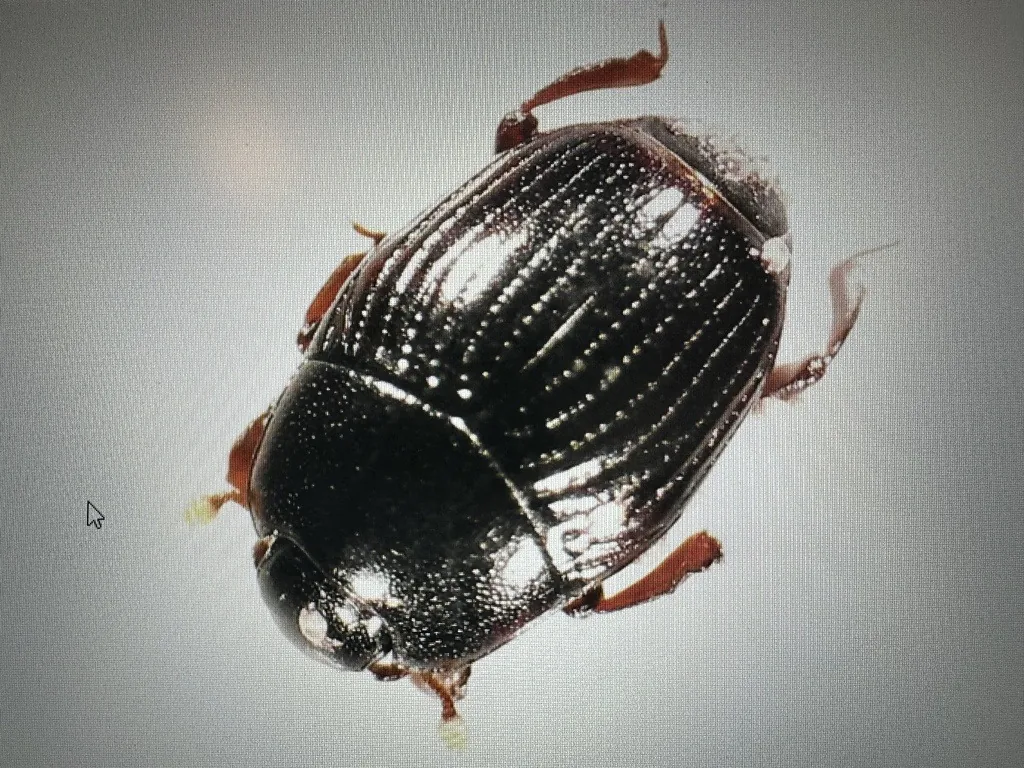
- A tiny beetle, 1.6 to 2.7 mm long (about 1/16 to 1/10 inch), black, oval and glossy, with legs that can be brownish red.[1]
- Each wing cover usually has seven lines of punctures, fourteen in all. The front shins are curved like a bow, and the jaws end in large, sickle-shaped tips.[1]
- The larvae are cream colored with a brown head; there are only two larval stages. Eggs are elongate ovals, white or cream, and under 1 mm long.[1]
- In poultry houses it lives in the manure under the cages, where all its life stages can be found when the manure moisture is between 55 and 80 percent.[1][2]
Look-alikes
| Look-alike | How to tell them apart |
|---|---|
| Lesser mealworm (litter beetle) | The other beetle common in poultry manure. UF/IFAS notes that the lesser mealworm is omnivorous and that dense lesser mealworm populations make it harder for Carcinops pumilio to establish; attractant traps for Carcinops use a screen fine enough to keep lesser mealworms out.[1] |
Where it lives
Found around the world, a spread possibly helped by its association with domestic chickens and turkeys. Outside poultry houses it turns up in wild bird nests, bat guano, carrion, moist decaying plant matter and dung, and in stored grain and flour.[1]
Biology and life cycle
The beetles prey on fly eggs and larvae. Laboratory studies found adults eating an average of 13 house fly eggs a day, and a single beetle can eat more than 100 fly eggs and maggots a day, depending on temperature.[1]
At about 78°F (25.5°C), eggs hatch in 2 to 11 days, the larval stage lasts about 15.5 days and the pupal stage about 17.5 days, so development from egg to adult takes roughly five to six weeks. At 90.5°F (32.5°C) it can take as little as 17 days. Adults can live two to three years.[1]
Adults go through dispersal phases. In one poultry-house study, a black-light trap caught more beetles from March through June and a mesh-bottomed trap on the manure caught more from June through August, with dispersal rising and falling between March and August.[3][1]
Beetles attack each other when crowded, which is one reason they cannot be mass-reared for release.[1][2]
Damage and signs
- It is a beneficial predator. House flies are the major pest of high-density caged-layer poultry houses, and without management fly numbers can reach pest levels within two or three weeks after manure cleanout, spilling over into nearby neighborhoods. Carcinops pumilio is valued for keeping those flies in check.[1]
- It also turns up in stored grain, flour and waste grain in mills and granaries, in discarded yeast in bakeries, and around bone processing and glue factories, where it preys on other insects.[1]
Health risk
Neither UF/IFAS nor the Salmonella study describes it biting or harming people directly, but it can carry Salmonella. In a laboratory study, beetles fed contaminated house fly eggs carried Salmonella enteritidis on their bodies for up to 4 days and inside for up to 13 days, and their droppings stayed positive for at least 14 days, so the researchers urged care when moving beetles between poultry facilities.[2][1]
Control
Prevention
No control is wanted in poultry houses; the goal is to keep the beetles. Producers build up Carcinops populations by keeping manure pits relatively dry and free of excess water.[1]
Biological control
Producers trap beetles and move them to houses where they are scarce. Black-light-trapped beetles, which tend to be dispersing, suit newly cleaned pits, while beetles from attractant traps are in better condition and are best released where fly numbers are already rising. Weigh the Salmonella risk before moving beetles between farms.[1][2]
Fly controls can be chosen to spare the beetles. Houses treated with the fly fungus Beauveria bassiana kept their Carcinops populations better than houses treated with pyrethrin insecticides, and the beetle is far less susceptible to Beauveria than house flies are. Parasitic wasps that attack fly pupae, such as Muscidifurax raptorellus, can be used alongside it.[1][4]
Pesticides
While beetle numbers build, UF/IFAS describes using low-residual pyrethrins against adult flies, and treating the whole house for lesser mealworm after manure removal, since dense lesser mealworm populations hinder the hister beetle.[1]
Common questions
- What are the tiny shiny black beetles in my chicken manure?
- They may be Carcinops pumilio, a hister beetle 1.6 to 2.7 mm long that lives in poultry manure and eats house fly eggs and maggots. It is a beneficial predator.[1]
- Can I buy Carcinops beetles for fly control?
- They cannot be reared in large numbers, because the beetles attack each other when crowded. Producers instead trap them in one poultry house and release them in another.[1][2]
- Are hister beetles in poultry houses a disease risk?
- They can carry Salmonella enteritidis for days after feeding on contaminated fly eggs, so moving them between poultry facilities should be carefully considered.[2]
Sources
- University of Florida IFAS Extension (EDIS), “A Hister Beetle, Carcinops pumilio (Erichson), Featured Creatures EENY-673 (M. R. Moore and P. E. Kaufman, 2017).” journals.flvc.org/edis/article/view/127200 (accessed 2026-11-09)
- Journal of Medical Entomology (Entomological Society of America); PubMed 10593097, “Gray, Maddox, Tobin, Gummo and Pitts 1999. Reservoir competence of Carcinops pumilio for Salmonella enteritidis. Journal of Medical Entomology 36(6):888-891 (abstract).” pubmed.ncbi.nlm.nih.gov/10593097/ (accessed 2026-11-09)
- Journal of Medical Entomology (Entomological Society of America); PubMed 11931240, “Kaufman, Rutz and Waldron 2002. Seasonal variation in Carcinops pumilio dispersal and potential for suppression of dispersal behavior. Journal of Medical Entomology 39(1):106-111 (abstract).” pubmed.ncbi.nlm.nih.gov/11931240/ (accessed 2026-11-09)
- Journal of Medical Entomology (Entomological Society of America); PubMed 38829822, “Geden, White, Pagac and Machtinger 2024. Comparative susceptibility of adult house fly and an important predator, Carcinops pumilio, to Beauveria bassiana. Journal of Medical Entomology 61(4):1009-1015 (abstract).” pubmed.ncbi.nlm.nih.gov/38829822/ (accessed 2026-11-09)
- iNaturalist, “Carcinops pumilio taxon page (order and family).” www.inaturalist.org/taxa/216104 (accessed 2026-11-09)