On this page
How to identify it
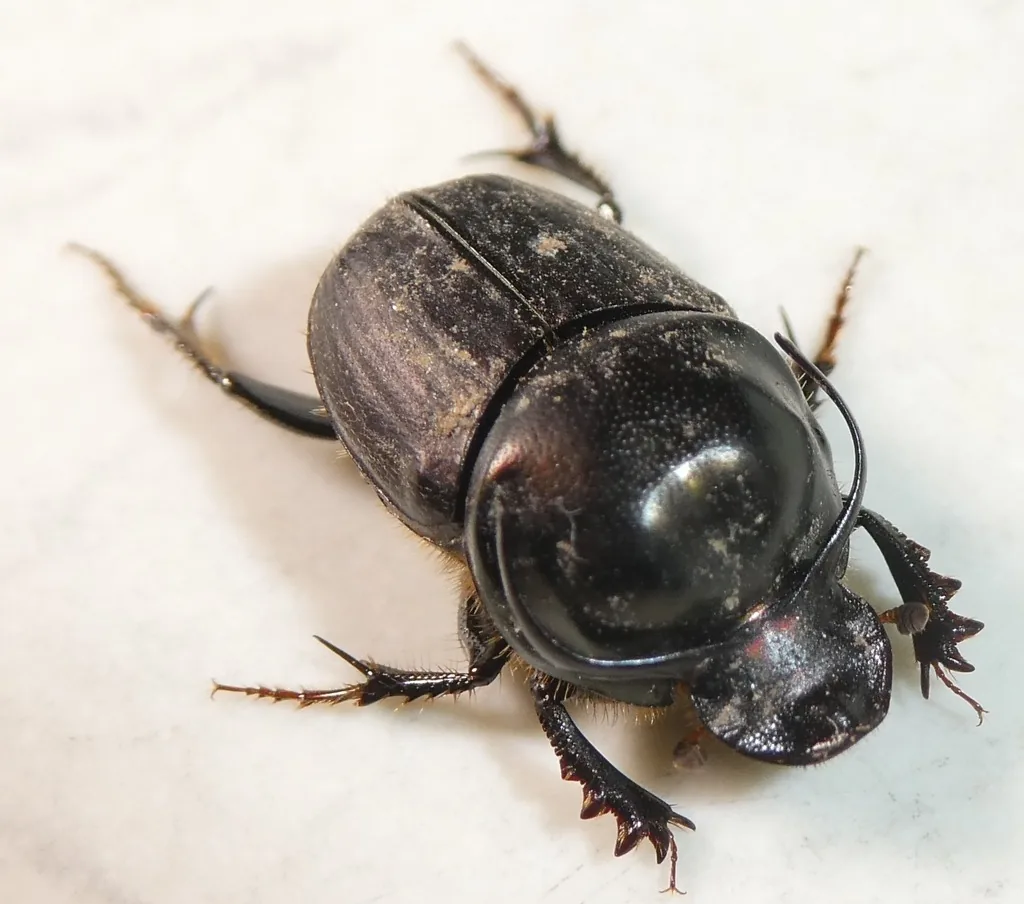
- Dung beetles are oval, stout scarabs with clubbed antennae whose feathery segments press together or fan open. The hind legs attach closer to the tip of the abdomen than to the middle legs, the head and pronotum are often broad, and in many species the males carry horns. Most are dull black, some shiny; the rainbow scarab is metallic green and copper. Missouri species run up to about 3/4 inch, and most people recognize them by behavior, when they see one collecting or rolling dung.[5]
- The true dung beetles (subfamily Scarabaeinae) are stout and usually under 12 mm, and most are tunnelers. Onthophagus hecate is 5 to 10 mm, dull black and covered with small pale hairs, the male with a horn-like projection on the pronotum; the bull-headed dung beetle (O. taurus) is 6 to 11 mm, dull black with a sheen, the male carrying two large curved horns; O. nuchicornis has black fore parts and light brown, black-mottled wing covers; O. pennsylvanicus is only 3.5 to 5 mm. The rainbow scarab (Phanaeus vindex) is 11 to 22 mm, metallic green with red and yellow reflections, the male with one large horn.[4][1]
- The small dung beetles (subfamily Aphodiinae) are smaller and more elongate and live in the dung on the pasture surface; most of the dung beetles in New York cattle pastures belong here. Earth-boring dung beetles (family Geotrupidae) are large and rounded: Geotrupes stercorarius is 16 to 25 mm, shiny black above with a metallic blue, purple or green underside.[4][2]
- A roller such as Canthon pilularius, common in West Virginia pastures, is 12 to 17 mm long with the long back legs typical of rollers; it forms a 2 to 3 cm ball and rolls it away to bury 5 to 10 cm down. The larvae of all dung beetles are whitish C-shaped grubs that develop in or beneath the dung or inside the ball their parents made.[1][5]
Look-alikes
| Look-alike | How to tell them apart |
|---|---|
| Rainbow scarab (Phanaeus vindex) | A metallic green and copper tunneling dung beetle, 11 to 22 mm, the male with one long horn; it is one of the beetles this page covers and has its own profile.[4][1] |
| Black turfgrass ataenius (Ataenius) | Small aphodiine scarabs; Ataenius strigatus is one of the dweller dung beetles recorded in New York cattle pastures.[2] |
| Hister (clown) beetles | Shiny, convex beetles 0.5 to 25 mm with the tip of the abdomen exposed and a small head hidden beneath the pronotum at rest; they share the pat but are predators of fly eggs and larvae rather than dung feeders.[2][4] |
| Rove beetles | Long, narrow beetles 2 to 35 mm with short wing covers and an exposed abdomen; adults and larvae hunt fly maggots and other small animals in the pat.[2][4] |
| Water scavenger beetles (Sphaeridium) | Oval, convex black or patterned beetles abundant in fresh cattle dung; their larvae eat fly maggots, and adults riddle pats with holes that give the manure a cheese-grater look.[1][4] |
Where it lives
About 170 dung beetle species occur in America north of Mexico. They are present on all New York beef and dairy farms and statewide in Missouri; a 2022 survey of grazing dairy farms in Vermont and New York found 20 species, all dwellers and tunnelers, since rollers are absent from those two states. West Virginia pastures hold rollers, tunnelers and dwellers.[3][4][2][5][1]
Biology and life cycle
Adults smell fresh manure and fly to it, in some species within hours of the animal defecating. A roller slices pieces from the pat, tamps them into a ball and perfects the shape with its flattened legs; a mated pair, sometimes trailed by rival males trying to steal the ball, rolls it away, digs a hole, buries it and mates, and the female lays her eggs inside. Canthon pilularius has one generation a year.[5][1]
Tunnelers dig a burrow beneath the pat, sometimes more than a meter deep, where the female lays eggs in dung balls the pair has dragged down. The grubs eat the ball, pupate inside it and emerge as adults anywhere from a few weeks to a year later; some species stay with the brood ball to remove mold. Male and female Onthophagus work together to bury the ball.[1][2]
Dwellers lay their eggs directly into fresh dung or just beneath it at the soil surface, and the larvae develop in the pat or in brood balls within it. These are mostly the smaller Aphodiinae, and they can arrive by the thousands at a single pat. A fourth group, the kleptocoprids, steals the brood balls of tunnelers and lays its eggs in them.[1][2][3]
Most species feed at least partly on dung, especially that of herbivorous mammals, though some take carrion or fungi; the adults' first job is to secure food for their young so the grubs never compete with fly maggots. Adults often fly to lights at night, and they are eaten by skunks, bats and birds.[5]
Damage and signs
- Dung beetles damage nothing; the ledger runs the other way. Manure left on the surface can sit for more than a year without insects, and much of its nitrogen escapes as gas. Beetles that mix it into the soil keep that nitrogen where plants can use it, which increases the biomass and nutritional value of pasture grasses, while their tunnels move air and soil into the pat, speed decomposition, improve water infiltration as deep as 30 cm and reduce compaction.[1][3]
- Because they eat and bury manure, they interrupt livestock parasites: strongyles, Nematodirus, Trichuris, tapeworms and coccidia leave the animal in dung and climb grass blades to be eaten again, and aggressive dung beetle activity reduces helminth egg counts four- to fifty-fold. Horn flies and face flies lay eggs only in dung up to a day old; dung feeders spread and dry the pat so quickly the flies cannot finish developing, while the predatory Sphaeridium and rove beetles sharing the pat eat fly eggs and maggots. Dung beetles have also been found to reduce the spread of E. coli to broccoli by thinning dung-breeding flies.[1][2]
Health risk
The sources describe no effect on people; the benefit is indirect, through fewer horn flies, face flies and parasites on livestock.[1][2]
Control
Prevention
No control is needed; the goal is the opposite. Dung beetle populations are declining worldwide with the loss of pasture, fewer grazing farms, habitat fragmentation and pesticide and fertilizer use, and veterinary parasite treatments excreted in dung are particularly toxic to them. Grazing livestock and extending the grazing season as long as possible keeps dung available year-round.[3]
Treat parasites so the beetles survive the manure: use rotational grazing that keeps the sward above four inches, since gastrointestinal parasites live near the base of the grass, mix livestock species so parasites land in the wrong host, plant diverse pastures that include anti-parasitic forages such as chicory and birdsfoot trefoil, run fecal egg counts and treat only the animals that need it, try parasitoid wasps, fly traps and other alternatives, and when a dewormer is needed choose one such as fenbendazole or moxidectin that is less harmful to beneficial insects.[3]
Biological control
To see what you have, break open a cow pat, drop dung into a bucket of water so the beetles float up, or set a pitfall trap with dung on wire mesh over a buried bucket; the beetles tunnel into the bait and fall in. Hister beetles, rove beetles and Sphaeridium water scavenger beetles found alongside them are fly predators worth keeping too.[3][2]
Common questions
- Beetles are rolling balls of manure across my pasture. Should I worry?
- No. Rollers carve a ball from a fresh pat, roll it away and bury it as food for their grubs, and in doing so they remove the manure that horn flies and face flies need to breed and carry its nitrogen into the soil.[5][1]
- Does deworming my cattle hurt dung beetles?
- It can. Parasiticides pass out in the dung and are particularly toxic to dung beetles; Vermont Extension suggests treating only animals that fecal egg counts show need it and choosing products such as fenbendazole or moxidectin that are less harmful to beneficial insects.[3]
- How many kinds of dung beetle are there in a pasture?
- A 2022 survey of grazing dairy farms in Vermont and New York found 20 species of dwellers and tunnelers out of roughly 170 dung beetles in America north of Mexico; in New York most are small Aphodiinae dwellers, with Onthophagus species doing the tunneling.[3][4][2]
Sources
- West Virginia University Extension, “Dung Beetles in West Virginia Pastures (reviewed June 2024).” extension.wvu.edu/agriculture/pasture-hay-forage/dung-beetles (accessed 2026-11-10)
- Cornell Integrated Pest Management (New York State IPM Program), “Dung Beetles of New York State Cattle and Dairy Pastures: A Visual Guide.” cals.cornell.edu/integrated-pest-management/eco-resilience/beneficial-insects/visual-guide-dung-beetles (accessed 2026-11-10)
- University of Vermont Extension, Northwest Crops and Soils Program, “Dung beetles in Vermont and New York, Part 1: what are dung beetles and why are they important? (Sands, Bruce, Giroux and Darby, May 2023).” www.uvm.edu/d10-files/documents/2025-02/Dung-beetle-fact-sheet-Part-1.pdf (accessed 2026-11-10)
- University of Vermont Extension, Northwest Crops and Soils Program, “Dung beetles in Vermont and New York, Part 2: identifying dung beetles (Sands, Bruce, Giroux and Darby, May 2023).” www.uvm.edu/d10-files/documents/2025-02/Dung-beetle-fact-sheet-Part-2.pdf (accessed 2026-11-10)
- Missouri Department of Conservation, “Dung Beetles (Tumblebugs) field guide.” mdc.mo.gov/discover-nature/field-guide/dung-beetles-tumblebugs (accessed 2026-11-10)
- iNaturalist, “Scarabaeinae taxon page (order and family).” www.inaturalist.org/taxa/125819 (accessed 2026-11-10)