On this page
How to identify it
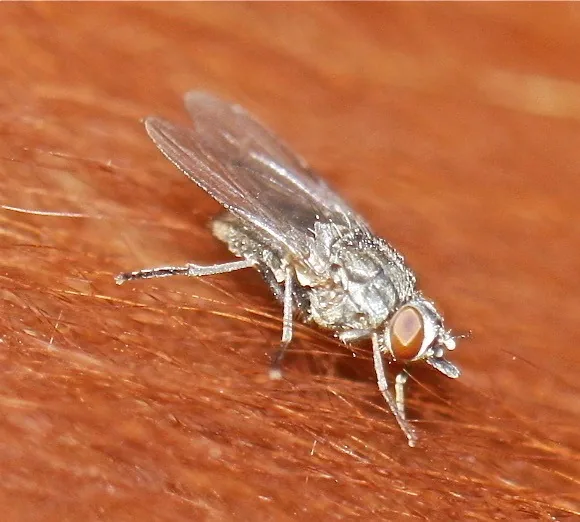
- Adults are about 3/16 inch long, roughly half the size of a house fly or stable fly, and dark gray with two dark stripes on the thorax.[3][1]
- They stay on the animal nearly all the time, resting head-down with the wings held partly open in a V; disturbed flies rise in a swarm and soon settle back.[1][3]
- In hot weather or rain they shift down to the lower sides and belly, out of direct sun.[1][3]
Look-alikes
| Look-alike | How to tell them apart |
|---|---|
| Stable fly | Stable flies and house flies are roughly twice the size of a horn fly. Horn flies are the small, dark gray flies that stay on cattle almost continuously.[3][1] |
Where it lives
Found on cattle worldwide, it ranks among the most economically important pests of pastured cattle in the United States.[4][3]
Biology and life cycle
Both males and females feed on blood, taking 20 or more small blood meals a day through needle-like mouthparts.[1][3]
Females leave the animal only to lay eggs in fresh manure, usually within about 10 minutes of it being dropped, and each can lay up to about 500 eggs.[1][3]
Eggs hatch within a day, and the maggots feed in the manure pat for 3 to 5 days before pupating in the soil underneath. Egg to adult takes 10 to 20 days, depending on weather.[3][1]
The maggots develop only in cattle manure and do best in the dung of cattle on grass; few flies come from the droppings of cattle on concentrated feed.[1]
Horn flies spend the winter as pupae in or under manure pats, and adults emerge in spring: April or May in Nebraska, late May in Kentucky.[3][1]
In Nebraska numbers usually peak in early summer, drop when hot, dry weather dries the manure pats, and peak again in late August or early September. Newly emerged flies that find no host can travel several miles looking for one.[3]
Damage and signs
- The constant biting costs weight: Kentucky reports that calves carrying an average of 200 or more horn flies wean about 15 pounds lighter than protected calves, and Nebraska studies found weaning weights 10 to 20 pounds higher when flies were controlled on the cows.[1][3]
- Cattle with 200 or more flies bunch together, stand in water or under trees for relief, and spend energy fighting flies instead of grazing; heavy populations also lower milk production.[3]
- Horn flies can spread summer mastitis, a disease of the udder in non-lactating cows, and have been implicated in spreading anaplasmosis. Bite wounds occasionally become infected.[1][3]
- Bulls usually carry the heaviest infestations.[1]
Health risk
Horn flies feed on cattle and sometimes on horses. Kentucky, Nebraska and UF/IFAS describe them only as livestock pests.[1][3][4]
Control
Traps and physical control
A walk-through fly trap has also been shown to reduce horn fly numbers; Kentucky's ENTFACT-508 describes one.[1]
Biological control
Predatory beetles in manure pats can cut horn fly production by more than 90 percent, and dung beetles and quick-drying manure add more natural control. The parasitic wasps sold for fly control around stables and feedlots are not practical against a pasture fly like this one.[1]
Pesticides
Count before treating. Kentucky and Nebraska use about 200 flies per animal as the treatment threshold, a level that may not arrive until early to mid-June; tagging too early can leave cattle poorly protected in late summer, when flies are most abundant.[2][3][1]
Insecticide ear tags, dust bags, back rubbers (oilers), pour-ons, sprays and feed-through larvicides mixed into mineral all control horn flies. Ear tags and forced-use dust bags, hung where cattle must pass to reach water or mineral, have given the most consistent results; Nebraska reports 80 to 90 percent fewer flies with well-kept forced-use bags.[1][3]
Horn flies became resistant to ear tags within several years of their introduction in the early 1980s. Rotate the insecticide class each year (pyrethroid, organophosphate, macrocyclic lactone), switch application methods, and remove tags in the fall once fly numbers drop.[3][2][1]
Feed-through larvicides work only when every animal eats the label amount every day, and flies moving in from untreated herds nearby can keep numbers high anyway.[3]
Common questions
- How many horn flies on a cow is too many?
- About 200 per animal is the point where Kentucky and Nebraska recommend treating. Treating earlier, especially with ear tags, can leave cattle poorly protected in late summer when flies are most numerous.[2][3]
- Do horn flies bite horses or people?
- They feed mainly on cattle and occasionally on horses. Kentucky and Nebraska describe them as livestock pests and mention no risk to people.[1][3]
- Why aren't my fly tags working as well as they used to?
- Horn flies become resistant to insecticides used the same way year after year, especially in ear tags. Rotating to a different insecticide class each year, changing application methods and pulling tags in the fall all slow resistance.[2][3]
Sources
- University of Kentucky Entomology, “Horn Flies and Cattle, ENTFACT-509 (L. Townsend).” entomology.ca.uky.edu/ef509 (accessed 2026-11-08)
- University of Kentucky Entomology, “Managing Pyrethroid-Resistant Horn Flies, ENTFACT-501 (L. Townsend and J. Webb).” entomology.ca.uky.edu/ef501 (accessed 2026-11-08)
- University of Nebraska-Lincoln Extension, “The Horn Fly, NebGuide G1180 (D. J. Boxler, February 2015).” extensionpubs.unl.edu/publication/g1180/2015/pdf/view/g1180-2015.pdf (accessed 2026-11-08)
- UF/IFAS Extension EDIS, “Horn Fly, Haematobia irritans irritans, EENY490/IN885 (D. Fitzpatrick and P. E. Kaufman, 2011; abstract).” journals.flvc.org/edis/article/view/119291 (accessed 2026-11-08)
- iNaturalist, “Haematobia irritans taxon page (order and family).” www.inaturalist.org/taxa/449246 (accessed 2026-11-08)