On this page
How to identify it
- Three of the four species are sucking lice that feed on blood and tend to cluster and stay put. The fourth, the cattle biting louse, has a broad head made for chewing, feeds on skin debris and hair, and moves off quickly when disturbed.[1][2][3]
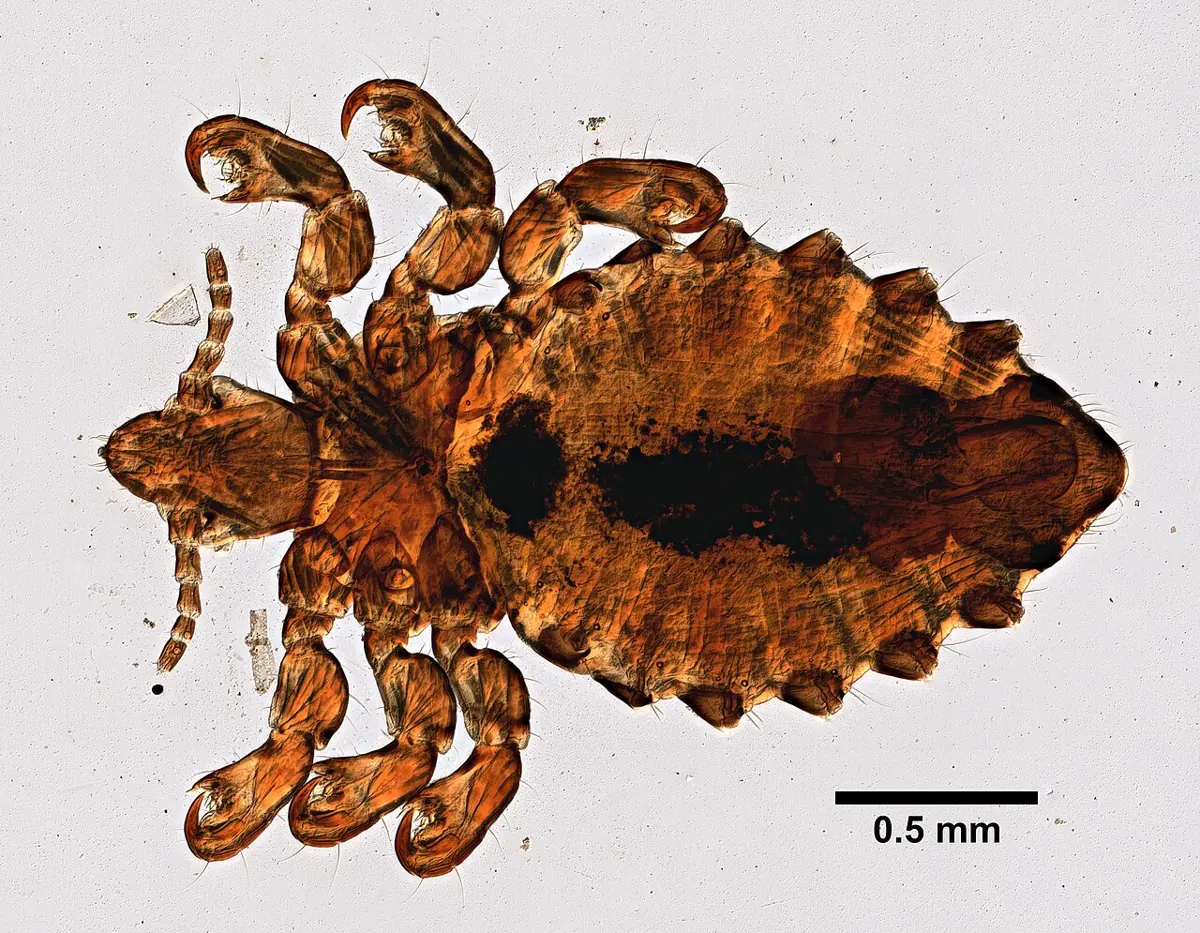
- The shortnosed cattle louse is the largest, about 1/8 to 1/5 inch long, gray-black to brown-gray with a broad, blunt head. It favors mature cattle, along the top of the neck and down to the dewlap and brisket.[1][2][3]
- The longnosed cattle louse is about 1/10 inch long, slender and bluish black, with a long, thin head. It is most common on calves and dairy cattle, on the dewlap, neck and shoulders.[1][2][3]
- The little blue cattle louse, about 1/16 inch long, is the smallest. It forms tight clusters on the muzzle, neck and dewlap and around the eyes, where heavy clusters can look like a pair of glasses.[1][2][3]
- The cattle biting louse, often called the little red louse, is also about 1/16 inch long, with a broad, bluntly triangular head and dark bands across the body. It spreads out along the topline, shoulders and tail head instead of packing into clusters.[1][2][3]
Look-alikes
| Look-alike | How to tell them apart |
|---|---|
| Shedding, mange mites and other causes of hair loss | Natural shedding, poor nutrition, mineral deficiency, photosensitivity and mite infestations can all cause rubbing and hair loss that looks like lice. Parting the hair and finding lice or their eggs confirms it.[3][1] |
Where it lives
The same four species are the cattle lice that matter in Kentucky, Nebraska and New York herds.[1][3][2]
Biology and life cycle
The whole life cycle, from egg (nit) to nymph to adult, is spent on the animal. Nits are glued to hairs and hatch in about 10 days to two weeks, and the nymphs look like small adults.[1][2][3]
Egg to egg-laying adult takes roughly three to four weeks for the sucking lice: Nebraska gives about 21 to 28 days depending on the species, and Cornell about 29 days.[3][2]
Cattle biting lice reproduce without mating, and their populations are almost entirely female.[2][3]
Lice are cold-season insects. They build up from December, when cattle carry thick coats and crowd together, peak in late winter and fade as weather warms; on a warm summer day, skin in direct sun gets hot enough to kill them.[3][2][1]
A few chronically infested animals, often older cows or bulls, carry lice through the summer and pass them to the rest of the herd in fall and winter.[1]
They spread mainly by direct contact, as at feeding or during shipping, and even contact across a fence can do it. Sucking lice die within a few hours off the animal; biting lice can survive several days under ideal conditions.[1][3]
Damage and signs
- Infested cattle rub and scratch, leaving hair on fences, losing clumps of hair and developing raw spots; heavy shortnosed louse infestations can give the coat a greasy look.[1][3][2]
- Heavy infestations cause anemia, weight loss, reduced milk production and general unthriftiness, and calves are hit hardest. Nebraska work found heavy lice can cut gains by as much as 0.21 pound a day.[2][1][3]
- Lice add to the strain of cold weather, shipping, poor nutrition and disease; Kentucky notes that low levels of lice together with intestinal worms can reduce gains by more than 8 percent.[1]
- Rubbing also damages fences and other structures, and irritated cattle can be dangerous to the people handling them.[2]
Health risk
Cattle lice are host-specific: they cannot survive off cattle and do not infest people or other kinds of livestock.[2]
Control
Prevention
Feed well. Calves on a higher plane of nutrition carry fewer lice and suffer less from them, and Kentucky calls a sound feeding program the foundation of louse control.[1][3]
Start checking in the fall. Part the hair with both hands on the face, neck, dewlap, back and tail head of at least 10 animals per group; Cornell treats under 5 lice per square inch as tolerable and 10 or more as the level that calls for treatment.[2][1][3]
Keep them out
Assume purchased cattle carry lice. Keep new animals apart (Cornell suggests at least three weeks of observation), inspect them, and treat them before they join the herd.[1][2][3]
Pesticides
Systemic products, the endectocides such as ivermectin, doramectin, eprinomectin and moxidectin, give long-lasting control of the blood-feeding lice. Given by injection they do little against the cattle biting louse, which does not feed on blood; Nebraska notes that a systemic pour-on kills both kinds, and sprays, dusts and non-systemic pour-ons also reach the biting louse.[2][3][1]
Be careful with systemic products in early winter if the herd was not treated for cattle grubs in the fall: killing grub larvae while they are in the esophagus or spinal canal can cause an adverse host reaction. Nebraska advises against systemics from November 1 to February 1 in that case, and Kentucky points to non-systemic products such as permethrin instead.[3][1]
Sprays and many other treatments do not kill the nits, so plan a second application 10 to 14 days after the first unless the label calls for only one.[2][3][1]
Dust bags and back rubbers let cattle treat themselves; Cornell notes dusts have historically worked best, and rotating active ingredients slows resistance.[2][1]
Common questions
- Why are my cows rubbing out patches of hair in the winter?
- Lice are a common cause, since they build up from December into late winter. Shedding, poor nutrition, mineral deficiency, mites and photosensitivity can look similar, so part the hair on the topline, withers and face and look for lice and nits.[3][1]
- Can people, horses or other livestock catch cattle lice?
- No. Cattle lice are host-specific and do not infest people or other kinds of livestock.[2]
- Why didn't an injectable dewormer clear up the lice?
- Injectable systemic products kill the blood-feeding lice but not the cattle biting louse, which feeds on skin debris. Nits that hatch after treatment are another reason a second application is often needed.[2][3]
Sources
- University of Kentucky Entomology, “Lice on Beef and Dairy Cattle, ENTFACT-512 (L. Townsend).” entomology.ca.uky.edu/ef512 (accessed 2026-11-08)
- Cornell University, New York State Integrated Pest Management, “Cattle Lice, Livestock IPM Fact Sheet (J. Leeser, January 2026).” cals.cornell.edu/integrated-pest-management/outreach-education/fact-sheets/cattle-lice-livestock-ipm-fact-sheet (accessed 2026-11-08)
- University of Nebraska-Lincoln Extension, UNL Beef, “Cattle Lice (D. Boxler, February 2, 2020).” beef.unl.edu/cattle-lice (accessed 2026-11-08)
- iNaturalist, “Haematopinus eurysternus taxon page (order and family).” www.inaturalist.org/taxa/407724 (accessed 2026-11-08)