On this page
How to identify it
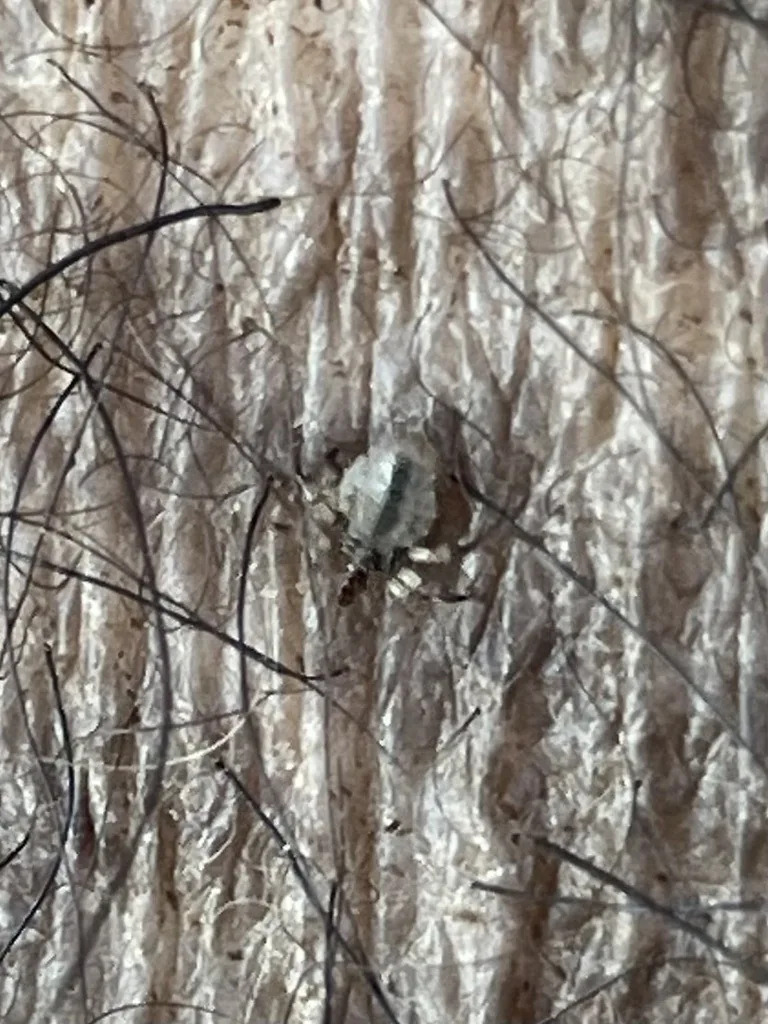
- Adults are broad and about 1/4 inch (5 to 6 mm) long, big enough to see with the naked eye, though they are easy to overlook.[2][1]
- They are grayish brown with brown to black markings and can look bluish from the blood they take. Arkansas describes them as slate blue, often close to the color of the pig's skin.[2][1]
- Look first inside the ears, sometimes deep in the ear canal, and in the skin folds around the neck, where lice gather in small clumps; they also favor the inner surface of the legs near the body.[1][2]
- Eggs are glued to the bristles close to the skin.[1][2]
Where it lives
It depends on swine and is covered by extension entomologists in Arkansas and Mississippi. Arkansas notes lice are often more prevalent in confined operations, where pigs are in close contact.[2][1]
Biology and life cycle
Hog lice spend their whole lives on the pig, and every stage is found on the animal. A louse knocked off its host lives only 2 to 3 days.[1][2]
A female glues her eggs to the hair shafts and may lay as many as 90 eggs over 25 days. The young hatch in 12 to 30 days, depending on conditions, and feed on blood through three nymphal stages before becoming adults, which live about 25 days.[2]
Arkansas puts the full life cycle at 25 to 30 days, with 8 to 12 generations a year.[1]
Lice spread by contact between pigs and usually enter a herd on newly bought animals. They attack hogs of any age or condition, though stressed or unthrifty animals are more susceptible, and infestations are heaviest in winter even though lice can be found year-round.[1][2]
Damage and signs
- Feeding irritates the skin. Pigs scratch with their feet or rub against feeders, posts and other objects, become restless, eat less and lose weight; Mississippi State notes that the stress of external parasites slows gains and raises the feed needed per pound of gain.[1][2]
- Repeated feeding leaves the skin thick, cracked, tender and sore, and heavily infested animals can develop a measles-like skin condition that lowers hide quality.[1]
Health risk
Hog lice can transmit swine pox, a potentially fatal viral disease of pigs marked by pockmark lesions on the belly, and they have been implicated as possible carriers of hog cholera and eperythrozoonosis. They can also contribute to anemia in young pigs. The louse depends on swine and generally does not attack other animals.[1][2]
Control
Prevention
Keep lice out by isolating new animals in a separate building or pen and treating them for internal and external parasites before they join the herd; isolation also gives time to watch them for signs of pests.[1][2]
Pesticides
Treat twice. For moderate to heavy infestations Mississippi State advises a second treatment 10 to 14 days after the first, and Arkansas notes a spray normally needs a second application about 14 days later. Often the whole herd needs treating, and Arkansas suggests treating all feeder pigs in the fall.[2][1]
Sprays, dusts, pour-ons and injectable products are labeled for hog lice. Arkansas lists ivermectin and doramectin injections, coumaphos for lice only, and permethrin, amitraz and phosmet among products that control both lice and mange. Follow the label dose and withdrawal period.[1]
When spraying, wet the animals thoroughly but avoid prolonged treatment, spray only on warm, sunny days so they dry quickly, and spray pens, hog houses and bedding at the same time.[1]
Common questions
- Where should I look for lice on a pig?
- Inside the ears, including deep in the ear canal, in the skin folds around the neck, and on the inner surface of the legs close to the body.[1][2]
- Do hog lice spread to other animals?
- The hog louse depends on swine and generally does not attack other animals, and once off a pig it survives only 2 to 3 days.[2]
- Why do pigs need a second lice treatment?
- Mississippi State advises two treatments 10 to 14 days apart whenever moderate to high numbers of lice are present, and Arkansas notes that a spray normally needs a second application about 14 days after the first.[2][1]
Sources
- University of Arkansas Cooperative Extension Service, “Protect Swine From External Parasites, FSA7034 (K. M. Loftin).” www.uaex.uada.edu/publications/PDF/FSA-7034.pdf (accessed 2026-11-08)
- Mississippi State University Extension, “Swine Ectoparasite Control, Publication 865 (J. Goddard and K. T. Edwards, 2024).” extension.msstate.edu/sites/default/files/publications/P865_web.pdf (accessed 2026-11-08)
- iNaturalist, “Haematopinus suis taxon page (order and family).” www.inaturalist.org/taxa/337716 (accessed 2026-11-08)