The short answer
- Clean barns and corrals at least once a week to break the fly life cycle, and spread the manure thinly or compost it. Minnesota's horse guide goes further: pick up manure at least twice a week and replace bedding weekly. Penn State says manure should ideally come out of stalls and areas where horses gather every day.[4][2][1]
- Know which fly you have. House flies and stable flies breed in manure, bedding and feed around the barn, while horn flies and face flies develop in fresh cattle manure, so they need different controls.[1][3][9][7]
- Track house flies with jug traps, sticky ribbons or spot cards. Penn State treats more than 250 flies per jug trap in a week, or spot-card counts over 100, as high fly activity.[1][5]
- Parasitoid wasps sold as fly parasites kill house fly and stable fly pupae and work alongside diligent sanitation, not instead of it. They don't help against horn flies or face flies.[1][3][11][8]
- Insecticides are a supplement. They kill adult flies but leave the breeding sites alone, resistance is a growing problem, and fly baits kill house flies but not stable flies.[4][1][5]
Flies around barns and livestock
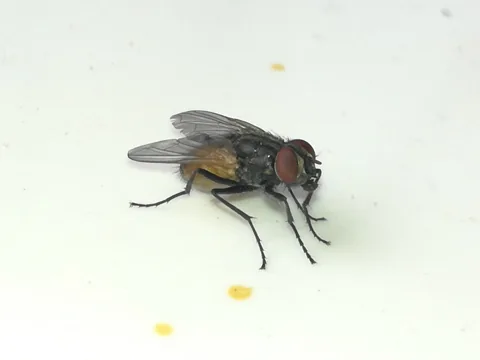 House Fly
Musca domestica
The house fly is a worldwide companion of people and domestic animals; it breeds in garbage, manure and other moist organic matter and is most numerous in hot summer months.
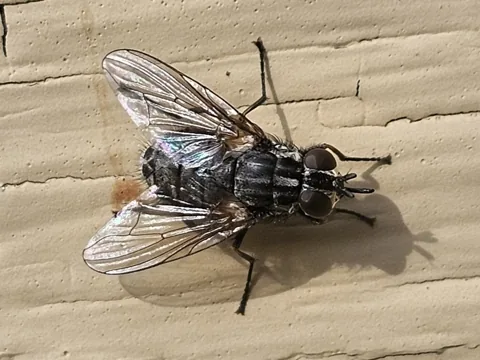 Stable Fly
Stomoxys calcitrans
The stable fly, also called the biting house fly or dog fly, looks much like a house fly but feeds on blood. Cattle are its main hosts, but it also bites horses, dogs and people, especially in neighborhoods near livestock.
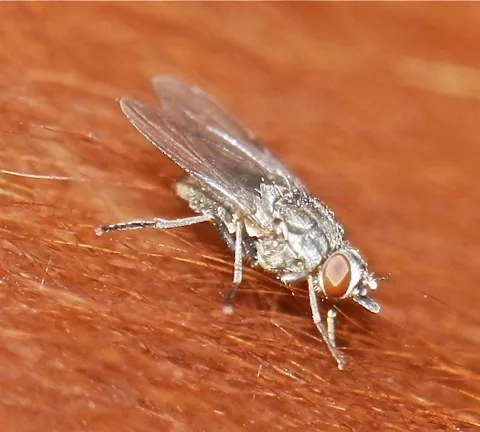 Horn fly
Haematobia irritans
The horn fly is a small, dark gray biting fly that lives on pastured cattle and breeds in their fresh manure. It counts among the most economically important pests of cattle, and without control a herd can carry several hundred flies per animal by late summer.
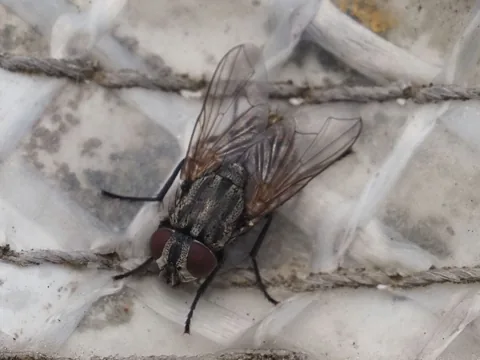 Face Fly
Musca autumnalis
The face fly is a serious pest of pastured cattle that also invades homes and barns near pastures. In fall the adults look for sheltered places to spend the winter, often inside attics and wall voids, much like cluster flies.
No photo yet
Filth fly parasitoids
Pupal parasitoid wasps, chiefly Muscidifurax raptor, M. raptorellus and Spalangia species
Filth fly parasitoids are tiny wasps that lay their eggs in the pupae of house flies and stable flies, killing the developing fly. They occur naturally on most farms where flies breed, and several species are sold for release around barns, dairies, horse farms, feedlots and poultry houses as part of a fly control program.
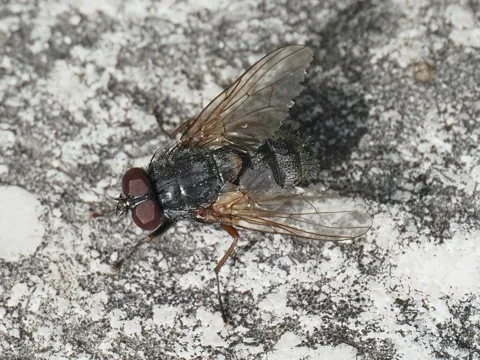 False stable fly
Muscina stabulans
The false stable fly looks much like a house fly, and Arkansas Extension lists it among the few flies that are persistent pests in and around buildings. It breeds in manure and rotting plant waste, and it is most plentiful in early spring, before house flies reach their peak.
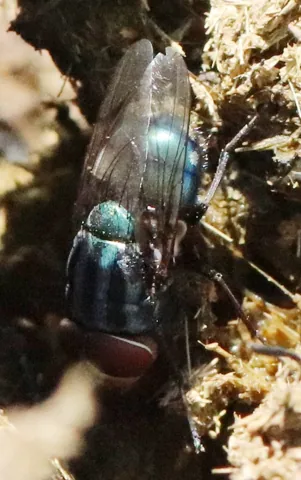 Secondary screwworm
Cochliomyia macellaria
The secondary screwworm, Cochliomyia macellaria, is a metallic blue-green blow fly whose maggots develop in carcasses and rotting meat. It is the closest relative of the New World screwworm and the fly most likely to be mistaken for it, but it does not lay its eggs on healthy living animals.
Which fly are you fighting?
Penn State's horse-farm guide covers four filth flies that look much alike: house flies, stable flies, face flies and horn flies. Where each one breeds and where it sits on the animal tells you which controls will work.[1]
- House flies don't bite. They sponge up liquid from almost any moist material, from manure to garbage, and can carry pathogens. On horses they gather near the eyes, nostrils, lips and wounds but can turn up anywhere on the body.[4][1][5]
- Stable flies look like house flies but have a pointed mouthpart sticking forward from the head, and both males and females feed on blood, usually on the legs and flanks. A stable fly stays on the animal only a few minutes; Minnesota Extension says only about 5 percent of the stable flies near a horse are on it at any one time, while the rest perch on fences, buildings and plants.[4][1][2][6]
- Horn flies develop only in fresh cattle manure and feed mainly on cattle, clustering on the back, sides and belly. They can feed on horses but can't develop in horse manure, so they show up on horse farms that are near cattle.[1][3][9][7]
- Face flies lay their eggs in fresh cattle manure and feed on the secretions around the eyes and nostrils. Their feeding irritates cattle and can spread pathogens, and Minnesota Extension says their main economic cost is the treatment of pinkeye.[1][3]
- Flies breed fast. Kentucky gives 7 to 14 days from egg to adult for house flies and 21 to 25 days for stable flies in summer. Penn State says house flies can develop in as few as seven days under ideal summer conditions, and Minnesota says the whole filth fly life cycle can take as little as two weeks. Kentucky's weekly cleaning schedule is meant to break that cycle.[4][1][2]
Start with manure, bedding and feed
House flies and stable flies need breeding material, moisture and warmth. Minnesota Extension says fly maggots do best in debris that is 40 to 80 percent moisture at 70 to 95 F, and Kentucky notes that dry manure isn't a good breeding site.[4][2]
Scout before the season starts. Minnesota's cattle guide suggests digging into bedding, spilled feed and manure piles in spring to find maggots and pupae, cleaning out those spots, and then removing debris often through the summer.[3]
For stable flies, UC Riverside's veterinary entomologists advise starting control after spring rains, before the flies begin to build up, and say removing the material larvae develop in is the preferred way to suppress them.[6]
- Manure: sources give different schedules. Kentucky says to clean barns and corrals once a week, Minnesota's horse guide says at least twice a week, and UC Riverside says manure buildup in animal pens should be removed at least once or twice a week in hot summer months. Penn State says that ideally manure should come out of stalls and congregation areas daily, because many fly eggs can hatch in as little as 12 hours. Spread the manure or compost it.[4][2][5][1]
- Bedding: replace it weekly. Minnesota says wood shavings and sawdust produce fewer flies than straw, and Penn State says sawdust supports fewer developing flies than shavings or straw.[2][1]
- Check the hidden spots. Penn State says flies often develop in small protected places such as between rubber stall mats or along the edges of stall walls. In cattle pens, UC Riverside points to wet manure near waterers, beneath fence lines and against structures where animals can't trample and compact it.[1][5][6]
- Feed: keep it dry, avoid feeding on the ground, clean up spills quickly and cover feed in bins. Disk, spread or compost waste feed.[2][1]
- Round bales: wasted hay trampled around a bale becomes stable fly habitat. Penn State suggests moving bale-feeding sites or ringing the bales with metal rings or other devices that keep waste from being trampled. UC Riverside links the stable fly's growing role as a pasture pest to hay waste from large round bales, and a USDA Agricultural Research Service and University of Nebraska analysis estimated that an average winter hay feeding site produces about 200,000 stable flies.[1][6][14]
- On small Florida horse farms, researchers found stable fly pupae mostly in hay mixed with horse manure and house fly pupae in fresh pine shavings mixed with manure.[12]
- Water: fix wet areas around waterers, keep waterers in good repair, and place them on well-drained ground away from where horses are fed.[4][2]
- On cattle farms, Minnesota suggests scraping, hauling, spreading or composting soiled bedding every other week in summer, if possible. UC Riverside's dairy advice is similar: remove organic bedding entirely every other week, replace it with new material, and spread the old bedding thinly to dry, compost it or haul it away.[3][6]
Handling the manure pile
Manure spread on a field right after it comes out of the stalls dries fast enough to support little or no fly development.[1][5]
Composting kills developing flies only if the pile stays hot, which means turning it often and keeping it covered. Simply covering a pile with a secured tarp keeps adult flies from laying eggs in it; the parts that most need covering are fresh additions and material up to seven days old. UC Riverside adds that compost piles need turning after rain or other wetting, because flies develop in the wet, cool outer layer.[1][5]
Where cattle share the farm, dragging paddocks often to spread out manure pats can eliminate horn fly and face fly breeding sites. UC Riverside says manure that dries within a few days won't produce horn flies, and Kentucky notes that fast drying of manure gives some natural control. NRCS and some state conservation districts can advise on manure storage and handling.[1][7][9]
Count flies before and after you act
Monitoring shows whether fly numbers are climbing and whether your controls are working. Penn State says filth fly problems run from spring through fall and usually peak in July and August, and that a farm can be well kept and still get flies from neighboring farms, so a zero-fly goal isn't realistic.[1][6]
Kentucky treats traps mainly as a record: a big jump in the catch from one week to the next is a signal to check sanitation and step up control. UC Riverside recommends using the same method at the same spots for the same length of time and keeping the records for several years, so you can compare one period with another.[4][5]
- House flies: use baited traps, sticky ribbons or spot cards. For a homemade jug trap, cut four 2-inch holes in the upper sides of a plastic milk jug, put the bait or pheromone and water in the bottom, and hang it in the eaves where flies rest or along a fence line.[1][5]
- Use at least five traps or cards spaced fairly evenly through the barn or along the fence lines. Replace traps at least every seven days in summer, because the dead flies become a place for new flies to develop.[1]
- Stable flies: count the flies on the horses' legs, count fly-avoidance behaviors such as stomping and tail swishing, or use a sticky stable fly trap, which also lets you confirm the species.[1][6]
- Horn flies and face flies: count them on the animal, at the same time of day, on the same animals and in the same place, about once a week. For horn flies, UC Riverside suggests counting 5 to 10 animals in the early to mid morning, from both sides, since flies bunch up on one side in direct sun. Minnesota, Kentucky and Nebraska all use about 200 horn flies per animal as the point to manage them.[1][7][3][9][10]
Screens, fans and fly gear
- Screen feed rooms, tack rooms and box stalls, and use nets and screens on barn doors and windows.[4][2]
- Fans that blow downward and outward keep flies from entering barns, and moving air interrupts flight so fewer flies land.[4][1]
- Fly sheets, masks, boots and leggings reduce flies on the horse itself. Check the gear routinely to make sure it hasn't shifted or started rubbing.[1][2]
- In a Minnesota trial with six horses, leggings and leg bands reduced hoof stomping and moving the head back toward the body, and a citronella spray reduced tail swishing and shoulder twitching, but no single product reduced every fly-avoidance behavior.[2]
- Repellents give stable fly relief that doesn't last. Apply them to the legs, where stable flies bite most, and reapply if the horse walks through wet vegetation. On-animal sprays and wipes also break down in sunlight, wash off with sweat and get buried under dirt when horses roll.[2][1]
- Homemade repellent recipes may include ingredients that harm horses with sensitive skin, and plant oils are less effective than commercial products. Products registered with EPA carry an EPA number on the label.[2]
Fly parasitoid wasps
These tiny stingless wasps, about 1/16 to 1/8 inch long, lay eggs in house fly and stable fly pupae, and the wasp larvae kill the developing fly. They occur naturally on most farms that produce flies, and companies sell them for release to boost the local population.[1][2][11][8]
Release them only after you've confirmed flies are developing on your property; Penn State says the wasps won't help if the flies are coming from somewhere else. A Florida study of small horse farms found no confirmed fly development on two of four farms and reached the same conclusion. Companies differ in their knowledge and colony quality.[1][12]
Release them close to where flies are developing. Cornell says to focus releases on areas with immature flies, and in a Florida field trial the highest parasitism by Spalangia cameroni was within about 5 meters of the release point; the authors say releases may not suit pastures where the wasps would have to fly far.[11][13]
Results vary. Cornell says two Muscidifurax species, combined with other IPM tactics, have controlled 35 to 80 percent of house flies and stable flies on farms. Minnesota's horse guide says success has been inconsistent among studies and likely depends on how much breeding material and how many fly pupae the wasps have to deal with, and Kentucky says there is no clear answer yet on how well releases work around confined livestock. UC Riverside reports success in confined areas such as calf barns but no substantial reduction in trials on large California dairies.[11][2][8][6]
Releases are repeated, not one-time. Kentucky says wasps are needed each year and that you shouldn't count on establishing a population; Cornell recommends weekly releases from May through September. Kentucky also advises leaving some manure in place so the wasps have hosts, while keeping excess manure from overwhelming them.[8][11]
Residual insecticides kill the wasps, so keep them out of release areas. Cornell says insect growth regulators are more compatible with the wasps if an insecticide is needed, and Kentucky suggests limiting chemicals to house fly baits and treatments that don't touch the manure. The wasps can't control horn flies or face flies: both develop in cattle manure, and face fly pupae are hardened so the wasps can't get through the case.[3][1][11][8]
Fly-killing fungi are a different biological option, and the sources disagree on them. Penn State says fungi such as Beauveria bassiana have given 75 to 100 percent fly control in about two weeks or less, depending on strain, but no products were labeled for fly control on horse facilities. UC Riverside says these fungi are common on animal facilities but unreliable, because flies are least likely to be infected in hot summer months, when control is most needed.[1][5]
Where insecticides fit
Insecticides kill adult flies after a problem has developed, but they don't touch the moist breeding material. Kentucky says large numbers of flies mean lots of breeding sites, which insecticides alone can't fix, and Penn State says fly resistance has made working products harder to find.[4][1][5]
Penn State still sees a place for them: when a large population needs knocking down fast, when the flies are coming from a neighbor's property, or to relieve fly pressure on individual horses for a while. Always read and follow the label.[1][2]
- Residual premise sprays go on walls, ceilings and rafters where flies rest, often above head height; clusters of brown fly specks show the spots. Minnesota says they may last up to 3 weeks, depending on how clean the site is. Protect animals, feed and water while you spray.[4][2][1][6]
- Automatic fly sprayer systems: Penn State warns that this kind of indiscriminate use breeds resistance quickly and repeatedly exposes people and animals to insecticide vapor and droplets.[1]
- Space sprays and fogs, usually pyrethrins, knock flies down quickly in enclosed areas but leave little residue, so they give only temporary relief and need repeating. UC Riverside says to apply them in the early morning, when stable flies are concentrated in their overnight resting spots, and that they don't last more than a day or two.[4][2][6]
- Fly baits in bait stations attract and kill house flies, not blood-feeding stable flies, and work best where there's little competing food. Kentucky lists imidacloprid among bait ingredients. Baits are toxic, so keep animals and children away from them.[4][1][3]
- Larvicides go directly on breeding sites with large numbers of maggots, for areas you can't clean often enough to break the life cycle. UC Riverside cautions that spraying a broad-spectrum insecticide over widespread breeding sites harms the natural enemies on the surface while the maggots underneath are partly protected.[4][1][6]
- Feed-through fly control passes into the manure and keeps maggots from developing; Kentucky lists cyromazine and diflubenzuron among the ingredients. Every animal on the property must get the correct amount every day, and it does nothing about wet spilled feed or straw. A feed-through given to horses won't touch horn flies or face flies, which develop in cattle manure. On pasture, Nebraska notes that fly numbers can stay high if flies move in from nearby untreated herds.[4][1][10]
- Resistance: don't use the same insecticide, or another from the same chemical class, over and over through a season. Penn State suggests checking the active ingredient against the IRAC mode-of-action chart and rotating to a different group.[4][1][7][6]
Cattle on pasture
- Ear tags, back rubbers, dusters and pour-ons are not effective against house flies and stable flies around the barn; those need sanitation, with premise sprays as a supplement.[3]
- Horn flies: once counts reach about 200 per animal, options include pour-ons, sprays, dust bags, feed additives and insecticide ear tags. Kentucky says ear tags and forced-use dust bags have given the most consistent control, and Nebraska says forced-use dust bags usually cut horn fly numbers by 80 to 90 percent. Feed additives cut the number of larvae in the manure but may not cut adult flies, which move easily between neighboring herds.[3][9][10]
- Face flies: insecticide ear tags work, and dust bags and back rubbers can work if they hang low enough to reach the animals' faces. Rotate the insecticide class in your tags to slow resistance; Kentucky also advises holding off on tagging until horn flies reach 200 per animal and removing tags once numbers fall in autumn, and Nebraska gives a four-year class rotation plan.[3][9][10]
- Some fly traps made for cattle, including one design you can build yourself, can reduce the number of pasture flies on cattle, especially horn flies.[3][9][7]
- Rove beetles and hister beetles eat fly larvae in dung pats, but many insecticides that kill fly larvae kill them too. Sources differ on how much predators help. Kentucky says predator beetles may reduce horn fly production by more than 90 percent, while Minnesota says research is not conclusive on whether predators, parasitoids or chickens following cattle significantly reduce fly numbers.[3][9]
- Feed-through insecticides hit those beetles too. A Cornell IPM and University of Vermont study of grazing beef farms found fewer dung beetles and predatory dung insects on farms using feed-through products, horn flies that rarely passed treatment thresholds even on untreated farms, and face flies that mostly passed them even on treated farms.[15]
- Horn flies on horses: they turn up on horses near pastured cattle, usually in low numbers. UC Riverside suggests a spot application or insecticide wipe where they rest and bite, and says controlling horn flies on the nearby cattle gives horses the longest relief.[7]
What doesn't work, and flies this plan won't reach
- Hanging plastic bags of water around buildings: there's no evidence they repel house flies.[2]
- Barn lime: the small amounts used in horse barns can dry stalls and cut ammonia odor but don't control flies, because maggots tolerate a wide range of pH. Too much lime on pasture can stop some plant growth.[2]
- Traps alone: sticky traps and UV electric traps catch house flies and stable flies, and baited traps catch house flies only, but poor debris management or flies coming from off the farm limit what traps can do. UC Riverside says sticky papers handle a few flies in a confined space but not a heavy infestation.[2][5]
- Black flies, horse flies, deer flies, biting midges and mosquitoes don't develop in the manure, bedding and feed that filth flies use, so a filth fly plan won't affect them. Minnesota says commercial repellents aren't effective against black flies, horse flies or deer flies; deep shade or housing during daylight gives horses relief from them. To prevent mosquito breeding on site, clean water tanks and empty or discard containers that hold rainwater for more than a week.[1][2]
When to get help
- If you can't tell which flies you have, collect maggots or pupae in isopropyl alcohol and send them to an extension educator for identification.[1]
- Ask your veterinarian about vaccinating horses against the mosquito-borne viruses that can kill them.[2]
- NRCS and some state conservation districts can recommend changes to manure storage and handling on your farm.[1]
Common questions
- Why do I still have flies after spraying the barn?
- Spraying kills adult flies but doesn't touch the manure, bedding and feed they breed in, and fly resistance to insecticides has been increasing. Kentucky says large numbers of flies mean lots of breeding sites, which insecticides alone can't fix.[4][1][5]
- Do fly parasites work?
- They can help against house flies and stable flies when sanitation is good and the flies are breeding on your farm, but study results have been inconsistent, releases have to be repeated every season, and they don't affect horn flies or face flies.[1][2][3][8]
- How often should I clean stalls to control flies?
- Kentucky says to clean barns and corrals once a week to break the fly life cycle; Minnesota's horse guide says to pick up manure at least twice a week and replace bedding weekly, and Penn State says daily removal from stalls is ideal.[4][2][1]
- Does barn lime keep flies down?
- No. Minnesota Extension says the amounts used in horse facilities don't control flies, because maggots tolerate a wide range of pH.[2]
- How many horn flies on a cow is too many?
- About 200 per animal. Minnesota, Kentucky and Nebraska all use that count as the point to start control, and Kentucky reports that calves carrying 200 or more horn flies through the summer wean lighter than protected calves.[3][9][10]
Photo credits
- House Fly: ivan_humljani, public domain (CC0), via iNaturalist
- Stable Fly: (c) Phoenix M.S, some rights reserved (CC BY) — via iNaturalist, CC BY 4.0
- Horn fly: Ann McKenzie, public domain (CC0), via iNaturalist
- Face Fly: (c) Michael Knapp, some rights reserved (CC BY) — via iNaturalist, CC BY 4.0
- False stable fly: (c) Michael Knapp, some rights reserved (CC BY) — via iNaturalist, CC BY 4.0
- Secondary screwworm: (c) Catherine C. Galley, some rights reserved (CC BY) — via iNaturalist, CC BY 4.0
Sources
- Penn State Extension, “Filth Fly Control on Horse Farms (updated January 15, 2019).” extension.psu.edu/filth-fly-control-on-horse-farms (accessed 2026-11-10)
- University of Minnesota Extension, “Fly control around horses.” extension.umn.edu/horse-care-and-management/fly-control-around-horses (accessed 2026-11-10)
- University of Minnesota Extension, “Managing flies on cattle farms.” extension.umn.edu/dairy-milking-cows/managing-flies-cattle-farms (accessed 2026-11-10)
- University of Kentucky Entomology, “ENTFACT-514: Fly Control Around Horse Barns and Stables.” entomology.ca.uky.edu/ef514 (accessed 2026-11-10)
- University of California, Riverside, Veterinary Entomology, “House Fly (Musca domestica L.).” www.veterinaryentomology.org/house-fly (accessed 2026-11-10)
- University of California, Riverside, Veterinary Entomology, “Stable Fly (Stomoxys calcitrans L.).” www.veterinaryentomology.org/stable-fly (accessed 2026-11-10)
- University of California, Riverside, Veterinary Entomology, “Horn Fly (Haematobia irritans L.).” www.veterinaryentomology.org/horn-fly (accessed 2026-11-10)
- University of Kentucky Entomology, “ENTFACT-502: Biological Control of Flies.” entomology.ca.uky.edu/ef502 (accessed 2026-11-10)
- University of Kentucky Entomology, “ENTFACT-509: Horn Flies and Cattle.” entomology.ca.uky.edu/ef509 (accessed 2026-11-10)
- University of Nebraska-Lincoln Extension, “The Horn Fly, NebGuide G1180 (2015).” extensionpubs.unl.edu/publication/g1180/2015/pdf/view/g1180-2015.pdf (accessed 2026-11-10)
- Cornell University, New York State Integrated Pest Management, “Muscidifurax raptor and M. raptorellus, Biocontrol Agent Fact Sheet.” cals.cornell.edu/integrated-pest-management/outreach-education/fact-sheets/muscidifurax-raptor-and-m-raptorellus-biocontrol-agent-fact-sheet (accessed 2026-11-10)
- Neotropical Entomology, abstract via PubMed, “Machtinger, Leppla and Hogsette 2016, House and stable fly seasonal abundance, larval development substrates, and natural parasitism on small equine farms in Florida.” pubmed.ncbi.nlm.nih.gov/26902468/ (accessed 2026-11-10)
- PLoS ONE, abstract via PubMed, “Machtinger, Geden and Leppla 2015, Linear dispersal of the filth fly parasitoid Spalangia cameroni and parasitism of hosts at increasing distances.” pubmed.ncbi.nlm.nih.gov/26061882/ (accessed 2026-11-10)
- Journal of Medical Entomology, abstract via PubMed, “Taylor, Moon and Mark 2012, Economic impact of stable flies on dairy and beef cattle production.” pubmed.ncbi.nlm.nih.gov/22308789/ (accessed 2026-11-10)
- Environmental Entomology, abstract via PubMed, “Wise, Sands and Tolz 2025, Feed-through insecticides for pest fly management on beef cattle pastures: impacts on dung-inhabiting Coleoptera.” pubmed.ncbi.nlm.nih.gov/40975803/ (accessed 2026-11-10)