The short answer
- You can't wipe them out locally. Their larvae live in wetlands, pond and stream edges, and treating those sites is impractical and environmentally unacceptable. The adults are strong fliers that come in from a distance.[1][3][2]
- Cover up. Long sleeves, long pants and a hat are Wisconsin Extension's first line of personal protection; a head net helps when they're bad.[3][1]
- Use a repellent, but expect partial results. DEET can give several hours of protection by Kentucky's account, though extension sources range from 'several hours' to 'only marginally effective'. Permethrin goes on clothing, never skin.[1][3][7]
- For deer flies circling your head, a sticky patch on the back of a cap or a blue sticky cup catches some of them and cuts down the bother.[3][2]
- For a yard or campground, a box trap or a ball-under-a-funnel canopy trap can catch horse flies, works best where flies funnel along narrow flyways, and won't stop every bite.[2][3][11]
- Give animals shade or a barn during the day. These flies stay in sunny areas, rarely enter barns or deep shade, and don't feed at night.[1][4]
- Skip fogging and yard sprays. Fogging kills only the flies present at that moment, and more can move in within minutes.[3]
Biting fly profiles
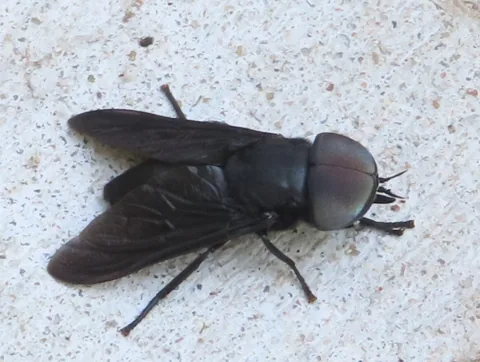 Horse Flies
Tabanus spp. (shown: black horse fly, Tabanus atratus)
Horse flies (Tabanus and related genera) are large, stout biting flies in the same family as deer flies. Only the females bite, during the day, slicing the skin and lapping up the blood.
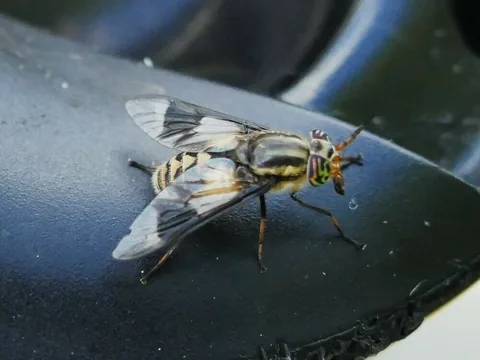 Deer Fly
Chrysops spp. (shown: Chrysops callidus)
Deer flies (genus Chrysops) are biting flies in the horse fly family. Only females bite, slicing the skin and lapping up the blood, mostly on warm days near the swamps, streams and woodland edges where their larvae develop.
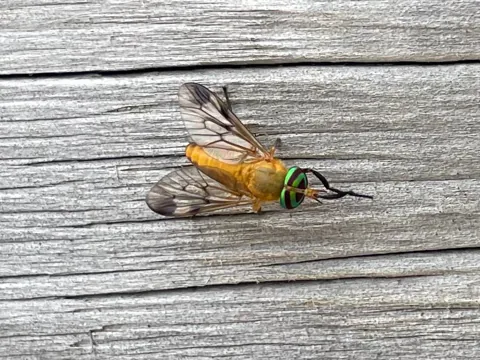 Yellow Fly
Diachlorus ferrugatus
The yellow fly, Diachlorus ferrugatus, is a biting fly in the same family as deer flies and horse flies and is common in the southeastern United States. Only the females bite, and their bites are painful and can swell fast.
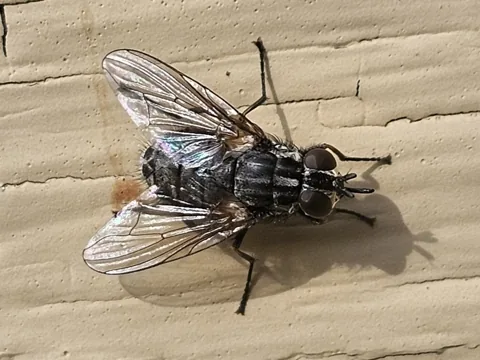 Stable Fly
Stomoxys calcitrans
The stable fly, also called the biting house fly or dog fly, looks much like a house fly but feeds on blood. Cattle are its main hosts, but it also bites horses, dogs and people, especially in neighborhoods near livestock.
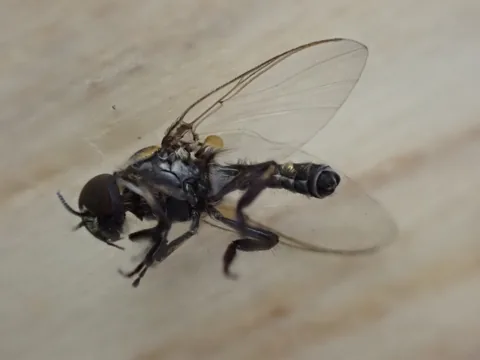 Black Flies
Simulium and related genera (family Simuliidae)
Black flies are tiny, stout, humpbacked biting flies, often called gnats or buffalo gnats. Their larvae live only in running water, and the females swarm around people and animals for blood, mostly in spring and early summer.
Horse fly or deer fly?
Both belong to the family Tabanidae. Only the females bite; the males feed on nectar and plant sugars. Wisconsin alone has more than 30 species, and North Carolina more than 40, though only about a dozen are common there.[3][2][1]
- Horse flies: the bigger of the two, with clear or solidly colored wings and brightly colored eyes. Kentucky gives 3/4 to 1-1/4 inches long and NC State 14 to 19 mm. Wisconsin notes some species, such as the black horse fly, reach two inches, and that the smaller species are black or gray, often with brilliant green eyes.[1][2][3]
- Deer flies: smaller, 10 to 13 mm long by NC State's measure, or a bit bigger than a house fly. The wings carry dark bands or patterns and the body is often striped yellow and black.[2][3][1]
- Where they bite: NC State says deer flies tend to bite around the head and neck, while horse flies often attack the legs. Wisconsin describes deer flies circling a person's head until they get a chance to bite.[2][3]
- When: Wisconsin puts the season at May to September, with deer flies most active in June and July. NC State says most adults emerge sometime from May through August. All of them feed only in daylight.[3][2][4]
- Not every daytime biter is a tabanid. Minnesota Extension describes stable flies as having seven black spots on a gray abdomen and bayonet-like mouthparts; they breed in manure and bedding, and the barn fly guide covers them.[4]
Where they breed, and why draining isn't an option
Females lay eggs in masses on plants standing over water or wet ground. The larvae drop into mud, water or wet soil and feed on decaying organic matter or small organisms there, then crawl to drier spots near the surface to pupate. Larval habitat includes pond edges, stream banks, swamps, marshes, flood plains, seepage areas and, for a few species, fairly dry soil.[1][2][3]
- Egg masses: Kentucky gives batches of 25 to 1,000 eggs; NC State says a mass holds 200 to 500 eggs cemented together. NC State adds that eggs hatch in about a week.[1][2]
- A slow life cycle: NC State says most species take a year, though some need 2 or 3 years. Kentucky gives a larval stage of one to three years depending on species, and Wisconsin says the larger species take up to two years. Pupation lasts 1 to 4 weeks.[2][1][3]
- Why you can't treat the source: the breeding sites are hard or impossible to find, may be large or far away, and are environmentally sensitive wetlands where drainage or insecticide could harm other wildlife and water supplies. NC State calls treating bogs and marshes for larvae impractical.[1][2][3]
- How far they travel: Minnesota Extension says adults tend to stay near swamps but can travel a few miles for hosts, so the flies biting you may come from water you can't see.[4][3]
Why they go after people, pools and livestock
The biting females find hosts by sight and by the carbon dioxide they breathe out. Kentucky lists movement, shiny surfaces, carbon dioxide and warmth as attractants, and Wisconsin says they're drawn to dark moving objects and carbon dioxide. Adults wait on tall grass or leaves for a large animal to pass, then circle and pursue it until they feed or are killed.[1][3]
- Pools: Kentucky says horse flies and deer flies can be serious nuisances around swimming pools, drawn by the shiny water surface or by swimmers moving. Field research in Hungary found 27 tabanid species, males and females, were attracted to horizontally polarized light, a cue some aquatic insects use to find water, which may help explain the attraction to shiny surfaces.[1][10]
- Trails and edges: they're common along hiking trails, narrow lanes and wooded edges near breeding areas. Wisconsin notes deer flies patrol the edges of broken woodlots.[2][3]
- Livestock: cattle and horses under attack bunch together and stop grazing, and Kentucky says animals may hurt themselves running from the flies. Large numbers of bites can lower milk production, and blood loss can be significant.[1]
- Disease in animals: because feeding is often interrupted and the flies move on to another host, they may spread some diseases mechanically. NC State lists equine infectious anemia of horses and anaplasmosis of cattle among the diseases they're suspected of spreading. The barn and livestock fly guide covers the manure-breeding flies on farms.[2][1]
What the bites do, and when to get help
A female slices the skin with blade-like mouthparts and laps up the blood that pools there, so the bite hurts right away and may bleed. Kentucky says the irritation and swelling usually disappear in a day or so, but scratching can lead to secondary infection.[1][3]
- Basic care: MedlinePlus advises washing a bite or sting with soap and water, applying ice wrapped in a washcloth for 10 minutes on and 10 minutes off, and using an antihistamine or anti-itch cream if needed. Kentucky notes general first-aid skin creams may ease the pain.[9][1]
- Watch for infection: over the next several days look for increasing redness, swelling or pain. A Glasgow hospital case report describes a woman with a large red swelling on her thigh after a suspected horse fly bite and notes there's uncertainty about the best treatment for these complications.[9][15]
- Allergy: some people react to the saliva. Kentucky says rare cases involve hives and wheezing, and Wisconsin mentions fevers, severe sores and allergic responses. A 2020 review in Clinical and Experimental Allergy found the medical literature limited to case reports and small case series, and advises a written action plan and self-injectable epinephrine where appropriate.[1][3][14]
- Get emergency help (911) for signs of anaphylaxis, which MedlinePlus says can come on very quickly: trouble breathing or wheezing, swelling of the face or mouth, throat tightness or difficulty swallowing, chest pain, fainting or lightheadedness.[9]
- Tularemia: CDC says deer flies have been shown to transmit tularemia in the western United States, usually causing the ulceroglandular or glandular form.[5]
- Loiasis (African eye worm) is spread by deer flies in the rain forests of West and Central Africa, not in North America. CDC says travelers are at higher risk when they're bitten over several months.[6]
Traps: what the evidence shows
Traps take advantage of the flies' attraction to large, dark, shiny or moving shapes. They can lower numbers in a small area, but none of the extension sources promises bite-free yards. Minnesota Extension says traps likely kill only a small fraction of the flies around horses and haven't been proven to improve horse comfort.[2][3][1][4]
- Box traps (horse flies): NC State says they apparently help reduce horse fly numbers in small areas such as home yards and campgrounds, especially where tall vegetation around the edge funnels flies into narrow flyways. Its design has four shiny black sides 16 x 32 inches, legs 24 inches high, a 32 x 32 inch metal-screen top (plastic gets damaged by birds) and slanted screens at the bottom leaving a 0.53 inch slot for flies to crawl in.[2]
- Make a box trap more attractive by hanging a shiny black ball, 14 to 16 inches across, under it and 4 to 6 inches above the soil, and keep vegetation low around the trap.[2]
- Canopy or ball traps: Wisconsin describes the design: a large dark ball swings in the wind under a funnel, flies that find the ball isn't a meal fly upward into the funnel, and the top must let light through. Commercial versions of this design exist.[3]
- How trap types compare: a USDA ARS and Cornell study in Florida and North Carolina compared an H-trap, a commercial trap of the ball-and-funnel type and the Nzi trap. Which caught most varied by site; in North Carolina the H-trap caught about twice as many as the canopy trap (1,458 vs 720). In follow-up tests, baiting traps with dry ice caught more than leaving them unbaited.[11][3]
- Trap color and fabric matter: in tests across Canada and the US, Nzi traps worked best only when made from the right blue fabric, and smooth, shiny polyester or nylon reduced catches. Nzi traps caught roughly similar numbers of biting flies as canopy traps, with differences by species and place.[12]
- Sticky cups (deer flies): NC State reports some success with blue cups or buckets coated with sticky glue. Wisconsin says sticky patches on the back of a cap have been shown to catch flies hovering around the head and reduce the bother; NC State calls hat strips somewhat effective.[2][3]
- Placement: these flies favor sunny areas and avoid deep shade, so set traps in sun rather than deep shade, near the edges and flyways where flies come in.[1][2]
Repellents and clothing
Repellents can keep some flies from landing or make them leave before feeding, but the things that attract them, such as movement and carbon dioxide, are still there, so they keep swarming. Kentucky says DEET can give several hours of protection. Wisconsin calls standard repellents only marginally effective, with high-DEET products giving some protection, and NC State says repellents give temporary relief.[1][3][2]
- DEET cautions: Wisconsin notes high-DEET products can melt plastics. Kentucky says to follow the label and check age restrictions. The repellent guide covers concentrations, picaridin and other EPA-registered ingredients.[3][1]
- Permethrin on clothing: Kentucky says permethrin repellents are for clothing only and typically last longer. CDC says permethrin-treated clothing keeps protecting after multiple washings and not to use permethrin products directly on skin. EPA notes treated clothing protects only the skin it covers, so use a skin repellent on the rest.[1][7][8]
- Clothing: long sleeves, long pants and a hat. Kentucky says light-colored clothing and mesh outdoor wear may help a little, and in extreme cases a hat with a mesh face and neck veil adds protection. Wisconsin's research summary notes the flies are drawn to dark moving objects.[3][1]
- On horses: Minnesota Extension says commercial repellents aren't effective against horse flies or deer flies. In a Swiss field test, a 15-17% DEET emulsion cut tabanid counts on horses, with efficacy of at least 80% at three hours and 71% at four hours, though that product is a European horse repellent. Follow your own product's label for animals.[4][13]
- Livestock sprays: Kentucky says permethrin sprays labeled for horses and livestock irritate the flies so they leave almost at once, often before they're killed, and they keep feeding on spots the spray missed or where it wore off. Wisconsin calls insecticide sprays on animals ineffective for the same reason.[1][3]
Timing, shade and pool days
Kentucky calls horse flies and deer flies sporadic problems tied to specific times of year, and says some changes in behavior or the use of repellents can let you enjoy the outdoors. Bites happen in daylight and in sun.[1][4]
- Animals: give horses and cattle access to a barn, shed or deep shade during the day, and let them graze at night when the flies aren't active. Wisconsin suggests the same for pets: a shaded shelter or doghouse.[1][4][3]
- People: plan yard work and hikes for when the season eases off, and stay out of wet, wooded edges at the peak. Wisconsin says swatting or running when flies are swarming only attracts more.[3][2]
- Pools: Kentucky says there are no effective recommendations for the problem at swimming pools. Covering up when out of the water and using repellent are what's left; no source we found has tested traps at home pools. Kentucky points to the shiny water surface and swimmers' movement as the draw.[1]
What doesn't work
Most of the ways people try to wipe out horse flies and deer flies fail for the same reason: the flies come from wetlands you can't treat and don't sit still long enough to be poisoned.[3][2]
- Fogging or spraying the yard: Wisconsin says residual sprays fail because adults don't rest on any surface for long, and fogging kills only the flies present while more arrive within minutes.[3]
- Treating ponds and wetlands for larvae: impractical because the larvae occupy large areas, and drainage or insecticide threatens other wildlife and water supplies.[2][1]
- Expecting a large spray program to fix it: NC State says large-scale adult control is only moderately successful because the breeding sites can't be found.[2]
- Relying on natural enemies: NC State says the few known parasites and predators don't work as real control.[2]
- A repellent alone on a horse: Minnesota Extension says commercial repellents aren't effective against these flies; shade and shelter work better.[4]
Common questions
- Why do horse flies keep circling me?
- They're attracted to movement, dark shapes, carbon dioxide and warmth, and they'll circle and pursue a host until they feed. Swatting and running tend to draw more of them in.[1][3]
- Why are there so many horse flies at my pool?
- The shiny water surface and moving swimmers attract them. Research shows tabanids are drawn to horizontally polarized light like that reflected from water. Kentucky says there are no effective recommendations for pools, so covering up and repellent are the main defenses.[1][10]
- Do horse fly traps work?
- They catch flies and may lower numbers in a small yard or campground, especially at narrow flyways. Catches vary by trap type and site, and Minnesota Extension says traps likely catch only a small fraction of the flies around horses.[2][11][4]
- Does DEET work on deer flies?
- Partly. Kentucky says it can give several hours of protection, but Wisconsin calls standard repellents only marginally effective. Flies often keep swarming even when they don't land.[1][3]
- Can deer flies make you sick?
- Usually the bite is just painful and swells for a day or so. In the western US, CDC says deer flies have been shown to transmit tularemia. Seek care for spreading redness or signs of allergic reaction.[1][5][9]
- When does horse fly season end?
- In Wisconsin they're active from May until September, and deer flies peak in June and July. Seasons vary by region and year.[3][1]
Photo credits
- Horse Flies: (c) Ken Clark, some rights reserved (CC BY) — via iNaturalist, CC BY 4.0
- Deer Fly: (c) John A. Gerwin, some rights reserved (CC BY) — via iNaturalist, CC BY 4.0
- Yellow Fly: (c) Philip Curley, some rights reserved (CC BY) — via iNaturalist, CC BY 4.0
- Stable Fly: (c) Phoenix M.S, some rights reserved (CC BY) — via iNaturalist, CC BY 4.0
- Black Flies: Stephen James McWilliam, public domain (CC0), via iNaturalist
Sources
- University of Kentucky Entomology, “Horse Flies and Deer Flies (Entfact 511).” entomology.ca.uky.edu/ef511 (accessed 2026-11-10)
- NC State Extension, “Horse Flies and Deer Flies.” content.ces.ncsu.edu/horse-flies-and-deer-flies (accessed 2026-11-10)
- University of Wisconsin-Madison Extension, Wisconsin Horticulture, “Deer Flies and Horse Flies.” hort.extension.wisc.edu/articles/deer-flies-and-horse-flies/ (accessed 2026-11-10)
- University of Minnesota Extension, “Fly control around horses.” extension.umn.edu/horse-care-and-management/fly-control-around-horses (accessed 2026-11-10)
- Centers for Disease Control and Prevention, “How Tularemia Spreads.” www.cdc.gov/tularemia/causes/index.html (accessed 2026-11-10)
- Centers for Disease Control and Prevention, “About Loiasis.” www.cdc.gov/filarial-worms/about/loiasis.html (accessed 2026-11-10)
- Centers for Disease Control and Prevention, “Preventing Mosquito Bites.” www.cdc.gov/mosquitoes/prevention/index.html (accessed 2026-11-10)
- U.S. Environmental Protection Agency, “Repellent-Treated Clothing.” www.epa.gov/insect-repellents/repellent-treated-clothing (accessed 2026-11-10)
- MedlinePlus, U.S. National Library of Medicine, “Insect bites and stings (Medical Encyclopedia).” medlineplus.gov/ency/article/000033.htm (accessed 2026-11-10)
- Naturwissenschaften, abstract via PubMed (PMID 18685822), “Horvath et al. 2008, Ventral polarization vision in tabanids: horseflies and deerflies are attracted to horizontally polarized light.” pubmed.ncbi.nlm.nih.gov/18685822/ (accessed 2026-11-10)
- Journal of Vector Ecology, abstract via PubMed (PMID 29757504), “Kline, Hogsette and Rutz 2018, A comparison of the Nzi, Horse Pal and Bite-Lite H-traps and selected baits for the collection of adult Tabanidae in Florida and North Carolina.” pubmed.ncbi.nlm.nih.gov/29757504/ (accessed 2026-11-10)
- Bulletin of Entomological Research, abstract via PubMed (PMID 16923207), “Mihok et al. 2006, Performance of the Nzi and other traps for biting flies in North America.” pubmed.ncbi.nlm.nih.gov/16923207/ (accessed 2026-11-10)
- Veterinary Parasitology, abstract via PubMed (PMID 27084474), “Herholz et al. 2016, Efficacy of the repellent DEET against tabanid flies on horses evaluated in a field test in Switzerland.” pubmed.ncbi.nlm.nih.gov/27084474/ (accessed 2026-11-10)
- Clinical and Experimental Allergy, abstract via PubMed (PMID 32512632), “Whyte, Popescu and Carlson 2020, Tabanidae insect (horsefly and deerfly) allergy in humans: a review of the literature.” pubmed.ncbi.nlm.nih.gov/32512632/ (accessed 2026-11-10)
- BMJ Case Reports, abstract via PubMed (PMID 36750307), “Kelly and Grose 2023, Horsefly (genus Tabanus) bite: allergy or infection?.” pubmed.ncbi.nlm.nih.gov/36750307/ (accessed 2026-11-10)