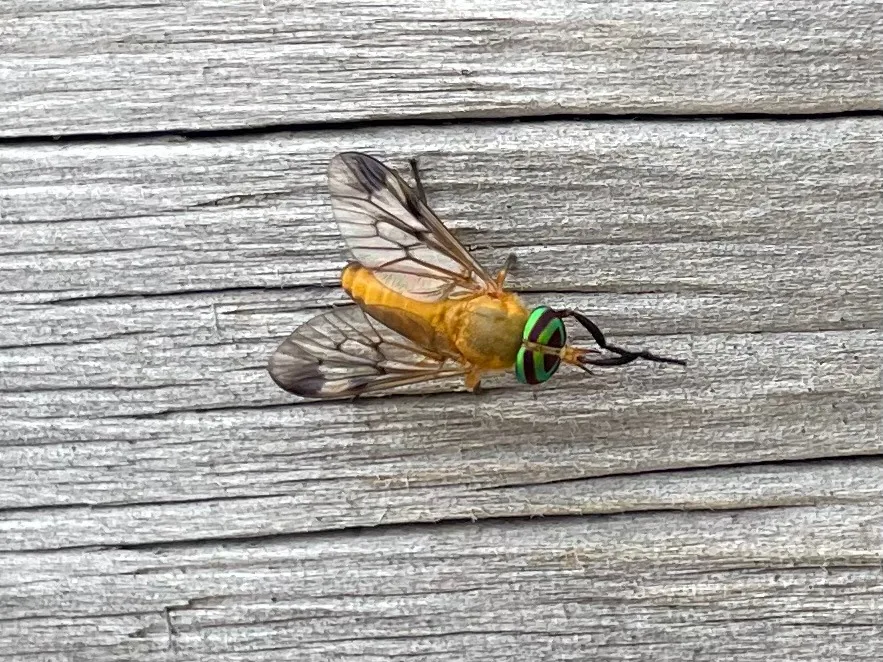
How to identify it
Look-alikes
| Look-alike | How to tell them apart |
|---|---|
| Deer flies | Deer flies have a brown band across the middle of the wing; the yellow fly's patch is at the wing tip.[1] |
| Horse flies | Yellow flies belong to the same family, Tabanidae.[1] |
Where it lives
It's found in the southeastern U.S. from New Jersey to Texas, plus the Bahamas and Mexico to Costa Rica.[1]
Biology and life cycle
Larvae live in water-soaked root mats in deep shade; the full life cycle usually takes about a year.[1]
In Florida adults fly March to November, peaking April through June.[1]
Damage and signs
- It bites most in late afternoon and on cloudy days, stays near forests and is one of the few tabanids that bites indoors.[1]
Health risk
Bites are painful and swell; people sensitive to bites should avoid exposure to prevent serious reactions.[1]
Control
Prevention
DEET is the most effective repellent; gloves and head nets are the only sure protection.[1]
Traps and physical control
Traps sometimes help in small areas such as yards, campsites and pools.[1]
Common questions
Sources
- University of Florida IFAS Extension (Featured Creatures), “Yellow Fly, Diachlorus ferrugatus (EENY-320).” edis.ifas.ufl.edu/publication/IN595 (accessed 2026-10-06)
- iNaturalist, “Diachlorus ferrugatus taxon page (order and family).” www.inaturalist.org/taxa/258381 (accessed 2026-10-06)