The short answer
- Use a 0.5% permethrin product and spray clothing outdoors while no one is wearing it, lightly moistening the outside of the fabric, then let it dry 2 hours (4 hours in humid weather) before you put it on.[3][7][5]
- Never apply a permethrin clothing spray to skin. Protect exposed skin with a repellent labeled for skin.[3][1][5][8]
- Treatment wears off. A military clothing-spray label says to reapply after six weeks and six launderings, and CDC says to read the product label to find out how long protection lasts.[3][5]
- Permethrin is highly toxic to fish, aquatic animals and bees, and cats are more sensitive to it than dogs or people.[2][3]
Pests treated clothing protects against
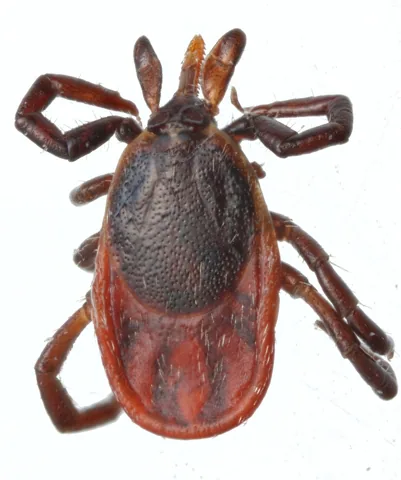 Blacklegged Tick
Ixodes scapularis
The blacklegged tick, often called the deer tick, is widely distributed across the eastern United States and transmits the bacteria that cause Lyme disease along with several other diseases.
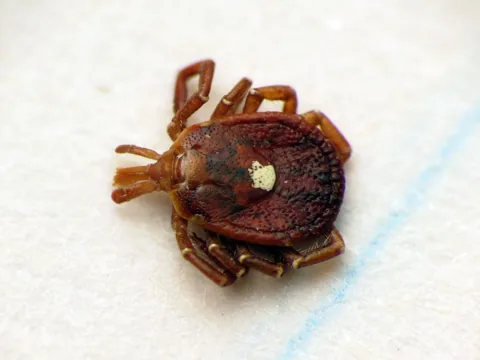 Lone Star Tick
Amblyomma americanum
The lone star tick is a very aggressive tick that readily bites people and pets across the Northeast, South and Midwest; its bite is linked to alpha-gal syndrome, a red meat allergy.
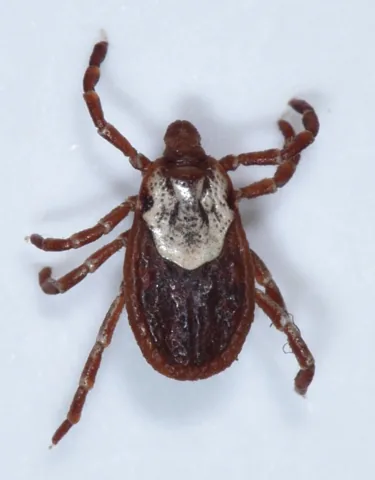 American Dog Tick
Dermacentor variabilis
The American dog tick, also called the wood tick, is widely distributed east of the Rocky Mountains. Adult females are the stage most likely to bite people, especially in spring and summer, and adults commonly climb to the crown of the head.
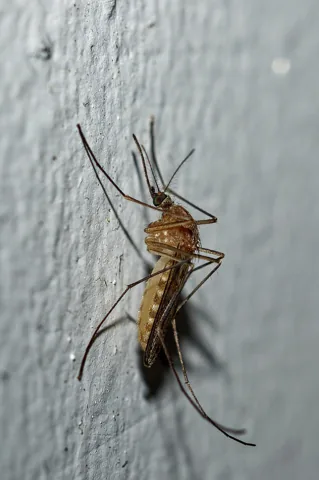 Mosquito
Culicidae (shown: Culex pipiens complex)
Mosquitoes are small, delicate flies whose females feed on blood and can pass on viruses such as West Nile; the control that works best goes after the larvae in standing water.
How permethrin clothing works
Permethrin is a synthetic pyrethroid insecticide that affects insects' nervous systems. It is more toxic to insects than to people and dogs because insects can't break it down as quickly.[2]
EPA treats permethrin on clothing as a repellent, though it works mainly by killing ticks that touch the treated fabric. CAES notes it can give high levels of protection against ticks and mosquitoes. CDC describes permethrin as an insecticide that kills or repels mosquitoes.[1][4][7][5]
Only skin covered by treated clothing is protected. Use an insect repellent labeled for skin on the rest of your body. CAES likewise says permethrin can be used together with a repellent labeled for skin.[1][7]
EPA first registered permethrin as a clothing repellent for the military in 1990, approved consumer sprays for clothing and gear at about the same time, and registered consumer factory-treated clothing in 2003.[1]
CDC lists boots, shirts, pants, socks, tents and backpacks among the things you can treat yourself, or you can buy clothing and gear that come already treated.[5][6]
Treating your own clothing
Consumer clothing sprays contain 0.5% permethrin, the strength CDC recommends for treating clothing and gear. The steps below come from one EPA-stamped label for a 0.5% aerosol (EPA Reg. No. 50404-5, a 6-ounce can made for Department of Defense use), checked against CAES's directions for homeowners. Follow the label on the product you buy, since directions can differ.[4][7][5][3]
- Work outdoors, in a spot protected from wind; the label requires all applications to be made outdoors, and CAES also says to apply in a well-ventilated area outdoors.[3][7]
- Lay the clothing out. Never treat clothing while someone is wearing it. CAES says the same: apply it before you put the clothing on.[3][7]
- Hold the can 6 to 8 inches away and spray the outer surfaces with a slow, sweeping motion for at least 30 seconds per side, until the fabric is lightly moist and shows a slight color change. Don't spray to the point of runoff. CAES puts it as lightly moisten the fabric, don't saturate it.[3][7]
- Cover the entire outside of the clothing, with special attention to socks, trouser cuffs and shirt cuffs. About three-quarters of the can treats one complete set of clothing.[3]
- Let it dry 2 hours, or 4 hours in humid conditions, before wearing it.[3][7]
- The same label allows treating mosquito netting with the rest of the can, and says not to treat caps.[3]
- Wear pant cuffs inside your socks or footwear for full protection against ticks and chiggers. Ohio State Extension likewise advises tucking pants into socks and your shirt into your pants.[3][8]
- If you get the spray on your skin, wash it off right away with soap and water.[7][3]
How long it lasts, and washing
That label says to launder treated clothing as usual each week and to reapply after six weeks and the sixth laundering.[3]
Other advice differs on timing. CAES's tick handbook says not to treat clothing more than once every two weeks and to launder it at least once before treating it again. CDC says treated clothing stays protective through several washings and to check the product label for how long protection lasts.[7][6][5]
Small amounts of permethrin come off in the wash, which is why labels tell you to wash permethrin-treated clothing separately from untreated clothing.[1]
Factory-treated clothing is a registered pesticide product, and its label is a hang-tag attached to the garment. Follow the directions and precautions on it.[1]
What studies show about how well it works
In CDC laboratory tests, a 1-minute forced contact with permethrin-treated fabric left no blacklegged tick nymphs moving normally an hour later; ticks also actively dropped off treated fabric held upright. The effect held across cotton, synthetic and blended garments.[9]
Some ticks take longer to be affected. Stopping normal movement in every tick took 1 minute of contact for blacklegged tick nymphs, 2 minutes for lone star tick nymphs, and 5 minutes for adult female blacklegged, American dog and lone star ticks. One hour after a 1-minute exposure, 82.0% of American dog tick females and 98.0% of lone star tick females were still moving normally.[9]
Wear and washing reduce it. After 16 days of wear and 16 rounds of machine washing and drying, shirts, pants and socks held 50 to 90% less permethrin, and 31 to 67% of blacklegged tick nymphs still moved normally after contact, compared with 90 to 100% on untreated fabric. Treated shoes that were worn but not washed stayed as toxic to ticks as new ones. The authors caution that lab results don't translate directly to real-life bite protection.[10]
In a North Carolina study of park employees who wore factory-treated uniforms for three months of summer, all pant and sock samples still held active permethrin, and 78% of pant and 88% of sock samples knocked down at least 85% of ticks on average. Mosquito kill was low. Absorbed permethrin averaged under 4 micrograms per kilogram of body weight per day.[11]
Old uniforms lose most of it. In factory-treated Army uniform trousers collected from West Point cadets, the amount of permethrin lost was related to the cadets' class year, and older uniforms with less permethrin no longer irritated ticks into dropping off and killed fewer of them.[12]
A review by a CDC tick researcher notes that experiments with permethrin-treated coveralls and uniform-style clothing reduced tick bites, but similar studies are lacking for people wearing ordinary summer-weight clothing in daily life, and permethrin-treated clothing is the least-used tick bite prevention step in public surveys.[13]
What EPA found about factory-treated clothing
Permethrin is the only insect repellent used for factory treatment of clothing.[1]
EPA's 2009 revised risk assessment covered toddlers wearing or mouthing treated clothing and military personnel wearing treated uniforms every day. All the scenarios showed factory-treated clothing unlikely to pose any significant immediate or long-term hazard.[1]
The amount of permethrin allowed in clothing is very low, it is poorly absorbed through skin, and EPA found no evidence of reproductive or developmental effects to mother or child.[1]
Only outer clothing is treated. Permethrin products for clothing are not applied to items such as underwear.[1]
Precautions for people, pets and water
- In studies, less than 1% of permethrin put on people's skin was absorbed. On skin it can cause irritation, tingling, burning or itching; in the eyes, redness, pain or burning. CAES also says skin reactions are uncommon and that permethrin is poorly absorbed through the skin.[2][4]
- The spray label warns that it is harmful if absorbed through skin and that prolonged or frequently repeated skin contact may cause allergic reactions in some people. Avoid getting it on skin or in your eyes, and wash after handling.[3]
- Cats are more sensitive to permethrin than dogs or people because their bodies take a long time to break it down. Cats accidentally exposed to products with high (45 to 65%) levels of permethrin may seem anxious, can't walk normally, and may have tremors and seizures.[2]
- Permethrin is highly toxic to fish and other aquatic animals and to bees. The label says not to apply it to or near water, and not to apply it or let it drift onto blooming crops or weeds while bees are actively visiting. The label calls it extremely toxic to aquatic organisms, including fish and invertebrates.[2][3]
- The aerosol is under pressure: don't use or store it near heat or open flame, and don't puncture or burn the can. The label adds that temperatures above 130°F may cause the can to burst.[3]
Other ways to protect clothing
EPA also registers clothing sprays that contain DEET or picaridin.[1]
In research CAES cites, DEET at about 20 to 30% applied to clothing was 86 to 92% effective at preventing blacklegged tick bites. DEET can damage some synthetic fabrics such as rayon and spandex, plastics such as watch crystals and eyeglass frames, and car and furniture finishes.[4]
Back indoors, CDC suggests checking clothing for ticks and tumble-drying dry clothes on high heat for 10 minutes to kill any ticks still on them; damp clothes may need longer, and if you wash them first, use hot water because cold and medium water won't kill ticks.[6]
Common questions
- Can I spray permethrin on my skin?
- No. Clothing sprays are labeled for clothing and netting only and say not to apply them to skin. Use a skin repellent on exposed skin.[3][1][5]
- How long does self-treated clothing stay protective?
- Check your product's label. The military label used for this guide says to reapply after six weeks and six launderings; CAES says not to retreat more often than every two weeks. In lab tests, clothing worn and washed 16 times had lost 50 to 90% of its permethrin but still affected ticks more than untreated fabric.[3][7][10]
- Is permethrin-treated clothing safe for kids?
- EPA's risk assessment included toddlers wearing and mouthing factory-treated clothing and found it unlikely to pose a significant hazard. Follow the label or hang-tag.[1]
- Does permethrin clothing work on all ticks?
- It works on the main U.S. species, but not equally fast. In CDC tests, blacklegged tick nymphs were affected after 1 minute on treated fabric, while adult female American dog and lone star ticks needed about 5 minutes.[9]
Photo credits
- Blacklegged Tick: (c) Christian Back, some rights reserved (CC BY) — via iNaturalist, CC BY 4.0
- Lone Star Tick: (c) Katja Schulz, some rights reserved (CC BY) — via iNaturalist, CC BY 4.0
- American Dog Tick: (c) Don Loarie, some rights reserved (CC BY) — via iNaturalist, CC BY 4.0
- Mosquito: (c) Donald Davesne, some rights reserved (CC BY) — via iNaturalist, CC BY 4.0
Sources
- U.S. Environmental Protection Agency, “Repellent-Treated Clothing (last updated February 26, 2026).” www.epa.gov/insect-repellents/repellent-treated-clothing (accessed 2026-11-10)
- National Pesticide Information Center, “Permethrin General Fact Sheet.” npic.orst.edu/factsheets/PermGen.html (accessed 2026-11-10)
- U.S. EPA Pesticide Product Label System, “Permethrin Arthropod Repellent (0.5% permethrin clothing spray for Department of Defense use) label, EPA Reg. No. 50404-5 (EPA-stamped, Jan. 14, 2026).” www3.epa.gov/pesticides/chem_search/ppls/050404-00005-20260114.pdf (accessed 2026-11-10)
- Connecticut Agricultural Experiment Station, “Managing Exposure to Ticks on Your Property (Kirby C. Stafford III, 2014).” portal.ct.gov/-/media/caes/documents/publications/fact_sheets/entomology/tickcontrolfspdf.pdf (accessed 2026-11-10)
- Centers for Disease Control and Prevention, “About Permethrin-Treated Clothing and Gear (May 14, 2024).” www.cdc.gov/mosquitoes/prevention/about-permethrin-treated-clothing-and-gear.html (accessed 2026-11-10)
- Centers for Disease Control and Prevention, “Preventing Tick Bites.” www.cdc.gov/ticks/prevention/index.html (accessed 2026-11-10)
- Connecticut Agricultural Experiment Station, “Tick Management Handbook, revised edition (Bulletin No. 1010; K. C. Stafford III).” portal.ct.gov/-/media/CAES/DOCUMENTS/Publications/Bulletins/b1010pdf.pdf (accessed 2026-11-10)
- Ohio State University Extension, “Ticks and Tick-Borne Diseases, HYG-2073.” ohioline.osu.edu/factsheet/HYG-2073 (accessed 2026-11-10)
- Journal of Medical Entomology (via NCBI PubMed), “Contact Irritancy and Toxicity of Permethrin-Treated Clothing for Ixodes scapularis, Amblyomma americanum, and Dermacentor variabilis Ticks (Prose et al., J Med Entomol 2018; abstract).” pubmed.ncbi.nlm.nih.gov/29800259/ (accessed 2026-11-10)
- Journal of Medical Entomology (via NCBI PubMed), “Impact of Wearing and Washing/Drying of Permethrin-Treated Clothing on Their Contact Irritancy and Toxicity for Nymphal Ixodes scapularis Ticks (Connally et al., J Med Entomol 2019; abstract).” pubmed.ncbi.nlm.nih.gov/30165532/ (accessed 2026-11-10)
- Parasites & Vectors (via NCBI PubMed), “Bioabsorption and effectiveness of long-lasting permethrin-treated uniforms over three months among North Carolina outdoor workers (Sullivan et al., Parasit Vectors 2019; abstract).” pubmed.ncbi.nlm.nih.gov/30674346/ (accessed 2026-11-10)
- Journal of Medical Entomology (via NCBI PubMed), “Reduced effectiveness of permethrin-treated military uniforms after prolonged wear (Davidson et al., J Med Entomol 2024; abstract).” pubmed.ncbi.nlm.nih.gov/38912641/ (accessed 2026-11-10)
- Ticks and Tick-borne Diseases (via NCBI PubMed), “Personal protection measures to prevent tick bites in the United States: knowledge gaps, challenges, and opportunities (Eisen, Ticks Tick Borne Dis 2022; abstract).” pubmed.ncbi.nlm.nih.gov/35364518/ (accessed 2026-11-10)