On this page
How to identify it
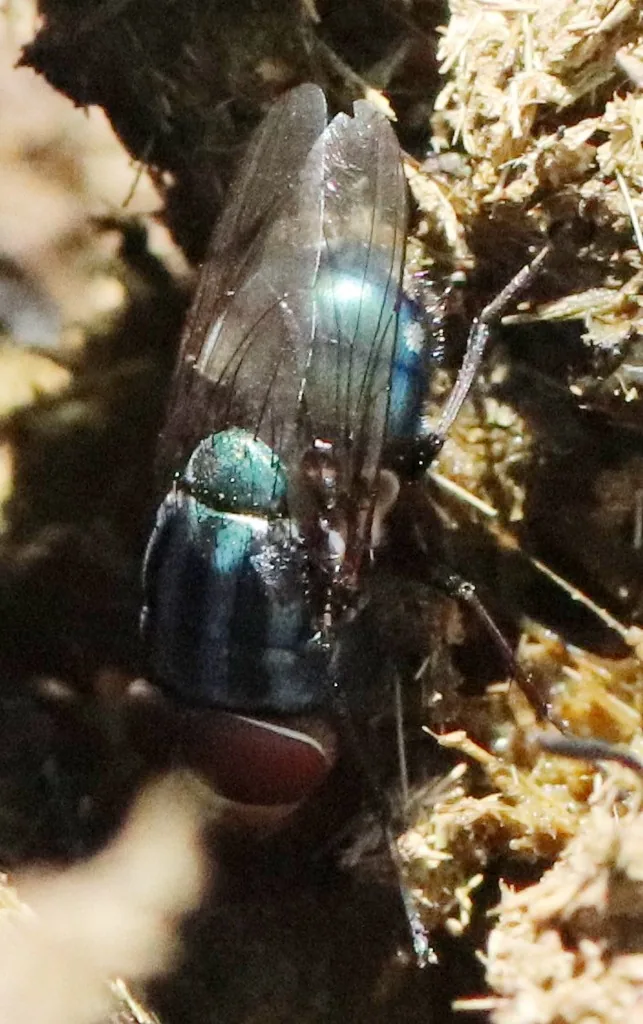
- Adults are blue to green and metallic, with bright yellow-orange cheeks, red eyes and three dark stripes down the back of the thorax. New Mexico State gives their length as 6 to 9 mm, a little smaller than New World screwworm at 8 to 10 mm.[10][11]
- On the secondary screwworm the three stripes usually all begin at the same point near the head and are fairly even. On the New World screwworm the middle stripe usually starts farther back, so it looks shorter than the outer two.[10][11][1]
- Seen up close, the underside of the secondary screwworm's abdomen has patches of white dust, and the female has a dark brown to black spot on the back of the head and a yellow to orange patch at the base of each wing.[10]
Look-alikes
| Look-alike | How to tell them apart |
|---|---|
| New World screwworm | Stripe pattern is the usual first check, but New Mexico State says recent field collections show it is no longer completely reliable, and the colors and stripes fade on dead flies. Its best single character is tiny black hairs on the plates between the eyes, present on New World screwworm and absent on the secondary screwworm; confirmation takes an expert. USDA asks people not to hunt for the flies at all, since many species look alike and a true screwworm could be one of the sterile flies released for eradication.[10][6][1] |
Where it lives
New Mexico State describes it as found in much of the United States, especially the South, and most active in summer and fall. GBIF holds U.S. records from 38 states since 1990, most from Texas, and records from Canada south through Mexico, Central America and South America to Argentina and Chile. In a 2025 Georgia study it was one of three blow flies that accounted for most of the seasonal change in the local blow fly community.[10][17][16]
Biology and life cycle
Gravid females are drawn to decomposing carcasses, carrion and rotten meat to lay eggs, and the larvae develop on that decaying material. In USDA laboratory tests, females laid far more eggs on rotten liver than on fresh liver.[12]
In a laboratory life-table study at about 29 C (84 F), females laid an average of 199 eggs per batch and about 681 eggs in total, adult life expectancy was about 18 days for males and 21 days for females, and a generation took about 17 days.[13]
Because its development on remains is well studied, forensic entomologists use it and other blow flies to estimate time since death; a 2023 case report warns that maggots already feeding in wounds before death can throw that estimate off.[13][16][15]
New Mexico State notes that it is often very abundant compared with New World screwworm, even in places where screwworm myiasis is occurring, and that it is more typically associated with rural areas.[10]
Damage and signs
- Extension sources differ in emphasis. Texas A&M and Penn State say the secondary screwworm does not lay eggs on living animals and poses no threat to animal health, while New Mexico State and a USDA research team describe it as a secondary or facultative myiasis fly that can feed on dead tissue in existing wounds after other flies have colonized them.[11][1][10][12]
- The USDA team also notes that it can carry disease agents mechanically and that its facultative myiasis causes economic losses in livestock.[12]
- Because other fly maggots feed on the dead tissue around a screwworm wound, Penn State advises sending specimens from the deepest part of the wound when a New World screwworm case is suspected.[1]
Health risk
A USDA research team calls it an agent of facultative myiasis that affects both livestock and people. Published human cases involve people who were already seriously ill: a 2023 report from Colima, Mexico describes five hospitalized patients, three on mechanical ventilation, who developed myiasis from this fly in the same ward after four days in hospital; two of the five died. CDC describes facultative myiasis flies, such as Phormia and Lucilia blow flies, as laying eggs in existing festering wounds without invading healthy tissue, whereas New World screwworm larvae are obligate parasites of living flesh.[12][14][9][8]
Control
Prevention
Treat wounds and the navels of newborn animals promptly and check animals regularly, as USDA APHIS recommends against New World screwworm. Prompt wound care matters for the secondary screwworm too, since it feeds on dead tissue in existing wounds.[4][10]
Sanitation
Remove garbage, carcasses and rotting meat promptly; these decaying materials are where the females lay eggs and the larvae develop.[12][10]
When to call a professional
Any maggots in a wound on a living animal need a veterinarian, because the larvae cannot be identified by eye and confirming New World screwworm takes a trained specialist. New Mexico State suggests preserving specimens in 70% isopropyl alcohol for laboratory confirmation.[1][10][6]
Report a suspected screwworm case in livestock or a pet to your veterinarian, your State animal health official or USDA; in Texas, USDA says livestock cases go directly to the Texas Animal Health Commission. Wildlife cases outside Texas go to USDA Wildlife Services, and people who think they have screwworm should contact a healthcare provider.[6][4]
New World screwworm status (USDA, November 2026)
USDA eradicated New World screwworm from the United States in 1966 and eliminated a small outbreak in the Florida Keys in 2017. Since 2023 it has spread north through Central America and Mexico.[4][8]
As of November 10, 2026, USDA's Screwworm.gov lists confirmed U.S. detections on a public dashboard and State maps of infested zones in Texas, New Mexico and Arizona, while USDA states that the current risk to animals and people in the United States is very low. Arizona's first detection, in a dog in Cochise County, was confirmed on October 28, 2026, and a 20 km infested zone with animal movement controls was set up around it.[5][3][7]
Status changes quickly; check Screwworm.gov's Current Status page for the latest detections and zones before relying on these dates.[5]
Common questions
- I found maggots in my animal's wound. Is it New World screwworm?
- You can't tell by looking. Secondary screwworm maggots feed on dead tissue in wounds, New World screwworm maggots eat living tissue, and confirming the larvae takes a trained specialist. Contact your veterinarian, and report suspected screwworm to your State animal health official or USDA.[10][1][6]
- I saw a shiny blue-green fly with three stripes. Should I report it?
- USDA says there's no need to watch for or report the flies themselves, because many species look alike. In much of the U.S. a fly like that is likely a secondary screwworm or another blow fly; focus instead on checking animals for maggots and draining wounds.[6][10]
- Is the secondary screwworm harmful?
- Mostly it is a carrion breeder. It can move into existing wounds and, rarely, infest very sick people, and it can carry disease agents mechanically, but it does not invade healthy living tissue the way New World screwworm does.[12][14][10]
Sources
- Penn State Extension, “Understanding the New World Screwworm: Biology, Identification, and Prevention (E. Machtinger, P. Alexander).” extension.psu.edu/understanding-the-new-world-screwworm-biology-identification-and-prevention (accessed 2026-11-11)
- iNaturalist, “Cochliomyia macellaria taxon page (order and family).” www.inaturalist.org/taxa/120921 (accessed 2026-11-11)
- USDA Animal and Plant Health Inspection Service (APHIS), “Screwworm.gov: Unified Government Response To Protect the United States (last modified November 10, 2026).” www.aphis.usda.gov/animals/animal-health/livestock-and-poultry-disease/stop-screwworm (accessed 2026-11-11)
- USDA Animal and Plant Health Inspection Service (APHIS), “New World Screwworm (last modified July 24, 2026).” www.aphis.usda.gov/livestock-poultry-disease/cattle/ticks/screwworm (accessed 2026-11-11)
- USDA Animal and Plant Health Inspection Service (APHIS), “Current Status of New World Screwworm (Screwworm.gov, last modified November 10, 2026).” www.aphis.usda.gov/animals/animal-health/livestock-and-poultry-disease/stop-screwworm/current-status (accessed 2026-11-11)
- USDA Animal and Plant Health Inspection Service (APHIS), “Report Suspected Cases of Screwworm (Screwworm.gov, last modified August 31, 2026).” www.aphis.usda.gov/animals/animal-health/livestock-and-poultry-disease/stop-screwworm/report-suspected-cases-screwworm (accessed 2026-11-11)
- USDA Animal and Plant Health Inspection Service (APHIS), “USDA Confirms New World Screwworm Detection in Arizona (news release, October 28, 2026).” www.aphis.usda.gov/news/agency-announcements/usda-confirms-new-world-screwworm-arizona (accessed 2026-11-11)
- U.S. Centers for Disease Control and Prevention (CDC), “About New World Screwworm (July 8, 2026).” www.cdc.gov/myiasis/about-new-world-screwworm-myiasis/ (accessed 2026-11-11)
- U.S. Centers for Disease Control and Prevention (CDC), Division of Parasitic Diseases and Malaria, “DPDx: Myiasis.” www.cdc.gov/dpdx/myiasis/index.html (accessed 2026-11-11)
- New Mexico State University Cooperative Extension Service, “Adult New World Screwworm Identification and Commonly Confused Species, Guide A-156.” pubs.nmsu.edu/_a/A156/index.html (accessed 2026-11-11)
- Texas A&M AgriLife Extension Service, “New World screwworm (fact sheet, May 2025).” agrilifeextension.tamu.edu/wp-content/uploads/2025/06/3-Fact-Sheet-Screwworm-May2025.pdf (accessed 2026-11-11). Used for the secondary screwworm identification and its no-living-animals statement only; status lines use USDA APHIS.
- Journal of Chemical Ecology, via PubMed, “Zhu JJ, Chaudhury MF, Tangtrakulwanich K, Skoda SR (2013), Identification of oviposition attractants of the secondary screwworm, Cochliomyia macellaria (F.) released from rotten chicken liver, Journal of Chemical Ecology 39(11-12):1407-1414 (USDA-ARS).” pubmed.ncbi.nlm.nih.gov/24174348/ (accessed 2026-11-11). Cited from the PubMed abstract.
- Neotropical Entomology, via PubMed, “Alvarez Garcia DM, Perez-Herazo A, Amat E (2017), Life history of Cochliomyia macellaria (Fabricius, 1775) (Diptera, Calliphoridae), a blowfly of medical and forensic importance, Neotropical Entomology 46(6):606-612.” pubmed.ncbi.nlm.nih.gov/28265808/ (accessed 2026-11-11). Cited from the PubMed abstract.
- American Journal of Tropical Medicine and Hygiene, via PubMed, “Espinoza-Gomez F et al. (2023), Case report: outbreak of nosocomial myiasis by Cochliomyia macellaria (Diptera, Calliphoridae) in a hospital in Colima, Mexico, American Journal of Tropical Medicine and Hygiene 109(4):748-751.” pubmed.ncbi.nlm.nih.gov/37696515/ (accessed 2026-11-11). Cited from the PubMed abstract.
- Journal of Forensic and Legal Medicine, via PubMed, “Battan Horenstein M, Moretta E, Granton F, Dib DM (2023), Case report on Cochliomyia hominivorax and Co. macellaria (Calliphoridae, Diptera) myiasis prior to death: implications on postmortem interval estimation, Journal of Forensic and Legal Medicine 97:102544.” pubmed.ncbi.nlm.nih.gov/37269708/ (accessed 2026-11-11). Cited from the PubMed abstract.
- Insects, via PubMed, “Mondor EB, Johnson GL, Williams SJ, Lampert EC (2025), Blow fly (Diptera: Calliphoridae) community composition across the Georgia Fall Line during seasonal transitions, Insects 16(11):1124.” pubmed.ncbi.nlm.nih.gov/41302870/ (accessed 2026-11-11). Cited from the PubMed abstract.
- Global Biodiversity Information Facility (GBIF), “Cochliomyia macellaria: occurrence records, 1990-2026 (GBIF occurrence search).” api.gbif.org/v1/occurrence/search?taxonKey=1502215&hasGeospatialIssue=false&occurrenceStatus=PRESENT&year=1990%2C2026&facet=stateProvince&facet=country&facetLimit=400&limit=0 (accessed 2026-11-11). Counts are records reported (iNaturalist research-grade, museum specimens, surveys), not abundance; the U.S. state split uses the same query with country=US.