On this page
How to identify it
- The maggots are cream to white and legless, from about 0.08 to 0.67 inch long, and are found in moist, soiled wool next to the skin.[1]
- Struck sheep are restless or in obvious discomfort. Look for black to greenish staining from wound discharge and for maggots and sores under discolored or dirty wool, often around the rear, where flies tend to lay eggs.[1]
- A foul odor develops and draws more flies, and the maggots can loosen large patches of wool that slough off or pull away easily, exposing raw, maggot-infested flesh.[2]
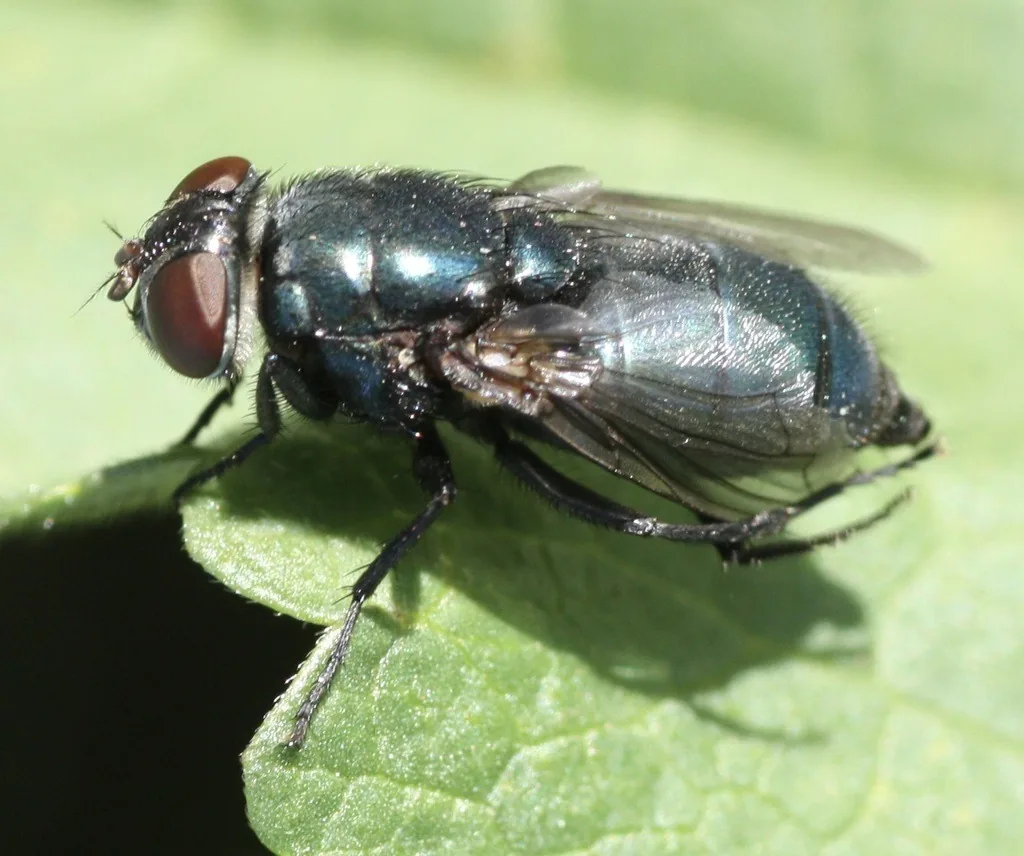
- The adult flies are typically metallic green and about 3/8 inch long. Cornell names the black blow fly and the green bottle fly as the main culprits, and the secondary screwworm can also strike sheep.[1]
Look-alikes
| Look-alike | How to tell them apart |
|---|---|
| New World screwworm | The primary screwworm is the only wound maggot that feeds exclusively on living flesh. The blow fly maggots behind fleeceworm strike start in soiled wool and on dead or damaged tissue, though they can burrow into the skin.[4][1] |
Where it lives
Fleeceworm strike is a problem for sheep flocks in warm, wet weather, when the flies are active and sheep get wet. Blow flies also gather on goats with wounds or skin infections.[2][1][3]
Biology and life cycle
The flies normally breed in carrion and other decaying matter, but they will lay eggs on moist or soiled wool. Bacterial activity on the animal is the main attraction, and wool soiled by urine or scours or matted with blood from wounds is a favorite egg-laying site.[1][3][2]
A female can lay up to 200 eggs at one time. The maggots feed through three stages, then drop off the animal to pupate in the soil; at 70 degrees F the black blow fly and green bottle fly go from egg to adult in about 130 to 140 hours, while the secondary screwworm takes longer.[1]
Damage and signs
- Feeding at the base of the wool irritates and reddens the skin and loosens the fibers. The maggots can burrow into skin and muscle, leaving an open wound that can become infected; an unchecked infestation costs much flesh and wool and can kill the animal.[1][2]
- Struck wool and meat become unmarketable, and strong-wooled breeds are at higher risk than fine-wool sheep.[1]
Health risk
Oklahoma State notes that blow flies do not bite goats, but fleeceworm strike is a serious animal welfare problem that needs immediate attention when found. Kentucky, Cornell and Oklahoma State discuss the risk to sheep and goats, not to people.[3][1][2]
Control
Prevention
Dock tails to prevent matted fleece, and if strike is a frequent problem consider shearing twice a year.[1]
Prevent wounds by removing barbed wire fencing and other sharp objects from pens, yards and pastures, and dress or protect cuts and castration and birthing wounds.[2]
Sanitation
Keep sheep clean and dry. Wet wool and wool soiled with urine or scours is what draws egg-laying flies.[1][2]
Clean up around barns, since blow fly larvae develop in decaying organic matter and dead animals. Oklahoma State stresses removing afterbirth promptly during kidding season.[3]
Traps and physical control
Check the flock often during warm, wet weather. If you find maggots, shear the wool from the affected area and physically remove all the maggots.[2][1]
Pesticides
Then treat the area with an appropriate insecticide and dress the wound; Kentucky notes that sprays, foams and dusts are used. Kentucky does not consider preventive insecticide treatments economical.[1][2]
Common questions
- What does flystrike look like?
- A struck sheep is restless and uncomfortable, with black to greenish staining in the wool, a foul smell, and maggots and sores under the dirty wool next to the skin. Patches of wool may loosen and pull away.[1][2]
- Which sheep are most likely to get fleeceworms?
- Sheep with wet wool or wool soiled by urine or scours, sheep with cuts or castration or birthing wounds, and strong-wooled breeds, especially during warm, wet weather.[1][2]
- Can goats get struck too?
- Blow flies gather on goats with wounds or skin infections, drawn by bacterial activity on the animal, and Cornell notes the maggots drop off sheep or goats to pupate. Oklahoma State advises special care to clean up afterbirth during kidding season.[3][1]
Sources
- Cornell University, Cornell Integrated Pest Management, “Flystrike (Myiasis) Livestock IPM Fact Sheet.” cals.cornell.edu/integrated-pest-management/outreach-education/fact-sheets/flystrike-myiasis-livestock-ipm-fact-sheet (accessed 2026-11-08)
- University of Kentucky Entomology, “Sheep Pests, ENTFACT-503 (L. Townsend).” entomology.ca.uky.edu/ef503 (accessed 2026-11-08)
- Oklahoma State University Extension, “External Parasites of Goats, EPP-7019 (revised June 2015).” pods.okstate.edu/fact-sheets/EPP-7019pod2015.pdf (accessed 2026-11-08)
- University of Florida IFAS Extension, “External Parasites of Sheep and Goats, ENY-273 (P. E. Kaufman, P. G. Koehler and J. F. Butler; revised March 2006; archival copy).” journals.flvc.org/edis/article/download/115718/113947/165982 (accessed 2026-11-08)
- iNaturalist, “Phormia regina taxon page (order and family).” www.inaturalist.org/taxa/449683 (accessed 2026-11-08)