On this page
How to identify it
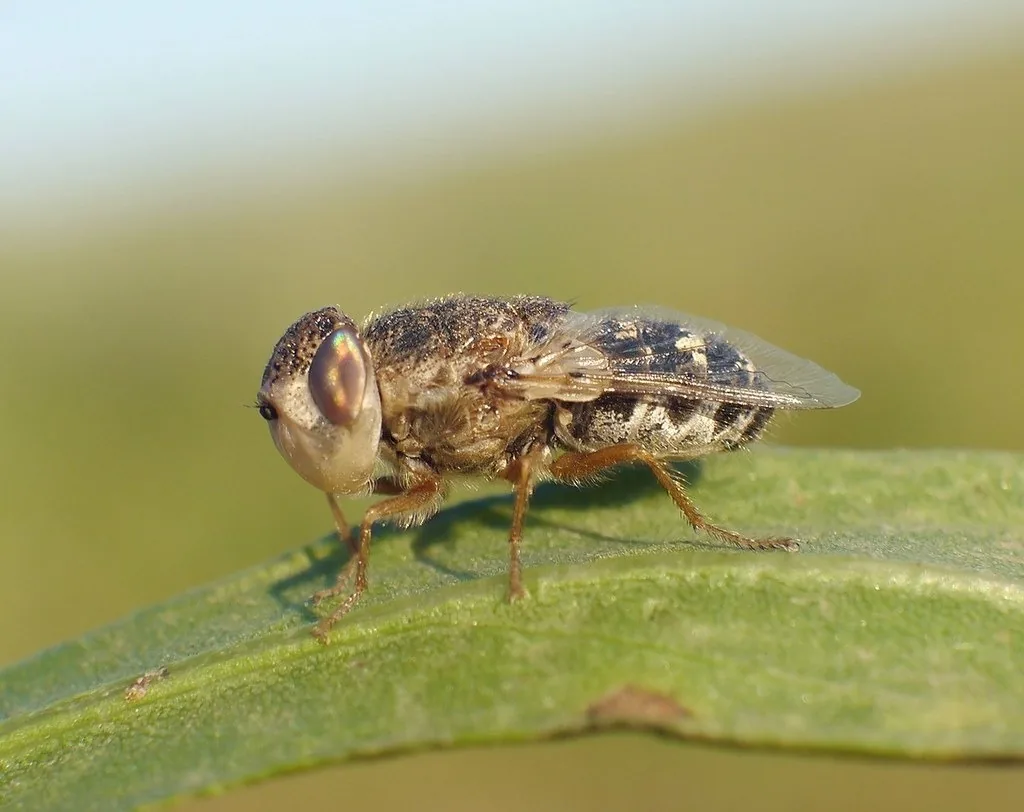
- The adult is a hairy, yellowish brown to gray fly with a light yellowish head and clear wings; Kentucky compares it to a bumble bee in size.[1][2]
- When the flies are about, on warm, still, sunny days from late spring into autumn, sheep shake their heads, stamp, snort, run or huddle, and push their noses into the dust, the grass or the wool of other sheep.[1][2]
- The larvae, or bots, are spiny grubs that start out white and about 1 mm long and grow to about 30 mm (just over an inch), turning tan as they mature.[2][1][4]
Where it lives
The sheep bot fly occurs worldwide. In North America it is generally not an economic problem, though Cornell notes occasional trouble, and it does more damage in warmer climates than in cold ones.[3][2]
Biology and life cycle
Females do not lay eggs: the eggs hatch inside them, and they dart at a sheep's head to drop droplets holding 2 to 20 live larvae at the nostrils, up to about 500 over an adult life of a few weeks. The adult females do not feed.[2][3][1]
The larvae crawl up the nasal passages feeding on mucus, settle in the sinuses and other hollow spaces of the head, and later work back down to the nose.[1][2]
Depending on season and climate, larvae stay in the head for 2 months to most of a year; in Kentucky the spring generation stays 2 to 3 months, while larvae deposited in fall spend the winter there.[1][2][4]
Full-grown larvae are sneezed out or crawl out onto the ground, burrow in and pupate within hours, and adults emerge 3 to 6 weeks later. Kentucky describes two generations a year.[1][2]
Kentucky research found more than 90 percent of the state's sheep infested from October through February, with the highest numbers in November and December.[1]
Damage and signs
- Fly attacks interrupt grazing as sheep bunch up and protect their noses.[2][1]
- Larvae in the nose and sinuses cause inflammation, nasal discharge, sneezing and labored breathing, and open the way to bacterial infections. In severe cases, larvae lodged in the nasal cavity or sinuses can kill the animal.[1][2]
- Heavy infestations reduce weight gain, wool and milk; Kentucky cites studies attributing weight losses of up to 4 percent to bots. Occasionally larvae get into a sheep's eye, and a veterinarian may need to remove them.[2][1]
Health risk
The sheep bot fly is the most common cause of ophthalmomyiasis in people, an infestation of the surface of the eye that is thought to start when a female fly deposits larvae there. It mostly affects shepherds and farmers, but U.S. cases have been reported in Texas, Hawaii and California, including one in which manure spread on a high school sports field was the suspected source. The treatment is removal of the larvae, and early care helps prevent rare complications deeper in the eye.[4]
Control
Prevention
Most infested sheep need no treatment, and mild cases show few or no signs. Treatment is for animals clearly affected by bots.[2]
Pesticides
For sheep that are clearly suffering, Cornell lists ivermectin, abamectin or moxidectin; Kentucky also points to a systemic ivermectin product for this pest.[2][1]
Going after the adult flies doesn't work: their visits to the flock are unpredictable, and no traps, repellents or external insecticides are effective against them.[2]
Common questions
- Why are my sheep stamping, shaking their heads and pushing their noses into the ground?
- That is the classic reaction to sheep bot flies trying to deposit larvae at their nostrils, usually on warm, still, sunny days from late spring into autumn.[1][2]
- Do sheep with nose bots need treatment?
- Usually not. Cornell says most infested sheep don't, and treatment is for animals showing a clear problem.[2]
- Can sheep bot flies affect people?
- Rarely. The larvae can infest the surface of a person's eye, most often in shepherds and farmers, and the larvae have to be removed. U.S. cases have been reported from Texas, Hawaii and California.[4]
Sources
- University of Kentucky Entomology, “Sheep Pests, ENTFACT-503 (L. Townsend).” entomology.ca.uky.edu/ef503 (accessed 2026-11-08)
- Cornell University, New York State Integrated Pest Management, “Sheep Bot Fly (Oestrus ovis), Livestock IPM Fact Sheet (K. Wise, H. Tolz and S. O'Hehir, July 2026).” cals.cornell.edu/integrated-pest-management/outreach-education/fact-sheets/sheep-bot-fly-oestrus-ovis-livestock-ipm-fact-sheet (accessed 2026-11-08)
- UF/IFAS Extension EDIS, “Sheep Bot Fly, Oestrus ovis, IN1267 (H. A. Sholar and J. L. Gillett-Kaufman, 2020; abstract).” journals.flvc.org/edis/article/view/115683 (accessed 2026-11-08)
- Journal of Investigative Medicine High Impact Case Reports (PubMed Central), “A Case and Review of Ophthalmomyiasis Caused by Oestrus ovis in the Central Valley of California, United States (C. D'Assumpcao and others, 2019).” pmc.ncbi.nlm.nih.gov/articles/PMC6452583/ (accessed 2026-11-08)
- iNaturalist, “Oestrus ovis taxon page (order and family).” www.inaturalist.org/taxa/362512 (accessed 2026-11-08)