On this page
How to identify it
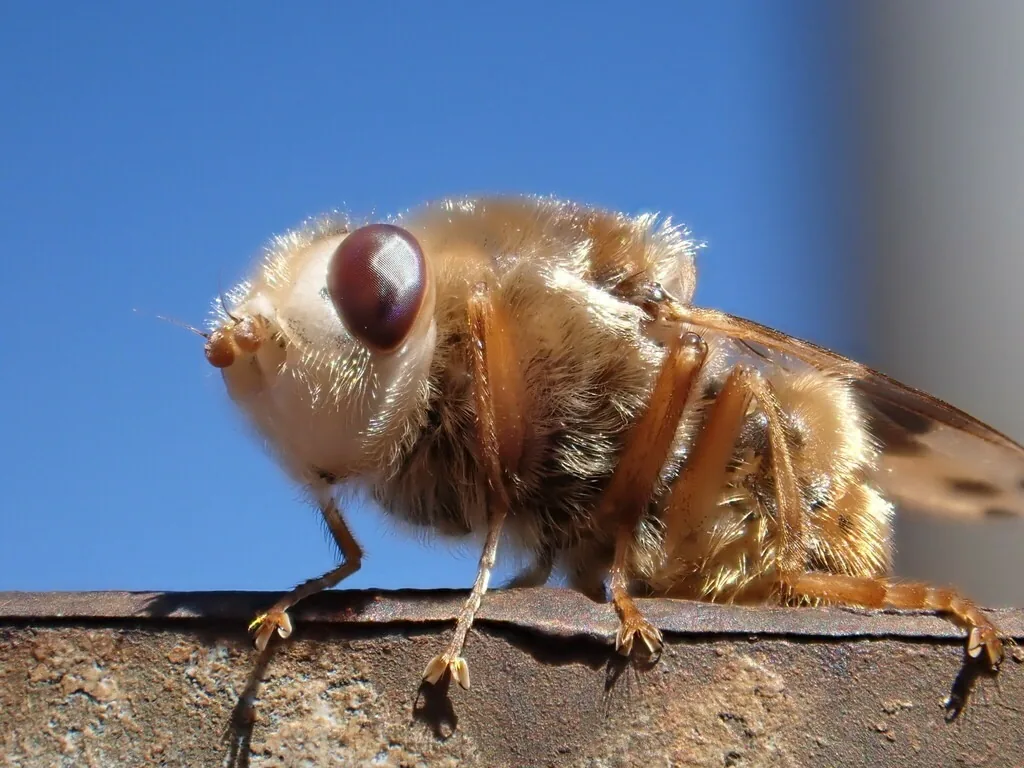
- The adults look like small honey bees and dart at horses to lay eggs. They have no working mouthparts, so they cannot feed, and they do not sting.[1][2]
- The eggs, or nits, are tiny yellow to gray specks glued to the hair, and their position tells you the species: the common horse bot lays mainly on the front legs (also the shoulders, belly, mane or flanks), the throat bot on hairs under the jaw, and the nose bot on the short hairs of the lips.[1][2][3]
Look-alikes
Where it lives
Bots are routine parasites of horses: Kentucky Extension expects virtually every horse in the state to be infested, and New Mexico State says most horses there pick them up every year.[1][2]
Biology and life cycle
Three species share nearly the same life cycle: the common horse bot (Gasterophilus intestinalis), the throat bot (G. nasalis) and the nose bot (G. haemorrhoidalis).[1][2][3]
Each female lays from a few hundred to 1,000 eggs. Most egg-laying happens in August and September, but it can continue until the first hard frost.[1]
Common horse bot eggs hatch after 2 to 5 days, often when the horse licks or bites at them and the warmth and moisture of its mouth trigger hatching; the other two species hatch on their own and the larvae make their way to the mouth. Cold weather can delay hatching, so live eggs may stay on the hair long after the flies are gone.[1][2]
Young bots, at least those of the common horse bot, spend about three weeks in the lips, gums or tongue. Then they move to the stomach or small intestine, hook onto the lining with their mouth hooks and stay for roughly 7 to 10 months.[1][2]
Full-grown bots pass out in the manure and pupate in the soil, and adults emerge 2 weeks to 2 months later, so one turn of the cycle takes about a year.[1][2]
Damage and signs
- The darting females frighten horses, which can hurt themselves or the people handling or riding them, and newly hatched larvae burrowing in the mouth irritate the horse.[1][2]
- A few bots in the stomach usually do little harm, but heavy loads can damage the stomach lining, slow the passage of food, and leave horses thin and unthrifty with digestive upsets or colic. In rare cases bots block the outlet of the stomach or lead to a fatal rupture.[2][1][3]
Health risk
On rare occasions newly hatched bots get into a person's mouth, typically after the person has petted or rubbed a horse where eggs are attached, and burrow behind the lips or inside the cheek. They cannot develop in people and die within a few days.[1]
Control
Sanitation
Good manure handling supports the whole parasite program: keep stalls clean, compost manure, and don't spread it where horses graze.[2]
Traps and physical control
Sponging egg-covered hair on the front legs with warm water (110 to 112 degrees F) can make some eggs hatch so the tiny larvae wash off, but it is of limited value and must be repeated often because flies lay new eggs daily. Clipping the hair is not practical.[1]
Pesticides
Because most of the life cycle happens inside the horse, control comes from a dewormer given internally that lists bots on its label; not every equine dewormer controls them. Ivermectin, for example, controls bots along with other internal parasites.[1][2]
Time the bot treatment for after egg-laying is over. New Mexico State advises starting about 30 days after all eggs have hatched, with an October to November treatment as a regular part of the yearly parasite program.[2][1]
When to call a professional
Plan the parasite program with your veterinarian and include every horse on the property; isolate and treat newly acquired or visiting horses before they mix with the others.[1][2]
Common questions
- What are the little yellow specks stuck to my horse's legs?
- Most likely bot fly eggs. The common horse bot glues its yellow to gray eggs mainly to the hair of the front legs, mostly in August and September.[1][2]
- Can bots make a horse sick?
- A few usually do little harm, but large numbers can damage the stomach lining and cause digestive upsets or colic, and in rare cases a blockage.[2][1]
- Does my regular dewormer take care of bots?
- Only if bots are on its label. Kentucky Extension warns that not all equine dewormers control them, while ivermectin products do.[1]
Sources
- University of Kentucky Entomology, “Horse Bots, ENTFACT-504 (L. Townsend).” entomology.ca.uky.edu/ef504 (accessed 2026-11-08)
- New Mexico State University Cooperative Extension Service, “Horse Bots, Guide B-705 (L. M. English, R. L. Byford and M. E. Craig, 1997-98).” pubs.nmsu.edu/_b/B705.pdf (accessed 2026-11-08)
- Extension Horses (Cooperative Extension), “Parasites: Bots (July 31, 2019).” horses.extension.org/parasites-bots/ (accessed 2026-11-08)
- iNaturalist, “Gasterophilus taxon page (order and family).” www.inaturalist.org/taxa/376429 (accessed 2026-11-08)