On this page
How to identify it
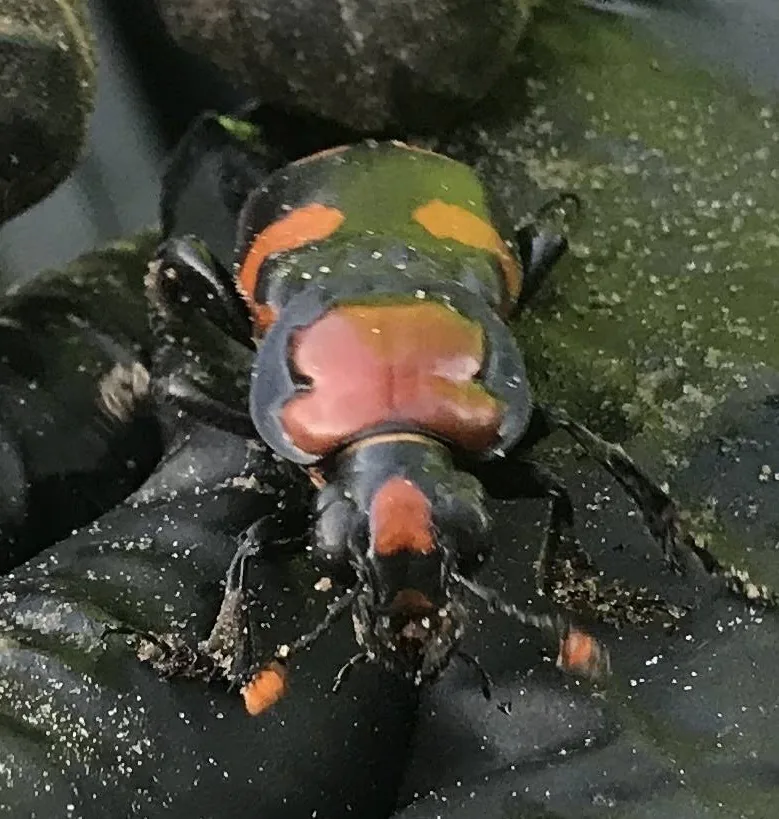
- The largest of the carrion beetles, up to 1 to 1 1/4 inches (about 25 to 35 mm) long: shiny black with bright orange-red bands across the wing covers, a bright orange-red patch just behind the head and another between the eyes, and orange knob-like tips to the antennae.[2][1]
- It is nocturnal, the only member of the genus that is, which is one reason artificial lighting is suspected in its decline. A mated pair at a carcass at night is the typical sighting.[2]
- Captive-bred beetles released in Missouri carry notches cut in the elytra so they can be told from wild-hatched offspring.[2]
Look-alikes
| Look-alike | How to tell them apart |
|---|---|
| Other burying beetles (Nicrophorus) | Smaller black-and-orange sexton beetles; the American burying beetle is the largest of the carrion beetles, carries an orange-red patch just behind the head, and by the Missouri account is the only member of the genus active at night.[2] |
Where it lives
Historically 35 states including Missouri and southern Ontario from Windsor to Toronto. By 2022 the Missouri Department of Conservation counted wild populations in only six states, none of them Missouri; Ontario's account names small, isolated populations in South Dakota, Oklahoma and Rhode Island, and recent field research comes from Oklahoma. Reintroduced populations are being established at Wah' Kon-Tah Prairie and Taberville Prairie conservation areas in southwest Missouri.[2][1][4]
Biology and life cycle
Using chemical receptors in the antennal tips, a beetle can pick up a carcass within an hour of death and, by Ontario's account, from as far as three kilometers away. Insects, mice, voles, opossums, birds, snakes and fish are all on the menu; small items are eaten on the spot, while a larger carcass becomes a nursery. A mated pair fights off competitors, drags or rolls the body to softer soil, and buries it by excavating beneath it with their flat, hard heads, usually about nine inches down and sometimes a foot or more; a mouse-sized carcass can be buried in a single night, and the beetles can move carcasses weighing 200 times their own weight.[2][1]
Underground the pair strips the feathers or fur, rolls the carcass into a ball and coats it with oral and anal secretions that slow decay. The female lays typically 10 to 30 eggs in a side chamber; they hatch within four days, and both parents feed the begging larvae by regurgitating carrion, a form of parental care rare among insects. New adults emerge after 48 to 60 days. Adults live four to six months by the Missouri account, about a year in Ontario's, with newly emerged adults remaining in the soil over winter, mating the following summer and dying after rearing their brood.[2][1]
Overwintering adults do not tolerate freezing: Oklahoma beetles had a mean super-cooling point of about -2 C and rely on burrowing below the frost instead. Survival rose with burial depth, while winters with wildly fluctuating temperatures and dry spells raised mortality and brought adults out of the ground earlier than previously documented.[4]
It prefers undisturbed deciduous forest but has been found in many habitats; what it needs is soil it can dig a brood chamber in, enough carcasses, and few enough competitors for them.[1]
Damage and signs
- None. By burying dead animals the beetles return nutrients to the soil, reduce contact between living animals and decaying tissue, and compete with fly maggots for carrion, which can mean fewer flies.[2]
Health risk
No harm to people is described; the beetle is a carrion recycler. The MDC notes that the nonessential experimental designation of the Missouri reintroductions assures neighboring landowners that the beetles' return will not affect farming or other activities.[2]
Control
Prevention
Do not kill or collect it. The species is federally threatened (downlisted from endangered), and the Ontario account lists it as extirpated with habitat protection to apply if it is ever found again. Likely causes of decline include loss of habitat and of the prey animals that once supplied carrion (the passenger pigeon among them), more competing scavengers such as raccoons, dogs and cats, attraction to artificial lights, road kill, and possibly pesticides. Ontario points private landowners to stewardship programs for species at risk and to local nature clubs and park volunteer projects.[2][1]
Keep neonicotinoid dust and drift away from carrion-beetle habitat. In laboratory tests a single low (nominal LD10) contact dose of imidacloprid killed 30 percent of American burying beetles within ten days and repeated doses 50 percent, and survivors moved erratically, struggled to right themselves and spread their wings without flying, effects that could leave wild beetles exposed to starvation, desiccation and predators. The contact thresholds fell within residue levels measured in planter exhaust and feedlot dust.[3]
Biological control
Recovery depends on captive breeding: the Saint Louis Zoo has bred the beetle since 2004 and, with the U.S. Fish and Wildlife Service, MDC and The Nature Conservancy, has released marked, pre-paired adults with a quail carcass into soil plugs on southwest Missouri prairies every year since June 2012, where their offspring are now surviving the winter.[2]
Common questions
- I found a big black beetle with orange bands on a dead bird at night. What should I do?
- Leave it and the carcass alone, photograph it if you can, and report it to your state wildlife agency. An inch-long nocturnal burying beetle with orange bands and an orange patch behind the head is the federally threatened American burying beetle; its smaller relatives are more likely in most places.[2][1]
- Why did it disappear from most of its range?
- No single cause is proven. Habitat change left fewer animals to die and more raccoons, opossums and other scavengers to compete, the passenger pigeon that once supplied carrion went extinct, the beetles are drawn to lights and killed on roads, and pesticides may have contributed; recent work shows neonicotinoids impair and kill them at realistic exposure levels.[1][2][3]
- Will reintroduced beetles on nearby public land restrict my farm?
- Missouri's reintroduced population is designated nonessential experimental under the Endangered Species Act, which the MDC says assures neighboring landowners that the beetles' presence will not affect farming and other activities.[2]
Sources
- Government of Ontario (Ontario.ca), “American burying beetle (Species at Risk in Ontario; updated August 12, 2021).” www.ontario.ca/page/american-burying-beetle (accessed 2026-11-10)
- Missouri Department of Conservation, “American Burying Beetle, Missouri Conservationist (August 2022).” mdc.mo.gov/magazines/missouri-conservationist/2022-08/american-burying-beetle (accessed 2026-11-10)
- PLoS ONE (Public Library of Science), “Neonicotinoid exposure causes behavioral impairment and delayed mortality of the federally threatened American burying beetle, Nicrophorus americanus. PLoS ONE 20: e0314243 (2025), PMC11750090.” pmc.ncbi.nlm.nih.gov/articles/PMC11750090/ (accessed 2026-11-10)
- Biology (MDPI), “Super-cooling point and effects of temperature, moisture, and habitat on overwintering survival of the threatened American burying beetle (Oklahoma). Biology (Basel) 15 (2026), PMC13509768.” pmc.ncbi.nlm.nih.gov/articles/PMC13509768/ (accessed 2026-11-10)
- iNaturalist, “Nicrophorus americanus taxon page (order and family).” www.inaturalist.org/taxa/107026 (accessed 2026-11-10)