On this page
How to identify it
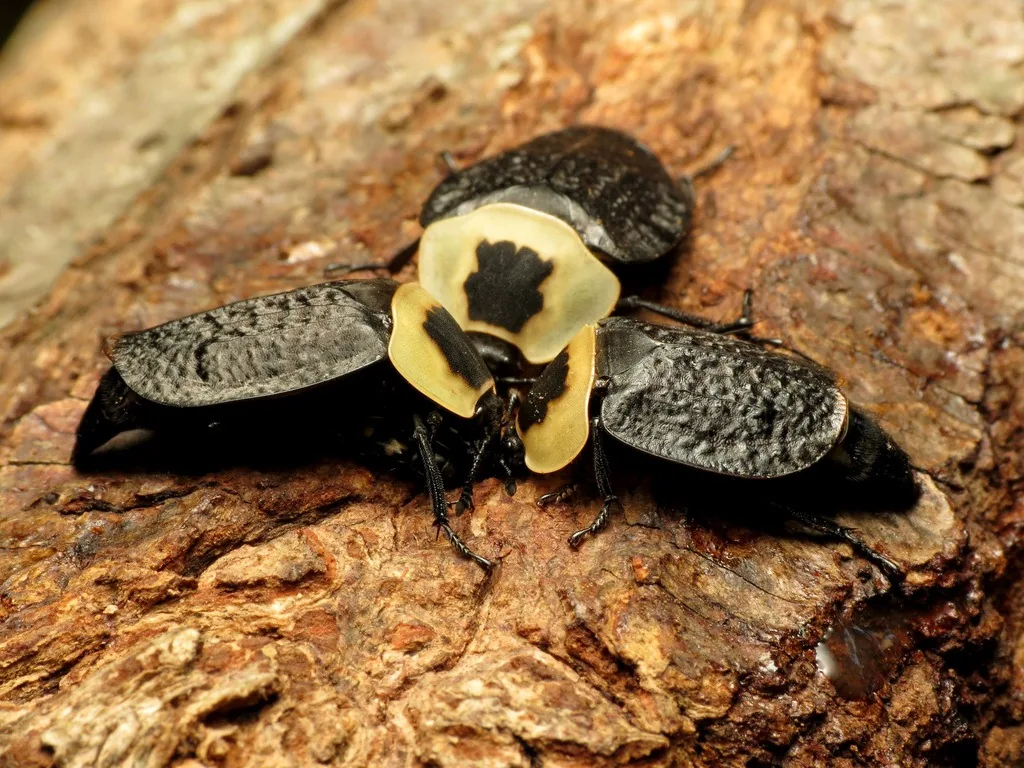
- The pronotum is yellow with a big black spot in the middle.[1]
- Adults are about 1/2 to 3/4 inch long. In flight they look like bumblebees.[1]
- As in other carrion beetles, the body is flattened, the wing covers are wider toward the rear than at the front, and the antennae end in a distinct club.[2]
- The larvae are black, teardrop-shaped grubs that look something like sowbugs.[1]
Look-alikes
| Look-alike | How to tell them apart |
|---|---|
| Margined carrion beetle (Oiceoptoma noveboracense) | A close relative that turns up at the same carcasses. Its pronotum is often orange rather than pale yellow, the dark spot has a lobe on each side, and it is smaller, reaching only about 1/2 inch.[1][4] |
| Burying beetles (Nicrophorus) | Burying beetles bury or cover small carcasses and a pair raises its young on them. The American carrion beetle and its subfamily, the Silphinae, feed on large carcasses and on the larvae of competing scavengers instead.[5][6] |
| Bumblebees | In flight the American carrion beetle looks like a bumblebee, and MDC notes that many carrion beetles mimic bees or wasps with their colors and heavy, loud-buzzing flight. Once it lands, the flat body, hard wing covers and clubbed antennae show it is a beetle.[1][2] |
Where it lives
It has been recorded in carrion-beetle studies in Texas, southwest Virginia, New Jersey and southeastern Ontario, and MDC profiles it in its Missouri field guide.[3][4][7][6][1]
Biology and life cycle
Adults find carcasses by smell, then mate and lay their eggs on the dead animal.[2][1]
Adults eat fly maggots as well as some carrion. Its subfamily, the Silphinae, feeds on large carcasses and on the larvae of competing scavengers, while the related burying beetles prefer small carcasses they can bury.[1][5][6]
The larvae hatch after the carcass has dried somewhat. They eat the carrion, especially dried skin, then crawl away to pupate.[1]
In Texas, adult records peak twice a year, in spring and again in late summer or fall. In southwest Virginia it was among the most common beetles on pig carcasses in spring and summer.[3][4]
In a 2016 trapping study in southeastern Ontario it was the most numerous carrion beetle caught: 2,361 in traps on the ground, against 17 in traps hung 6 meters up in the forest canopy.[6]
Damage and signs
Health risk
MDC states that carrion beetles are harmless to humans, though they often secrete or spray foul-smelling substances. A 1989 study of the gut bacteria of 36 carrion beetles from a New Jersey refuge, this species among them, found no frank pathogens, although several of the bacteria identified are known opportunistic pathogens.[2][7]
Control
Prevention
No control is needed. Carrion beetles are harmless to humans, they help recycle dead animals, and MDC notes they also help check fly populations; this species' adults eat fly maggots.[2][1]
Common questions
- Why are these beetles on a dead animal in my yard?
- Adults smell rotting material and come to carcasses to eat fly maggots and carrion, mate and lay eggs. The larvae then feed on the carcass once it has dried somewhat.[2][1]
- Is the American carrion beetle dangerous?
- No. MDC calls carrion beetles harmless to humans, though they can give off a foul smell.[2]
- Why do forensic scientists study it?
- The age and life stages of carrion beetles on a body help forensic scientists estimate the time of death, and in a carrion-succession study in southwest Virginia this species was among the most common beetles.[2][4]
Sources
- Missouri Department of Conservation, “American Carrion Beetle (Field Guide).” mdc.mo.gov/discover-nature/field-guide/american-carrion-beetle (accessed 2026-11-09)
- Missouri Department of Conservation, “Carrion Beetles (Burying Beetles) (Field Guide).” mdc.mo.gov/discover-nature/field-guide/carrion-beetles-burying-beetles (accessed 2026-11-09)
- Zootaxa (Magnolia Press), indexed in PubMed (PMID 26217847), “Mullins, Riley and Oswald. Identification, distribution, and adult phenology of the carrion beetles (Coleoptera: Silphidae) of Texas. Zootaxa 3666: 221-251 (2013), doi:10.11646/zootaxa.3666.2.7 (abstract).” doi.org/10.11646/zootaxa.3666.2.7 (accessed 2026-11-09)
- Journal of Medical Entomology (Entomological Society of America), indexed in PubMed (PMID 15311476), “Tabor, Brewster and Fell. Analysis of the successional patterns of insects on carrion in southwest Virginia. Journal of Medical Entomology 41: 785-795 (2004), doi:10.1603/0022-2585-41.4.785 (abstract).” doi.org/10.1603/0022-2585-41.4.785 (accessed 2026-11-09)
- Molecular Ecology (Wiley), indexed in PubMed (PMID 24102980), “Kaltenpoth and Steiger. Unearthing carrion beetles' microbiome: characterization of bacterial and fungal hindgut communities across the Silphidae. Molecular Ecology 23: 1251-1267 (2014), doi:10.1111/mec.12469 (abstract).” doi.org/10.1111/mec.12469 (accessed 2026-11-09)
- PeerJ, full text in PubMed Central (PMC6240436), “Wettlaufer, Burke, Schizkoske, Beresford and Martin. Ecological divergence of burying beetles into the forest canopy. PeerJ 6: e5829 (2018), doi:10.7717/peerj.5829.” doi.org/10.7717/peerj.5829 (accessed 2026-11-09)
- Journal of Medical Entomology (Entomological Society of America), indexed in PubMed (PMID 2769717), “Solter, Lustigman and Shubeck. Survey of medically important true bacteria found associated with carrion beetles (Coleoptera: Silphidae). Journal of Medical Entomology 26: 354-359 (1989), doi:10.1093/jmedent/26.4.354 (abstract).” doi.org/10.1093/jmedent/26.4.354 (accessed 2026-11-09)
- iNaturalist, “Necrophila americana taxon page (order and family).” www.inaturalist.org/taxa/81746 (accessed 2026-11-09)