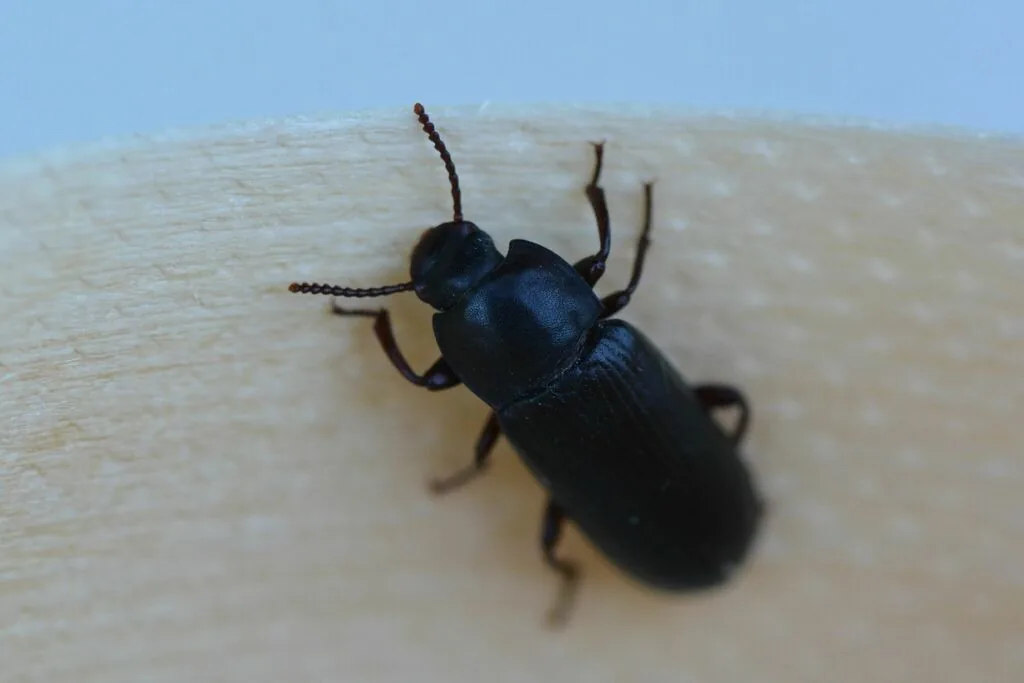
How to identify it
- Adults are shiny dark brown to black beetles about half an inch long, roughly 13 to 14 mm, and their antennae are not clubbed.[1][2]
- Larvae are smooth, shiny, hard-bodied and worm-like, yellowish to brown, and grow to about 1 to 1 1/4 inches long before pupating.[3]
- The common name comes from the yellowish larvae, which are lighter in color than the larvae of the closely related dark mealworm.[1][2]
Look-alikes
| Look-alike | How to tell them apart |
|---|---|
| Dark mealworm | Adults look almost the same, but dark mealworm adults have a dull luster while yellow mealworm adults are somewhat shinier, and dark mealworm larvae are darker.[2] |
| Confused flour beetle | A much smaller member of the same darkling beetle family that feeds on cracked, broken or milled grain products such as flour, cereal and pasta.[2] |
| Cadelle | Another large black stored-grain beetle, but flattened, with a clear waist between the thorax and wing covers, and its white larvae have black heads.[5] |
Where it lives
Found worldwide; in the United States it is more common in the cooler northern states.[1]
Biology and life cycle
Females lay an average of 400 to 500 eggs, singly or in clusters; UMaine Extension reports up to 1,000 eggs, which hatch in about 18 days.[1][3]
Larvae take six to nine months to mature, and there is usually one generation a year, though ideal conditions can shorten the cycle to about four months.[1][3]
Adults usually emerge in spring or early summer and live two or three months. They are active at night, can fly, and are often drawn to lights.[1][3]
They hide in dark, moist spots: under feed sacks in warehouses and feed stores, in grain bins, and in the litter of chicken houses and birdhouses.[1][3]
Mealworms are also raised commercially as food for pet reptiles, amphibians and birds.[2]
Damage and signs
- They feed mainly on milled grain with high moisture, and occasionally on cereal products in homes, though a typical kitchen doesn't suit them well.[1][3]
- Outbreaks start where grain is processed or stored; litter left in old or abandoned poultry houses has produced explosive populations that bothered residents up to half a mile away.[3]
Health risk
They contaminate food rather than biting people; UC IPM notes pantry pests may introduce microbes that can form mycotoxins in warm, humid storage, so infested food should be thrown away.[4][2]
Control
Prevention
Keep grain products and pet food in sturdy, tightly sealed containers, and wash containers before refilling them.[3][2][4]
Keep them out
Seal gaps around windows, doors, foundations and pipe entries and keep screens tight, since adults also fly in from outdoors and come to lights.[2][3]
Sanitation
Find and discard infested food, and check dry pet food and the areas around pet dishes where crumbs build up.[3][2]
In barns and feed rooms, clean up spilled feed and hay promptly, and deal with old poultry litter rather than dumping it on the ground.[2][3]
Traps and physical control
Before throwing infested food out, kill the insects by heating it at 130 to 150 degrees F for 30 minutes or freezing it for about five days.[3]
Vacuum shelves and cabinet interiors, then seal the vacuum bag or contents in a plastic bag so the infestation doesn't spread.[3][2]
Pesticides
Insecticides aren't recommended for pantry pests in the kitchen; for adults that keep coming from outside, UMaine notes a perimeter insecticide labeled for that use can help.[4][3]
Common questions
- Are the mealworms in my house the same ones sold as pet food?
- Yes, the yellow mealworm is one of the species raised to feed pet reptiles, amphibians and birds, and escaped or stray larvae can wander far from their food.[2][1]
- Why do I see big black beetles at my porch light?
- Adult yellow mealworms are night-active beetles that fly and are attracted to lights, often coming from feed, grain or poultry litter nearby.[1][3]
- Will freezing kill mealworms in food?
- Yes. UMaine says about five days in a freezer should kill all life stages; heating the food at 130 to 150 degrees F for 30 minutes also works.[3]
Sources
- University of Florida, Entomology and Nematology Department, “Yellow Mealworm, Tenebrio molitor (stored product pests image gallery).” entnemdept.ufl.edu/projex/gallery/dl/stored_product_pests/text/yellow_mealworm.htm (accessed 2026-10-06)
- Virginia Cooperative Extension, Virginia Tech, “Darkling Beetles and Mealworms, ENTO-283NP (revised February 2023).” pubs.ext.vt.edu/ENTO/ENTO-283/ENTO-283.html (accessed 2026-10-06)
- University of Maine Cooperative Extension, “Pest Management Fact Sheet #5044: Mealworms (reviewed and revised 2023).” extension.umaine.edu/ipm/ipddl/publications/5044e/ (accessed 2026-10-06)
- University of California Statewide IPM Program, “Pest Notes: Pantry Pests, Publication 7452.” ipm.ucanr.edu/home-and-landscape/pantry-pests/ (accessed 2026-10-06)
- University of Kentucky College of Agriculture, Entomology, “ENTFACT-134: Insect Pests of Stored Grain: Cadelle Beetle (revised March 2026).” entomology.mgcafe.uky.edu/ef134 (accessed 2026-10-06)
- iNaturalist, “Tenebrio molitor taxon page (order and family).” www.inaturalist.org/taxa/131970 (accessed 2026-10-06)