How to identify it
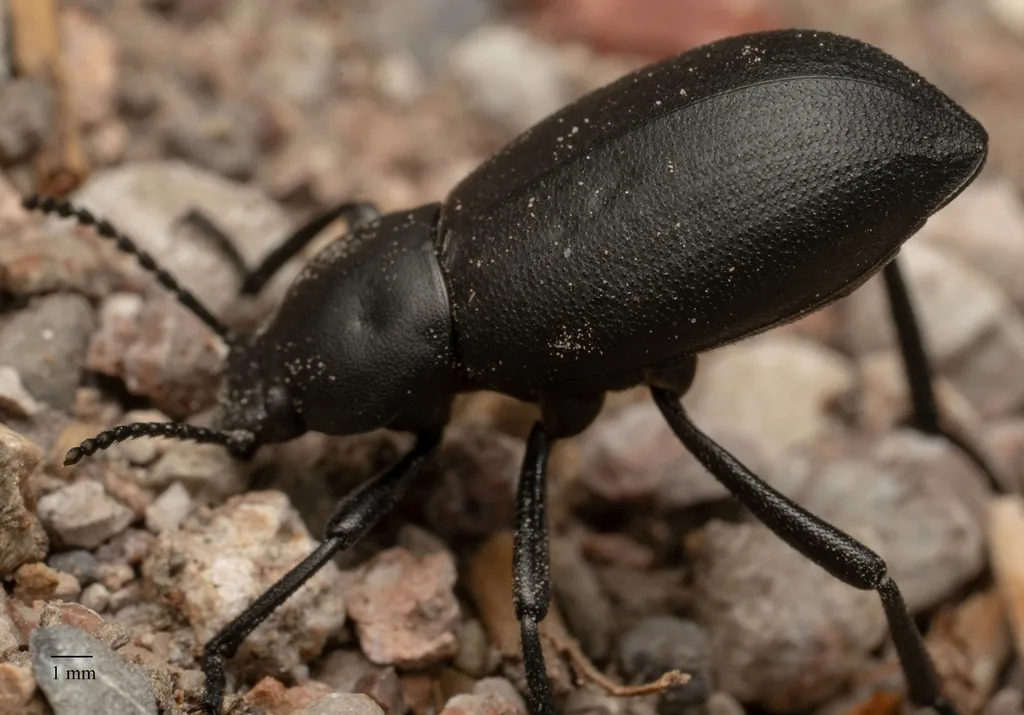
- Eleodes adults are black and slow-moving, and range from about 0.4 inch to 2 inches long; they are among the largest beetles commonly seen in California.[1][2]
- They can't fly, because the wing covers are fused together over the back.[1][2]
- When disturbed they raise the abdomen in the air in a headstand and may release a smelly, reddish-black fluid, then play dead if that fails.[1][2]
- Across the whole family, adults range from tan to reddish brown to brownish black and may be shiny or dull, with smooth, grooved or sculptured wing covers.[3]
Look-alikes
| Look-alike | How to tell them apart |
|---|---|
| Ground beetles | Darkling stink beetles are slow, flightless and known for their headstand defense; their wing covers are fused shut.[1] |
| Mealworms and flour beetles | Small darkling beetles such as flour beetles and mealworms infest damp or broken stored grain indoors; large outdoor stink beetles don't.[3] |
Where it lives
Eleodes stink beetles are common across the American West, including Arizona and California, especially in coastal and desert areas. The wider darkling beetle family has more than 20,000 species.[2][1][3]
Biology and life cycle
Adults and larvae live on the ground and feed on dead or decaying plant matter; outdoors they hide under boards, rocks, decaying wood and bark.[1][3]
They spend the hottest part of the day sheltering in animal burrows and under rocks, are drawn to moist spots, and can be seen throughout the year.[2]
The larvae, called false wireworms, are shiny, cylindrical and brown to yellowish, closely resembling pet-store mealworms.[1][3]
They overwinter as adults or larvae, and adults are known to live several years.[1]
In desert areas, some species migrate in large numbers at certain times of year.[1]
Damage and signs
Health risk
There's no reason to fear them, but the defensive spray contains a benzoquinone that smells bad and can irritate skin, eyes and mucous membranes, so keep your distance from the tip of the abdomen.[2]
Control
Keep them out
Keep them out the same way you would scorpions and centipedes: maintain weather stripping, caulk around windows and doors, and keep window screens in good repair.[2][3]
Seal gaps in foundation walls and where pipes enter the building.[3]
Sanitation
Around barns and animal housing, clean up spilled feed and hay promptly, since it attracts darkling beetles.[3]
Traps and physical control
An occasional darkling beetle indoors can be removed with a vacuum or fly swatter; an aerosol insecticide is an option, following the label carefully.[3]
Common questions
- Why is it called a stink beetle?
- When threatened, it stands on its head with its rear end raised and releases an offensive-smelling fluid to deter predators.[1][2]
- Are stink beetles dangerous?
- No. They mostly mind their own business; the only concern is the irritating spray, so don't handle them near the tip of the abdomen.[2]
- Can stink beetles fly into my house?
- No. Their wing covers are fused, so they walk in through gaps around doors, windows and foundations instead.[1][3]
Sources
- Bohart Museum of Entomology, University of California, Davis, “Darkling Beetles (Information Note No. 033).” bohart.ucdavis.edu/sites/g/files/dgvnsk4616/files/media/documents/note_33_darkling_beetle.pdf (accessed 2026-10-06)
- University of Arizona Cooperative Extension, Yavapai County, “Pinacate Beetle (Backyard Gardener #55, January 15, 2023).” www.extension.arizona.edu/sites/extension.arizona.edu/files/barnesm/PinacateBeetle.pdf (accessed 2026-10-06)
- Virginia Cooperative Extension, Virginia Tech, “Darkling Beetles and Mealworms (ENTO-283NP, revised February 17, 2023).” pubs.ext.vt.edu/ENTO/ENTO-283/ENTO-283.html (accessed 2026-10-06)
- iNaturalist, “Eleodes taxon page (order and family).” www.inaturalist.org/taxa/53817 (accessed 2026-10-06)