The short answer
- Seal the house before the fall flight: Kentucky says late spring or summer is the time to caulk cracks around windows, doors, soffits, fascia boards and utility lines, and to screen attic vents.[1][2][3]
- Vacuum beetles that are already inside. Kentucky and Penn State call it the easiest and most efficient way to remove them, and sweeping or swatting makes them release their staining yellow fluid.[1][2][7]
- Don't spray or fog indoors. Kentucky, Penn State and Minnesota say indoor sprays and bug bombs don't stop more beetles coming out of the walls, and dead beetles in wall voids can feed carpet beetles.[1][2][3][6]
- If sealing isn't enough, an exterior insecticide band around windows, doors and eaves in late September or early October, before the beetles arrive, can help. Spraying after they're already in the walls doesn't help.[1][2][3][4]
- Black light traps catch beetles in attics and dark rooms at night.[5][6][7][1]
- They don't damage wood, food or fabric and don't carry disease, but they can pinch or bite, and allergy studies show some people in heavily infested homes become allergic to them.[1][3][5][8]
Related profiles
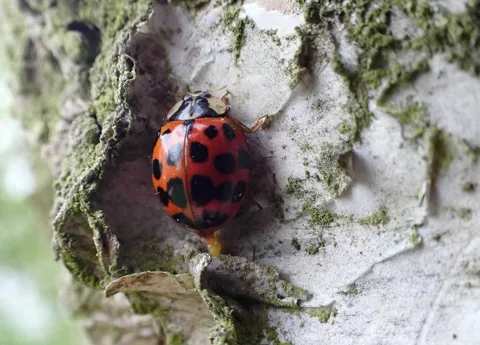 Multicolored Asian Lady Beetle
Harmonia axyridis
The multicolored Asian lady beetle is a beneficial aphid predator outdoors but becomes a nuisance when it flies to buildings in fall to overwinter and ends up indoors. Clemson and Colorado State extension both describe it as a valuable aphid predator on crops, trees and shrubs.
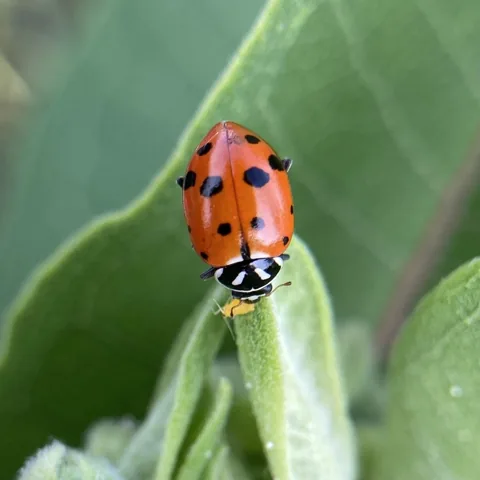 Convergent Lady Beetle
Hippodamia convergens
The convergent lady beetle is a native lady beetle named for the two short white marks on its thorax that angle toward each other. Adults and larvae eat aphids and other soft-bodied insects, and it is essentially the only lady beetle sold in stores and catalogs for aphid control.
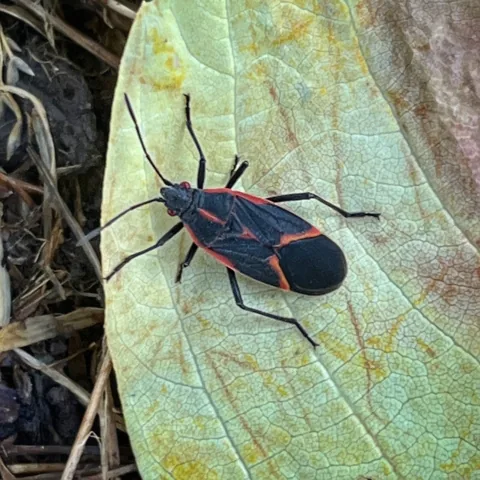 Boxelder Bug
Boisea trivittata
Boxelder bugs feed mainly on the seeds of female boxelder trees and become a nuisance in fall, when large numbers gather on and around homes looking for a place to spend the winter. Indoors they can stain fabrics and smell when crushed, but they don't damage the structure and don't breed inside.
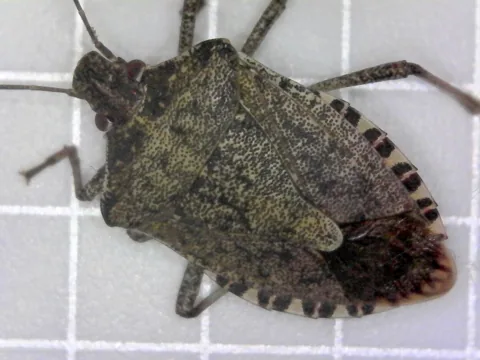 Brown Marmorated Stink Bug
Halyomorpha halys
The brown marmorated stink bug is an invasive insect from east Asia that damages fruit and vegetable crops and invades homes in fall looking for overwintering sites. Minnesota Extension says it feeds on about 200 plant species and, unlike the native stink bugs there, prefers to spend the winter in homes. Clemson notes that the bugs gather on outside walls before they move in.
 Kudzu Bug
Megacopta cribraria
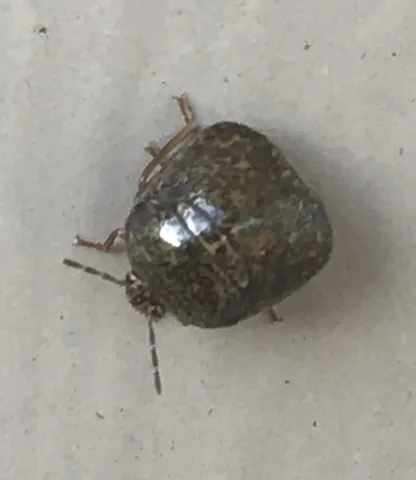
The kudzu bug is an invasive Asian insect, related to stink bugs, that feeds on kudzu, wisteria and soybeans. In late summer and fall it gathers in large numbers on houses, especially light-colored ones, hunting for places to spend the winter.
 Cluster Fly
Pollenia species (e.g., P. rudis)
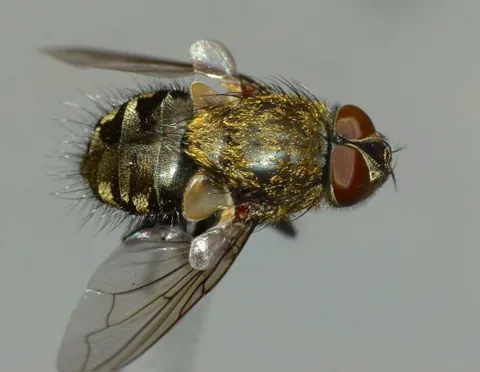
Cluster flies gather on the sunny sides of buildings in fall to find places to overwinter and then appear indoors, often in large numbers, on warm days through winter and spring. They do not breed indoors.
 Varied Carpet Beetle
Anthrenus verbasci
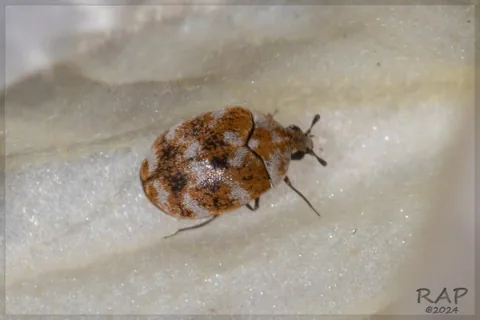
Carpet beetles are small beetles whose larvae damage wool, silk, fur, feathers, leather and other animal products; the adults feed on pollen outdoors and often fly in through windows.
First, make sure they're Asian lady beetles
The multicolored Asian lady beetle (Harmonia axyridis) is the lady beetle that gathers on houses in large numbers. Minnesota lists other names for it: Asian lady beetle, Halloween lady beetle and Japanese lady beetle. Penn State notes that "lady beetle" and "ladybug" are both names for the whole lady beetle family, so an Asian lady beetle is also an Asian ladybug. Our types of beetles in the house guide covers the other beetles that turn up indoors.[3][2][1]
- The mark: most have a black M- or W-shaped mark on the whitish area just behind the head. In dark beetles the mark can be filled in to a black patch.[1][2][3][7]
- Size: Kentucky, Arkansas and Washington State give about 1/4 inch; Penn State gives 9/32 inch (7 mm); Minnesota, Iowa State and Wisconsin give about 1/3 inch. Penn State and Minnesota say they are larger than most native lady beetles.[1][7][6][2][3][5][4]
- Color and spots: tan, yellowish orange, orange or red, with up to 18 black spots according to Penn State and Arkansas, or 19 according to Minnesota, Iowa State and Wisconsin. The spots can be faint or missing, and some are black with red or orange spots.[1][2][7][3][5][4][6]
- Larvae: spiny, alligator-shaped, dark with orange markings. Penn State says the orange-and-black pupae are sometimes found attached to walls.[1][2][3]
Why they swarm your house
In fall the adults leave fields, yards and woods for protected places to spend the winter, and buildings are one of those places. Kentucky says flights run from September through November depending on location and weather; Minnesota gives late September to late October, and Iowa State mid-September through October. Flights are heaviest on sunny afternoons after a cool spell, once temperatures get back to at least the mid-60s.[1][3][5][2]
- Which houses: beetles go for the sunny south and southwest sides lit by afternoon sun. Kentucky says contrasting light-dark features, such as dark shutters on light siding, attract them more than house color or building material. Iowa State says light-colored buildings in full sun appear to attract the most.[1][2][5][4]
- Location: homes near woods or fields are especially prone, though others get them too.[1][3][5]
- Where they hide: cracks around windows and door frames, behind fascia boards and siding, and in soffits, attics and wall voids. Penn State says tens of thousands can gather in attics, ceilings and wall voids.[1][2]
- Why they show up all winter: warmth reaching the walls wakes them, and they follow it toward windows and lights. In late winter and spring they try to get back outside and some wander into the living space instead.[1][2][3]
- They don't breed indoors. Every beetle you see in winter and spring came in the previous fall, so killing the ones inside doesn't change next year's numbers.[1][3][5]
Step 1: Seal the house before they arrive
Every source puts exclusion first. Kentucky calls sealing cracks and openings the most permanent way to keep lady beetles out, and Penn State calls mechanical exclusion the best method of control. Timing matters: Kentucky says to do it in late spring or summer, before the adults start flying to buildings. Our pest-proofing guide covers sealing for other pests at the same time.[1][2][7]
- Gap size: Kentucky and Minnesota say beetles fit through openings of 1/8 inch; Wisconsin says gaps of 1/16 inch or less let them in. Check for light showing under doors while lying on the floor.[1][3][4]
- Caulk: seal cracks around windows, doors, siding, fascia boards, utility pipes and wires, outdoor faucets and dryer vents, and behind chimneys, with good quality silicone, silicone-latex or acrylic latex caulk. Check where different materials meet, such as brick and wood siding.[1][2][3][4]
- Bigger holes: plug with cement, expanding urethane foam, steel wool or copper mesh.[1][3][4]
- Screens: repair door and window screens and screen attic vents, which Kentucky says are common entry points. Penn State and Arkansas specify number 20 or finer mesh over attic, chimney and exhaust vents. Arkansas suggests leaving window screens on rather than storing them.[1][2][7][3]
- Doors: fit tight door sweeps or thresholds on every exterior door and a rubber seal on the garage door. Foam weather stripping in the track seals gaps under sliding glass doors.[1][3][7][4]
- Set expectations: Minnesota says sealing reduces how many get in but won't stop every one, and Iowa State says thorough pest proofing is time-consuming, often impractical and usually not 100 percent effective. Iowa State adds that trees grown to shade the south and west sides can bring long-term relief.[3][5][1]
Step 2: Close the routes from the walls into rooms
Once beetles are in the walls, Penn State says to find where they come out into the living space and seal those spots, starting with the rooms where you see the most. They head for light, so they find cracks that let light into the wall.[2][7]
- Usual exits: cracks under or behind baseboards, around window and door trim, and around ceiling exhaust fans and light fixtures.[2][7]
- Arkansas suggests removing cover plates on outlets, switches and heating and return-air vents, sealing behind them and replacing them, and doing the same at the base plates of light fixtures and ceiling fans.[7]
- Tape works as a temporary seal, Penn State says.[2]
Step 3: Vacuum the ones inside
Vacuuming is the method every source recommends for beetles indoors. Kentucky says a broom is more likely to cause staining, because disturbed beetles release a smelly yellowish fluid from their leg joints that can stain walls, carpet, drapes and furniture. Arkansas says not to swat or crush them.[1][2][7][4][3]
- Stocking trick: put a knee-high nylon stocking into the hose and hold it with a rubber band. The beetles collect in the stocking, which you tie off and throw away after vacuuming.[2][3]
- Bagged vacuums: remove the bag after each session and tape it shut and discard it, or freeze it, so beetles don't crawl back out. Minnesota says changing the bag often also cuts the smell.[2][3][7]
- Releasing them: Kentucky says a cloth between the hose and the bag lets you release beetles outdoors. Washington State says to let them go far from the building or they'll come back.[1][6]
- If you're allergic: Penn State warns that the vacuum exhaust can spread the beetles' defensive odor, so people allergic to lady beetles may not be able to do the vacuuming.[2]
- Iowa State says repeated vacuuming is the most practical option all winter, while beetles keep emerging from the walls.[5]
Light traps for attics and dark rooms
Light traps use a lamp to draw beetles at night into a funnel and a container they can't climb out of. They collect the beetles rather than killing them. Iowa State says black light bulbs work best but incandescent bulbs also work; Washington State describes a USDA-designed black light trap that catches the beetles alive in an attached bag.[5][6][7]
- Where they work: Kentucky says light traps can be useful in dark, enclosed spaces such as attics, but catch relatively few of the beetles entering living spaces in fall or coming out of hiding the next spring.[1]
- Sources differ on how well they work: Arkansas calls a commercial black light trap very effective for beetles already in the home, while Kentucky is more limited about it, as above.[7][1]
- Using one: Arkansas says to run it in a dark room or at night in the most infested room, leave it on all night, empty the container often, and dust the trap's "wings" with cornstarch, talc or baby powder so the beetles slide in.[7]
- Homemade versions: Iowa State and Arkansas say a trap can be built from a light fixture, a funnel and a container. Arkansas describes one made from a clamp light, a 60W bulb and plastic milk jugs.[5][7]
- What doesn't work: Kentucky says lady beetle "houses" sold in garden catalogs won't keep beetles out of your home.[1]
Why indoor sprays and bug bombs backfire
Kentucky, Penn State and Minnesota all advise against insecticides indoors. Bug bombs kill beetles on walls and ceilings, but more come out of the walls soon after the room airs out, and sprays into the cracks they come from don't stop them either. Indoor treatments can also stain or leave residue on walls and counters.[1][2][3][5]
- Carpet beetles: Penn State, Washington State and Arkansas warn that killing beetles in wall voids leaves piles of dead ones that carpet beetles feed on, and the carpet beetles can then move on to wool, stored foods and other animal products in the house. Our carpet beetle profile covers them.[2][6][7]
- Not in spring either: Arkansas says not to spray the outside of the house in spring while beetles are trying to leave, because it can drive them into the living space instead. Kentucky says spring barrier sprays don't work, since the beetles got in the previous fall.[7][1]
Exterior insecticide barriers: timing is everything
Where sealing is impractical, as on tall buildings with endless gaps around eaves and siding, a residual insecticide sprayed outside can reduce entry. The sources agree on timing: late September or early October, just before the beetles gather. For Kentucky, the extension fact sheet gives late September to early October, varying with the season. Arkansas says to start no more than two weeks before beetles usually arrive. Several sources suggest hiring a licensed pest control company. Our perimeter spray guide covers how to apply one safely.[1][2][3][4][7]
- What's used: Wisconsin and Iowa State name pyrethroids such as permethrin, cypermethrin, cyfluthrin, deltamethrin, lambda-cyhalothrin and esfenvalerate. Iowa State says homeowner insecticides other than pyrethroids usually don't give satisfactory prevention.[4][5][1][7]
- Where: a targeted band around windows, doors, eaves, soffits, attic vents and other entry points, especially on the south and west sides.[1][3][4]
- Label limits: Arkansas notes that outdoor pyrethroid labels limit sprays on hard surfaces such as windows, doors, eaves, patios and driveways to spot and crack-and-crevice treatment, allow foundations up to 3 feet high, and forbid spraying where it can run into gutters or storm drains. Always read and follow the label.[7][1]
- How long it lasts: sources differ. Penn State says sunlight breaks the insecticide down so it may not work much beyond several days to a week or two; Arkansas says about 3 weeks, less with frequent rain.[2][7]
- Kentucky's bottom line: vacuuming, pest proofing and well-timed exterior sprays help, but none keeps out every beetle.[1]
Bites, stains and allergies
Asian lady beetles don't attack wood, food or clothing, can't sting and don't carry disease. They are a nuisance, but sources list a few real health effects.[1][3][5][2]
- Bites: they occasionally pinch or bite, mostly when swarming beetles land on skin in fall. Kentucky says it feels like a pinprick and is seldom serious; Minnesota says some bite hard enough to break the skin, with minor, short-lived discomfort. Arkansas says bites may cause welts lasting 24 to 48 hours.[1][3][7][2]
- Skin and eyes: Penn State says some people get a small welt from the defensive fluid. Kentucky advises not touching your eyes after handling the beetles.[2][1]
- Allergy: Kentucky, Penn State and Minnesota say infestations can cause allergies in some people, from eye irritation to asthma. A medical review describes runny nose and itchy eyes, asthma, hives and facial swelling, with peaks during fall swarms and smaller spring ones. A Virginia study found allergy antibodies to the beetle in 15 of 20 allergy patients living in infested houses.[1][2][3][9][10][11]
- How common: estimates differ. In a Kentucky survey of residents of infested homes, 50 percent self-reported lady beetle allergy; the same medical review cites a prevalence of 10 percent in one area where the beetles are common. The Kentucky authors called for diagnostic testing to confirm their self-reported figure.[8][9]
- Cockroach cross-reaction: Penn State notes some people who react to cockroaches also react to lady beetles. The Kentucky study authors recommend that doctors ask patients with fall, winter or spring allergies about lady beetle infestations. Kentucky extension says to see a physician if you suspect an allergic reaction.[2][10][8][1]
- A rare severe case: a 2026 case report described anaphylactic shock after an Asian lady beetle contaminated a person's albuterol nebulizer.[13]
- Pets: Penn State says pets that eat the beetles can get chemical burns in the mouth. A veterinary case report describes a dog with 16 beetles embedded in the roof of its mouth that had to be removed by hand, with injuries consistent with a chemical burn.[2][12]
They're beneficial outdoors
Larvae and adults eat hundreds of aphids a day, and Minnesota calls the beetle an important predator of soybean aphids. Penn State also says it is displacing native lady beetles and can damage grapes and other fruit late in the season, usually fruit already injured. Penn State adds that buying and releasing Asian lady beetles in a home garden generally doesn't work, since they fly off; see our guide to releasing beneficial insects.[1][3][2]
Common questions
- When should I seal my house against Asian lady beetles?
- In late spring or summer, before the fall flight. Once beetles are in the walls, sealing outside won't get them out; seal the indoor exits instead and vacuum.[1][2]
- Why do I have lady beetles in my house in January?
- They came in last fall and spent the winter in the walls or attic. Warm days wake them and they head toward light. They don't breed indoors.[1][3][2]
- Should I use a bug bomb for Asian lady beetles?
- No. Bug bombs kill the beetles in the room but more come out of the walls soon after, and dead beetles in wall voids can feed carpet beetles.[2][1][7]
- What's the best way to get rid of lady beetles in the house?
- Vacuum them, using a stocking in the hose or emptying the bag right after. Sweeping or crushing them releases a fluid that stains.[1][2][3][7]
- Do Asian lady beetles bite?
- Occasionally. The bite usually feels like a pinprick; some can break the skin, and Arkansas notes welts that can last 24 to 48 hours.[1][3][7]
- Are Asian lady beetles harmful?
- They don't damage the house or food or spread disease, but some people develop allergies to them, and pets that eat them can get mouth burns.[1][2][9][12]
Photo credits
- Multicolored Asian Lady Beetle: (c) Sascha Nunheim, some rights reserved (CC BY) — via iNaturalist, CC BY 4.0
- Convergent Lady Beetle: (c) Jody, some rights reserved (CC BY) — via iNaturalist, CC BY 4.0
- Boxelder Bug: (c) Alfonso Benítez-Mora, some rights reserved (CC BY) — via iNaturalist, CC BY 4.0
- Brown Marmorated Stink Bug: (c) Stan Rullman, some rights reserved (CC BY) — via iNaturalist, CC BY 4.0
- Kudzu Bug: (c) Cole Shoemaker, some rights reserved (CC BY) — via iNaturalist, CC BY 4.0
- Cluster Fly: (c) Steve Kerr, some rights reserved (CC BY) — via iNaturalist, CC BY 4.0
- Varied Carpet Beetle: (c) RAP, some rights reserved (CC BY) — via iNaturalist, CC BY 4.0
Sources
- University of Kentucky Entomology, “Asian Lady Beetle Infestation of Structures, ENTFACT-416 (M. F. Potter, R. Bessin, L. Townsend).” entomology.mgcafe.uky.edu/ef416 (accessed 2026-11-10)
- Penn State Extension, “Multicolored Asian Lady Beetle.” extension.psu.edu/multicolored-asian-lady-beetle (accessed 2026-11-10)
- University of Minnesota Extension, “Multicolored Asian lady beetles.” extension.umn.edu/nuisance-insects/multicolored-asian-lady-beetles (accessed 2026-11-10)
- University of Wisconsin-Madison Extension, Wisconsin Horticulture, “Multicolored Asian Lady Beetle, XHT1050 (P. Pellitteri).” hort.extension.wisc.edu/articles/multicolored-asian-lady-beetle/ (accessed 2026-11-10)
- Iowa State University Extension and Outreach, “Ladybug - Multicolored Asian Lady Beetle (Yard and Garden, 2016).” yardandgarden.extension.iastate.edu/encyclopedia/ladybug-multicolored-asian-lady-beetle (accessed 2026-11-10)
- Washington State University Hortsense, “Common Insects and Mites: Asian lady beetle.” hortsense.cahnrs.wsu.edu/fact-sheet/common-insects-and-mites-asian-lady-beetle/ (accessed 2026-11-10)
- University of Arkansas System Division of Agriculture Cooperative Extension Service, “Multi-Colored Asian Lady Beetle (MALB) Management Procedures (handout).” www.uaex.uada.edu/farm-ranch/pest-management/docs/Multi-Colored%20Asian%20Lady%20Beetle%20MALB%20Pest%20Management%20HANDOUT.pdf (accessed 2026-11-10)
- Annals of Allergy, Asthma & Immunology (PubMed 17069109), “Sharma K et al. Ladybug hypersensitivity among residents of homes infested with ladybugs in Kentucky. Ann Allergy Asthma Immunol 2006;97(4):528-31.” pubmed.ncbi.nlm.nih.gov/17069109/ (accessed 2026-11-10)
- Allergy and Asthma Proceedings (PubMed 18430308), “Goetz DW. Harmonia axyridis ladybug invasion and allergy. Allergy Asthma Proc 2008;29(2):123-9.” pubmed.ncbi.nlm.nih.gov/18430308/ (accessed 2026-11-10)
- Journal of Allergy and Clinical Immunology (PubMed 17291858), “Nakazawa T et al. Asian ladybugs (Harmonia axyridis): a new seasonal indoor allergen. J Allergy Clin Immunol 2007;119(2):421-7.” pubmed.ncbi.nlm.nih.gov/17291858/ (accessed 2026-11-10)
- Annals of Allergy, Asthma & Immunology (PubMed 17069108), “Albright DD et al. Multicolored Asian lady beetle hypersensitivity: a case series and allergist survey. Ann Allergy Asthma Immunol 2006;97(4):521-7.” pubmed.ncbi.nlm.nih.gov/17069108/ (accessed 2026-11-10)
- Toxicon (PubMed 18582484), “Stocks IC, Lindsey DE. Acute corrosion of the oral mucosa in a dog due to ingestion of Multicolored Asian Lady Beetles (Harmonia axyridis). Toxicon 2008;52(2):389-91.” pubmed.ncbi.nlm.nih.gov/18582484/ (accessed 2026-11-10)
- Annals of Allergy, Asthma & Immunology (PubMed 42402310), “Udomkittivorakul N, Polk B. Anaphylactic shock due to a contaminated albuterol nebulizer with an Asian lady beetle (Harmonia axyridis): a case report. Ann Allergy Asthma Immunol 2026 (online ahead of print).” pubmed.ncbi.nlm.nih.gov/42402310/ (accessed 2026-11-10)