The short answer
- Lady beetles bought in stores rarely work: most fly away within a day or two of release, even when aphids are plentiful.[2][3][6][7]
- If you release them, refrigerate them until use (don't freeze), mist the plants with water, and release at dusk at the base of plants. It takes large numbers: about 1,500 beetles per heavily infested rose bush, twice, a week apart.[3][2]
- Lacewing larvae eat aphids and other soft-bodied pests, but commercial lacewings work best in greenhouses; adults released outdoors disperse widely.[5][8]
- Timing matters: release only when the pest is present, or the natural enemies die or leave.[4]
- Praying mantid egg cases are a poor buy: mantids prey indiscriminately on bees, butterflies and other harmless or beneficial insects, and UC IPM says they are of no benefit for biological pest control.[14][15][16]
- Protecting the lady beetles and lacewings already in your yard usually does more than buying them: grow flowering plants, control ants and avoid broad-spectrum insecticides.[6][7][1][2]
Pests releases target
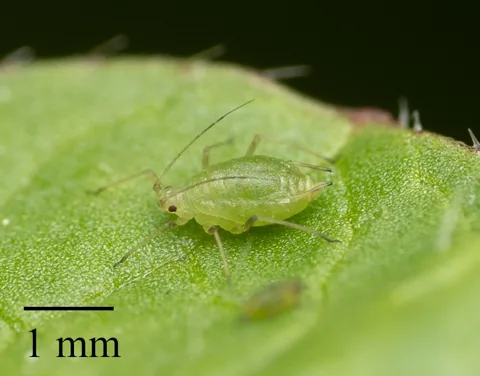 Aphids
Myzus persicae
Aphids are small, soft-bodied insects that pierce tender stems and leaves and suck out plant sap. Almost every plant hosts at least one aphid species, but established plants usually tolerate them, treating aphids for the plant's health is usually unnecessary, and natural enemies often bring numbers down.
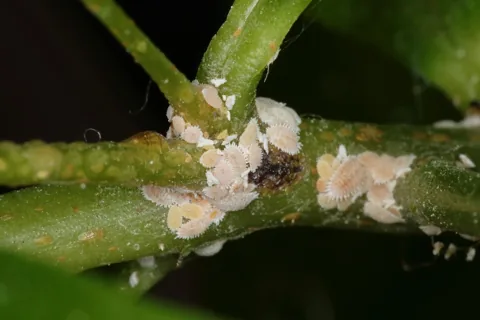 Mealybugs
Planococcus citri
Mealybugs are soft, oval insects covered in white wax that suck sap from houseplants and outdoor plants. They thrive indoors and where winters are mild, and their wax and hiding habits make them hard to reach with sprays.
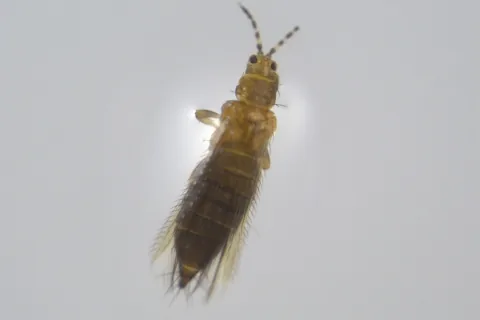 Thrips
Frankliniella occidentalis
Thrips are tiny, slender insects with fringed wings that scar and distort leaves, flowers and fruit. Woody plants usually tolerate them, but flowers, vegetables and young plants can be hurt badly, and thrips are hard to control.
When releases make sense
Augmentation means increasing natural enemies by buying and releasing commercially available species when the resident ones aren't enough.[1]
Some marketed natural enemies are not effective, and many are generalist predators that are cannibalistic and eat pests and beneficial species alike, which lowers their value.[1]
Success generally takes advance planning, biological know-how, careful monitoring, good release timing, patience, and a situation where some pests and damage can be tolerated. A garden already overrun with pests or damage is a poor candidate.[1]
Commercial insectaries sell predatory mites, lacewings and many parasitoids. A release works only with the right timing, when the host is present, and the right number per area, and for many situations the best release rate isn't known.[4][8][10]
Only a few natural enemies can be effectively added in gardens and landscapes. UC IPM's examples are insect-killing nematodes against certain tree-boring and lawn insects, and convergent lady beetles bought in bulk and released in very large numbers at intervals.[1]
Minnesota Extension suggests a few questions before buying lady beetles. Could they control your problem? They are best against small, soft-bodied insects such as aphids, so identify the pest first. How big is the problem? Research suggests large aphid outbreaks can take several releases of thousands of beetles. Can you handle them properly? They need prompt shipping, cool storage and water after release. And is the problem a recurring one? If it is, look for a longer-term fix, because almost all released beetles leave within a few days.[7]
Convergent lady beetles
The lady beetle sold for aphid control is the convergent lady beetle, Hippodamia convergens. Suppliers collect the beetles from large overwintering aggregations in California's foothills and mountains. Colorado State says essentially all lady beetles sold by nurseries and catalogs are this species, collected from mountain aggregation sites on the West Coast.[3][2][6]
Collected beetles are primed to disperse: most fly away from the release site within 1 or 2 days, even if aphids are plentiful, though each adult can eat about 100 aphids a day before it leaves. In research studies about 95% flew away within 48 hours, and released beetles are unlikely to lay eggs on the plants. Colorado State and Minnesota add that field-collected beetles are usually in reproductive diapause, a resting state in which they don't produce eggs, and resume egg laying only after feeding for several weeks, by which time most have left.[2][3][6][7]
UC research has shown releases can control aphids in a limited area if beetles are handled well and released in enough numbers. One large, heavily infested rose bush needed two releases of about 1,500 beetles each, a week apart; most store packages hold only enough for one aphid-infested shrub or a few small plants. The UC IPM Natural Enemies Gallery gives a slightly different schedule for roses: about 1,500 beetles per shrub, released at 1- to 2-week intervals for as long as conditions suit aphids, bought by mail in advance so you have enough when you need them.[3][2]
Beetles from retail outlets are unlikely to be good enough in number and quality to control aphids; beetles bought in bulk by mail order, refrigerated and released in very large numbers at intervals can control aphids temporarily. Colorado State sums up the record for lady beetles released in gardens as typically poor.[1][6]
Colorado State also notes that some collected beetles carry a small parasitic wasp, Perilitus coccinellae, that develops inside the beetle and then pupates in a cocoon underneath it.[6]
- Keep them refrigerated until release, but don't freeze them. Beetles left at room temperature deteriorate quickly.[3][2][7]
- Give them water: mist them lightly with a squirt bottle before refrigerating, without letting water puddle, and repeat about weekly. If you hold beetles for periodic releases, UC IPM suggests warming them to room temperature once a week and misting them with very dilute sugar water from a trigger-pump bottle, but not refrigerating them with food, which makes them give off an unpleasant odor.[3][2]
- Release at dusk or early evening. In the heat of the day or in sunshine they fly away almost immediately.[3][2]
- Mist the plants first so the beetles can drink, then place them at the base of plants or in the crotches of low branches; they'll climb up looking for aphids. Minnesota also says released beetles will likely need water right away.[3][2][7]
- Don't release them on plants sprayed with insecticides; residues from most insecticides are likely to kill them, though insecticidal soaps and oils leave no toxic residue once dry. Colorado State says soaps, horticultural oils, pyrethrum and neem are largely compatible with lady beetles as long as the beetles aren't sprayed directly, and that Bacillus thuringiensis products don't affect them.[3][6]
- Control ants on the plants. Ants that tend aphids for their honeydew often attack and drive off lady beetles and other predators.[6][2]
- If aphids come back a week or two later, release more beetles, hose the aphids off with water, use insecticidal soap, or wait for native beneficial insects to arrive.[3]
Green lacewings
Lacewing larvae, sometimes called aphid lions, are generalist predators of aphids, thrips, mealybugs, leafhoppers, scales and other soft-bodied insects; each has been reported to eat between 100 and 600 aphids. They may have trouble finding prey on plants with hairy or sticky leaves.[5][8][9]
Most commercial strains work best in greenhouses, because lacewings released in the open tend to disperse widely. Larvae are likely to stay near the release site if aphids or other prey are available, but newly emerged adults leave in search of food, often over great distances. UC IPM likewise describes commercial green lacewings as sometimes released to help control pests in greenhouses.[5][8]
Lacewings are shipped as eggs, young larvae, pupae and adults. Cornell recommends Chrysoperla carnea for dry areas and Chrysoperla rufilabris for humid ones, such as greenhouses, irrigated crops and the Southeast and Midwest. UC IPM lists adults, eggs and larvae as the stages sold.[5][8]
Released lacewings need repeated releases. Adults need nectar, pollen or honeydew before laying eggs, and young larvae can dry out, so flowering plants, and tolerating a low level of aphids, help keep them around. Cornell notes that artificial foods and honeydew substitutes sold for lacewings may help adults lay eggs but can't stop newly emerged adults from dispersing.[5][8]
Only the larvae are reliable predators. NC State notes that adult green lacewings often feed on pollen and nectar rather than prey, and UC IPM says adults of the commonly sold genus Chrysoperla are not predaceous.[9][8][5]
Other natural enemies sold by mail
Insectaries also sell predatory mites, small parasitic wasps and specialist lady beetles. The same rule applies to all of them: release them only when their host is already present, or they die or leave. Each has its own profile page on this site.[4][10][12][11]
- Predatory mites (Phytoseiulus persimilis) are bought to control spider mites in crops such as caneberries, strawberries and nursery and floral plants. UC IPM says releases work better if you control ants, reduce dust by hosing off plants and avoid broad-spectrum, persistent insecticides and miticides.[10]
- Mealybug destroyer (Cryptolaemus montrouzieri) is shipped as adults or larvae. In greenhouses and indoor plantings UC IPM suggests several beetles per square foot of growing area or per plant where mealybug egg masses are present. Check a sample: a healthy shipment is about half females, which have black to dark brown front legs, and if most are males (orange front legs) UC IPM suggests asking the supplier for a replacement.[11]
- Encarsia formosa is a tiny parasitic wasp sold for whiteflies on crops such as floral and nursery plants, tomatoes and strawberries. UC IPM says releases work best when started while whiteflies are still scarce, only a few per plant.[12]
- Trichogramma wasps kill the eggs of pest moths. They are shipped as immatures inside moth eggs glued to small cards that you attach to infested plants; the successful mass releases UC IPM reports were in avocado, tomato and walnut crops.[13]
- Praying mantids are sold as egg cases. UC IPM says mantids feed on any insect they can catch, including bees, butterflies and syrphid flies, and that even if they ate only pests they would help little, since each one eats relatively few insects; it calls them of no benefit for biological pest control. Kentucky calls mantids beneficial but of small value next to lady beetles and green lacewings, because they are cannibalistic and tend to move away, so placing many egg cases may not raise their numbers. Ohio State says releasing them may not improve pest control but won't harm the garden.[14][15][16]
Helping the natural enemies you already have
Most gardens already hold far more beneficial insects than pests. Encourage them by avoiding pesticides that kill them and by choosing plants that give them pollen, nectar and shelter.[1][6][7]
Colorado State and Minnesota both say lady beetles favor shallow flowers such as dill, coriander and alyssum. Minnesota suggests keeping something in bloom through the season and leaving some brush or leaves where lady beetles can spend the winter.[6][7]
Control ants, which protect aphids from predators, and keep dust down by hosing off small, dusty plants, since dust interferes with natural enemies and can lead to spider mite outbreaks.[6][1][2]
If you do need a pesticide, use it only when nonchemical controls aren't working and pests are reaching intolerable levels, and choose the least toxic effective material.[1][7]
Lacewings show how this works: the spring emergence of their first generation lines up with the population peak of many garden pests, so supporting the wild population is another good way to increase predation.[5]
Common questions
- Do store-bought ladybugs work?
- Usually not well. Most fly away within a day or two, store packages rarely hold enough beetles, and poor handling in stores or shipping can leave them weak or dead. Large numbers released carefully at dusk can control aphids on a few plants for a while. Colorado State calls their garden record typically poor, and Minnesota says almost all released beetles leave within a few days.[2][3][1][6][7]
- How many lady beetles do I need?
- UC research needed two releases of about 1,500 beetles each, a week apart, for one large, heavily infested rose bush. UC IPM's Natural Enemies Gallery puts it at about 1,500 per rose shrub released every 1 to 2 weeks while aphids persist, and Minnesota says large outbreaks can take several releases of thousands.[3][2][7]
- Do lacewings work better in a greenhouse?
- Yes. Most commercial lacewing strains are best used in greenhouses, because lacewings released outdoors tend to disperse widely; outdoors, larvae stay put only if they have prey nearby. UC IPM also describes commercial lacewings as mainly a greenhouse release.[5][8]
- Why don't the lady beetles I release lay eggs?
- Beetles collected for sale are usually in a resting state that stops egg production, and they start laying again only after several weeks of feeding. UC IPM says released beetles are unlikely to lay eggs on the plants they were released on, and most fly off well before then.[6][7][3]
- Should I buy praying mantis egg cases?
- Probably not for pest control. UC IPM says mantids are of no benefit for biological control because they eat beneficial insects as readily as pests and each eats relatively few. Kentucky rates their value as small, and Ohio State says releases may not improve pest control, though they do no harm, and watching them can be a good way to introduce children to insects.[14][15][16]
Photo credits
- Aphids: Jesse Rorabaugh, public domain (CC0), via iNaturalist
- Mealybugs: (c) Carlos Alexandre Mattos Raposo, some rights reserved (CC BY) — via iNaturalist, CC BY 4.0
- Thrips: (c) Julia Palmer, some rights reserved (CC BY) — via iNaturalist, CC BY 4.0
Sources
- University of California Statewide IPM Program, “Pest Notes: Biological Control and Natural Enemies of Invertebrates, UC ANR Publication 74140 (Home and Landscape).” ipm.ucanr.edu/home-and-landscape/biological-control-and-natural-enemies-of-invertebrates/ (accessed 2026-11-10)
- University of California Statewide IPM Program, “Natural Enemies Gallery: Convergent Lady Beetle.” ipm.ucanr.edu/natural-enemies/convergent-lady-beetle/ (accessed 2026-11-10)
- University of California Statewide IPM Program, “Lady Beetles: Do They Really Work for Aphid Control? Retail Nursery and Garden Center IPM News 7(1), May 2017.” ipm.ucanr.edu/pdf/pubs/retailipmnews.2017.may.pdf (accessed 2026-11-10)
- New York State Integrated Pest Management Program, Cornell University, “How to Use Biocontrol.” cals.cornell.edu/integrated-pest-management/eco-resilience/biocontrol/how-use-biocontrol (accessed 2026-11-10)
- New York State Integrated Pest Management Program, Cornell University, “Common Green Lacewing Biocontrol Agent Factsheet.” cals.cornell.edu/integrated-pest-management/outreach-education/fact-sheets/common-green-lacewing-biocontrol-agent-factsheet (accessed 2026-11-10)
- Colorado State University Extension, “Lady Beetles, Fact Sheet 5.594.” extension.colostate.edu/resource/lady-beetles/ (accessed 2026-11-10)
- University of Minnesota Extension, “Lady beetles.” extension.umn.edu/beneficial-insects/lady-beetles (accessed 2026-11-10)
- University of California Statewide IPM Program, “Natural Enemies Gallery: Green Lacewings.” ipm.ucanr.edu/natural-enemies/green-lacewings/ (accessed 2026-11-10)
- NC State Extension, Department of Entomology and Plant Pathology, “Green Lacewing.” entomology.ces.ncsu.edu/biological-control-information-center/beneficial-predators/green-lacewing/ (accessed 2026-11-10)
- University of California Statewide IPM Program, “Natural Enemies Gallery: Phytoseiulus Predatory Mites.” ipm.ucanr.edu/natural-enemies/phytoseiulus-predatory-mites/ (accessed 2026-11-10)
- University of California Statewide IPM Program, “Natural Enemies Gallery: Mealybug Destroyer.” ipm.ucanr.edu/natural-enemies/mealybug-destroyer/ (accessed 2026-11-10)
- University of California Statewide IPM Program, “Natural Enemies Gallery: Whitefly Encarsia Formosa Parasitoid.” ipm.ucanr.edu/natural-enemies/whitefly-encarsia-formosa-parasitoid/ (accessed 2026-11-10)
- University of California Statewide IPM Program, “Natural Enemies Gallery: Trichogramma Parasitoids.” ipm.ucanr.edu/natural-enemies/trichogramma-parasitoids/ (accessed 2026-11-10)
- University of California Statewide IPM Program, “Natural Enemies Gallery: Mantids, or Praying Mantises.” ipm.ucanr.edu/natural-enemies/mantids/ (accessed 2026-11-10)
- University of Kentucky Entomology, “Praying Mantids, ENTFACT-418.” entomology.mgcafe.uky.edu/ef418 (accessed 2026-11-10)
- Ohio State University Extension, “Ohio's Natural Enemies: Mantids, ENT-67.” ohioline.osu.edu/factsheet/ent-67 (accessed 2026-11-10)