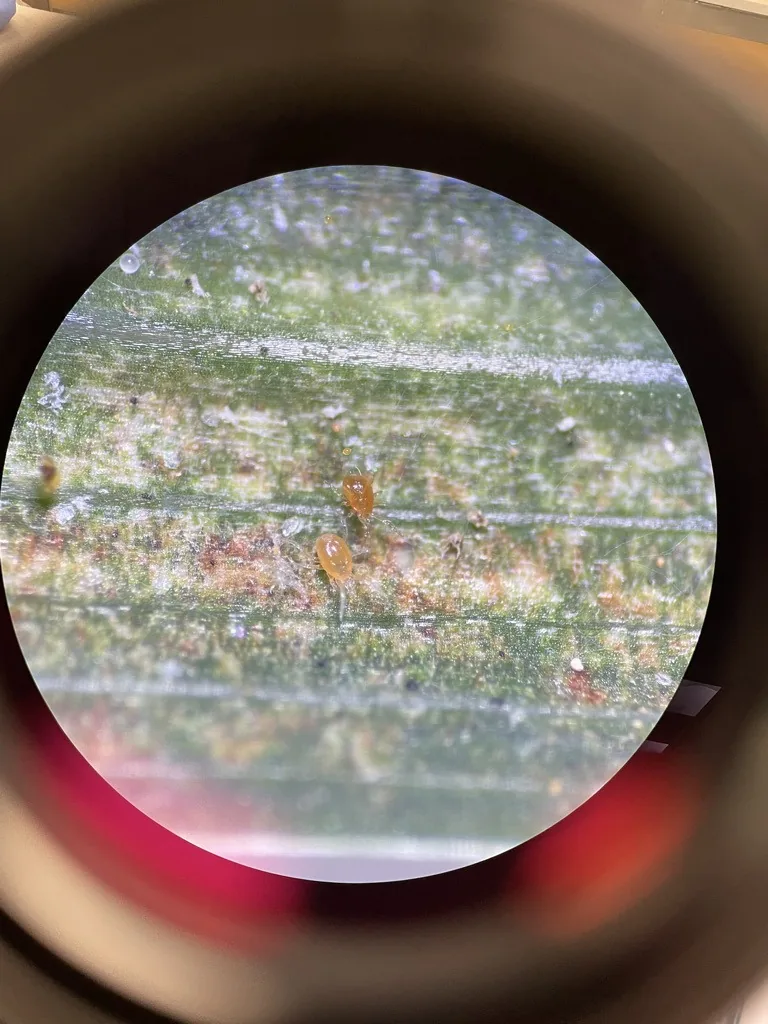
How to identify it
- Adults are pear-shaped, bright reddish to orange, and about 1/50 inch (0.5 mm) long; a hand lens shows them.[1][2]
- Compared with spider mites they move faster, are slightly larger and have long legs.[1][2]
- Nymphs are pale salmon colored, and eggs are oval and about twice the size of spider mite eggs.[1][2]
Look-alikes
| Look-alike | How to tell them apart |
|---|---|
| Twospotted spider mite | Twospotted spider mites can turn reddish over winter, but two dark blotches on the abdomen usually set them apart.[1][2] |
| Euseius predatory mites | These can also turn reddish after feeding; telling the predatory species apart takes expert examination.[1] |
Where it lives
Of tropical origin with no resting stage, it's active year-round in greenhouses, interior plantscapes and mild-winter areas, and occurs in crops infested with twospotted spider mites.[2][1]
Biology and life cycle
Eggs hatch in 2 to 3 days; a six-legged larva that doesn't feed is followed by two eight-legged nymph stages.[1][2]
Egg to adult takes about 25 days at 59°F but only about 5 days at 86°F.[1][2]
A female lays up to 60 eggs over a lifespan of about 50 days, and generations run 7 to 17 days, about twice as fast as its prey.[1][2]
Low humidity hurts them: in one study at 40% relative humidity only 7.5% of eggs hatched, against 99.7% at 80%.[2]
Damage and signs
- They don't feed on plants. Adults eat 5 to 20 spider mites or eggs a day and attack every stage of the twospotted spider mite.[2]
Health risk
Phytoseiulus persimilis feeds, reproduces and completes its development only on plant-feeding spider mites.[1][2]
Control
Prevention
Before treating red mites, check with a hand lens: fast, unspotted, pear-shaped orange mites may be predators.[1][2]
Biological control
It can be bought and released in crops such as caneberries, strawberries, and floriculture and nursery ornamentals.[1]
Released mites must have spider mites to eat, or they disperse or starve.[2]
Common questions
- Are the red mites on my plants pests or predators?
- Predators move faster, are slightly larger and lack the two dark blotches that usually mark twospotted spider mites.[1][2]
- Why didn't the predatory mites I released work?
- They need spider mites to eat and fairly humid conditions; with no prey they leave or starve, and dry air stops their eggs hatching.[2]
Sources
- University of California Statewide IPM Program, “Phytoseiulus Predatory Mites (Natural Enemies Gallery).” ipm.ucanr.edu/natural-enemies/phytoseiulus-predatory-mites/ (accessed 2026-10-06)
- Cornell University College of Agriculture and Life Sciences, “Biological Control: A Guide to Natural Enemies in North America: Phytoseiulus persimilis.” biocontrol.entomology.cornell.edu/predators/Phytoseiulus.php (accessed 2026-10-06)
- iNaturalist, “Phytoseiulus persimilis taxon page (order and family).” www.inaturalist.org/taxa/395199 (accessed 2026-10-06)