How to identify it
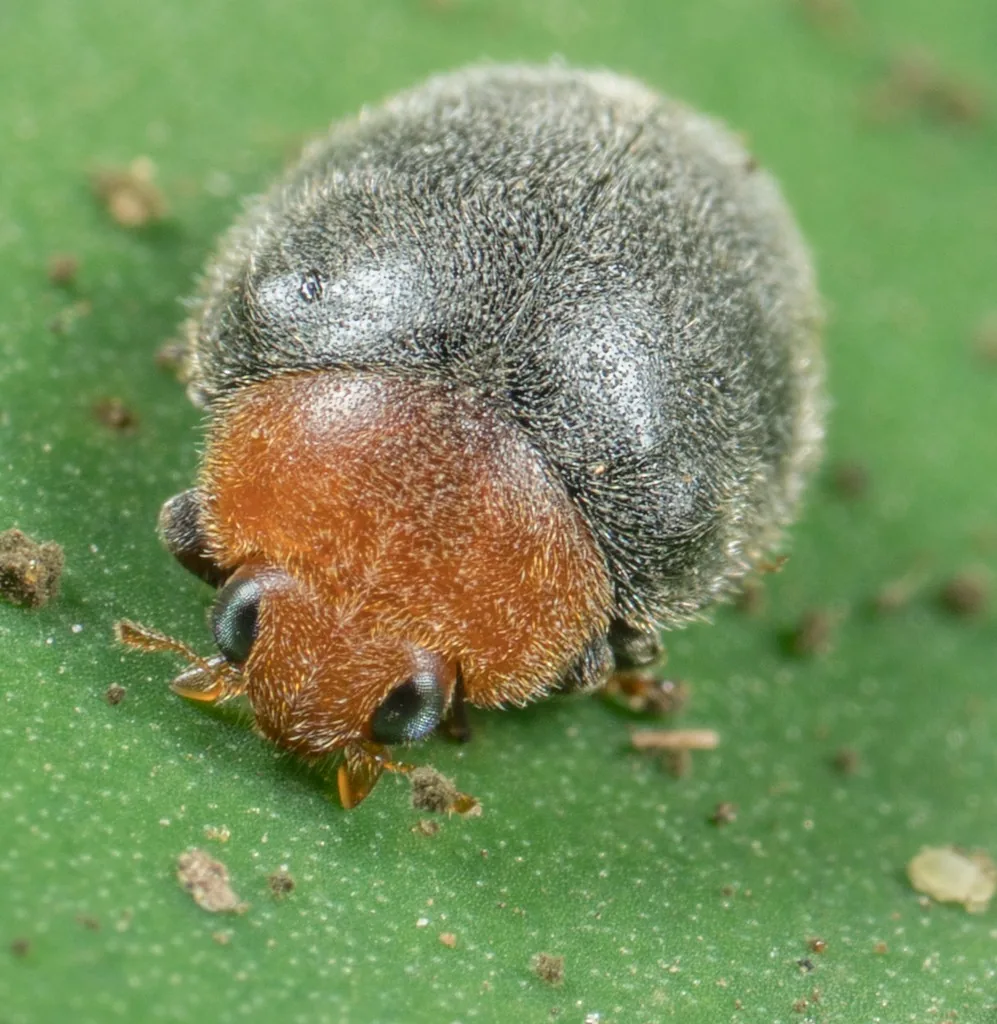
- Adults are dome-shaped lady beetles about 1/8 to 1/6 inch (3 to 4 mm) long, blackish to dark gray with an orange to dark brown head and thorax.[1][2]
- Larvae grow to about 1/2 inch and are covered in long, woolly wax filaments.[1][2]
- Mature larvae are more than twice the size of an adult female mealybug and move faster.[1]
- Eggs are oblong and yellow, laid singly or in groups in mealybug egg sacs.[1][2]
Look-alikes
Where it lives
A tropical species from Australia that tolerates cold poorly. In California it overwinters at low numbers on the coast and is released in citrus groves, greenhouses and interiorscapes.[1][2]
Biology and life cycle
A female lays about 200 to 400 eggs among host egg masses, and eating waxy host eggs stimulates her to lay.[1]
Eggs hatch in about 5 days at 80°F, and larvae feed for 3 to 4 weeks before pupating in sheltered spots.[1][2]
Egg to adult takes about 4 to 6 weeks in warm weather, with about four generations a year in California.[1]
Below 68°F and in short days reproduction slows sharply, so it often can't control mealybugs over winter.[1]
Damage and signs
- They don't feed on plants. Each larva can eat more than 250 young mealybugs or over 1,000 mealybug eggs, and they also take egg-sac-producing scales and sometimes aphids.[1]
Health risk
Mealybug destroyers feed on mealybugs, egg-sac-producing scales and other soft insects; UC IPM and Cornell describe them only as predators and note no risk to people.[1][2]
Control
Prevention
Before treating mealybugs, check for larger, faster larvae with visible legs; they may be mealybug destroyers.[1]
Biological control
Purchased beetles work best when mealybugs are plentiful; they need cottony egg masses to lay eggs, which long-tailed mealybugs don't make.[2]
They can't survive cold winters, so they must be reintroduced each spring except in mild coastal areas.[2]
Common questions
- Are these white fuzzy bugs mealybugs?
- Check their size and speed. Mealybug destroyer larvae are bigger, move faster and have long wax filaments over the back and sides.[1]
- Will they survive the winter?
- Usually not well: this tropical beetle overwinters poorly, at low numbers on the coast and less well or not at all inland.[1][2]
Sources
- University of California Statewide IPM Program, “Mealybug Destroyer (Natural Enemies Gallery).” ipm.ucanr.edu/natural-enemies/mealybug-destroyer/ (accessed 2026-10-06)
- Cornell University College of Agriculture and Life Sciences, “Biological Control: A Guide to Natural Enemies in North America: Cryptolaemus montrouzieri (Mealybug Destroyer).” biocontrol.entomology.cornell.edu/predators/Cryptolaemus.php (accessed 2026-10-06)
- iNaturalist, “Cryptolaemus montrouzieri taxon page (order and family).” www.inaturalist.org/taxa/244084 (accessed 2026-10-06)