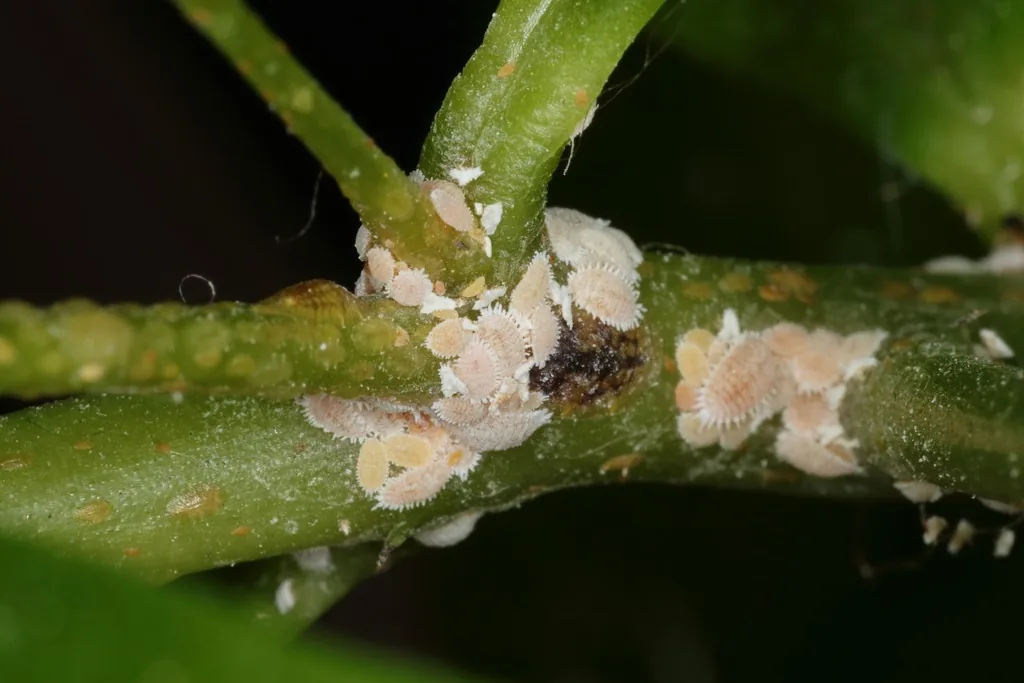
How to identify it
- Adult females are wingless, about 1/8 inch long, with oval, segmented bodies dusted in white wax and short wax filaments around the edges.[1][3]
- The citrus mealybug often shows a faint dark stripe down the back; the longtailed mealybug has two tail filaments longer than its body.[1][3]
- Females lay eggs in white, cottony egg sacs, so infested plants can look like they have bits of cotton stuck to them.[1][3]
- Colonies tuck into protected spots: leaf joints, branch crotches, plant crowns, stems near the soil and between touching fruits.[1][2]
- Adult males are rarely seen; they are tiny two-winged insects with long white tail threads.[1][2]
Look-alikes
| Look-alike | How to tell them apart |
|---|---|
| Cottony cushion scale and soft scales | These also make wax and honeydew; check the insect under the wax to confirm a segmented, legged mealybug.[1] |
| Whiteflies | Whitefly nymphs are flat, legless-looking and fixed in place, while mealybug nymphs and adults keep their legs and can crawl.[1][4] |
Where it lives
The citrus mealybug is native to Asia and now occurs through the Americas, Europe and Oceania, thriving outdoors where winters are mild and on indoor plants elsewhere.[3][1]
Biology and life cycle
Most females lay 100 to 200 or more eggs over 10 to 20 days; a citrus mealybug female can lay 300 to 600.[1][3]
Newly hatched crawlers are yellow to pink, wax-free and mobile; they soon settle to feed and start producing wax.[1]
Females can't fly, so they spread on new plants, pots and tools or are carried by ants; tiny nymphs can also be blown by wind.[1][2]
Mealybugs have two to six generations a year, and indoors or in warm climates all stages may be present year-round.[1]
Damage and signs
- Feeding weakens plants; heavy infestations slow growth and cause leaves to yellow, wilt and drop.[1][3]
- Sticky honeydew falls on leaves and fruit below and grows black sooty mold.[1][3]
- Some plants react strongly to citrus mealybug saliva, which can cause stunting, wilting or dieback.[2]
- Common houseplant targets include cactus, dracaena, ferns, ficus, hoya, jade, orchids, palms, philodendron, schefflera, poinsettia, rosemary and coleus.[1][2]
Health risk
Mealybugs feed only on plants; the harm is weakened plants, sticky honeydew, sooty mold and ruined appearance.[1][2]
Control
Prevention
Inspect new plants closely before bringing them home or planting them, and return or discard any that carry mealybugs.[1]
Go easy on nitrogen fertilizer, which spurs the tender growth where mealybugs prefer to lay eggs.[1]
Traps and physical control
Handpick or prune out small infestations, and check pots and stakes for egg sacs. Discard badly infested houseplants rather than treating them over and over.[1]
On houseplants, dab mealybugs with a cotton swab dipped in 70% or weaker rubbing alcohol; test a small area first for leaf burn and repeat weekly.[1][2]
Biological control
Outdoors, parasitic wasps, lady beetles such as the mealybug destroyer, lacewings and spiders usually keep mealybugs in check; keep ants away and avoid broad-spectrum sprays.[1]
Pesticides
Insecticidal soap, horticultural oil or neem oil sprayed directly on young mealybugs can reduce numbers; egg sacs shield eggs, so plan on two or three weekly treatments.[1][2]
Systemic products with dinotefuran or imidacloprid are less reliable on mealybugs than on other sap feeders and should be avoided on flowering plants to protect pollinators.[1]
Common questions
- What is the white cottony stuff on my houseplant?
- Often mealybugs or their egg sacs. Look in leaf joints and along stems for small, oval, wax-covered insects and sticky honeydew.[1][2]
- Does rubbing alcohol kill mealybugs?
- Yes, on small houseplant infestations. Dab them with 70% or weaker isopropyl alcohol on a cotton swab after testing the plant for leaf burn.[1][2]
- Why don't sprays work well on mealybugs?
- Their waxy coating repels most contact insecticides, and they cluster in hidden crevices that sprays can't reach.[1]
Sources
- University of California Statewide IPM Program, “Mealybugs (Pest Notes, Home and Landscape).” ipm.ucanr.edu/home-and-landscape/mealybugs/ (accessed 2026-10-06)
- NC State Extension, “Citrus Mealybug (PDIC Factsheet, reviewed August 10, 2023).” content.ces.ncsu.edu/citrus-mealybug (accessed 2026-10-06)
- University of Florida/IFAS Extension (EDIS), “Citrus Mealybug, Planococcus citri (Risso) (Featured Creatures, IN947).” edis.ifas.ufl.edu/publication/IN947 (accessed 2026-10-06)
- University of California Statewide IPM Program, “Whiteflies (Pest Notes, Home and Landscape).” ipm.ucanr.edu/home-and-landscape/whiteflies/ (accessed 2026-10-06)
- iNaturalist, “Planococcus citri taxon page (order and family).” www.inaturalist.org/taxa/330251 (accessed 2026-10-06)