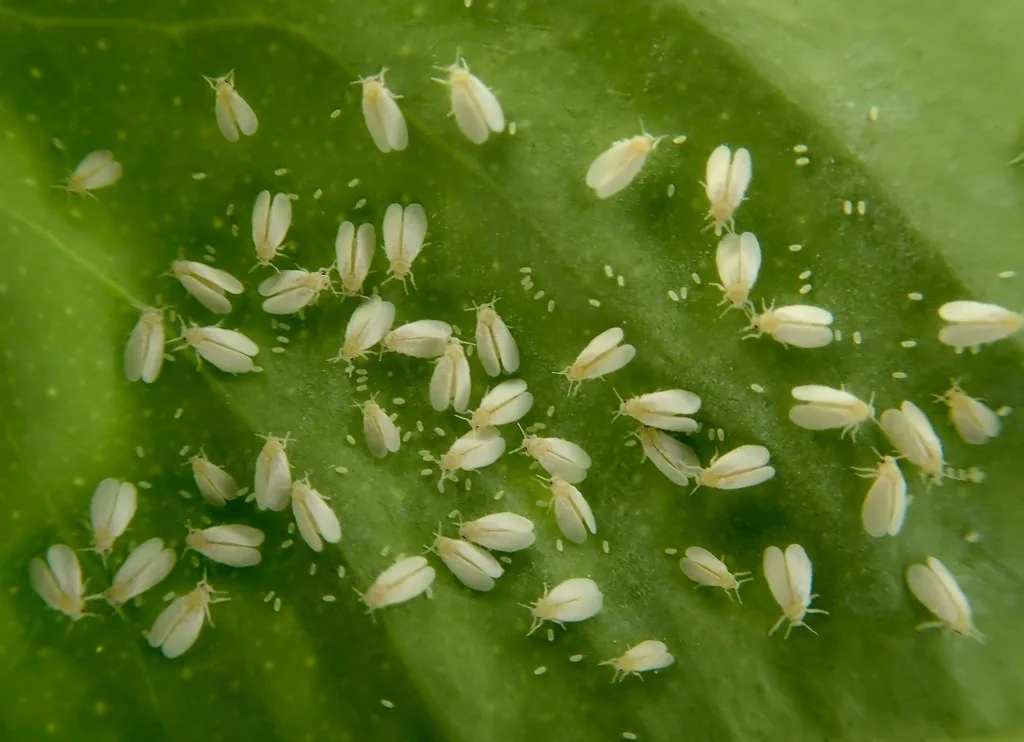
How to identify it
- Adults are tiny, about 1/16 inch (1.5 millimeters), with yellowish bodies and four whitish wings dusted in white wax, so they look like miniature moths.[1][2]
- They are not true flies; they belong to the same insect order as aphids, scales and mealybugs.[1]
- The young are flat, oval and scale-like, sitting motionless on leaf undersides; many species are easiest to tell apart in this last nymph stage.[1]
- Greenhouse whitefly eggs are pale green to purple and often laid in a circle or crescent on the underside of a leaf.[2]
Look-alikes
| Look-alike | How to tell them apart |
|---|---|
| Aphids | Both excrete honeydew, but adult whiteflies have four whitish, wax-covered wings, while most adult aphids are wingless.[1][3] |
| Giant whitefly | A larger relative, up to about 0.19 inch, that leaves spirals of wax on leaves and has nymphs with wax filaments up to 2 inches long.[1] |
Where it lives
The greenhouse whitefly is a worldwide pest, first found in the northeastern United States in 1870; it infests greenhouses and survives outdoors in the growing season, especially in sheltered spots.[2]
Biology and life cycle
Eggs hatch into crawlers that wander for a few hours or days, then settle, insert their mouthparts and stay put through the remaining nymph stages.[1][2]
The greenhouse whitefly reproduces fairly slowly, one generation every 30 to 45 days, but a female may lay up to 400 eggs and live up to two months.[2]
Greenhouse and sweetpotato whiteflies feed on a wide range of weeds and crops and breed year-round in warm areas, moving from host to host.[1]
All stages feed by sucking sap from the plant's food-conducting tissue and excrete the excess as honeydew.[1]
Damage and signs
- Large populations turn leaves yellow, make them look dry, or cause them to drop.[1][2]
- Honeydew leaves foliage sticky and coated with black sooty mold, and it draws ants that interfere with the whiteflies' natural enemies.[1]
- Sweetpotato whitefly feeding can distort, discolor or silver leaves, and some whiteflies spread viruses to vegetable crops.[1]
- Adults alone rarely cause significant harm unless spreading a plant disease; real losses come from large numbers of nymphs.[1]
Health risk
Whiteflies are plant feeders; they harm leaves through sap feeding, honeydew, sooty mold and plant virus spread.[1][2]
Control
Prevention
Inspect new plants for whiteflies and nymphs before bringing them into the garden or greenhouse, and remove plants that host heavy populations year after year.[1]
Reflective silver mulches repel whiteflies from vegetable gardens; remove them when summer temperatures get high so plants don't overheat.[1]
Traps and physical control
Early on, pick off heavily infested leaves and hose plants down; pull infested vegetable plants after harvest.[1]
Yellow sticky traps help monitor whiteflies and can trim numbers somewhat, though they won't eliminate a damaging population.[1]
Biological control
Lacewings, bigeyed bugs, minute pirate bugs, small lady beetles and parasitic wasps attack whiteflies; control dust and ants that shield whiteflies from them.[1]
Pesticides
Insecticidal soaps and oils such as neem kill only the whiteflies they hit, so cover leaf undersides thoroughly, repeat as needed, and spray below 90 degrees F.[1]
Carbaryl, pyrethroids and foliar imidacloprid can wipe out natural enemies; whiteflies quickly build resistance, and immature stages resist many sprays.[1][2]
Is it parasitized?
Check empty whitefly pupal cases: a round or oval exit hole means a parasitic wasp emerged, while a T-shaped slit means a healthy whitefly did.[1]
Many parasitized nymphs darken before the wasp emerges, though some whitefly species are naturally black.[1]
Common questions
- What are the tiny white insects under my plant's leaves?
- Most likely whiteflies, small sap-sucking insects with white, waxy wings that cluster on leaf undersides.[1][2]
- Why do whiteflies come back after I spray?
- Sprays reach only whiteflies they contact, eggs and young resist many products, and broad-spectrum insecticides kill the natural enemies that keep whiteflies down.[1][2]
Sources
- University of California Statewide IPM Program, “Whiteflies (Pest Notes, Home and Landscape).” ipm.ucanr.edu/home-and-landscape/whiteflies/ (accessed 2026-10-06)
- University of Minnesota, College of Food, Agricultural and Natural Resource Sciences (Horticultural IPM), “Greenhouse Whitefly, Trialeurodes vaporariorum.” ncipmhort.cfans.umn.edu/greenhouse-whitefly (accessed 2026-10-06)
- University of California Statewide IPM Program, “Aphids (Pest Notes, Home and Landscape).” ipm.ucanr.edu/home-and-landscape/aphids/ (accessed 2026-10-06)
- iNaturalist, “Trialeurodes vaporariorum taxon page (order and family).” www.inaturalist.org/taxa/409155 (accessed 2026-10-06)